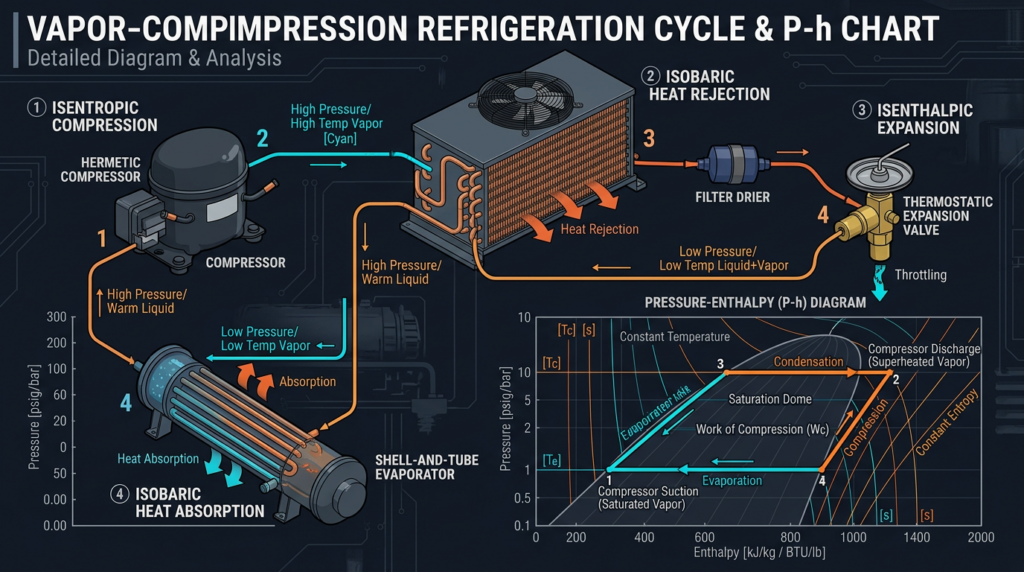
Imagine stepping into a cool, air-conditioned room on a sweltering summer day. That relief you feel is the result of one of the most important thermodynamic processes in modern life: the refrigeration cycle. Contrary to what many people assume, your air conditioner or refrigerator does not create cold. Instead, it moves heat from one location to another. This single principle underpins virtually every cooling system on the planet, from the kitchen refrigerator in your home to massive industrial chillers in skyscrapers. Understanding the refrigeration cycle is essential for homeowners, building managers, HVAC students, and entry-level technicians alike. This article breaks the process into clear, manageable steps, covering the thermodynamic principles at work, the four main components, the four phases of the cycle, the refrigerants that make it possible, and the practical applications that affect your daily life.
Key Concepts and Thermodynamic Principles
Before examining the cycle itself, you need a solid grasp of the physical principles that make mechanical refrigeration possible. Three foundational concepts govern every cooling system: heat transfer, the laws of thermodynamics, and phase changes.
Heat Transfer
Heat transfer is the movement of thermal energy from a warmer object or space to a cooler one. This occurs through three mechanisms: conduction (direct contact between materials), convection (movement of fluids or gases), and radiation (electromagnetic waves). In every case, the driving force is a temperature difference. Heat always flows naturally from hot to cold. The greater the temperature difference between two objects, the faster heat moves between them. The refrigeration cycle exploits this principle by manipulating the temperature and pressure of a working fluid so that it absorbs heat where cooling is needed and releases heat where it can be rejected.
The Laws of Thermodynamics
Two laws of thermodynamics are directly relevant to refrigeration. The First Law of Thermodynamics, also called the law of conservation of energy, states that energy cannot be created or destroyed, only converted from one form to another. In a refrigeration system, the electrical energy consumed by the compressor is converted into the work required to move heat. The total energy balance holds: the heat rejected at the condenser equals the heat absorbed at the evaporator plus the work input from the compressor.
The Second Law of Thermodynamics states that heat cannot spontaneously flow from a colder body to a hotter body. To move heat “uphill” against the natural temperature gradient, external work must be performed. This is precisely why the compressor exists. Without it, the refrigerant could never release heat into outdoor air that is already warmer than the indoor space. The Second Law also introduces the concept of entropy, a measure of disorder in a system. Every real refrigeration cycle increases the total entropy of the universe, meaning some energy is always lost to inefficiency.
Phase Changes and Latent Heat
The refrigeration cycle relies heavily on phase changes, the transitions between liquid and gas states. When a liquid evaporates into a gas, it absorbs a large quantity of energy known as the latent heat of vaporization. Crucially, this heat absorption occurs without a change in temperature. The substance stays at its boiling point while it absorbs energy to change state. Conversely, when a gas condenses into a liquid, it releases the latent heat of condensation. This is the same amount of energy, now expelled into the surrounding environment. By forcing a refrigerant to evaporate in one location and condense in another, the refrigeration cycle moves substantial amounts of heat with remarkable efficiency.
The Four Main Components
Every vapor-compression refrigeration system contains four essential components. Each one plays a specific role in manipulating the refrigerant’s pressure, temperature, and phase.
Evaporator
The evaporator is where the cooling actually happens. Low-pressure, low-temperature liquid refrigerant enters the evaporator coil, which is typically constructed from copper or aluminum tubing with thin aluminum fins to maximize surface area. As warm indoor air passes over the coil (driven by a blower fan), heat transfers from the air into the refrigerant. This heat causes the refrigerant to boil and evaporate into a low-pressure gas. The air, now stripped of some of its thermal energy, exits the evaporator cooler than when it entered.
In a residential air conditioning system, the evaporator sits inside the indoor air handler or furnace. In a refrigerator, it lines the walls of the freezer compartment. Common issues include ice buildup on the coil, which occurs when airflow is restricted or the refrigerant charge is low, and refrigerant leaks at brazed joints or corroded tubing.
Compressor
The compressor is often called the heart of the refrigeration system. Its job is to draw in the low-pressure, low-temperature gas from the evaporator and compress it into a high-pressure, high-temperature gas. This compression raises the refrigerant’s temperature well above the outdoor ambient temperature, which is necessary for the condenser to reject heat to the outside air.
Compressors come in several types. Reciprocating compressors use pistons and are common in smaller systems. Scroll compressors, which use two interleaving spiral elements, are widely used in residential and light commercial air conditioning because of their reliability, quiet operation, and efficiency. Rotary compressors are common in window units and small split systems. Modern variable-speed compressors (also called inverter-driven compressors) adjust their speed to match the cooling load, dramatically improving energy efficiency and comfort.
The compressor is the largest energy consumer in any refrigeration system, typically accounting for 60% to 70% of total system power draw. Common failure modes include overheating from low refrigerant charge, electrical winding failure, and mechanical wear.
Condenser
The condenser performs the opposite function of the evaporator. High-pressure, high-temperature refrigerant gas enters the condenser coil, and a fan forces outdoor air across the finned tubing. Because the refrigerant is now significantly hotter than the outdoor air, heat flows from the refrigerant into the atmosphere. As the refrigerant loses thermal energy, it condenses from a gas back into a high-pressure liquid.
In a typical split-system air conditioner, the condenser is located in the outdoor unit alongside the compressor. In a refrigerator, the condenser coil is mounted on the back or bottom of the appliance. Water-cooled condensers, used in larger commercial systems, reject heat into a water loop connected to a cooling tower rather than directly to the air.
Dirty condenser coils are one of the most common causes of reduced system efficiency and premature compressor failure. A layer of dirt, leaves, or debris on the coil restricts airflow and raises the condensing pressure, forcing the compressor to work harder and consume more energy.
Expansion Valve (Metering Device)
The expansion valve, also called a metering device, controls the flow of refrigerant and creates the critical pressure drop between the high-pressure and low-pressure sides of the system. High-pressure liquid refrigerant passes through a narrow restriction, and its pressure drops sharply. This sudden expansion lowers the refrigerant’s temperature to well below the temperature of the space to be cooled, preparing it to absorb heat in the evaporator.
Several types of metering devices exist. The capillary tube is a simple, fixed-length narrow tube common in window units and refrigerators. The thermostatic expansion valve (TXV) uses a sensing bulb attached to the evaporator outlet to modulate its opening based on the degree of superheat, providing more precise control. The electronic expansion valve (EEV) uses a stepper motor controlled by a microprocessor, offering the most accurate refrigerant flow control and optimal efficiency across a wide range of operating conditions. Common problems include clogging from debris or moisture in the system and incorrect superheat settings on TXVs.
The Four Phases of the Refrigeration Cycle
With the components understood, here is how they work together in a continuous loop.
Phase 1: Evaporation
Low-pressure, low-temperature refrigerant (a mix of liquid and vapor after the expansion device) enters the evaporator coil. As warm air from the conditioned space blows across the coil, heat transfers into the refrigerant, causing the remaining liquid to boil and fully evaporate. The refrigerant exits the evaporator as a low-pressure, low-temperature gas. The air passing over the coil is cooled and, if it drops below its dew point, moisture condenses out of it, providing dehumidification as a secondary benefit.
Phase 2: Compression
The compressor pulls in the low-pressure gas from the evaporator and compresses it. This increases both the pressure and the temperature of the refrigerant. For example, in a residential R-410A system, the compressor might raise the refrigerant from about 120 psi and 50°F at the evaporator outlet to roughly 400 psi and 160°F or higher at the compressor discharge. The refrigerant is now a superheated gas with enough thermal energy to reject heat even on a hot day.
Phase 3: Condensation
The high-pressure, high-temperature gas flows into the condenser coil. Outdoor air (or cooling water) absorbs heat from the refrigerant because the refrigerant temperature exceeds the outdoor temperature. The refrigerant releases its latent heat of condensation, transitions from a gas back into a liquid, and exits the condenser as a high-pressure, warm liquid. This is where all the heat collected from the indoor space, plus the heat energy added by the compressor’s work, is expelled to the outdoors.
Phase 4: Expansion
The high-pressure liquid refrigerant flows through the expansion valve, where its pressure drops dramatically. This pressure reduction causes the refrigerant’s boiling point to fall, and a small portion of the refrigerant flashes into vapor, cooling the remaining liquid. The refrigerant exits the expansion valve as a cold, low-pressure mixture of liquid and vapor, ready to enter the evaporator and begin the cycle again.
Refrigerants: The Working Fluid
A refrigerant is the substance circulating through the system that absorbs and releases heat. Ideal refrigerant properties include a high latent heat of vaporization, a suitable boiling point at common operating pressures, chemical stability, low toxicity, low flammability, and minimal environmental impact.
Early refrigerants such as CFCs (R-12) and HCFCs (R-22) were phased out under the Montreal Protocol because they deplete the ozone layer. R-22 production for new equipment ceased in the United States in 2010, and production for servicing ended in 2020. HFC refrigerants like R-410A (GWP of 2,088) and R-134a (GWP of 1,430) replaced them but carry significant global warming potential. Under the AIM Act of 2020, the EPA is phasing down HFC production by 85% by 2036.
The industry is now transitioning to lower-GWP alternatives:
- R-32 (GWP of 675) is an A2L (mildly flammable) refrigerant increasingly used in residential and commercial systems worldwide.
- R-454B (GWP of 466) is the leading R-410A replacement in the U.S. residential market, effective January 1, 2025, for new equipment.
- R-1234yf (GWP of less than 1) is an HFO refrigerant now standard in automotive air conditioning.
- Natural refrigerants such as R-290 (propane, GWP of 3), R-744 (CO2, GWP of 1), and R-717 (ammonia, GWP of 0) are gaining traction in commercial refrigeration and smaller appliances.
Technicians who handle refrigerants must hold an EPA Section 608 certification, and all refrigerants must be recovered rather than vented to the atmosphere.
Common Misconceptions
- “Air conditioning creates cold.” False. It removes heat from indoor air and moves it outdoors. No cold is generated; heat is relocated.
- “Closing vents in unused rooms saves energy.” This actually increases static pressure in the duct system, which can reduce airflow, cause the evaporator coil to freeze, and force the blower motor to work harder.
- “More refrigerant is always better.” Overcharging a system raises condensing pressure, reduces efficiency, and can cause liquid slugging in the compressor, leading to mechanical damage.
- “All refrigerants are interchangeable.” Each refrigerant has unique pressure-temperature relationships, oil compatibility requirements, and safety classifications. Mixing refrigerants is dangerous and illegal in most cases.
Practical Applications
The refrigeration cycle is embedded in nearly every sector of modern life:
- Residential: Central air conditioners, heat pumps, refrigerators, freezers, and dehumidifiers all use the vapor-compression cycle.
- Commercial: Supermarket display cases, walk-in coolers, rooftop units, and chilled-water systems for large buildings.
- Transportation: Refrigerated trucks, shipping containers, and vehicle air conditioning systems keep goods fresh and passengers comfortable.
- Medical: Vaccine storage, blood bank refrigeration, MRI machine cooling, and cryogenic applications.
- Industrial: Chemical processing, data center cooling, food and beverage manufacturing, and cold storage warehouses.
Related Topics
Heat pumps use the same refrigeration cycle but include a reversing valve that allows the system to switch the roles of the evaporator and condenser, providing both heating and cooling from a single system. Understanding the refrigeration cycle also connects directly to psychrometrics (the study of air and moisture properties), HVAC system design, and energy efficiency strategies. Modern efficiency metrics such as SEER2 (Seasonal Energy Efficiency Ratio 2) and EER2, which became the U.S. standard in January 2023, measure how effectively a system performs the refrigeration cycle under standardized conditions. Higher ratings mean less electrical energy is consumed per unit of cooling delivered.
Key Takeaways
The refrigeration cycle is a continuous loop of four processes: evaporation, compression, condensation, and expansion. Four components make it work: the evaporator absorbs heat, the compressor raises pressure and temperature, the condenser rejects heat, and the expansion valve drops pressure to restart the cycle. The entire process is governed by the laws of thermodynamics and relies on the latent heat absorbed and released during phase changes of the refrigerant. Whether you are a homeowner trying to understand why your energy bill spikes in July, a student preparing for certification, or a technician diagnosing a system fault, understanding this cycle is the foundation of all HVAC and refrigeration knowledge. For any installation, repair, or maintenance work, always consult a qualified HVAC professional with proper EPA certification to ensure safe, efficient, and code-compliant operation.