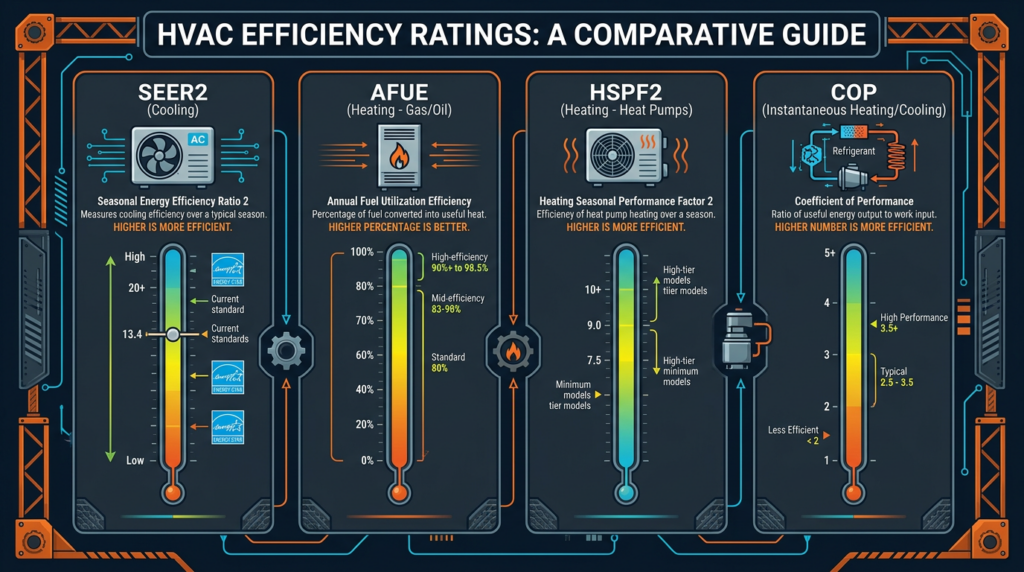
When your energy bill arrives and the number keeps climbing, the natural question is whether your HVAC system is working as efficiently as it should. The answer often lies in a set of standardized ratings that quantify exactly how much useful heating or cooling you get for every unit of energy consumed. These ratings, including SEER2, AFUE, HSPF2, and COP, serve as the benchmarks for comparing HVAC equipment and making purchasing decisions that affect your comfort, your wallet, and the environment. Yet most homeowners find these acronyms confusing, and the 2023 updates to federal testing standards added another layer of complexity. This article breaks down each rating, explains how the new standards differ from previous ones, and provides the practical context you need to choose the right system for your home.
The Evolution of HVAC Efficiency Ratings
HVAC efficiency ratings emerged from the need for a standardized way to compare equipment across manufacturers. Before the U.S. Department of Energy (DOE) established minimum efficiency requirements, consumers had no reliable method for evaluating whether one furnace or air conditioner outperformed another. The original standards introduced SEER for cooling, HSPF for heat pump heating, and AFUE for furnaces and boilers, each providing a single number that represented seasonal or annual performance.
In January 2023, the DOE implemented updated testing procedures under the M1 testing methodology from the Air Conditioning, Heating, and Refrigeration Institute (AHRI). These changes gave rise to SEER2 and HSPF2, replacing their predecessors. The primary motivation was accuracy: the older testing conditions did not reflect the static pressures and airflow resistances found in real-world duct systems. By increasing the external static pressure during laboratory testing, the new ratings better represent how equipment actually performs once installed in your home. Alongside these updated metrics, the DOE also raised minimum efficiency thresholds, pushing the industry toward higher-performing equipment.
Understanding SEER2: Cooling Efficiency
What SEER2 Measures
Seasonal Energy Efficiency Ratio 2 (SEER2) quantifies the cooling efficiency of air conditioners and heat pumps over an entire cooling season. It is calculated by dividing the total cooling output in British Thermal Units (BTU) by the total electrical energy consumed in watt-hours during a simulated cooling season. The result is expressed in BTU per watt-hour. A unit rated at 15.2 SEER2, for example, delivers 15.2 BTU of cooling for every watt-hour of electricity consumed across the season.
How SEER2 Testing Differs from SEER
The most significant change between SEER and SEER2 is the increase in external static pressure during testing. Under the old procedure, residential systems were tested at approximately 0.1 to 0.2 inches of water column (in. w.c.) of external static pressure. SEER2 testing raises this to 0.5 in. w.c. for ducted residential systems. This higher pressure simulates the resistance that ductwork, registers, grilles, and filters impose on airflow in a typical home installation. Because the equipment must work harder against this resistance, SEER2 numbers are generally lower than equivalent SEER numbers for the same unit, typically by about 4.7% depending on the system type.
The testing also incorporates temperature bin data that more accurately represents the range of outdoor conditions a system encounters throughout a cooling season, rather than relying on a single peak condition.
Minimum SEER2 Requirements
The DOE established regional minimum efficiency standards that took effect on January 1, 2023:
- Northern Region: 13.4 SEER2 for split-system air conditioners and heat pumps under 45,000 BTU
- Southeast and Southwest Regions: 14.3 SEER2 for split-system air conditioners and heat pumps under 45,000 BTU
The regional differences reflect cooling demand. Southern states rely on air conditioning for a larger portion of the year, so requiring higher efficiency in those areas produces greater aggregate energy savings.
Practical Cost Implications
Consider a homeowner in the Southeast running a 3-ton (36,000 BTU) air conditioner for roughly 1,200 cooling hours per year. A system rated at 14.3 SEER2 would consume approximately 3,021 kilowatt-hours (kWh) annually for cooling. Upgrading to a 20 SEER2 unit would drop consumption to around 2,160 kWh. At an electricity rate of $0.14 per kWh, that difference saves roughly $120 per year. Over a system’s 15- to 20-year lifespan, those savings accumulate to $1,800 to $2,400, which can offset the higher upfront cost of premium equipment.
However, these savings depend on proper installation. Leaky ductwork, incorrect refrigerant charge, or improper system sizing can prevent a unit from ever reaching its rated SEER2 performance. The rating assumes the system operates under specific conditions, and real-world results will vary based on your home’s envelope, duct system, and usage patterns.
Common Misconceptions About SEER2
The most widespread misunderstanding is that SEER and SEER2 ratings are interchangeable. They are not. A unit previously marketed as SEER 16 might now carry a SEER2 rating of approximately 15.2 under the stricter testing protocol. When comparing older equipment to newer models, you must account for this difference to avoid misleading conclusions.
Another misconception is that the highest SEER2 number automatically guarantees the lowest energy bills. Climate, thermostat settings, home insulation, window quality, and occupant behavior all influence actual energy consumption. A 21 SEER2 system in a poorly insulated home with leaky ducts may cost more to operate than a 16 SEER2 system in a well-sealed, well-insulated home.
Understanding AFUE: Heating Efficiency for Furnaces and Boilers
What AFUE Measures
Annual Fuel Utilization Efficiency (AFUE) expresses the percentage of fuel energy that a furnace or boiler converts into usable heat. A furnace with an AFUE of 96% converts 96 cents of every dollar spent on fuel into heat for your home, with the remaining 4 cents lost through exhaust gases and other inefficiencies. AFUE is calculated using a straightforward formula: heat output divided by fuel input, multiplied by 100.
Testing and Minimum Requirements
Unlike SEER2 and HSPF2, the AFUE testing methodology did not undergo a major overhaul in 2023. The rating continues to measure steady-state and part-load efficiency through established DOE procedures. However, it is important to note that AFUE is a combustion efficiency rating. It does not account for heat lost through ductwork after the furnace produces warm air.
Current federal minimum AFUE requirements include:
- Non-weatherized gas furnaces: 80% AFUE (with ongoing regulatory discussions about increasing this to 92% or higher nationally)
- Weatherized gas furnaces (packaged units): 81% AFUE
- Oil furnaces: 83% AFUE
High-efficiency condensing furnaces achieve AFUE ratings of 90% to 98.5% by extracting additional heat from exhaust gases before they vent outside. These units use a secondary heat exchanger to capture latent heat from water vapor in the combustion byproducts.
Practical Cost Implications
Suppose you currently heat your home with an older 80% AFUE furnace and spend $1,200 per year on natural gas for heating. Upgrading to a 96% AFUE condensing furnace means that the same amount of heat now requires less fuel. Your annual heating fuel cost would drop to approximately $1,000, saving around $200 per year. Over the furnace’s expected 15- to 20-year lifespan, total savings range from $3,000 to $4,000.
The catch is that condensing furnaces carry higher purchase and installation costs, often $1,000 to $2,500 more than standard-efficiency models. They also require condensate drains and may need different venting materials. A proper cost-benefit analysis should factor in your local fuel prices, climate severity, and available tax credits or utility rebates for high-efficiency equipment.
Common Misconceptions About AFUE
AFUE does not represent total heating cost. Two homes with identical 96% AFUE furnaces can have dramatically different heating bills if one has poor insulation and the other is tightly sealed. AFUE also does not reflect duct losses, which can waste 20% to 30% of heated air in unconditioned spaces like attics and crawl spaces. Addressing duct leakage and insulation often yields a better return on investment than upgrading furnace efficiency alone.
Understanding HSPF2: Heat Pump Heating Efficiency
What HSPF2 Measures
Heating Seasonal Performance Factor 2 (HSPF2) measures the heating efficiency of heat pumps over an entire heating season. Like SEER2, it is expressed in BTU per watt-hour. The calculation divides total heating output (BTU) by total electrical energy input (watt-hours) during a simulated heating season. A heat pump rated at 10 HSPF2 delivers 10 BTU of heating for every watt-hour of electricity consumed across the season, including the energy used by supplemental electric resistance heating during extremely cold periods.
How HSPF2 Testing Differs from HSPF
The transition from HSPF to HSPF2 mirrors the changes made to cooling efficiency testing. External static pressure during testing increased to 0.5 in. w.c. for ducted residential systems, matching the SEER2 protocol. The revised temperature bin profiles used in HSPF2 calculations also better represent heating season conditions across climate zones. As with SEER2, the result is that HSPF2 ratings are typically lower than the older HSPF ratings for the same piece of equipment.
Minimum HSPF2 Requirements
Federal minimums effective January 1, 2023 include:
- Northern Region: 7.5 HSPF2 for split-system heat pumps under 45,000 BTU
- Southeast and Southwest Regions: 7.5 HSPF2 for split-system heat pumps under 45,000 BTU
High-performance heat pumps, particularly those using variable-speed inverter compressors, can achieve HSPF2 ratings of 10 or higher, delivering significantly greater efficiency by modulating output to match heating demand rather than cycling on and off at full capacity.
Practical Considerations
HSPF2 accounts for the total electrical energy consumed during heating, including defrost cycles and supplemental resistance heating. When outdoor temperatures drop below a heat pump’s balance point (the temperature at which the heat pump alone cannot meet the home’s heating load), auxiliary electric resistance strips activate. These strips operate at a COP of 1.0, meaning they convert electricity to heat at a one-to-one ratio with no efficiency multiplier. Frequent reliance on auxiliary heat significantly reduces seasonal efficiency.
Modern cold-climate heat pumps, however, can maintain effective heating capacity at outdoor temperatures as low as negative 15 degrees Fahrenheit, greatly reducing or eliminating the need for auxiliary heat. When shopping for a heat pump in a cold climate, look for models specifically rated for low-temperature performance and compare their HSPF2 ratings alongside their rated heating capacity at 5 degrees Fahrenheit and 17 degrees Fahrenheit.
Common Misconceptions About HSPF2
HSPF and HSPF2 are not directly comparable numbers. A unit previously rated at HSPF 9.0 may now test at approximately HSPF2 8.1. Always confirm which metric is being cited when comparing equipment.
The persistent belief that heat pumps cannot work in cold climates is increasingly outdated. While conventional heat pumps lose capacity as temperatures fall, cold-climate models with enhanced vapor injection compressors and intelligent defrost controls perform well in northern regions. The key is selecting equipment matched to your climate zone and heating load.
Understanding COP: Instantaneous Efficiency
What COP Measures
Coefficient of Performance (COP) measures the instantaneous efficiency of a heat pump or refrigeration system at a specific set of operating conditions. It is a simple ratio: heating or cooling output in watts divided by electrical input in watts. Because both values use the same unit, COP is a dimensionless number. A heat pump with a COP of 3.5 produces 3.5 watts of heating or cooling energy for every 1 watt of electricity consumed at that particular moment.
How COP Relates to Seasonal Ratings
COP provides a snapshot of performance at a single temperature and operating condition, while SEER2 and HSPF2 represent aggregated performance across an entire season. For example, a heat pump might have a COP of 4.0 at 47 degrees Fahrenheit outdoor temperature but drop to a COP of 2.0 at 17 degrees Fahrenheit. The HSPF2 rating blends performance across all expected temperature conditions into one seasonal number.
COP is most useful for engineers designing systems, comparing heat pump performance at specific conditions, or evaluating ground-source (geothermal) heat pumps, which maintain more consistent COP values because ground temperatures remain relatively stable year-round. Geothermal systems commonly achieve heating COP values between 3.5 and 5.0.
Common Misconceptions About COP
COP values listed in manufacturer specifications can appear impressively high, but they represent ideal laboratory conditions at a favorable temperature. Real-world COP fluctuates constantly with changing outdoor conditions, indoor load, and system cycling. Homeowners should rely on HSPF2 and SEER2 for purchasing decisions and treat COP as supplementary data for understanding how performance varies across conditions.
Beyond the Ratings: Other Factors That Affect Efficiency
Efficiency ratings tell only part of the story. Several other factors determine how much energy your HVAC system actually consumes:
- Proper sizing: An HVAC system must match the heating and cooling load of your home. Oversized equipment short-cycles, reducing dehumidification and increasing wear. Undersized equipment runs continuously without reaching setpoint. A Manual J load calculation performed by a qualified contractor ensures correct sizing.
- Insulation and air sealing: The building envelope determines how much heating and cooling energy your home retains. Adding insulation to attics, walls, and crawl spaces and sealing air leaks around windows, doors, and penetrations reduces the workload on your HVAC system.
- Ductwork integrity: Leaky ducts can waste 20% to 30% of conditioned air. Sealing duct joints with mastic or metal tape and insulating ducts in unconditioned spaces preserves the efficiency your equipment was designed to deliver. Professional duct leakage testing can quantify losses.
- Regular maintenance: Dirty filters, fouled coils, low refrigerant charge, and worn components degrade performance over time. Annual professional inspections and monthly filter checks keep your system running at or near its rated efficiency.
- Smart thermostats: Programmable and learning thermostats optimize run times by adjusting temperatures based on occupancy patterns, reducing unnecessary heating and cooling when no one is home.
- Climate awareness: Choose equipment matched to your region. A heat pump with a high HSPF2 may be the right choice in a moderate climate, while a high-AFUE furnace paired with a moderate-SEER2 air conditioner might be more cost-effective in a region with severe winters and mild summers.
Key Takeaways
Understanding HVAC efficiency ratings empowers you to compare equipment objectively, estimate operating costs, and invest wisely in comfort and energy savings. SEER2 and HSPF2 replaced the older SEER and HSPF metrics in 2023 with more realistic testing that better predicts real-world performance. AFUE remains the standard for furnace and boiler efficiency, expressed as a simple percentage of fuel converted to heat. COP offers a useful but narrow view of heat pump performance at a single operating point.
No rating exists in isolation. The most efficient system on paper will underperform if installed in a home with poor insulation, leaky ducts, or incorrect sizing. Before purchasing new HVAC equipment, have a qualified contractor perform a load calculation, inspect your ductwork, and evaluate your building envelope. Combine the right equipment with the right installation and ongoing maintenance, and you will achieve the comfort, energy savings, and long-term value these efficiency ratings are designed to help you find.