What HVAC Warranties Are and Why They Matter
An HVAC warranty is a legally binding agreement between a manufacturer, contractor, or third-party provider and the equipment owner that guarantees coverage for specific defects, failures, or service needs within a defined time period. For a system that represents a $5,000 to $15,000 investment and is expected to operate reliably for 15 to 20 years, the warranty is one of the most important documents a homeowner or building manager will ever receive. Understanding what a warranty covers, what it excludes, and how to file a claim can mean the difference between a free compressor replacement and a $3,000 out-of-pocket repair bill.
HVAC warranties are governed by a combination of federal law (most notably the Magnuson-Moss Warranty Act), state consumer protection statutes, and the specific terms written by manufacturers and contractors. They intersect with industry standards from AHRI, ASHRAE, ACCA, and EPA regulations on refrigerant handling. A warranty is only as good as the owner’s ability to maintain it, and that requires understanding the rules from day one.
Types of HVAC Warranties
Manufacturer’s Warranty
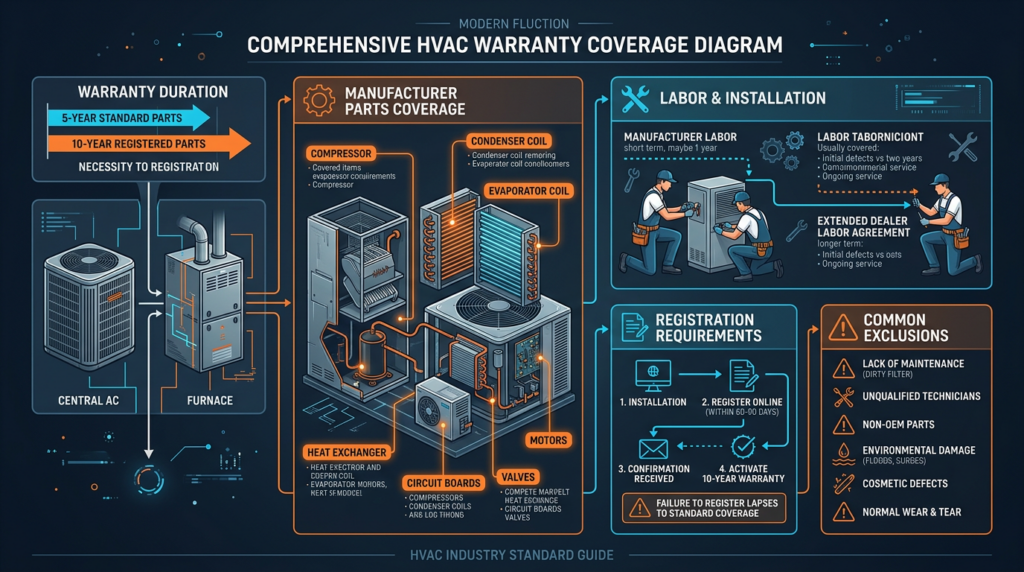
The manufacturer’s warranty is the standard warranty provided by the equipment maker. It covers defects in materials and workmanship for a specified period. Typical terms include 5 to 10 years of parts coverage and up to 10 years (sometimes limited lifetime) on critical components such as the compressor and heat exchanger. Most manufacturers require product registration within 60 to 90 days of installation to activate the full warranty term. Without registration, coverage often drops to a base warranty of 5 years on parts.
Manufacturer’s warranties generally cover the cost of the replacement part only. They do not cover labor, refrigerant, or ancillary materials needed to complete the repair. The homeowner or a separate labor warranty must cover those costs.
Labor Warranty
The labor warranty is typically provided by the installing contractor and covers the cost of technician labor for diagnosing and repairing covered issues. Labor warranties are usually much shorter than manufacturer’s warranties, ranging from 1 to 2 years, though some premium contractors offer up to 5 years. This warranty is only as reliable as the contractor behind it. If the contractor goes out of business, the labor warranty goes with them.
Extended Warranty and Service Agreements
Extended warranties can be purchased from equipment manufacturers, installing contractors, or third-party warranty companies. These policies extend coverage beyond the standard manufacturer’s warranty and may include labor, parts, and even refrigerant. Costs typically range from $300 to $800 for 5 additional years, though prices vary significantly based on equipment type, coverage scope, and deductible structure.
Before purchasing an extended warranty, buyers should carefully review the fine print. Common limitations include required annual maintenance by approved technicians, caps on per-incident or per-year payouts, and restrictions on which service providers can perform covered work.
Home Warranty (Third-Party)
Third-party home warranties are service contracts sold by companies that cover repairs or replacements on major home systems, including HVAC. While they can provide peace of mind, they come with notable drawbacks:
- Coverage caps that may fall well below actual repair or replacement costs (often $1,500 to $3,000 per system)
- Service call fees of $75 to $125 per visit
- Limited control over which technician performs the work
- Potential delays while waiting for claim approval
- Exclusions for pre-existing conditions and systems not properly maintained
Home warranties should not be confused with manufacturer’s warranties. They are separate products with separate terms, and having one does not substitute for the other.
What HVAC Warranties Cover
Warranty coverage varies by manufacturer and product line, but standard manufacturer’s warranties typically cover the following components against defects in materials and workmanship:
- Compressor: Often covered for 10 years with registration; some brands offer limited lifetime compressor warranties on premium models
- Heat exchanger: Typically covered for 10 to 20 years; some manufacturers offer limited lifetime coverage
- Evaporator and condenser coils: Usually covered for 5 to 10 years
- Fan motors and blower assemblies: Typically 5 to 10 years
- Electronic controls and circuit boards: Usually 5 to 10 years
- Refrigerant leaks caused by manufacturing defects: Covered under the parts warranty; however, leaks caused by improper installation, vibration damage, or corrosion from environmental factors are generally excluded
A defect in materials and workmanship means the component failed because of a flaw in how it was manufactured, not because of external factors, improper use, or normal degradation over time. The manufacturer determines whether a failure qualifies as a covered defect, often through inspection of the failed component.
Consequential damages, such as water damage from a failed condensate drain or mold growth from a malfunctioning system, are almost universally excluded from HVAC warranties. Homeowners should check their homeowner’s insurance policy for coverage of such events.
Transferability
Many manufacturer’s warranties are transferable to subsequent homeowners, but the terms often change. A transferable warranty may revert to a shorter coverage period (for example, from 10 years to 5 years) upon transfer. Some manufacturers require notification of the transfer within a specific window, often 30 to 60 days of the property sale. Always check the manufacturer’s specific transfer policy before buying or selling a home.
Common Warranty Exclusions
Warranty claims are denied far more often than most homeowners expect. The most common reasons for denial include the following:
Improper Installation
This is the single most frequent cause of warranty claim denial. If equipment was not installed according to the manufacturer’s specifications and applicable codes, the warranty may be void. Proper installation should follow ACCA Manual J (load calculations), Manual D (duct design), and Manual S (equipment selection). ASHRAE guidelines on commissioning and startup procedures also apply. A system that is oversized, undersized, improperly charged, or connected to inadequate ductwork may fail prematurely, and the manufacturer is not obligated to cover failures resulting from these installation errors.
Lack of Maintenance
Virtually every HVAC warranty requires the owner to perform regular maintenance. Failure to change filters, clean coils, clear condensate drains, or schedule annual professional inspections can void coverage. Manufacturers may request maintenance records during the claims process. If records do not exist or show gaps, the claim may be denied.
Unauthorized Repairs or Modifications
Using technicians who are not licensed or making modifications to the equipment (such as altering control wiring, adding non-approved accessories, or using unapproved refrigerants) can void the warranty. Technicians performing work on systems containing refrigerants must hold EPA Section 608 certification as required by federal law.
Misuse or Abuse
Operating equipment outside its specified parameters constitutes misuse. Examples include running a heat pump below its rated minimum outdoor temperature without auxiliary heat, supplying incorrect voltage, or blocking airflow to the equipment. Using the wrong refrigerant is also considered abuse. With the industry’s transition away from R-410A (effectively banned in new residential and light commercial air conditioners and heat pumps as of January 1, 2025) to lower-GWP alternatives like R-32 and R-454B, using the correct refrigerant for the specific equipment model is critical.
Acts of God and Normal Wear and Tear
Natural disasters such as floods, lightning strikes, and hurricanes are excluded. Similarly, normal wear and tear on components like capacitors, contactors, and filters is not covered. These items are considered maintenance or consumable items.
The Warranty Claims Process
Step 1: Product Registration
Register the HVAC system with the manufacturer immediately after installation. Most manufacturers allow online registration and require it within 60 to 90 days. For example, major brands typically offer 10-year parts coverage with registration but only 5 years without it. This single step can save thousands of dollars over the life of the equipment.
Step 2: Troubleshooting
Before calling for service, check basic items: thermostat settings, circuit breakers, air filters, and condensate drain lines. Many service calls result from issues that are not equipment failures.
Step 3: Contact the Installing Contractor
The installing contractor should be the first call for warranty-related issues. They are familiar with the installation and can diagnose whether the problem is installation-related, maintenance-related, or a genuine equipment defect. If the original contractor is unavailable, contact the manufacturer directly for an authorized service provider.
Step 4: Provide Documentation
Gather the following before the service visit:
- Proof of purchase (invoice or receipt)
- Installation date and contractor information
- Warranty registration confirmation
- Maintenance records (filter changes, annual tune-ups, repair history)
- Model number, serial number, and equipment specifications
Step 5: Inspection and Diagnosis
A qualified technician will inspect the system and diagnose the failure. For warranty claims, the manufacturer may require the failed component to be returned for analysis. The technician will determine whether the failure constitutes a covered defect or falls under an exclusion.
Step 6: Claim Approval and Repair
If the claim is approved, the manufacturer ships the replacement part at no charge. The homeowner is typically responsible for labor costs unless a separate labor warranty or extended warranty applies. Turnaround times vary from a few days to several weeks depending on part availability.
Step 7: Dispute Resolution
If a claim is denied, the homeowner has options. The Magnuson-Moss Warranty Act requires manufacturers to clearly disclose warranty terms and prohibits them from requiring the use of specific branded parts or service providers as a condition of warranty coverage (with narrow exceptions). State consumer protection laws may provide additional remedies. Filing a complaint with the state attorney general’s office or pursuing small claims court are both viable paths for resolving disputes.
Maintaining Warranty Validity
Keeping a warranty valid requires ongoing attention. The following checklist represents minimum recommended maintenance:
- Monthly: Inspect and replace air filters (or clean reusable filters)
- Quarterly: Clear debris from around outdoor condenser unit; check condensate drain for clogs
- Annually (spring): Schedule professional cooling season tune-up; clean evaporator and condenser coils; check refrigerant charge; inspect electrical connections
- Annually (fall): Schedule professional heating season tune-up; inspect heat exchanger for cracks; test safety controls; check gas connections on furnaces
- As needed: Address unusual noises, odors, or performance changes promptly
Annual maintenance visits from a licensed HVAC contractor typically cost $80 to $200 per visit. Many contractors offer maintenance agreements for $150 to $400 per year that include two visits (one for heating, one for cooling) plus discounts on repairs. Keeping receipts and service records from every visit is essential. Digital copies stored in cloud storage provide an accessible backup.
Equipment Ratings and Warranty Implications
As of January 1, 2023, all new HVAC equipment must meet SEER2 and HSPF2 efficiency standards, which use updated testing procedures that more accurately reflect real-world performance conditions. Minimum efficiency levels vary by region. For example, split-system air conditioners must meet a minimum of 14.3 SEER2 in the Southeast and Southwest regions and 13.4 SEER2 in the North. Heat pumps must meet a minimum of 7.5 HSPF2 nationally.
AFUE (Annual Fuel Utilization Efficiency) remains the standard for measuring furnace efficiency. Minimum AFUE for non-weatherized gas furnaces is 80%, though high-efficiency condensing furnaces achieve 95% to 98% AFUE.
Higher-efficiency equipment often comes with longer or more comprehensive warranties because manufacturers use premium components and tighter manufacturing tolerances. Equipment that qualifies for Energy Star certification and the Inflation Reduction Act (IRA) tax credits (up to $2,000 for qualifying heat pumps, $600 for qualifying furnaces and central air conditioners) frequently carries 10-year or longer parts warranties with registration.
AHRI standards, including AHRI Standard 210/240 for unitary air conditioners and heat pumps, define the testing methods that establish these efficiency ratings. Equipment must be AHRI certified, and warranty coverage depends on the equipment performing within its certified ratings when properly installed and maintained.
Common Misconceptions
- “Lifetime warranty” means forever. A “limited lifetime warranty” typically refers to the expected useful life of the product (as defined by the manufacturer), not the lifetime of the owner. Coverage scope is usually very narrow, often limited to a single component like the heat exchanger.
- The warranty covers everything. No HVAC warranty covers all possible failure modes. Labor, refrigerant, consequential damage, and failures from installation errors or lack of maintenance are routinely excluded.
- Homeowners can perform their own repairs. DIY repairs on warranted equipment void the warranty in most cases. Refrigerant work specifically requires EPA 608 certification.
- All extended warranties are a good investment. Extended warranties make financial sense in some situations but not all. The cost should be weighed against the statistical likelihood of failure, the cost of potential repairs, and the limitations of the extended coverage.
- “My contractor said it’s covered.” Contractors do not make warranty decisions. Only the manufacturer determines whether a specific failure is covered. Verbal assurances from a contractor do not override the written warranty terms.
Real-World Warranty Scenarios
Compressor Failure After 7 Years
A homeowner’s compressor fails 7 years after installation on a system with a 10-year registered parts warranty. The homeowner contacts the installing contractor, who diagnoses the failure and submits a warranty claim to the manufacturer. The manufacturer approves the claim and ships a replacement compressor at no charge. The homeowner pays $800 to $1,500 for labor, refrigerant, and miscellaneous materials to complete the installation. Without the warranty, the total cost would have been $2,500 to $4,000.
Refrigerant Leak from Poor Installation
A system develops a refrigerant leak 3 years after installation. A technician determines the leak originates from a poorly brazed joint at the evaporator coil connection, an installation defect. The manufacturer denies the warranty claim because the failure resulted from improper installation, not a manufacturing defect. The homeowner’s recourse is to pursue the installing contractor’s labor warranty (if still active) or file a claim against the contractor’s liability insurance. Proper installation practices per ASHRAE Standard 15 and manufacturer specifications would have prevented this failure.
Key Takeaways
- Register your HVAC equipment with the manufacturer within 60 to 90 days of installation to secure full warranty coverage.
- Hire licensed, insured HVAC contractors who follow ACCA and ASHRAE standards for installation and service.
- Maintain detailed records of all installation documents, maintenance visits, and repairs.
- Perform regular maintenance according to manufacturer recommendations. A missed maintenance history is the most common reason for warranty claim denial after improper installation.
- Read the full warranty document before purchase. Do not rely on verbal summaries from contractors or sales representatives.
- Evaluate extended warranties carefully by comparing the cost against likely repair expenses and coverage limitations.
- Report problems promptly. Delaying service can turn a warrantied repair into a denied claim if secondary damage results from the original failure.
- Understand that manufacturer’s warranties cover parts only. Budget separately for labor costs, which can represent 40% to 60% of total repair expenses.