Ventilation Standards: ASHRAE 62.2 for Residential Buildings
Americans spend roughly 90% of their time indoors, and the Environmental Protection Agency has consistently found that indoor air pollutant concentrations can be two to five times higher than outdoor levels. In tightly sealed modern homes, inadequate ventilation leads to moisture accumulation, elevated concentrations of volatile organic compounds, carbon dioxide buildup, and a host of respiratory health problems. ASHRAE Standard 62.2 stands as the definitive residential ventilation standard in the United States, establishing minimum requirements for mechanical and natural ventilation systems designed to deliver acceptable indoor air quality. This article covers the standard’s background, key technical requirements, calculation methods, ventilation system types, recent updates, and practical guidance for HVAC professionals and building scientists working in residential construction.
Background and Significance of ASHRAE 62.2
The American Society of Heating, Refrigerating and Air-Conditioning Engineers (ASHRAE) is a global professional organization responsible for developing consensus-based standards for building systems, energy conservation, and indoor environmental quality. ASHRAE has published ventilation guidelines for decades, but residential buildings historically received less attention than commercial structures. Early approaches to residential IAQ relied heavily on natural infiltration through gaps, cracks, and leaky building envelopes, an approach that became increasingly inadequate as construction practices improved and homes became tighter.
ASHRAE Standard 62.2 was first published in 2003 to fill this gap. Its stated purpose is to define the roles of and minimum requirements for mechanical and natural ventilation systems and the building envelope intended to provide acceptable indoor air quality in residential buildings. The standard applies to single-family houses, low-rise multifamily buildings (three stories or fewer), and individual dwelling units within high-rise buildings. It does not cover commercial, industrial, or institutional spaces, which fall under ASHRAE Standard 62.1.
While ASHRAE 62.2 is a voluntary consensus standard, it carries significant regulatory weight. The International Residential Code (IRC) references it directly, and many state and local jurisdictions have adopted it, either fully or with modifications, as part of their mandatory building codes. In jurisdictions where it has been adopted, compliance is legally required for new construction and, in some cases, major renovations. HVAC professionals must verify local code requirements, as adopted versions may differ from the current ASHRAE publication.
Key Concepts and Terminology
Ventilation Rate
The ventilation rate refers to the volume of outdoor air delivered to or removed from a dwelling unit per unit of time, typically measured in cubic feet per minute (CFM) or liters per second (L/s). Adequate ventilation rates dilute indoor pollutants, including carbon dioxide, formaldehyde, particulate matter, and moisture vapor, to levels considered acceptable for human health.
Continuous vs. Intermittent Ventilation
Continuous ventilation operates around the clock at a lower flow rate, providing steady dilution of indoor pollutants and maintaining consistent IAQ. Intermittent ventilation operates at higher flow rates for shorter periods. ASHRAE 62.2 generally favors continuous whole-building ventilation for its reliability and consistent performance, though intermittent operation is permitted with adjustments to account for the off-cycle periods.
Local Exhaust Ventilation
Local exhaust ventilation removes pollutants at their source before they can spread throughout the dwelling. Kitchens and bathrooms are the primary targets, as cooking produces combustion byproducts, grease particles, and moisture, while bathrooms generate high humidity levels.
Infiltration and Building Tightness
Infiltration is the uncontrolled leakage of outdoor air into a building through cracks, joints, and penetrations in the building envelope. In older, leaky homes, infiltration may provide substantial unintended ventilation. In modern energy-efficient construction, infiltration rates are dramatically lower, making mechanical ventilation essential. A blower door test measures building airtightness, expressed as air changes per hour at 50 pascals of pressure (ACH50), and provides the data needed to estimate infiltration contributions.
Pressurization
Ventilation strategies create different pressure relationships within the home. Negative pressure results from exhaust-only systems and can draw in soil gases and unconditioned air through the envelope. Positive pressure results from supply-only systems and pushes indoor air outward, potentially driving moisture into wall cavities in cold climates. Balanced pressure systems, such as HRVs and ERVs, minimize pressure differentials and their associated risks.
Dwelling Unit Volume and Occupancy
ASHRAE 62.2 uses floor area and number of bedrooms as proxies for dwelling size and expected occupancy. The standard assumes occupancy equals the number of bedrooms plus one, which serves as a reasonable approximation without requiring actual headcounts.
Technical Specifications and Calculation Methods
Whole-Building Ventilation Rate Calculation
The core calculation in ASHRAE 62.2 determines the total required ventilation rate (Qtot) for a dwelling unit. The fundamental formula is:
- Qtot = 0.01 × Afloor + 7.5 × (Nbr + 1)
Where:
- Qtot = Total required ventilation rate in CFM
- Afloor = Conditioned floor area in square feet
- Nbr = Number of bedrooms (not actual occupants)
For example, a 2,000-square-foot home with 3 bedrooms requires: 0.01 × 2,000 + 7.5 × (3 + 1) = 20 + 30 = 50 CFM (approximately 24 L/s) of total ventilation.
The required mechanical fan ventilation rate (Qfan) is determined by subtracting the infiltration credit (Qinf) from the total requirement:
- Qfan = Qtot − Qinf
Infiltration Credit
The infiltration credit accounts for outdoor air that enters through the building envelope without mechanical assistance. To claim this credit, a blower door test must be performed to measure the building’s air leakage rate. The standard provides a method for converting the blower door result (typically in CFM50) to an estimated natural infiltration rate using weather factors and building height corrections. Very tight homes with low measured leakage receive little or no infiltration credit, requiring the full Qtot to be provided mechanically. Homes that cannot demonstrate their airtightness through testing receive no infiltration credit by default.
Local Exhaust Requirements
ASHRAE 62.2 specifies minimum local exhaust rates independent of whole-building ventilation:
- Kitchens: 100 CFM (47 L/s) intermittent or 5 ACH continuous, vented to outdoors
- Bathrooms: 50 CFM (24 L/s) intermittent or 20 CFM (10 L/s) continuous
The standard also addresses noise levels to encourage occupant use of exhaust fans. Continuous-operation fans must not exceed 1.0 sone, while intermittent fans should not exceed 3.0 sones. Quieter fans see dramatically higher usage rates, making noise requirements a practical IAQ measure.
Equipment Performance and Controls
Ventilation equipment must be rated and labeled according to recognized testing standards, primarily through the Home Ventilating Institute (HVI). Energy Star certification provides an additional benchmark for energy-efficient fan performance. The standard permits various control strategies:
- Manual controls: Simple on/off switches; low cost but rely on occupant behavior
- Timers and programmable controllers: Automate run schedules to ensure minimum ventilation
- Occupancy sensors: Activate ventilation based on detected presence
- Demand-controlled ventilation (DCV): Uses CO2 or VOC sensors to modulate ventilation rates based on actual air quality conditions, offering both IAQ and energy benefits
Recent Changes and Updates
The 2022 edition of ASHRAE 62.2 represents the most current published version as of this writing. ASHRAE maintains a continuous maintenance process, meaning addenda and updates are published between major revisions. Several notable developments have shaped the standard in recent years.
Filtration requirements have received increased attention. The standard now includes provisions for minimum filtration efficiency on outdoor air supplied mechanically, reflecting growing concerns about wildfire smoke and outdoor particulate matter. MERV 13 filtration is increasingly referenced in discussions about supply air treatment, though specific requirements depend on the edition and applicable addenda.
The standard has also refined its approach to compartmentalization in multifamily buildings, recognizing that air transfer between dwelling units can introduce pollutants from neighboring spaces, including tobacco smoke and cooking odors. Requirements for sealing between units have been strengthened.
Smart ventilation concepts continue to gain traction within ASHRAE committees. The Ventilation Rate Procedure has been supplemented with provisions that allow time-varying ventilation rates, provided that the equivalent cumulative ventilation over a 24-hour period meets or exceeds the minimum requirement. This flexibility enables systems to ventilate more during mild weather and less during extreme conditions, reducing energy penalties without sacrificing IAQ.
Future directions under active discussion include tighter integration with filtration standards, expanded guidance for high-pollution outdoor environments, and refined approaches to moisture management in different climate zones. The growing availability of low-cost air quality sensors may also influence future editions by enabling more sophisticated demand-based control strategies.
Practical Applications and Implementation
Exhaust Ventilation Systems
Exhaust ventilation uses one or more fans to remove air from the dwelling, typically from bathrooms and kitchens. Replacement air enters through the building envelope via infiltration or passive inlets. This approach is the simplest and least expensive to install. However, it creates negative pressure, which can draw radon, soil gases, or unconditioned air through unintended pathways. It also provides no filtration or conditioning of incoming air. Exhaust-only systems work best in cold and mixed climates where the inward pressure difference is less likely to drive moisture into wall assemblies.
Supply Ventilation Systems
Supply ventilation uses a fan to bring outdoor air into the dwelling, often ducted into the return side of a central HVAC system. Indoor air exits through the envelope and exhaust openings. Supply systems allow filtration and tempering of incoming air and create slight positive pressure, which can prevent infiltration of soil gases. In cold climates, however, positive pressure can push warm, moist indoor air into wall cavities, creating condensation risks. Proper vapor barrier design and climate-appropriate application are essential.
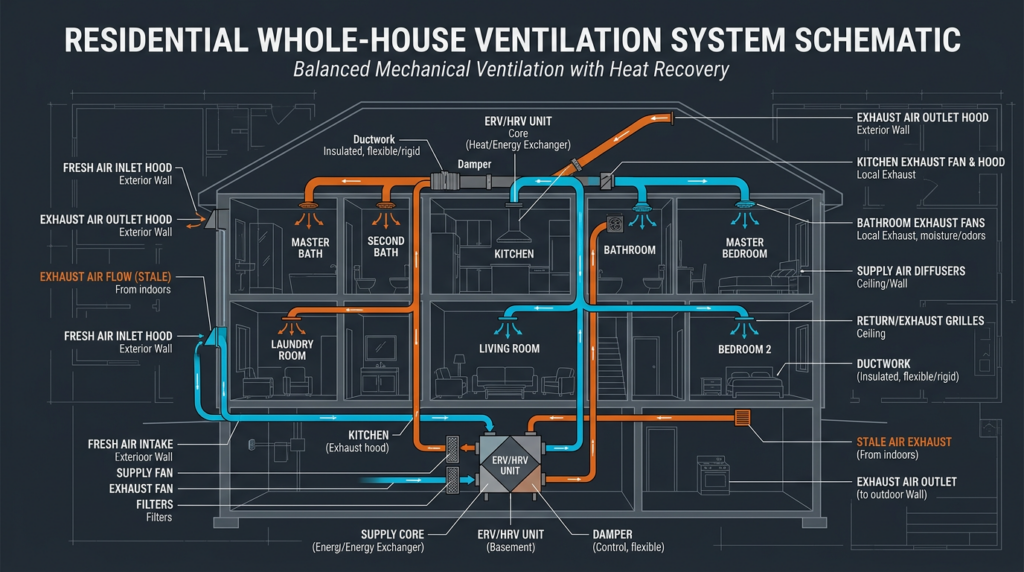
Balanced Ventilation: HRVs and ERVs
Balanced ventilation simultaneously supplies and exhausts equal volumes of air, minimizing pressure imbalances. Heat Recovery Ventilators (HRVs) transfer sensible heat between the outgoing and incoming airstreams, recovering 70% to 85% of thermal energy in cold weather. Energy Recovery Ventilators (ERVs) transfer both heat and moisture, making them preferable in humid climates where dehumidification loads are significant. HRVs are generally better suited to cold, dry climates, while ERVs perform well in hot, humid regions. Both system types carry higher installation costs but deliver the best combination of IAQ performance and energy efficiency.
Installation Best Practices
- Size ductwork according to manufacturer specifications and ACCA Manual D to minimize pressure drop and noise
- Seal all duct connections with mastic or approved tape to prevent air leakage
- Insulate ducts in unconditioned spaces to prevent condensation
- Commission ventilation systems after installation by measuring actual airflows at each terminal
- Establish a maintenance schedule that includes filter replacement every 3 to 6 months and periodic fan cleaning
Retrofitting Existing Homes
Adding mechanical ventilation to existing homes presents unique challenges, including limited space for ductwork, unknown building tightness, and existing HVAC system constraints. A blower door test should be the first step in any retrofit to establish baseline airtightness. In many cases, a single high-quality exhaust fan in a central bathroom, combined with a timer control, can satisfy whole-building ventilation requirements at minimal cost. For more comprehensive solutions, supply ventilation ducted to an existing forced-air system or a ductless ERV unit can provide balanced performance without extensive ductwork modifications.
Common Misconceptions about ASHRAE 62.2
- “Opening windows provides enough ventilation.” Natural ventilation depends on wind speed, temperature differences, and occupant behavior. It is inconsistent, unmeasurable in practice, and essentially nonexistent during extreme weather when windows remain closed. Mechanical ventilation provides reliable, quantifiable airflow regardless of outdoor conditions.
- “ASHRAE 62.2 is primarily about energy efficiency.” The standard’s primary objective is protecting human health through acceptable indoor air quality. Energy efficiency is a secondary consideration that influences system selection and control strategies, but IAQ always takes priority.
- “My home is already well-ventilated.” Modern construction techniques, spray foam insulation, and high-performance windows have dramatically reduced uncontrolled air leakage. Homes built to current energy codes often have ACH50 values below 3.0, meaning natural infiltration alone falls far short of minimum ventilation requirements.
- “More ventilation is always better.” Over-ventilation wastes energy, can create comfort problems from excessive drafts, and may introduce outdoor pollutants or humidity beyond what the HVAC system can manage. The standard establishes minimum rates that balance IAQ with practical energy and comfort considerations.
- “The standard is too complex for practical use.” While the full standard document contains detailed provisions, the core ventilation rate calculation requires only floor area and bedroom count. Software tools and simplified worksheets are available from ASHRAE and other organizations to streamline compliance.
Related Considerations
Filtration works alongside ventilation to improve IAQ. Filters with a Minimum Efficiency Reporting Value (MERV) of 13 or higher capture fine particulate matter, pollen, and mold spores from both recirculated and outdoor supply air. Source control remains the most effective IAQ strategy and includes using low-VOC building materials, properly venting combustion appliances, and controlling moisture at its origin. Moisture management is closely linked to ventilation, as both excessive and insufficient ventilation can contribute to humidity problems and mold growth. In regions with elevated radon risk, ventilation system design must account for pressure relationships that could draw radon into the living space, and dedicated radon mitigation may be required independently of the ventilation system.
Key Takeaways
ASHRAE Standard 62.2 provides the essential framework for ensuring acceptable indoor air quality in residential buildings. The standard requires both whole-building mechanical ventilation, calculated from floor area and bedroom count, and local exhaust ventilation in kitchens and bathrooms. Building tightness testing through blower door tests determines how much of the ventilation requirement natural infiltration can satisfy and how much must be provided mechanically. System selection among exhaust, supply, and balanced configurations depends on climate, building characteristics, and project budget. HVAC professionals should verify local code adoption status, perform accurate load calculations, commission installed systems to confirm actual performance, and educate homeowners on the importance of ongoing maintenance. In an era of increasingly tight construction, mechanical ventilation is no longer optional; it is a fundamental requirement for healthy residential environments.