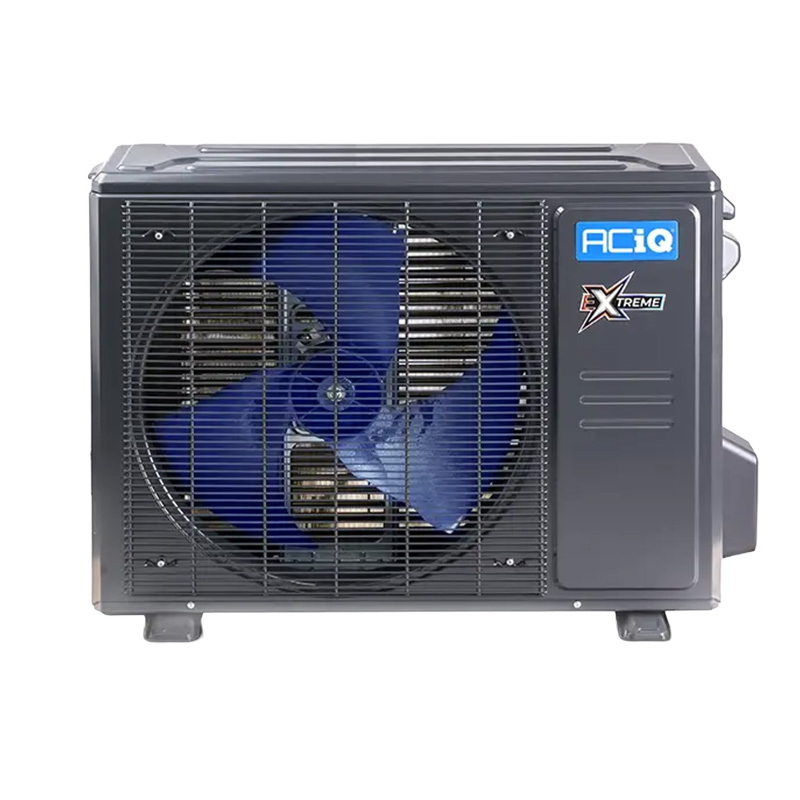
ACiQ 1.5 Ton Heat Pump AC Condenser | 19 SEER2 High Efficiency Extreme Heat Inverter R454B (ACIQ-18-HPD)
View on AC Direct see your lowest price →Check current price on AC Direct →
Key features
- 19 SEER2 inverter-driven compressor for variable-capacity operation
- 1.5-ton capacity (approximately 18,000 BTU/h) suited for smaller zones or homes
- R-454B refrigerant with lower global-warming potential for long-term code compliance
- 12-year parts warranty included, no dealer registration markup
- Sold factory-direct, which removes dealer margin from the purchase price
- Quiet operation at part-load conditions due to continuous compressor modulation
About this system
The ACiQ 1.5-ton 19 SEER2 inverter heat pump condenser (ACIQ-18-HPD) is a compact, high-efficiency outdoor unit designed for smaller homes, conditioned spaces, or add-on zones that fall in the 500-to-700-square-foot cooling range under typical conditions. At 19 SEER2, it clears the threshold that separates standard-efficiency equipment from genuine high-efficiency hardware, meaning real monthly savings compared to a 14 or 15 SEER2 replacement. The inverter-driven compressor is the core technology here: rather than cycling fully on and off, it ramps up or down continuously to match the load, which is what produces the low-noise operation and tighter temperature control that owners of variable-speed systems consistently notice versus single-stage alternatives.
The unit runs on R-454B refrigerant, a lower-global-warming-potential alternative that is positioned for long-term regulatory compliance as R-410A is phased down under EPA rules. That matters for buyers who plan to own this system for 15 or more years and want to avoid a refrigerant-transition headache mid-life. ACiQ sells direct, cutting out dealer margin and passing that savings to the buyer, but the flip side is that you will need an independent licensed HVAC contractor for installation and future service rather than a brand-authorized dealer network. This condenser is a good fit for budget-conscious homeowners who want inverter efficiency without paying Carrier or Trane retail prices, and who already have a contractor they trust or can vet independently.
The ACIQ-18-HPD delivers genuinely high-efficiency inverter performance at a price point well below comparable name-brand hardware, making it a strong contender for cost-conscious buyers who can secure a qualified independent installer. The unknowns are real: the brand is young, long-term reliability data is thin, and the undisclosed manufacturer makes parts sourcing harder if a failure occurs outside the warranty window. Buyers who value brand transparency and a local dealer relationship will be more comfortable with a Carrier or Trane alternative.
Overall score is the average of the five ratings above.
What we like
- 19 SEER2 rating puts it in the high-efficiency tier and should produce meaningful energy savings over standard-efficiency replacements
- Inverter compressor delivers quieter operation and steadier indoor temperatures compared to single-stage units
- 12-year parts warranty is competitive with or better than most name brands at this price level
- R-454B refrigerant is forward-compatible with tightening EPA regulations, reducing future retrofit risk
- Factory-direct pricing undercuts name-brand equivalents by a meaningful margin without sacrificing core technology
Trade-offs
- Undisclosed manufacturer makes it harder to cross-reference parts, service bulletins, or long-term compressor data
- No brand-authorized dealer network means service quality depends entirely on the independent contractor you choose
- Consumer Reports has not yet ranked ACiQ due to insufficient long-term field data, so reliability is unproven at scale
- Inverter systems are more complex to diagnose and repair than single-stage units, which raises the stakes when choosing a service contractor
What homeowners and pros say about ACiQ
Early owner feedback on ACiQ equipment skews positive, with quiet operation and steady temperature control being the most repeated observations from inverter-model owners. Responsive customer support through ACiQ’s direct channel is also mentioned frequently, which matters when you have no local dealer to call. However, because the brand is relatively new to the market, Consumer Reports has not yet ranked it, citing insufficient long-term data. That absence is not a red flag on its own, but it does mean buyers are working without the kind of independent, statistically grounded reliability assessment that exists for Carrier, Trane, or Lennox equipment with decades of field history behind them.
The specific failure mode concerns that come up in the ACiQ context are the same ones that apply broadly to any inverter heat pump from an undisclosed manufacturer: capacitor failures, refrigerant coil leaks, and long-term compressor lifespan under variable-load cycling are the areas where thin long-term data leaves genuine uncertainty. The undisclosed manufacturer situation compounds this because when a part fails out of warranty, cross-referencing it against a known OEM catalog is harder, and an independent contractor diagnosing an unfamiliar brand faces a steeper learning curve than they would with a Carrier or Trane unit they have serviced dozens of times. These are real trade-offs, not reasons to avoid the product entirely, but they are worth weighing honestly against the upfront price advantage.
Sources: Consumer Reports heat pump ratings, HVACDirect on the ACiQ brand, AHRI Directory of Certified Product Performance, U.S. DOE appliance and equipment efficiency standards.
What it costs to run
At 19 SEER2, cooling this 1.5-ton system for a typical 1200-hour cooling season at the U.S. average electricity rate of $0.17/kWh works out to roughly $193 per year in cooling, about $81 less per year than a minimum-efficiency 13.4 SEER2 unit of the same size. Your real cost depends on your climate and local rate.
Method: (18,000 BTU/hr ÷ 19 SEER2) × 1200 hours ÷ 1000 × $0.17/kWh. Rate source: U.S. EIA average; cooling hours: moderate-climate estimate.
How it compares
| Brand | Comparable model | SEER2 | Stage | Price position |
|---|---|---|---|---|
| ACiQ | ACIQ-18-HPD | 19 | Variable (inverter) | Value pick |
| Carrier | Infinity 20 (25VNA0) | 20+ | Variable | Significantly higher than ACiQ through dealer network |
| Trane | XV20i | 20 | Variable | Significantly higher than ACiQ through dealer network |
| Lennox | XP21 | 19-20 | Variable | Moderately to significantly higher than ACiQ through dealer network |
Competitor rows are comparable single-stage units at similar efficiency; price is relative position, not a quote.
Questions about this system
Who actually manufactures this unit, and does it matter for parts availability?
ACiQ is AC Direct's house brand and the underlying manufacturer is not publicly disclosed. Forum speculation points to the ICP/Carrier family but this is unconfirmed. It matters practically because cross-referencing OEM parts or service history is harder than with a named brand, particularly after the warranty period ends.
Why does this unit use R-454B instead of R-410A, and will that cause any installation problems?
R-454B is a lower-global-warming-potential refrigerant being adopted industry-wide as the EPA phases down R-410A. It requires equipment and components rated for it, so your contractor must use R-454B-compatible tools and materials. Most newer contractors are equipped for this, but confirm before booking.
Is a 1.5-ton unit large enough for my home?
Proper sizing depends on a Manual J load calculation, not square footage rules of thumb alone. A 1.5-ton unit is generally appropriate for well-insulated spaces in the 500-to-700-square-foot range in moderate climates, but an undersized unit will short-cycle and an oversized one will cause humidity problems. Have your contractor run the numbers before ordering.
How does the 12-year warranty work if ACiQ does not have a dealer network?
ACiQ's 12-year parts warranty is handled direct, not through a dealer, which removes the registration fees some brands charge. You will need to work through ACiQ's support process to source covered parts, and labor costs are your responsibility and your contractor's arrangement, so confirm those terms before installation.
What should I ask an HVAC contractor before having them install this unit?
Ask whether they have experience installing and commissioning inverter-driven systems, whether they carry R-454B refrigerant and compatible tools, and whether they are comfortable working with a direct-shipped brand that lacks a local distributor. An inverter system installed incorrectly by a contractor unfamiliar with variable-speed commissioning can underperform or fail prematurely.
Specifications
| Cooling capacity | 1.5 Ton |
| Efficiency | 19 SEER2 |
| Refrigerant | R-454B |