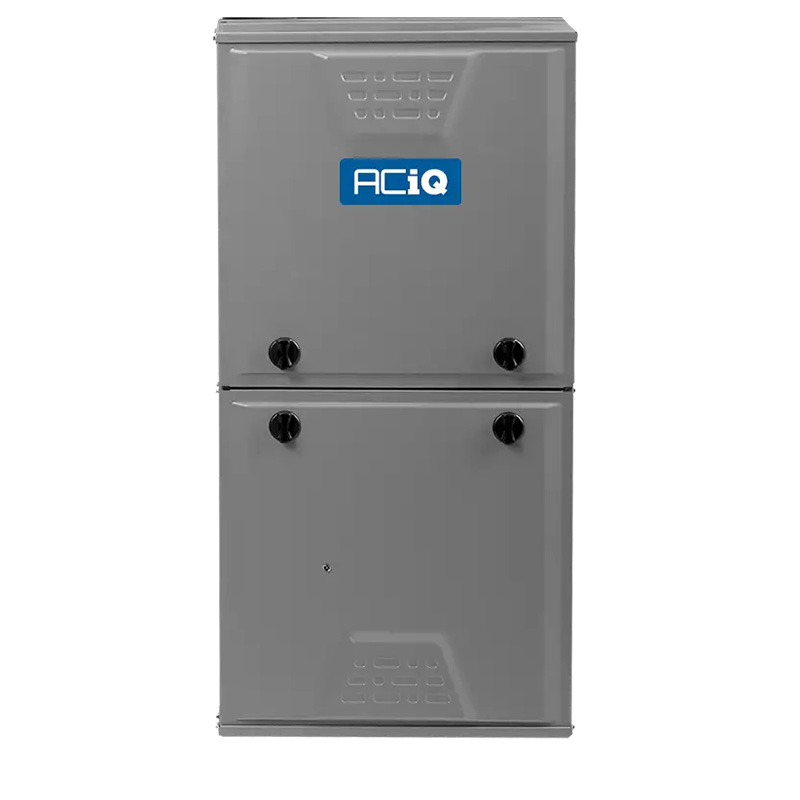
ACiQ 100000 BTU Gas Furnace – 96% Two Stage Variable Speed Multi-Positional (G96VTN1002120A)
View on AC Direct see your lowest price →Check current price on AC Direct →
Key features
- 96% AFUE high-efficiency rating for substantial fuel savings over mid-efficiency units
- Two-stage gas valve reduces cycling and improves temperature consistency
- Variable-speed ECM blower motor for quiet, even airflow and better humidity control
- Multi-positional cabinet supports upflow, downflow, and horizontal installation
- 100,000 BTU capacity suited to larger homes in cold climates
- 12-year parts warranty included with no dealer markup required
About this system
The ACiQ G96VTN1002120A is a 100,000 BTU, 96% AFUE two-stage variable-speed gas furnace designed for homes that need serious heating muscle without the price premium of a name-brand unit. At 96% AFUE, it converts 96 cents of every dollar of natural gas into usable heat, placing it firmly in the high-efficiency tier and making it eligible for federal tax credits and some utility rebates. The two-stage gas valve means the furnace runs on a lower first stage the majority of the time, ramping up to full capacity only during the coldest stretches, which reduces temperature swings and cuts fuel consumption compared to a single-stage unit.
The variable-speed ECM blower motor is the real comfort workhorse here. It ramps airflow up and down in small increments rather than simply switching on and off, which produces quieter operation, more even heat distribution throughout the home, and better humidity control. The multi-positional cabinet means it can be installed upflow, downflow, or horizontal, giving contractors flexibility when placing it in a basement, crawlspace, attic, or closet. This unit suits homeowners in cold climates with larger homes, typically in the 2,000 to 3,000 square foot range depending on insulation and local design temperatures, who want premium features at a below-market price point.
The ACiQ G96VTN1002120A delivers genuinely high-efficiency, feature-rich heating at a price that undercuts comparable name-brand units by a meaningful margin. The trade-off is an undisclosed manufacturer, thin long-term reliability data, and a service model that puts more responsibility on the homeowner to find qualified independent contractors. For cost-conscious buyers comfortable with those uncertainties, it is a strong option; buyers who prioritize a proven service network and decades of reliability data should weigh the gap carefully.
Overall score is the average of the five ratings above.
What we like
- 96% AFUE places it in the high-efficiency tier, reducing monthly gas bills versus 80% AFUE alternatives
- Variable-speed ECM motor produces notably quieter operation compared to single-speed blowers
- Two-stage firing reduces short-cycling and temperature swings for more consistent comfort
- Multi-positional design gives installers flexibility across a wide range of home configurations
- 12-year parts warranty is competitive with or better than many name-brand furnace warranties at this price
Trade-offs
- Manufacturer identity is not disclosed, making parts sourcing and service history harder to cross-reference
- No independent long-term reliability data yet; Consumer Reports does not rank ACiQ due to insufficient history
- Sold direct rather than through a dealer network, so finding a contractor willing to install and service it may take extra effort
- Resale and trade-in value is less predictable than with established brands that buyers and inspectors recognize by name
What homeowners and pros say about ACiQ
Early owners of ACiQ furnaces consistently point to quiet operation and responsive customer support as the standout positives, with many noting the variable-speed blower produces noticeably less noise than the single-speed units they replaced. That matches what you would expect from an ECM motor running at reduced capacity most of the time. However, the brand is new enough that Consumer Reports has not assigned it a reliability score, citing insufficient long-term data, and independent tracking of failure rates over five to ten years simply does not exist yet. That is not a condemnation, but it is a genuine unknown that separates ACiQ from Carrier, Trane, or Lennox, where decades of field data exist.
The most specific concern voiced by HVAC professionals about the ACiQ line is the undisclosed manufacturer. When a technician cannot confirm which platform a furnace is built on, cross-referencing parts, looking up known failure patterns, or finding a compatible control board becomes harder than with a labeled ICP or Carrier unit. The direct-to-consumer sales model also means there is no factory-authorized dealer obligated to prioritize your service call; you are finding your own contractor, which is manageable in most markets but adds a step. For buyers willing to do that legwork, the combination of 96% AFUE, variable-speed performance, and a 12-year warranty at below-name-brand pricing is genuinely competitive.
Sources: Consumer Reports heat pump ratings, HVACDirect on the ACiQ brand, AHRI Directory of Certified Product Performance, U.S. DOE appliance and equipment efficiency standards.
How it compares
| Brand | Comparable model | SEER2 | Stage | Price position |
|---|---|---|---|---|
| ACiQ | G96VTN1002120A | N/A (gas furnace) | Two-stage variable-speed | Value pick |
| Carrier | Performance 96 (58TP) | N/A (gas furnace) | Two-stage variable-speed | Moderately higher than ACiQ |
| Trane | S9V2 (XR95 series) | N/A (gas furnace) | Two-stage variable-speed | Moderately to significantly higher than ACiQ |
| Lennox | SLP98V | N/A (gas furnace) | Modulating variable-speed | Significantly higher than ACiQ |
Competitor rows are comparable single-stage units at similar efficiency; price is relative position, not a quote.
Questions about this system
Who actually manufactures the ACiQ G96VTN1002120A, and does it matter for parts availability?
ACiQ is AC Direct's house brand and the actual manufacturer is not publicly disclosed, though forum discussion points toward the ICP and Carrier family without confirmation. This matters practically because a technician cannot easily cross-reference the unit with a known manufacturer's service history or parts catalog, which can slow down diagnosis and sourcing if something fails outside of warranty.
Is 100,000 BTU the right size for my home?
BTU sizing depends on your climate zone, insulation levels, window area, and square footage, not square footage alone. A proper Manual J load calculation is the only reliable way to confirm the right size; installing an oversized furnace leads to short-cycling, poor humidity control, and increased wear even on a variable-speed unit. Have your contractor run the calculation before ordering.
How do I get warranty service if there is no local ACiQ dealer?
ACiQ warranties are serviced through independent HVAC contractors rather than a factory dealer network. You are responsible for finding a licensed contractor willing to work on the unit; ACiQ's support team can assist with parts claims, but the labor coordination falls to you. Confirming contractor availability in your area before purchase is a reasonable step.
Does the 96% AFUE rating qualify this furnace for the federal energy efficiency tax credit?
As of current IRS guidance, gas furnaces must meet a 97% AFUE threshold in most U.S. climate zones to qualify for the 25C energy efficiency tax credit, though the requirement is 96% AFUE in the South. Confirm your climate zone and the current IRS rules with a tax professional before assuming eligibility, as thresholds can change.
Can any licensed HVAC technician install this furnace, or does it require special training for the variable-speed controls?
Any licensed HVAC technician can perform the mechanical installation, but the variable-speed ECM blower and two-stage controls do require familiarity with communicating or multi-stage furnace setup during commissioning. Confirm that your contractor has experience with variable-speed gas furnaces, not just single-stage equipment, before scheduling the installation.
Specifications
| Furnace output | 100000 BTU |
| Furnace efficiency | 96% AFUE |