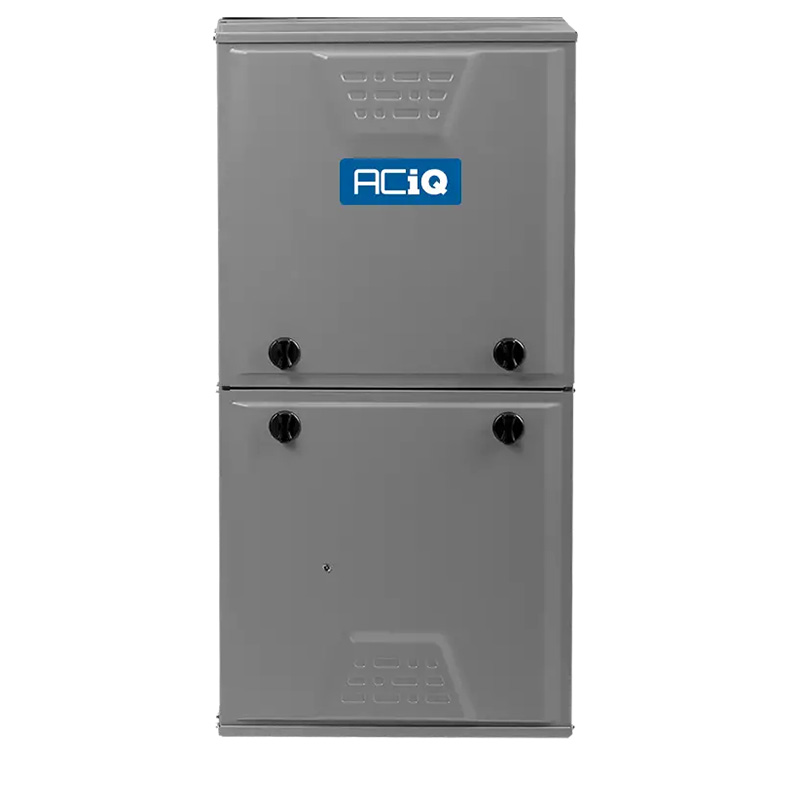
ACiQ 60000 BTU Gas Furnace – 96% Two Stage Variable Speed Multi-Positional Communicating (G96CTN0601714A)
View on AC Direct see your lowest price →Check current price on AC Direct →
Key features
- 96% AFUE high-efficiency rating meets northern climate energy codes
- Two-stage gas valve reduces short-cycling and temperature swings
- Variable-speed ECM blower motor for quiet, consistent airflow
- Multi-positional cabinet installs upflow, downflow, or horizontal
- Communicating controls compatible with smart and communicating thermostats
- Ships with a 12-year parts warranty at no dealer markup
About this system
The ACiQ G96CTN0601714A is a 60,000 BTU, 96% AFUE two-stage gas furnace with a variable-speed ECM blower motor and multi-positional cabinet that can be installed upflow, downflow, or horizontal. It is aimed at smaller to mid-size homes, typically in the 1,200 to 2,000 square-foot range depending on climate and insulation, where a full 80,000 or 100,000 BTU unit would short-cycle and waste fuel. The 96% AFUE rating means only about four cents of every dollar spent on gas is lost as exhaust heat, placing it squarely in the high-efficiency tier required by many northern climate energy codes.
Two-stage operation gives the furnace a low-fire setting for milder days and a high-fire setting for peak cold snaps, which reduces temperature swings, lowers average fuel consumption compared to single-stage alternatives, and cuts the number of noisy on-off cycles per hour. The variable-speed blower works in tandem with that staging to move air quietly and consistently, and the communicating controls allow the furnace to share data with a compatible thermostat or air handler for tighter system coordination. Multi-positional flexibility is a real practical advantage during installation: contractors are not locked into a single cabinet orientation, which matters in tight utility closets, basements, or attic applications.
The ACiQ G96CTN0601714A delivers a genuinely capable 96% AFUE two-stage furnace at a price that undercuts most name-brand equivalents, and its variable-speed blower adds comfort that single-stage budget competitors cannot match. The honest trade-off is that the brand is relatively new, Consumer Reports has not yet assigned a reliability score, and the undisclosed manufacturer makes long-term parts cross-referencing harder than it is with Carrier or Trane. Buyers who are comfortable sourcing their own contractor and accepting some uncertainty around decade-plus reliability get real value; those who want the deepest service network or established resale credibility may want to weigh that carefully.
Overall score is the average of the five ratings above.
What we like
- 96% AFUE reduces annual heating bills versus 80% AFUE units in cold climates
- Two-stage operation and variable-speed blower together produce noticeably quieter, more even heat distribution
- Multi-positional cabinet gives installers flexibility in confined or irregular mechanical spaces
- 12-year parts warranty comes standard without dealer markup, which is strong for the price tier
- Early owner feedback consistently cites quiet operation and responsive factory support
Trade-offs
- Consumer Reports has not yet ranked ACiQ, so independent long-term reliability data is thin
- The actual manufacturing origin is undisclosed, complicating parts sourcing and service history research
- Sold direct rather than through a dealer network, so finding an experienced service contractor falls on the homeowner
- Communicating system benefits require a compatible thermostat or air handler, adding potential integration cost
What homeowners and pros say about ACiQ
Early owners of ACiQ furnaces most often mention how quiet the variable-speed blower runs compared to the single-stage units they replaced, and factory support response times draw consistent positive remarks in online forums and retailer review sections. Consumer Reports has not yet ranked ACiQ because the brand is relatively new and long-term failure data has not accumulated to the point where a statistically reliable score is possible. That absence of a formal reliability rating is the single most commonly raised concern among buyers researching the brand: it is not a mark against ACiQ so much as an honest gap in the public record that prospective buyers should weigh against the lower purchase price.
The specific failure modes that apply to ACiQ as a brand center on factors connected to its direct-to-consumer model rather than on documented mechanical defects in the hardware itself. Because the manufacturer is not disclosed, a contractor who encounters an unfamiliar part or a wiring configuration they do not recognize may have a harder time sourcing a cross-reference or pulling a service bulletin than they would with a Carrier or Trane unit. Service also depends entirely on independent contractors since there is no factory dealer network, which puts the burden of finding qualified warranty service on the homeowner. Contractors familiar with the brand report no unusual patterns of capacitor failure, coil issues, or early heat exchanger problems so far, but the data window is still short enough that drawing firm conclusions about decade-long durability would go beyond what the evidence currently supports.
Sources: Consumer Reports heat pump ratings, HVACDirect on the ACiQ brand, AHRI Directory of Certified Product Performance, U.S. DOE appliance and equipment efficiency standards.
How it compares
| Brand | Comparable model | SEER2 | Stage | Price position |
|---|---|---|---|---|
| ACiQ | G96CTN0601714A | N/A | Two-stage | Value pick |
| Carrier | Performance 96 (59TP6) | N/A | Two-stage | Moderately higher than ACiQ through dealer install |
| Trane | S9X2 (XR95 series) | N/A | Two-stage | Moderately to significantly higher than ACiQ through dealer install |
| Lennox | ML196V | N/A | Two-stage variable-speed | Significantly higher than ACiQ through dealer install |
Competitor rows are comparable single-stage units at similar efficiency; price is relative position, not a quote.
Questions about this system
Who actually manufactures the ACiQ G96CTN0601714A, and does it matter for parts?
ACiQ is AC Direct's house brand and the actual manufacturing source is not publicly disclosed. Forum speculation points toward the ICP and Carrier family but that is unconfirmed. In practice it can make cross-referencing replacement parts or pulling a manufacturer's reliability history harder than it would be with a brand whose factory origin is known, so it is worth confirming parts availability with your contractor before purchasing.
Is 60,000 BTU the right size for my home?
Output sizing depends on your climate zone, insulation levels, window area, and house geometry, not square footage alone. A proper Manual J load calculation is the only reliable way to confirm fit. As a rough reference, 60,000 BTU often suits well-insulated homes in the 1,200 to 1,800 square-foot range in moderate to cold climates, but an undersized or oversized furnace will hurt both comfort and efficiency regardless of brand.
What does 'communicating' mean on this furnace, and do I need a special thermostat?
Communicating means the furnace can exchange detailed operational data with a compatible thermostat or air handler over a digital bus rather than relying on simple on-off signals. You do not need a communicating thermostat to run the furnace, but you will only get the full efficiency and diagnostic benefits of the communicating feature if you pair it with a compatible communicating control. A standard 24-volt thermostat will operate the basic heating function.
How does ACiQ warranty service work if there is no local dealer?
ACiQ sells direct and does not have a proprietary dealer network, so warranty service is handled through independent licensed HVAC contractors. You are responsible for finding and scheduling a qualified technician; ACiQ covers the parts cost under the 12-year warranty but labor costs are typically not included. Confirming that a local contractor is willing to work on the brand before you buy is a practical step worth taking.
How much more efficient is 96% AFUE compared to a standard 80% AFUE furnace, in real-world terms?
An 80% AFUE furnace loses roughly 20 cents of every gas dollar up the flue, while a 96% AFUE unit loses about four cents. In a heating-heavy climate spending several hundred dollars a season on gas, that gap can translate to meaningful annual savings, though the exact payback period depends on local gas prices, how many heating degree days your area sees, and the price difference between the two units.
Specifications
| Furnace output | 60000 BTU |
| Furnace efficiency | 96% AFUE |