Daikin 10 Ton Commercial Package Unit AC With Electric Heat – 15.2 IEER, 208-230/3/60, Two Stage, R32
View on AC Direct see your lowest price →Check current price on AC Direct →
Key features
- 10-ton cooling capacity for mid-size commercial applications up to roughly 10,000-12,000 sq ft
- 15.2 IEER efficiency rating — upper-mid tier for commercial packaged units in this size class
- Two-stage compressor operation reduces energy use and humidity swings during partial-load conditions
- R-32 refrigerant with lower global warming potential than R-410A, ahead of tightening regulations
- Electric heat configuration eliminates gas-line requirements and heat exchanger maintenance
- Three-phase 208-230V/60Hz power supply required — commercial and light industrial applications only
About this system
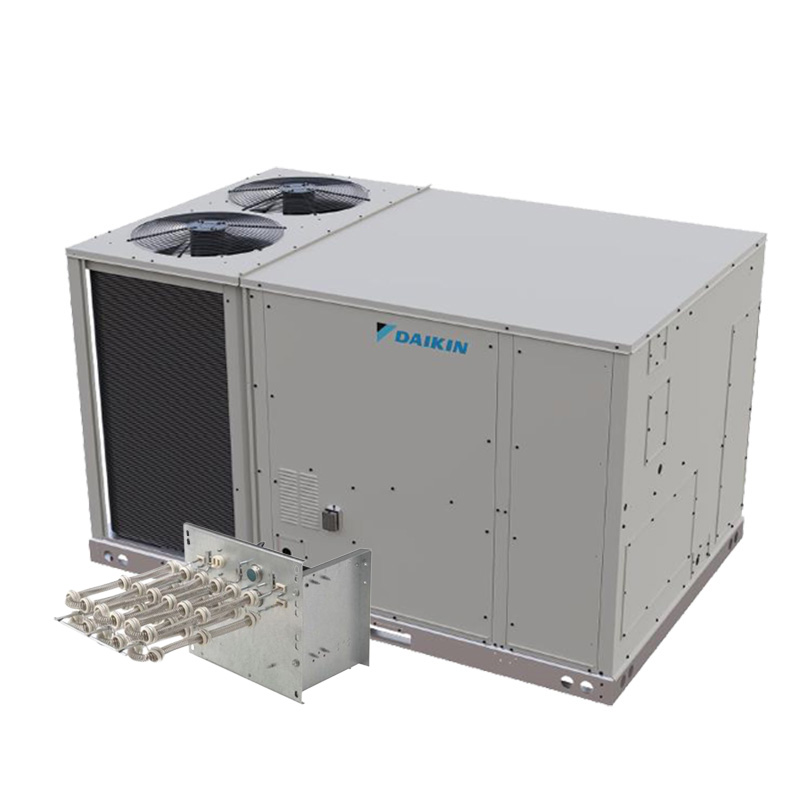
The Daikin 10-ton commercial packaged unit combines air conditioning and electric heat in a single rooftop or ground-level cabinet, making it a practical choice for mid-size commercial spaces such as retail storefronts, light industrial bays, offices, and multi-tenant suites in the 8,000 to 12,000 square foot range. At 10 tons of cooling capacity, this is not a residential product — it is sized for sustained commercial duty cycles, and the three-phase 208-230V electrical requirement means it will only fit buildings with three-phase service already in place or under construction.
The 15.2 IEER (Integrated Energy Efficiency Ratio) rating is the commercial-unit equivalent of a residential SEER or SEER2 score, and 15.2 sits solidly in the upper-mid tier for commercial packaged equipment of this size class. Two-stage operation is a meaningful real-world advantage over single-stage competitors: the unit runs at reduced capacity during moderate load conditions, which cuts energy consumption, reduces humidity swings, and avoids the harsh on-off cycling that accelerates compressor wear. R-32 refrigerant is a forward-looking choice — it carries a lower global warming potential than the R-410A still found in older competing units, and it simplifies long-term service compliance as refrigerant regulations tighten.
Electric heat strips rather than a gas heat exchanger keep the mechanical footprint simpler and eliminate gas-line requirements, which can be an advantage for buildings without natural gas service. The trade-off is that electric resistance heat is more expensive to operate than gas in most utility markets, so this configuration is best suited to climates where heating hours are modest or where electricity costs are low. Buyers in heating-heavy climates should price out the annual operating cost difference before committing.
This Daikin 10-ton commercial packaged unit is a well-engineered, durability-focused option for commercial buyers who want two-stage efficiency and forward-compatible R-32 refrigerant in a single cabinet. The premium price is real, and Daikin's documented parts availability and service support issues are a legitimate concern at this size class where downtime is costly. Buyers who pair it with a reliable local Daikin commercial dealer and register the warranty promptly will be best positioned to get full value from the hardware.
Overall score is the average of the five ratings above.
What we like
- 15.2 IEER two-stage operation delivers genuine energy savings over single-stage units during the long partial-load hours common in commercial buildings
- R-32 refrigerant is lower GWP than R-410A, reducing regulatory risk as phasedown rules tighten
- Daikin's build quality and longevity are consistently recognized by HVAC experts and Consumer Reports as above-average for the industry
- All-electric, self-contained packaged design simplifies installation where gas service is unavailable or undesirable
- 12-year parts warranty (with registration) is competitive for commercial packaged equipment at this capacity
Trade-offs
- Electronic control board and circuit board failures are the most commonly reported technical issue, and commercial downtime while waiting on parts is costly
- Parts availability and warranty claims handling are recurring complaints; having a stocking Daikin commercial distributor nearby is important
- Electric resistance heat is significantly more expensive to operate than gas in most markets — this configuration carries a real ongoing cost penalty in cold climates
- Premium price point versus Carrier, Trane, and Lennox competitors in the same efficiency tier requires justification from the longevity and efficiency advantages
What homeowners and pros say about Daikin
Among HVAC professionals who work on commercial packaged equipment, Daikin earns consistent respect for build quality and component durability — industry observers and Consumer Reports both place Daikin among the longer-lasting brands, and that reputation holds for their commercial line. Technicians who have serviced Daikin commercial units long-term generally note that the mechanical side holds up well, with sheet metal, coils, and cabinet construction that outlast budget-tier competitors. The two-stage compressor in this class of unit is also noted as a genuine efficiency and longevity benefit rather than a marketing feature, since reduced cycling extends compressor life in high-runtime commercial environments.
The other side of the conversation centers on the documented failure modes that show up in service records and on complaint platforms like PissedConsumer, where Daikin scores around 1.4 out of 5 — a heavily complaint-weighted channel, but the themes are consistent. Electronic control board and circuit board failures are the most cited technical issue, sometimes leaving units in fault-code lockout until replacement boards arrive. Compressor degradation and gradual noise increases, including rattling and humming on start and stop cycles, are also documented. Most critically for commercial operators, parts availability and warranty claims handling draw the sharpest criticism: if a local distributor does not stock common control boards, lead times can stretch, and that downtime is expensive in a commercial setting. The practical takeaway is that Daikin’s hardware quality is real, but the ownership experience is strongly shaped by the quality and proximity of the installing and servicing dealer.
Sources: PissedConsumer Daikin reviews, AHRI Directory of Certified Product Performance, U.S. DOE appliance and equipment efficiency standards, Daikin product specifications.
How it compares
| Brand | Comparable model | SEER2 | Stage | Price position |
|---|---|---|---|---|
| Daikin | 10 Ton Commercial Packaged Unit, Two-Stage, R-32, Electric Heat | N/A (15.2 IEER) | Two-stage | Premium tier |
| Carrier | WeatherMaster 50XC (10-ton commercial packaged) | N/A (IEER varies by config) | Two-stage | Comparable premium pricing, broadly similar installed cost |
| Trane | Precedent YSC (10-ton commercial packaged) | N/A (IEER varies by config) | Single-stage or two-stage depending on model | Comparable to slightly lower than Daikin at this tonnage |
| Lennox | Landmark LCA (10-ton commercial packaged) | N/A (IEER varies by config) | Single-stage standard; two-stage available on select configs | Generally lower upfront than Daikin, wider parts network in many regions |
Competitor rows are comparable single-stage units at similar efficiency; price is relative position, not a quote.
Questions about this system
Does this unit require three-phase power, and can I run it on single-phase service?
Yes, this unit is rated 208-230/3/60, meaning it requires a three-phase electrical service. It cannot be run on standard single-phase power without a phase converter, which Daikin does not recommend for commercial packaged units of this size. Confirm your building's electrical service before purchasing.
What does the 12-year parts warranty actually cover, and what do I need to do to activate it?
Daikin's 12-year parts warranty covers the compressor and functional parts when the unit is registered within 60 days of installation by a licensed contractor. If you miss that 60-day window, coverage typically drops to a shorter base warranty. Labor is not included, so factor in service contract costs separately.
How does two-stage operation benefit a commercial building compared to a single-stage unit?
Two-stage operation allows the unit to run at a lower capacity setting during moderate load conditions — which accounts for the majority of operating hours in most climates. This reduces energy consumption, improves humidity control, and puts less wear on the compressor than constant full-capacity cycling.
What are the most common service issues reported on commercial Daikin packaged units?
The most frequently documented technical problems are electronic control board and circuit board errors that can leave the unit throwing fault codes or becoming unresponsive. Compressor performance degradation and noise development over time are also reported. Parts availability and warranty service response are the most consistent complaints from commercial operators.
Why does this unit use R-32 refrigerant, and does that affect service costs or technician availability?
R-32 has a significantly lower global warming potential than R-410A, making it more compliant with current and anticipated refrigerant regulations. Technician familiarity with R-32 is growing in commercial markets, but you should confirm that your local Daikin service dealer stocks R-32 and is certified to handle it, as it is still less universally stocked than R-410A.
Specifications
| Cooling capacity | 10 Ton |
| Refrigerant | R-32 |