Daikin 12.5 Ton Commercial Package Unit AC With Electric Heat – 15.2 IEER, 208-230/3/60, Two Stage, R32
View on AC Direct see your lowest price →Check current price on AC Direct →
Key features
- 12.5-ton two-stage commercial packaged unit for medium-to-large commercial applications
- 15.2 IEER efficiency rating, meeting current DOE commercial efficiency standards
- R-32 refrigerant with lower global warming potential than R-410A
- 208-230/3/60 three-phase electrical configuration for commercial power service
- Integrated electric heat strips, no gas piping required
- 12-year parts warranty with registration within 60 days of installation
About this system
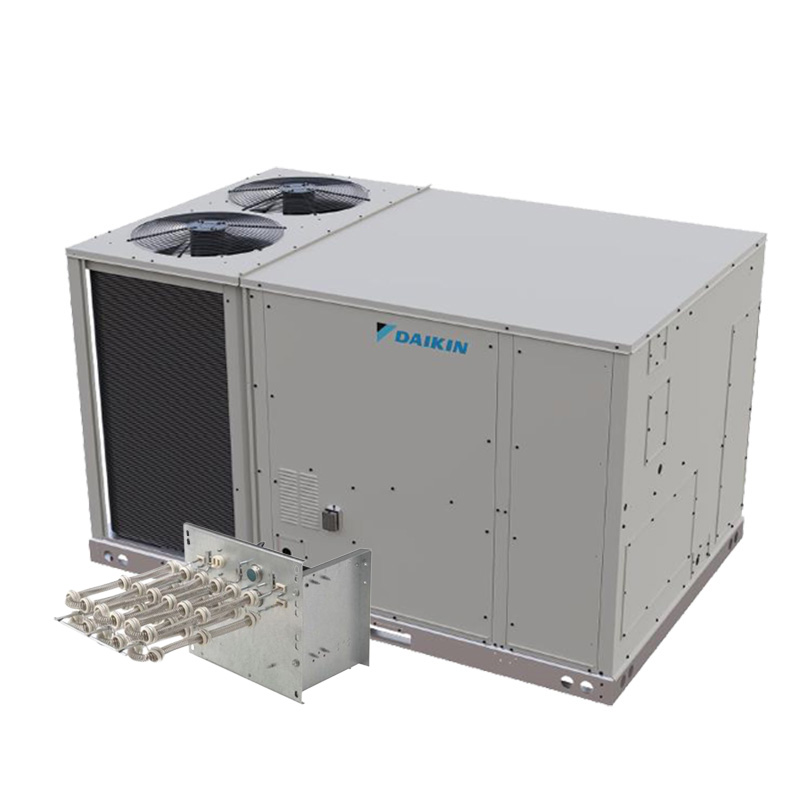
The Daikin 12.5-ton commercial packaged unit is a rooftop or ground-mounted all-in-one system designed for medium-to-large commercial spaces: retail buildings, light industrial facilities, schools, and office suites that need both cooling and electric heat in a single cabinet. At 12.5 tons, it handles roughly 8,000 to 12,000 square feet depending on insulation and climate, and the two-stage operation means it runs at a lower capacity during mild weather, reducing short-cycling, evening out temperatures, and lowering operating costs compared to single-stage units of the same tonnage.
This unit runs on R-32 refrigerant, a lower-global-warming-potential option that is gradually replacing R-410A across the commercial market. The 208-230/3/60 electrical configuration is standard three-phase commercial power, so it is not suitable for single-phase residential service. The 15.2 IEER (Integrated Energy Efficiency Ratio) is the commercial efficiency metric equivalent to SEER2 on residential equipment; that figure sits solidly in the mid-tier for commercial packaged units, meeting or exceeding current DOE efficiency standards without reaching the premium-efficiency bracket. Electric heat strips are built in, keeping the footprint compact and eliminating gas piping requirements, though resistance heat is inherently less efficient than a heat pump for heating-heavy climates.
Daikin positions this product for commercial contractors and facilities managers who want a long-service-life platform backed by a recognizable global brand. The tradeoffs are real: Daikin commands premium pricing over comparable domestic brands, parts and service support outside major metros can be slow, and the three-phase requirement and commercial tonnage mean this is strictly a licensed-contractor installation. Buyers who prioritize long-term durability and are comfortable with Daikin’s service ecosystem will find the build quality matches the price; those who need fast local parts support should verify distributor coverage in their region before committing.
The Daikin 12.5-ton two-stage commercial package unit offers solid mid-tier efficiency, genuine two-stage capacity control, and Daikin's well-documented long-service-life build quality in a self-contained R-32 cabinet. It is priced at the premium end for this class, and buyers should enter with clear eyes about Daikin's parts availability and service support limitations outside of well-served markets. For facilities managers who can verify strong local distributor support, it is a defensible long-term investment; for those in underserved markets, the risk-reward calculus shifts noticeably.
Overall score is the average of the five ratings above.
What we like
- Two-stage operation reduces short-cycling and improves temperature consistency across large spaces
- R-32 refrigerant is better positioned for long-term regulatory compliance than R-410A equipment
- 15.2 IEER meets current commercial efficiency standards and reduces energy costs versus single-stage alternatives
- Daikin is consistently rated among the longer-lasting commercial HVAC brands by industry experts and Consumer Reports
- All-in-one packaged configuration simplifies rooftop installation and eliminates the need for separate indoor air handlers
Trade-offs
- Electronic control boards are the most documented failure point, with error codes and unresponsive controls cited in service records
- Parts availability and warranty claims processing draw consistent complaints, particularly in regions with thin Daikin distributor coverage
- Electric resistance heat is significantly less efficient than heat pump heating, raising operating costs in heating-heavy climates
- Premium pricing over comparable Carrier, Trane, and Lennox commercial packaged units at similar efficiency tiers
What homeowners and pros say about Daikin
Among facilities managers and commercial HVAC contractors, Daikin’s reputation sits in an interesting split. Industry professionals and sources such as Consumer Reports consistently place Daikin among the longer-lasting commercial HVAC brands, citing robust component quality and above-average service life when the equipment is properly maintained. That durability reputation is a genuine selling point for buyers evaluating total cost of ownership over a 15-to-20-year horizon. On the other side, complaint-driven channels like PissedConsumer show ratings around 1.4 out of 5 across a small but vocal set of reviews, with the loudest grievances centering on price shock during repairs and service responsiveness rather than outright equipment failure rates.
The specific failure modes that come up in commercial technician forums mirror what the broader data shows: electronic control board and circuit board errors are the most frequently cited issue, sometimes manifesting as persistent fault codes or a unit that becomes unresponsive until the board is replaced. Compressor problems, while less common, do appear in service histories, and some contractors note that units can develop rattling or humming on startup and shutdown as they age. The most consistent operational complaint, though, is parts availability and warranty handling; technicians in markets without a strong Daikin commercial distributor presence report longer lead times on boards and refrigerant-circuit components than they would see with Carrier or Trane. Buyers who do their homework on local distributor support before purchase tend to report far better experiences than those who discover coverage gaps after installation.
Sources: PissedConsumer Daikin reviews, AHRI Directory of Certified Product Performance, U.S. DOE appliance and equipment efficiency standards, Daikin product specifications.
How it compares
| Brand | Comparable model | SEER2 | Stage | Price position |
|---|---|---|---|---|
| Daikin | 12.5-Ton Two-Stage Commercial Package Unit (R-32, Electric Heat) | N/A (15.2 IEER) | Two-stage | Premium pricing tier for commercial packaged units |
| Carrier | 48LC/50LC Series 12.5-Ton Commercial Package | N/A (comparable IEER range) | Single-stage or two-stage depending on configuration | Comparable to slightly below Daikin at similar efficiency; wider parts network |
| Trane | Precedent Series 12.5-Ton Commercial Package (WSC/YSC) | N/A (comparable IEER range) | Single-stage or two-stage depending on configuration | Comparable to Daikin at premium end; strong national parts and service coverage |
| Lennox | LGH/LCH 150 Series 12.5-Ton Commercial Package | N/A (comparable IEER range) | Single-stage standard; two-stage available | Generally slightly below Daikin at similar efficiency tier; moderate parts availability |
Competitor rows are comparable single-stage units at similar efficiency; price is relative position, not a quote.
Questions about this system
Does this unit require three-phase power, and can it run on single-phase commercial service?
Yes, the 208-230/3/60 rating means it requires three-phase power. Single-phase service will not work. Before purchasing, confirm with your electrical contractor that your building has three-phase service at the panel feeding the rooftop or equipment pad.
What does the 12-year parts warranty actually cover, and what are the registration requirements?
Daikin's 12-year parts warranty covers replacement components on the registered unit. It requires registration within 60 days of installation; missing that window typically drops coverage to a shorter base warranty. Labor is not included, so factor in service labor costs when comparing warranty value against competing brands.
How efficient is the electric heat on this unit, and is it suitable for cold climates?
Electric resistance heat strips operate at roughly 100 percent efficiency in converting electricity to heat, but that is far less efficient than a heat pump that can deliver two to three units of heat per unit of electricity. In climates with significant heating seasons, operating costs with electric strips will be substantially higher than a comparable heat pump packaged unit; this configuration is best suited to mild-winter climates or applications where heating runtime is minimal.
What are the most common service issues reported on Daikin commercial packaged units?
Documented failure modes include electronic control board and circuit board errors that can leave the unit throwing fault codes or becoming unresponsive, compressor degradation or outright failure in some cases, and units growing noisier over time with rattling or humming on startup and shutdown. Parts availability and warranty claim processing are the most consistent service complaints, particularly outside major metro areas.
How does IEER differ from SEER2, and is 15.2 IEER a good rating for a unit this size?
IEER (Integrated Energy Efficiency Ratio) is the efficiency metric used for commercial unitary equipment, while SEER2 is used for residential systems; they are not directly comparable numbers. A 15.2 IEER on a 12.5-ton commercial package unit sits in the mid-efficiency tier, meeting current DOE minimum standards and offering meaningful savings over older baseline equipment, but it does not reach the high-efficiency bracket occupied by units rated 16 IEER and above.
Specifications
| Cooling capacity | 12.5 Ton |
| Refrigerant | R-32 |