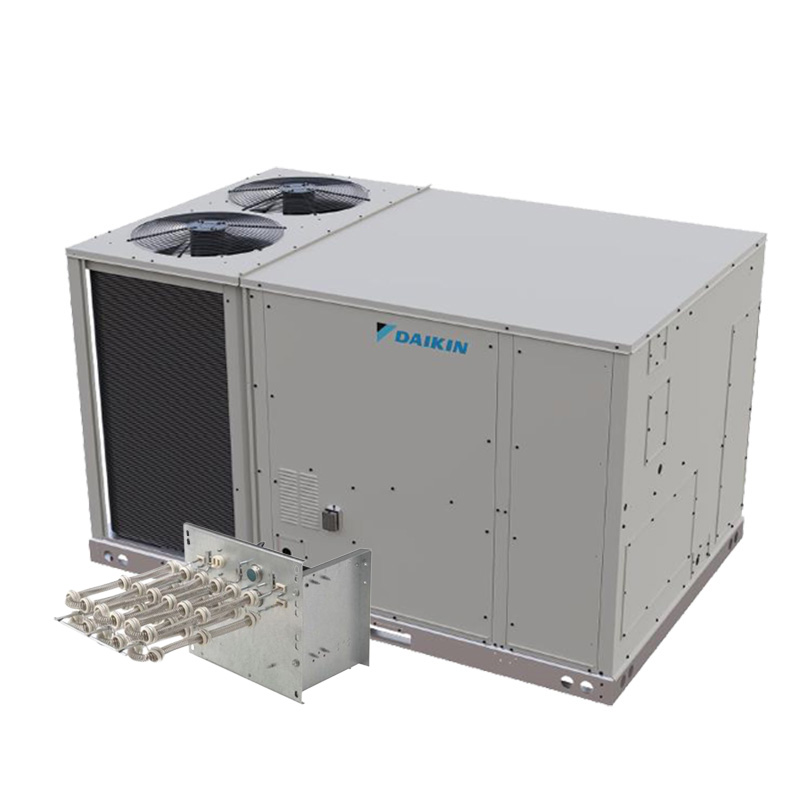
Daikin 12.5 Ton Commercial Package Unit AC With Electric Heat – 15.2 IEER, 460/3/60, Two Stage, R32
View on AC Direct see your lowest price →Check current price on AC Direct →
Key features
- 12.5-ton cooling capacity for medium commercial applications
- 15.2 IEER two-stage efficiency on 460/3/60 three-phase power
- R-32 refrigerant with lower global warming potential than R-410A
- Two-stage compressor reduces part-load energy use and wear
- Self-contained package design simplifies rooftop or ground-mount installation
- Electric heat strips eliminate need for gas service at the unit
About this system
The Daikin 12.5-ton commercial package unit is a self-contained rooftop or ground-mount system designed for medium-sized commercial spaces such as retail stores, light industrial facilities, restaurants, and small office buildings. With everything housed in a single cabinet, including the compressor, condenser, and air handler, it eliminates the need for a separate indoor unit and simplifies the mechanical room footprint. The 460/3/60 electrical configuration means it runs on three-phase power at 460 volts, which is standard for commercial construction but requires a proper three-phase service, so this unit has no place in a typical residential setting.
The two-stage compressor operation is a meaningful advantage in commercial applications. On mild days the system runs at its lower stage, reducing energy consumption, wear on mechanical components, and noise levels. Only when demand peaks does it shift to full capacity. The 15.2 IEER (Integrated Energy Efficiency Ratio) rating reflects solid part-load efficiency for a commercial package unit in this class, a metric more relevant to commercial buyers than residential SEER2. R-32 refrigerant has a lower global warming potential than R-410A and is increasingly the direction the industry is heading, though technicians will need EPA 608 certification and familiarity with R-32 handling procedures. Daikin, as the world’s largest HVAC manufacturer, has deep engineering investment in R-32 systems given its wide use in their global lineup.
Electric heat strips rather than a gas heat exchanger keep the unit all-electric, making it a practical fit for buildings without natural gas service or facilities prioritizing simplified fuel management. The trade-off is higher operating costs in climates with cold winters compared to a gas-fired package unit. At 12.5 tons of cooling capacity this system is sized for roughly 10,000 to 15,000 square feet depending on building envelope, occupancy, and climate zone, and a proper Manual N commercial load calculation should always precede selection.
This Daikin commercial package unit offers a well-engineered, two-stage platform with competitive IEER efficiency and a forward-looking refrigerant choice, backed by the manufacturing depth of the world's largest HVAC brand. The premium price point and documented concerns around parts availability and electronic controls are real considerations for facilities managers who cannot tolerate extended downtime. For buyers with a capable commercial Daikin dealer nearby, it is a strong long-term investment; for those in markets with thin Daikin commercial service coverage, that calculus changes.
Overall score is the average of the five ratings above.
What we like
- Two-stage operation meaningfully reduces part-load energy costs in variable occupancy buildings
- 15.2 IEER is a competitive efficiency rating for commercial package units in this tonnage class
- R-32 refrigerant is lower GWP and positions the system well ahead of anticipated regulatory shifts
- Daikin's build quality and component longevity are consistently recognized by HVAC industry experts
- Self-contained package configuration reduces installation complexity versus split-system alternatives
Trade-offs
- Electronic control boards are the most frequently cited failure mode, and parts delays can extend downtime
- Three-phase 460V power requirement limits this strictly to commercial sites with appropriate electrical service
- Electric heat strips carry higher operating costs than gas heat in cold climates
- 12-year parts warranty requires registration within 60 days of installation or coverage reverts to a shorter term
What homeowners and pros say about Daikin
Among HVAC professionals who work on commercial equipment, Daikin’s package units earn consistent respect for build quality and component longevity, placing the brand alongside Carrier and Trane in conversations about which systems actually last in demanding commercial environments. Consumer Reports and industry experts place Daikin among the longer-lasting brands, and that reputation holds in the commercial rooftop segment. That said, the service side of ownership tells a more complicated story. On complaint-oriented review channels, Daikin scores around 1.4 out of 5 on PissedConsumer, with the volume of negative feedback centered on parts delays and warranty handling friction rather than the equipment failing in spectacular ways. For a facilities manager, the practical concern is downtime: when electronic control boards, the most frequently documented failure mode on Daikin commercial units, throw error codes or go unresponsive, how quickly can a replacement board be sourced? That answer depends heavily on your local distributor’s inventory.
The two specific failure modes that commercial buyers should budget for over a long service life are electronic controls and compressor health. Circuit board errors are the leading documented complaint, sometimes requiring full board replacement rather than a simple reset. Compressors in this tonnage class can lose capacity or fail outright, a risk present across all brands at this price point but worth factoring into a service agreement conversation at purchase. The R-32 refrigerant is broadly seen by technicians as a positive direction, though it adds a layer of training and handling requirements that not every local shop has fully absorbed yet. Buyers who lock in a commercial maintenance agreement with a certified Daikin dealer at install, and who register the unit within the mandatory 60-day window to secure the 12-year parts warranty, are in a significantly better position than those who treat service as something to figure out after the first breakdown.
Sources: PissedConsumer Daikin reviews, AHRI Directory of Certified Product Performance, U.S. DOE appliance and equipment efficiency standards, Daikin product specifications.
How it compares
| Brand | Comparable model | SEER2 | Stage | Price position |
|---|---|---|---|---|
| Daikin | 12.5-Ton Commercial Package Unit with Electric Heat, Two-Stage, R-32 | N/A (15.2 IEER) | Two-stage | Premium tier |
| Carrier | 48XC (12.5-ton commercial package, two-stage) | N/A (IEER comparable range) | Two-stage | Similar premium tier, widely available commercial service network |
| Trane | Voyager TC (12.5-ton commercial rooftop package) | N/A (IEER comparable range) | Two-stage | Similar to slightly higher premium, strong commercial parts and service coverage |
| Lennox | LGH/LCH Series (12.5-ton commercial package unit) | N/A (IEER comparable range) | Two-stage | Comparable premium pricing, narrower commercial dealer footprint than Carrier or Trane |
Competitor rows are comparable single-stage units at similar efficiency; price is relative position, not a quote.
Questions about this system
Does this unit require any special handling because it uses R-32 refrigerant?
Yes. R-32 is mildly flammable (A2L classification) and technicians need EPA 608 certification and should follow R-32 specific safety procedures including adequate ventilation during service. Most commercial HVAC contractors are becoming familiar with it, but confirm your service provider has R-32 experience before installation.
What happens to the warranty if I do not register within 60 days of installation?
Daikin's 12-year parts warranty is contingent on registration within 60 days of the installation date. Missing that window means the warranty defaults to a shorter base coverage period, so registration should be treated as a required step immediately after commissioning, not an afterthought.
Can this package unit be used in a single-phase commercial building?
No. This unit is rated 460/3/60, meaning it requires 460-volt, three-phase, 60-Hz power. Single-phase service cannot run this equipment, and attempting to do so would cause immediate damage. Verify your building's electrical service with your electrician before purchasing.
How does a 15.2 IEER compare to other commercial package units in this size range?
IEER measures weighted average efficiency across a range of part-load conditions, which is the realistic operating profile for most commercial buildings. A 15.2 IEER sits at the more efficient end of standard commercial package unit offerings in the 10-15 ton class, though premium variable-speed units can push higher. It is a meaningful step above baseline equipment.
What are the most common service issues reported for Daikin commercial package units?
The most documented issues are electronic control and circuit board faults, which can leave the unit throwing error codes or unresponsive, and compressor problems that can cause reduced or lost cooling. Parts availability and warranty claim handling are the most frequent complaints from service contractors, so having a stocked Daikin commercial distributor nearby is worth confirming before you buy.
Specifications
| Cooling capacity | 12.5 Ton |
| Refrigerant | R-32 |