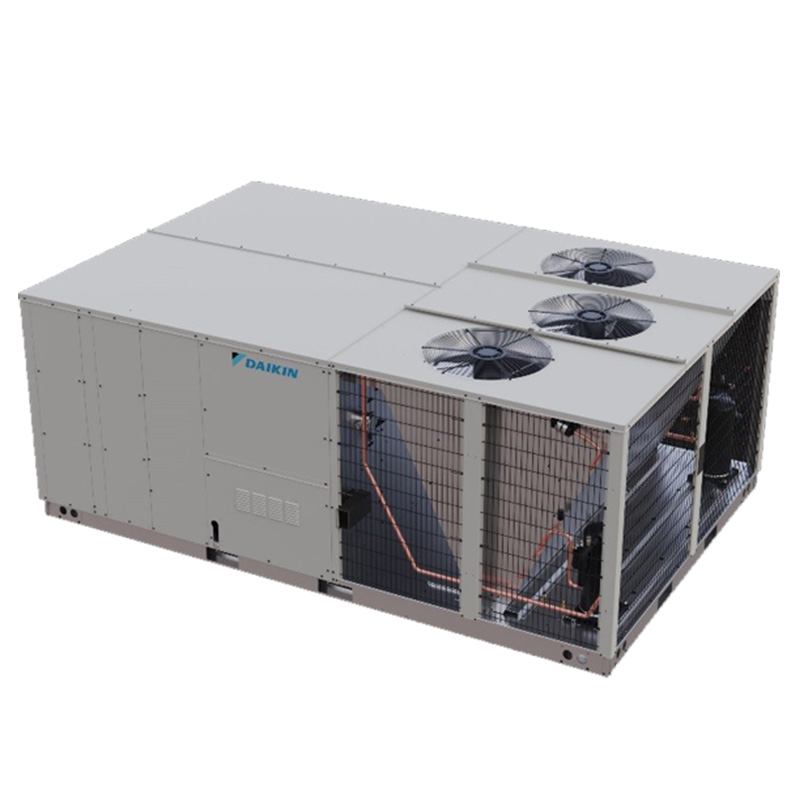
Daikin 15 Ton AC And 360000 BTU Gas/Electric Commercial Package Unit – 14 IEER, Two Stage, 81% AFUE, R32
View on AC Direct see your lowest price →Check current price on AC Direct →
Key features
- 15-ton (360,000 BTU) cooling capacity for large commercial spaces
- Two-stage operation for reduced short-cycling and better humidity control
- 14 IEER cooling efficiency rating
- 81% AFUE gas heating for combined gas/electric operation
- R-32 refrigerant with lower global warming potential than R-410A
- 12-year parts warranty with required registration within 60 days of installation
About this system
The Daikin 15-ton, 360,000 BTU gas/electric commercial package unit is built for large-footprint applications where a single rooftop or ground-mounted unit needs to handle significant heating and cooling loads simultaneously. Think mid-size retail spaces, multi-tenant office suites, warehouses with conditioned office areas, schools, or large restaurants. At 15 tons, this is not a residential unit in any sense; it requires licensed commercial HVAC contractors for installation, dedicated electrical service, and gas supply infrastructure. The two-stage operation is a meaningful real-world advantage: the unit runs at reduced capacity during moderate load conditions, reducing short-cycling, improving humidity control, and lowering operating costs compared to a single-stage unit of the same size.
The 81% AFUE gas heating rating deserves honest context. For a commercial package unit in this size class, 81% AFUE is standard-grade efficiency, not a high-efficiency headline. It meets code minimums in most commercial jurisdictions but falls well short of the 90%+ AFUE achievable with premium condensing equipment. On the cooling side, no SEER2 rating is published for this commercial-class unit, which is typical; commercial rooftop equipment is rated by IEER (Integrated Energy Efficiency Ratio), and this unit carries a 14 IEER rating, which is a respectable mid-tier figure for the tonnage class. R-32 refrigerant is a forward-looking choice with a lower global warming potential than the R-410A it replaces in many competing units, though technicians working on it will need proper R-32 handling certification and compatible equipment.
This Daikin commercial package unit delivers solid two-stage performance and a forward-looking refrigerant choice at a competitive price point for the 15-ton class, but the 81% AFUE heating efficiency is only baseline-adequate and Daikin's well-documented parts availability and service support issues are a real operational risk at this scale. Buyers who can lock in a qualified Daikin commercial service partner before installation will get a durable unit; those in markets with thin Daikin commercial support should factor in that risk carefully.
Overall score is the average of the five ratings above.
What we like
- Two-stage compressor meaningfully improves part-load efficiency and humidity management over single-stage competitors
- 14 IEER is a respectable efficiency rating in the 15-ton commercial package class
- R-32 refrigerant is a lower-GWP, future-oriented choice as regulations on older refrigerants tighten
- Daikin's build quality and component longevity are consistently rated among the best in class by HVAC professionals and durability-focused reviewers
- 12-year parts warranty provides long-term coverage if registration is completed on time
Trade-offs
- 81% AFUE heating is baseline efficiency only, not a high-efficiency rating, and operating costs will reflect that in colder climates
- Daikin's parts availability and warranty claim handling draw consistent complaints, a serious concern for commercial operations where downtime is costly
- Electronic control boards and circuit board errors are the most documented failure mode, and sourcing replacements quickly can be difficult
- R-32 servicing requires certified technicians with compatible recovery equipment, which may narrow your local service pool
What homeowners and pros say about Daikin
Among HVAC professionals who work on commercial package equipment, Daikin earns consistent respect for build quality and component longevity. The brand is routinely placed alongside Trane and Carrier by durability-focused reviewers and industry experts as a unit that, when properly maintained, tends to outlast many competitors. That reputation for long service life is a meaningful data point for commercial buyers calculating total cost of ownership over a 15-to-20-year equipment horizon. However, the professional community also surfaces a consistent concern: when something goes wrong, getting parts quickly and resolving warranty claims smoothly can be a frustrating process. Electronic control board failures are the most frequently cited breakdown type for Daikin commercial equipment, and contractors in markets without strong Daikin distributor presence report delays sourcing replacements. Compressor degradation and increasing operational noise over time are also documented failure patterns worth building a maintenance plan around.
On platforms like PissedConsumer, Daikin scores around 1.4 out of 5, though that channel skews sharply toward complaints and represents a small sample dominated by pricing and service dissatisfaction rather than equipment failure data. Consumer Reports and independent HVAC experts paint a more balanced picture, consistently ranking Daikin among the longer-lasting brands in the field. For a 15-ton commercial unit, the honest takeaway is that Daikin’s hardware tends to hold up, but the support infrastructure around it, specifically parts access, warranty processing, and service response, is where owners encounter friction. Buyers should treat pre-purchase service network vetting as seriously as they treat the equipment specs themselves.
Sources: PissedConsumer Daikin reviews, AHRI Directory of Certified Product Performance, U.S. DOE appliance and equipment efficiency standards, Daikin product specifications.
How it compares
| Brand | Comparable model | SEER2 | Stage | Price position |
|---|---|---|---|---|
| Daikin | 15-Ton Gas/Electric Commercial Package Unit, 14 IEER, Two-Stage, 81% AFUE, R-32 | N/A (14 IEER) | Two-stage | Value pick in the 15-ton commercial class |
| Carrier | WeatherMaster 50XC Series, 15-Ton Commercial Rooftop | N/A (IEER rated) | Two-stage | Typically priced higher than this Daikin unit, with stronger regional parts and service network |
| Trane | Precedent Series PKG, 15-Ton Commercial Package Unit | N/A (IEER rated) | Two-stage available | Generally priced at a premium over this Daikin, with broad parts distribution and dealer network |
| Lennox | LGH/LCH Series, 15-Ton Commercial Gas/Electric Package | N/A (IEER rated) | Two-stage available | Comparable to slightly above this Daikin unit depending on efficiency tier selected |
Competitor rows are comparable single-stage units at similar efficiency; price is relative position, not a quote.
Questions about this system
What does the 12-year parts warranty actually cover and what do I need to do to keep it valid?
The 12-year parts warranty covers manufacturer defects in components, but it requires product registration within 60 days of installation or it typically defaults to a shorter base warranty. Labor costs are not included, so budget for service call and labor fees separately. Given Daikin's documented complaints about warranty claim processing, keep all registration confirmation records and installation paperwork in an accessible file.
Do my technicians need special certification or equipment to service the R-32 refrigerant?
Yes. R-32 is an A2L mildly flammable refrigerant, and technicians need proper R-32 handling certification and recovery equipment specifically rated for A2L refrigerants. Standard R-410A equipment cannot be used. Before purchasing, confirm your service contractor is equipped and certified for R-32, since this will affect both maintenance costs and emergency service availability.
Is 81% AFUE going to be a problem for our heating bills in a cold climate?
In climates with significant heating seasons, yes, the efficiency gap matters. At 81% AFUE, roughly 19 cents of every dollar spent on gas exits as waste heat, compared to only about 10 cents with a 90% AFUE unit. For a 15-ton commercial unit running substantial heating hours, that difference accumulates meaningfully over a season. If heating load is a major operating cost driver for your facility, this unit's heating efficiency is a real trade-off worth pricing out before committing.
What are the most common failure points we should plan for with this unit?
Based on Daikin's documented failure modes at this class of equipment, electronic control boards and circuit board errors are the most frequent reported issue, sometimes causing the unit to become unresponsive or display error codes with no obvious cause. Compressor performance degradation over time and increasing noise on startup and shutdown are also reported. Stocking a spare control board or identifying a local distributor who carries them in inventory is a practical precaution for a commercial operation.
How does two-stage operation benefit a large commercial space compared to a single-stage 15-ton unit?
A single-stage 15-ton unit runs at full blast or not at all, which causes short-cycling during mild weather, poor humidity control, and greater wear on the compressor. Two-stage operation lets the unit run at a lower capacity during lighter load conditions, maintaining more consistent temperatures and better moisture removal without the energy and mechanical stress of constant full-capacity cycling. For a large commercial space with variable occupancy or weather, this translates to improved comfort and lower operating costs over the unit's life.
Specifications
| Cooling capacity | 15 Ton |
| Furnace output | 360000 BTU |
| Furnace efficiency | 81% AFUE |
| Refrigerant | R-32 |