Daikin 15 Ton Commercial Package Unit AC With Electric Heat – 14.2 IEER, 208-230/3/60, Two Stage, R32
View on AC Direct see your lowest price →Check current price on AC Direct →
Key features
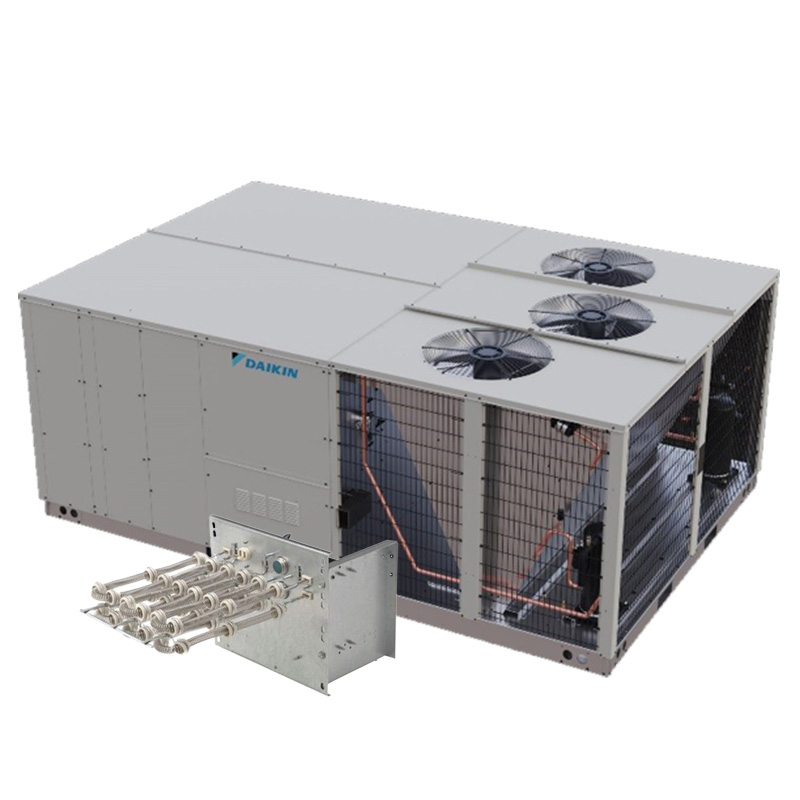
- 15-ton two-stage cooling capacity in a single packaged cabinet
- 14.2 IEER part-load efficiency rating for commercial operation
- R-32 refrigerant with lower global-warming potential than R-410A
- 208-230/3/60 three-phase power configuration for commercial electrical service
- Electric heat strips integrated, eliminating gas piping requirements
- Daikin commercial build quality with 12-year parts warranty (registration required)
About this system
The Daikin 15-ton commercial packaged unit with electric heat is built for mid-size commercial applications where a single rooftop or ground-mount cabinet needs to handle substantial cooling loads in one self-contained box. At 15 tons, this unit is sized for spaces roughly in the 6,000 to 9,000 square foot range depending on climate zone, building envelope, and internal heat load, making it a practical choice for retail stores, mid-size office suites, light industrial spaces, and multi-tenant strip center bays. The 208-230/3/60 electrical configuration means it requires a three-phase commercial power supply, which is standard in most commercial construction but rules out most residential and light single-phase applications entirely.
The 14.2 IEER (Integrated Energy Efficiency Ratio) rating reflects solid part-load efficiency for a commercial packaged unit in this size class. IEER is the commercial equivalent of SEER2 and weights efficiency across a range of operating conditions rather than just peak load, so a 14.2 score indicates real-world savings during the partial-load hours that make up the majority of a building’s operating year. Two-stage cooling adds to that story by allowing the unit to run at a lower capacity during mild conditions rather than cycling on and off at full tonnage, which reduces wear and holds space temperatures more steadily. R-32 refrigerant is a lower global-warming-potential alternative to the older R-410A that is now common in new commercial equipment, and it carries a favorable efficiency profile at the compressor level.
Electric heat in a packaged unit simplifies the mechanical room and eliminates gas piping and combustion venting requirements, which can reduce installation complexity in buildings without existing natural gas infrastructure. The trade-off is operating cost: electric resistance heat is significantly more expensive per BTU than gas in most utility markets, so this configuration is best suited to climates with mild heating seasons or buildings where the heating load is genuinely small relative to the cooling demand. Buyers in cold climates with heavy heating seasons should weigh gas or heat-pump alternatives carefully before committing to electric strip heat at this tonnage.
The Daikin 15-ton two-stage commercial packaged unit delivers competitive IEER efficiency and genuine two-stage part-load performance in a package that Daikin's long track record suggests will hold together well over time. The premium price is real, the three-phase requirement is non-negotiable, and prospective buyers should go in clear-eyed about the brand's documented parts availability and customer service friction. For buyers who can absorb the upfront cost and secure a qualified commercial HVAC contractor for ongoing support, this is a well-engineered unit in a reliable product class.
Overall score is the average of the five ratings above.
What we like
- 14.2 IEER is a competitive part-load efficiency figure for commercial packaged equipment at this tonnage
- Two-stage operation reduces short cycling, holds temperature more consistently, and lowers compressor wear versus single-stage
- R-32 refrigerant offers lower environmental impact and favorable thermodynamic properties
- Daikin's commercial build quality is consistently recognized by HVAC professionals for durability and longevity
- Self-contained packaged design simplifies rooftop or pad installation with a single refrigerant circuit and integrated heat
Trade-offs
- Premium price point sits above comparable commercial units from Carrier and Trane, which can be meaningful on a multi-unit project
- Electronic control board and circuit board errors are the most frequently documented failure mode, and replacement parts can be slow to source through Daikin's service network
- Electric resistance heat carries significantly higher operating cost per BTU than gas in most utility markets, limiting suitability for cold-climate applications
- 12-year parts warranty requires registration within 60 days of installation, and warranty claims processing has drawn consistent complaints from contractors
What homeowners and pros say about Daikin
Among HVAC professionals who have worked with Daikin commercial equipment, the consistent theme is that the hardware itself tends to hold up well over the long haul, a view that aligns with Consumer Reports and industry expert assessments placing Daikin among the longer-lasting brands in the commercial space. That reputation for durability is meaningful at 15 tons, where a unit that lasts 20 years instead of 14 represents real total-cost-of-ownership value even at a premium upfront price. At the same time, experienced commercial contractors are quick to flag the documented weak points: electronic control board and circuit board failures are the most commonly reported service issue, and when a board goes down the unit can become entirely unresponsive until the part arrives. Given Daikin’s parts availability and warranty handling complaints, contractors often advise keeping a spare control board on hand for critical facilities where downtime is expensive.
On review platforms like PissedConsumer, Daikin’s commercial and residential lines score around 1.4 out of 5, though that channel skews heavily toward frustrated customers rather than satisfied ones and covers a wide range of product lines and service situations. The compressor failure and noise complaints that appear in those reviews are consistent with what field technicians report: compressors that lose cooling capacity prematurely in some units, and rattling or humming that develops on start and stop cycles as equipment ages. The R-32 refrigerant in this specific unit is relatively new to the commercial packaged category, and some service technicians note that familiarity with R-32 handling requirements varies among commercial HVAC technicians depending on geography, making technician selection worth considering when planning a service contract for this unit.
Sources: PissedConsumer Daikin reviews, AHRI Directory of Certified Product Performance, U.S. DOE appliance and equipment efficiency standards, Daikin product specifications.
How it compares
| Brand | Comparable model | SEER2 | Stage | Price position |
|---|---|---|---|---|
| Daikin | 15-Ton Two-Stage Commercial Packaged Unit with Electric Heat, R-32 | N/A (14.2 IEER) | Two-stage | Premium tier |
| Carrier | 48XB / WeatherMaker Series 15-ton Commercial Package Unit | N/A (IEER varies by configuration) | Single-stage or two-stage depending on model | Comparable premium pricing, often slightly lower than Daikin at this tonnage |
| Trane | Precedent Series 15-ton Commercial Packaged Rooftop Unit | N/A (IEER varies by configuration) | Single-stage or two-stage depending on configuration | Comparable to Daikin, sometimes slightly higher on specific configurations |
| Lennox | LGH/LCH 15-ton Commercial Packaged Rooftop Unit | N/A (IEER varies by configuration) | Single-stage or two-stage depending on configuration | Generally positioned slightly below Daikin and Trane at this tonnage class |
Competitor rows are comparable single-stage units at similar efficiency; price is relative position, not a quote.
Questions about this system
Does this unit require three-phase power, and can it run on single-phase 240V?
Yes, the 208-230/3/60 rating is specific to three-phase commercial power and it cannot be run on single-phase residential or light commercial service. If your building only has single-phase power, you would need either a different unit or a phase converter, the latter of which adds cost and complexity and is generally not recommended by Daikin for this application.
What does 14.2 IEER actually mean in terms of energy savings for my building?
IEER measures efficiency across a weighted mix of part-load operating points rather than only at peak capacity, so a 14.2 rating reflects how the unit will actually perform during the many hours it runs below full load. In practical terms, the two-stage compressor is a major contributor here, since the unit can drop to lower capacity during mild weather and avoid the energy waste of repeated full-power cycling. The exact savings versus an older or lower-IEER unit will depend on your local utility rates, climate, and operating hours.
How important is it to register the unit within 60 days for the 12-year warranty?
Very important. Daikin's 12-year parts warranty coverage is contingent on registration within 60 days of installation, and missing that window typically drops coverage to a shorter base warranty period. Make sure your installing contractor confirms registration at the time of commissioning and provides you with documentation.
What are the most common service issues I should be prepared for with this unit?
Based on documented failure patterns in Daikin commercial equipment, electronic control board and circuit board errors are the most frequently reported problems, sometimes leaving the unit unresponsive or displaying persistent error codes. Compressor performance issues and increasing operational noise over time have also been reported. Parts sourcing through Daikin's commercial service network has drawn consistent complaints from contractors, so establishing a relationship with a well-stocked local commercial HVAC distributor before you need parts is a worthwhile step.
Is electric heat practical for a 15-ton commercial unit, or should I be looking at a gas-electric package?
Electric resistance heat is operationally straightforward and eliminates combustion venting and gas piping, but it costs significantly more per BTU to run than natural gas in most U.S. utility markets. If your building has meaningful heating loads across multiple months of the year, a gas-electric packaged unit will typically offer lower operating costs. Electric heat makes the most sense in climates where heating is occasional, where gas infrastructure is unavailable or costly to add, or where the cooling load heavily dominates the annual energy budget.
Specifications
| Cooling capacity | 15 Ton |
| Refrigerant | R-32 |