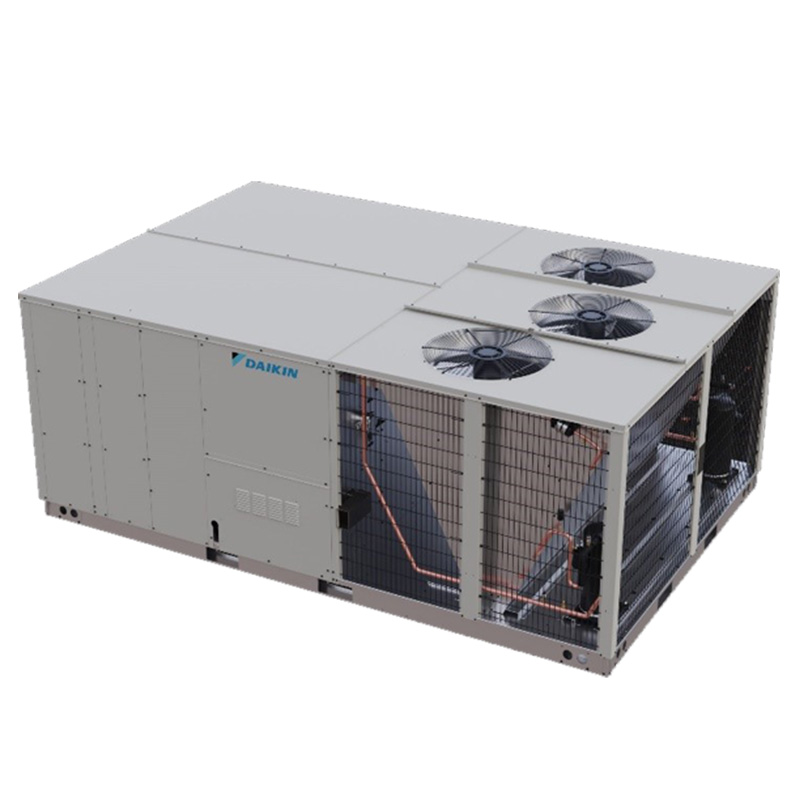
Daikin 20 Ton Commercial Package Unit AC Cooling Only – 14.2 IEER, 208-230/3/60, Two Stage, R32
View on AC Direct see your lowest price →Check current price on AC Direct →
Key features
- 20-ton cooling capacity on a single self-contained package platform
- Two-stage compressor reduces part-load energy use and runtime cycling
- 14.2 IEER mid-efficiency commercial rating
- R-32 refrigerant with lower global warming potential than R-410A
- 208-230V / 3-phase / 60Hz electrical configuration (commercial only)
- 12-year parts warranty available with registration within 60 days of install
About this system
The Daikin 20-ton commercial package unit is a self-contained rooftop or ground-mount cooling system designed for medium to large commercial buildings: multi-tenant retail strips, light industrial facilities, small office campuses, or any space where a single ducted system needs to carry a substantial cooling load. At 20 tons, this unit is squarely in commercial territory and is typically specified by mechanical engineers or commercial contractors rather than residential HVAC installers. The two-stage compressor operation means the unit can run at a reduced capacity during moderate weather, cutting unnecessary energy consumption and wear during the bulk of the cooling season rather than cycling on and off at full blast every time the thermostat calls.
The 14.2 IEER (Integrated Energy Efficiency Ratio) rating is the commercial-equipment equivalent of SEER2, and at 14.2 it sits solidly in the mid-efficiency tier for commercial package units of this class. It is not a budget baseline unit, but it is also not at the very top of what the commercial market offers in variable-capacity or inverter-driven configurations. The R-32 refrigerant is a meaningful specification: R-32 has a lower global warming potential than the R-410A it is gradually replacing, and it operates at higher efficiency in warmer ambient conditions. Servicing technicians will need to be R-32 certified, which narrows the pool of available service providers in some markets. The 208-230/3/60 electrical requirement means three-phase power is mandatory, confirming this is strictly a commercial application.
The Daikin 20-ton commercial package unit is a well-built, mid-efficiency rooftop system that earns its place through durable construction and the genuine energy savings of two-stage operation, backed by Daikin's standing as the world's largest HVAC manufacturer. The 14.2 IEER is respectable but not class-leading, and buyers should go in with clear eyes about Daikin's documented service and parts-support weaknesses before committing at the premium price point this brand commands. For a buyer who can vet a qualified R-32-certified commercial contractor upfront, this unit represents a solid long-term asset; for a buyer who needs fast, inexpensive service on demand, those service complaints are a real consideration.
Overall score is the average of the five ratings above.
What we like
- Two-stage operation cuts part-load energy consumption and reduces mechanical stress versus single-stage cycling
- R-32 refrigerant is lower-GWP and performs efficiently at elevated ambient temperatures
- Daikin's build quality is consistently rated among the longest-lasting in the industry by HVAC professionals
- Self-contained package configuration simplifies rooftop installation and reduces refrigerant line complexity
- 12-year parts warranty is competitive for a commercial unit of this class when registered on time
Trade-offs
- Electronic control board failures and unexplained error codes are the most commonly reported service issue for Daikin commercial equipment
- Parts availability and warranty claims handling draw consistent complaints, which carries real cost risk on a 20-ton commercial system
- R-32 certification requirement limits the technician pool in some regions, potentially increasing service cost and wait times
- Premium brand pricing means upfront cost is higher than comparable-efficiency units from competing commercial lines
What homeowners and pros say about Daikin
Among HVAC professionals who work on commercial buildings, Daikin’s larger package units carry a reputation for solid mechanical construction that tends to hold up over time, which aligns with Consumer Reports and industry experts consistently placing Daikin among the longer-lasting brands. That durability reputation is a genuine selling point at the 20-ton commercial scale, where a system failure means shutting down a retail space or office building. However, the same professionals often flag the electronic control board as the weak link: fault codes and unresponsive controls are the most frequently cited technical complaint, and on a large commercial unit a board failure that cannot be resolved quickly has real business consequences. Compressor degradation and noise development over time are also documented issues, not widespread enough to call them endemic but common enough to factor into a service contract conversation.
On the owner and facilities-manager side, the feedback picture is shaped heavily by service experience rather than the hardware itself. The PissedConsumer rating of approximately 1.4 out of 5 reflects a complaint-heavy channel, but the recurring theme of slow parts availability and difficult warranty handling is consistent enough across sources to treat as a real operational risk on a premium-priced system. The 12-year parts warranty is a meaningful backstop if registration is completed on time, but buyers who have reported warranty disputes often point to registration or documentation gaps as the sticking point. For a 20-ton commercial unit where downtime is expensive, having a clear service agreement with a Daikin-certified commercial contractor before the unit goes on the roof is not optional; it is the thing that determines whether the durability advantage actually pays off in practice.
Sources: PissedConsumer Daikin reviews, AHRI Directory of Certified Product Performance, U.S. DOE appliance and equipment efficiency standards, Daikin product specifications.
How it compares
| Brand | Comparable model | SEER2 | Stage | Price position |
|---|---|---|---|---|
| Daikin | 20-Ton Commercial Package AC, Two-Stage, R-32 | N/A (14.2 IEER) | Two-stage | Premium tier |
| Carrier | WeatherMaster 50XC / 50XP Series (20-ton commercial package) | N/A (IEER comparable range) | Two-stage | Comparable to slightly below Daikin at this capacity |
| Trane | Precedent WCD/WCH Series (20-ton commercial package) | N/A (IEER comparable range) | Two-stage | Comparable to Daikin, premium commercial tier |
| Lennox | Landmark LGH/LCH Series (20-ton commercial package) | N/A (IEER comparable range) | Two-stage | Generally competitive with or slightly below Daikin and Trane at this size |
Competitor rows are comparable single-stage units at similar efficiency; price is relative position, not a quote.
Questions about this system
What does IEER mean and how does 14.2 compare to other commercial package units?
IEER stands for Integrated Energy Efficiency Ratio and is the standard efficiency metric for commercial unitary equipment, measuring performance across a weighted range of part-load conditions rather than just peak load. A 14.2 IEER is a solid mid-tier rating for a 20-ton commercial package unit, meaningfully better than minimum-efficiency baseline units (which often land in the 11 to 12 range) but below the best variable-capacity commercial systems that can reach 16 or higher. For most commercial applications the two-stage operation will provide noticeable energy savings over single-stage alternatives at a similar IEER.
Why does this unit require three-phase power, and what if my building only has single-phase service?
At 20 tons, the compressor and blower motor draw far more current than single-phase 208-230V service can practically deliver, so three-phase power is both a design and a code requirement for a unit this size. If your building does not currently have three-phase service, you would need to coordinate with your utility for a service upgrade, which can be a significant added cost and project timeline item. This is a critical infrastructure question to answer before specifying this unit.
Do I need a specially certified technician to service R-32 refrigerant?
Yes. R-32 is classified as an A2L refrigerant (mildly flammable), and most jurisdictions require technicians to have specific R-32 or A2L handling certification in addition to standard EPA Section 608 certification. In areas where R-32 adoption is still early, the pool of qualified service technicians may be smaller than for R-410A systems, so it is worth confirming local technician availability before purchase.
What is the most important thing to do immediately after installation to protect the warranty?
Daikin's 12-year parts warranty requires product registration within 60 days of installation. Missing that window drops coverage to the base unregistered warranty, which is substantially shorter. Make sure your installing contractor or you complete online registration promptly and keep the confirmation record, because warranty disputes over registration timing are among the service complaints documented against Daikin.
What are the most common failure points owners and technicians report on Daikin commercial package units?
The most frequently documented issues are electronic control board and circuit board errors that can leave the unit throwing fault codes or going unresponsive, along with compressor cooling loss or outright failure in some cases. Units have also been reported to develop rattling or humming noises on startup and shutdown as they age. Parts availability when something does fail is the other consistent complaint, with some owners describing long lead times for replacement components through Daikin's service network.
Specifications
| Cooling capacity | 20 Ton |
| Refrigerant | R-32 |