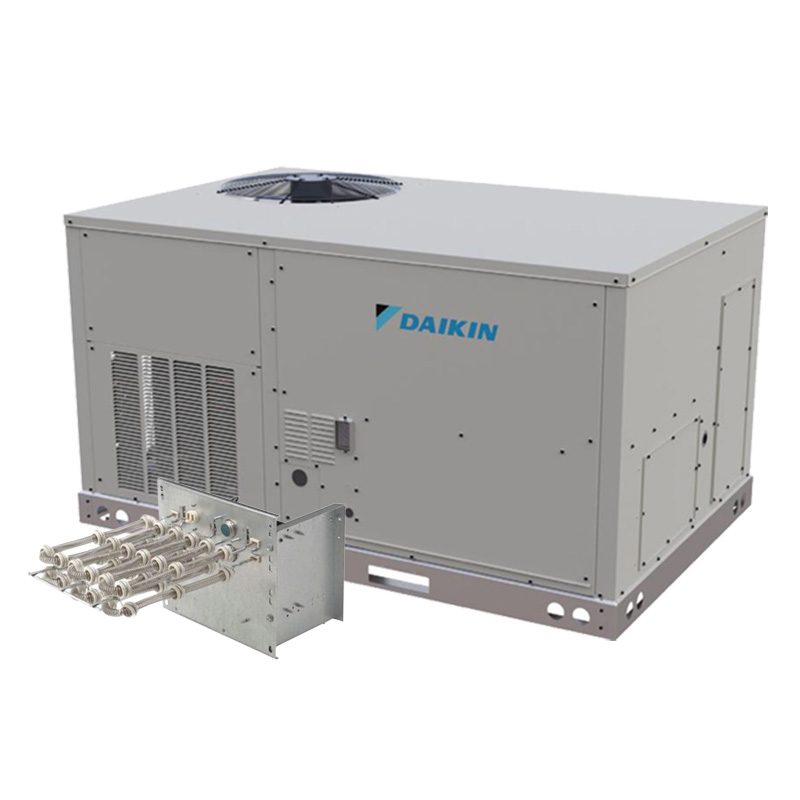
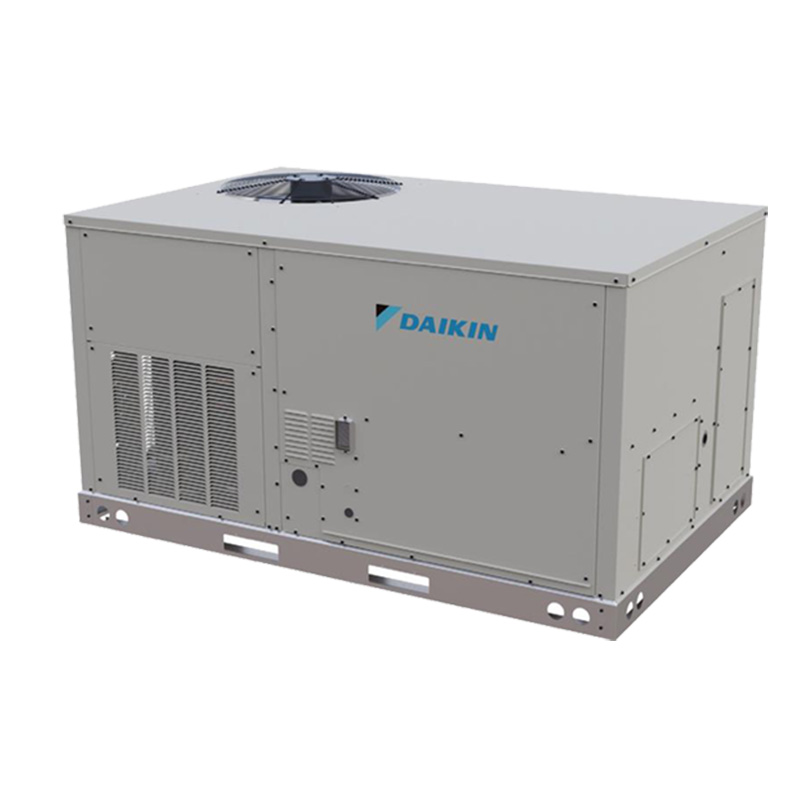
Daikin 3 Ton Commercial Package Unit Heat Pump AC – 14 SEER2, 208-230/3/60, Single Stage, R32
View on AC Direct see your lowest price →Check current price on AC Direct →
Key features
- 3-ton capacity in a self-contained commercial package unit configuration
- 14 SEER2 efficiency rating, meeting current federal minimum standards
- R-32 refrigerant with lower global warming potential than R-410A
- 208-230V / 3-phase / 60Hz power supply for commercial electrical service
- Single-stage compressor for straightforward operation and serviceability
- 12-year parts warranty available with registration within 60 days of installation
About this system
The Daikin 3-ton commercial package unit heat pump runs on 208-230V three-phase power at 14 SEER2, placing it at the entry tier of current federal efficiency minimums for commercial rooftop applications. It uses R-32 refrigerant, a lower global-warming-potential option that is becoming the industry standard and is easier to handle in smaller charge quantities than older R-410A systems. The single-stage compressor runs at full capacity whenever it is on, which makes sizing and installation straightforward but means the unit cycles on and off rather than modulating output to match a partially loaded space.
This unit is built for light commercial settings: small retail spaces, server closets, restaurants, office suites, or any application that requires three-phase power and a self-contained rooftop or ground-mounted package. Because the compressor, air handler, and controls are all in one cabinet, it simplifies the mechanical room footprint and avoids the refrigerant line set runs that split systems require. Single-stage operation at this tonnage is well matched to spaces with relatively steady cooling loads rather than highly variable occupancy patterns. Buyers who need finer comfort control or tighter humidity management in a variable-load environment should consider a two-stage or variable-capacity package unit instead.
This Daikin package unit delivers solid build quality and a well-regarded lifespan in a configuration that suits light commercial three-phase applications without complexity. At 14 SEER2 and single-stage operation it is efficient enough to meet code but not a standout on operating costs, and Daikin's documented parts-availability and service support issues are a real consideration for commercial buyers who cannot afford downtime. It earns its place for buyers who prioritize hardware durability over first-call service convenience.
Overall score is the average of the five ratings above.
What we like
- Daikin's manufacturing reputation supports above-average unit lifespan compared with many competing brands
- R-32 refrigerant reduces environmental impact and is increasingly well-supported by service technicians
- All-in-one package design eliminates refrigerant line sets and simplifies rooftop installation
- 12-year parts warranty is competitive for commercial equipment when registration is completed on time
- Three-phase electrical compatibility suits a wide range of commercial building services
Trade-offs
- Electronic control boards and circuit boards are the most frequently reported failure point, sometimes causing error codes or full unresponsiveness
- Parts availability and warranty claims processing draw consistent complaints, which can extend downtime in a commercial setting
- Single-stage operation offers no capacity modulation, which can lead to short cycling in lightly loaded spaces or humid climates
- 14 SEER2 is the efficiency floor for new equipment, meaning operating costs will be higher than units in the 16+ SEER2 range over a long service life
What homeowners and pros say about Daikin
Daikin’s reputation among HVAC professionals generally lands in a comfortable middle ground: the hardware is regarded as well-built and longer-lasting than many competitors, a position reinforced by Consumer Reports and independent HVAC experts who consistently place Daikin among the more durable brands for lifespan. On the commercial side, technicians familiar with the platform appreciate the straightforward refrigerant circuit and the move to R-32. That said, the service experience around warranty claims and parts sourcing is a real and recurring frustration. PissedConsumer aggregates Daikin reviews at roughly 1.4 out of 5, a score heavily weighted by billing disputes and wait times for parts rather than unit failures alone, but the volume of complaints around those specific issues is consistent enough to take seriously for a commercial buyer who cannot afford extended downtime.
For this specific three-phase package unit, the documented failure modes most worth tracking are electronic control board errors, which are the leading complaint and can leave a unit fully unresponsive until a board is sourced and replaced, and compressor degradation in older units showing as reduced cooling capacity. Units also develop noise over time, with rattling or humming on start and stop cycles noted by owners. None of these are unique to Daikin in the commercial space, but the parts availability complaint is a legitimate differentiator compared with brands like Carrier or Trane that maintain deeper domestic parts networks. Buyers with a strong local Daikin distributor relationship will have a much better experience than those relying on general HVAC supply channels.
Sources: PissedConsumer Daikin reviews, AHRI Directory of Certified Product Performance, U.S. DOE appliance and equipment efficiency standards, Daikin product specifications.
What it costs to run
At 14 SEER2, cooling this 3-ton system for a typical 1200-hour cooling season at the U.S. average electricity rate of $0.17/kWh works out to roughly $525 per year in cooling, about $23 less per year than a minimum-efficiency 13.4 SEER2 unit of the same size. Your real cost depends on your climate and local rate.
Method: (36,000 BTU/hr ÷ 14 SEER2) × 1200 hours ÷ 1000 × $0.17/kWh. Rate source: U.S. EIA average; cooling hours: moderate-climate estimate.
How it compares
| Brand | Comparable model | SEER2 | Stage | Price position |
|---|---|---|---|---|
| Daikin | 3-Ton Commercial Package Heat Pump, 208-230/3/60 | 14 | Single-stage | Value pick |
| Carrier | 50XC Series Commercial Package Heat Pump | 14-15 | Single-stage | Comparable to slightly higher than Daikin; widely available through broad dealer network |
| Trane | Precedent Series Commercial Package Heat Pump | 14-15 | Single-stage | Typically priced at a modest premium over Daikin with strong national parts support |
| Lennox | LRP16HP Series Commercial Package Heat Pump | 14-16 | Single-stage | Priced similarly to Daikin at the base efficiency tier, with higher-efficiency models at a notable premium |
Competitor rows are comparable single-stage units at similar efficiency; price is relative position, not a quote.
Questions about this system
Does this unit require three-phase power, and can I use it on single-phase service?
Yes, this unit is rated 208-230V/3/60, meaning it requires a three-phase electrical supply. It cannot be run on standard single-phase residential or light commercial service without a phase converter, which is generally not recommended for HVAC compressors and would likely void the warranty.
What does the 12-year parts warranty actually cover, and what do I need to do to get it?
Daikin's 12-year parts warranty covers the original purchaser on parts for the duration, but it requires product registration within 60 days of installation. Missing that window typically drops coverage to a shorter base warranty period. Labor is not included, and warranty service complaints around parts availability and processing times are among the most common issues reported by Daikin owners.
Is R-32 refrigerant readily available and safe for service technicians?
R-32 is increasingly available through HVAC distributors and is handled with standard EPA Section 608 certification. It is mildly flammable (A2L classification), so technicians working on it should follow updated safe-handling practices, but it is not considered high-risk in the field. Availability is improving quickly as the industry transitions away from R-410A.
What are the most common things that go wrong with this type of Daikin unit?
Across documented owner and technician feedback, electronic control board failures are the most reported issue, sometimes leaving the unit throwing error codes or failing to start. Compressor performance loss over time and increasing noise on startup and shutdown are also noted. Parts sourcing and warranty handling are the most consistent service frustrations for commercial owners.
Will a single-stage unit at this tonnage handle a space that has variable occupancy or load?
A single-stage compressor runs at full output whenever it is on, so in a space where the cooling load varies significantly throughout the day it will cycle on and off more frequently rather than modulating down. This can reduce dehumidification efficiency and increase wear. For spaces with highly variable loads, a two-stage or variable-capacity package unit would be a better long-term fit.
Specifications
| Cooling capacity | 3 Ton |
| Efficiency | 14 SEER2 |
| Refrigerant | R-32 |