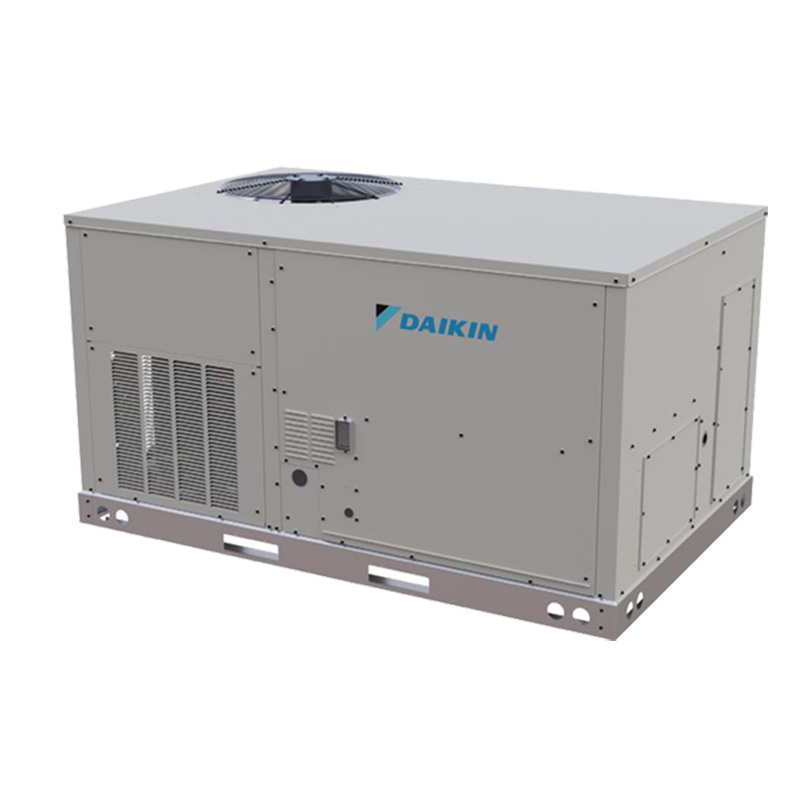
Daikin 4 Ton Commercial Package Unit AC Cooling Only – 13.7 SEER2, 208-230/1/60, Single Stage, R32
View on AC Direct see your lowest price →Check current price on AC Direct →
Key features
- 4-ton cooling capacity in a single self-contained package cabinet
- 13.7 SEER2 efficiency rating meeting current federal minimums for commercial equipment
- R-32 refrigerant with lower global-warming potential than legacy R-410A
- Single-stage compressor operation for consistent full-load cooling output
- 208-230V / 1-phase / 60Hz electrical configuration for commercial service compatibility
- 12-year parts warranty available with registration within 60 days of installation
About this system
The Daikin 4-Ton Commercial Package Unit is a self-contained cooling-only system built for light commercial and larger residential applications where all mechanical components need to sit in a single outdoor cabinet. Running on 208-230V single-phase power and using R-32 refrigerant, this unit delivers 13.7 SEER2 efficiency in a single-stage configuration, meaning the compressor runs at full capacity whenever it is on. That straightforward operation keeps the mechanical design simpler than two-stage or variable-speed alternatives, which can be an advantage in high-demand commercial settings where consistent full-load cooling is the norm.
R-32 is a lower global-warming-potential refrigerant that is increasingly common in newer equipment, and technicians in most markets are now well equipped to handle it. The 4-ton capacity targets spaces in roughly the 1,800 to 2,400 square foot range under typical commercial load conditions, though actual sizing depends on building envelope, occupancy, and local climate. At 13.7 SEER2, this unit meets current federal minimum efficiency standards for commercial package equipment but sits toward the lower end of the efficiency spectrum compared to two-stage or variable-capacity alternatives. Buyers prioritizing low upfront cost and simple serviceability over long-term energy savings will find this configuration practical.
This Daikin package unit offers the build durability the brand is known for in a straightforward single-stage commercial cooling configuration, but 13.7 SEER2 is entry-level efficiency and the single-stage operation means higher operating costs compared to staged or variable alternatives. It is a workable choice for buyers who prioritize mechanical simplicity and Daikin's long-term build quality over energy efficiency or responsive customer service.
Overall score is the average of the five ratings above.
What we like
- Daikin's reputation for robust construction and above-average equipment lifespan, consistently noted by HVAC experts and Consumer Reports
- R-32 refrigerant is environmentally preferable to R-410A and increasingly well supported by service technicians
- All-in-one package cabinet simplifies rooftop or ground-level installation with a single refrigerant circuit and no line set runs
- Single-stage design means fewer variable-speed components that can fail or require specialized diagnostics
- 12-year parts warranty is competitive for the commercial package segment when registration is completed on time
Trade-offs
- 13.7 SEER2 is at the low end of current efficiency offerings, which translates to higher monthly operating costs versus higher-SEER2 alternatives over the equipment's lifespan
- Single-stage operation provides no modulation, so the unit cycles fully on and off rather than matching partial loads, reducing comfort and humidity control compared to staged units
- Daikin's parts availability and warranty claims handling draw consistent complaints, which can mean extended downtime in a commercial setting if a component fails
- Electronic control boards and circuit board errors are the most documented failure mode on Daikin commercial equipment, and sourcing replacement boards can be slow
What homeowners and pros say about Daikin
Among HVAC professionals who work regularly with Daikin commercial equipment, the brand earns consistent respect for build quality and longevity. Experts and Consumer Reports place Daikin among the longer-lasting brands in the industry, and that reputation carries into the commercial package segment. On installer forums and contractor review platforms, technicians frequently note that Daikin cabinets and coils hold up well over time compared to some competitors at similar price points. The R-32 refrigerant used in this unit is seen as a forward-looking choice, and most commercial technicians are comfortable servicing it.
The other side of that picture comes through clearly on complaint-weighted review channels. PissedConsumer shows Daikin sitting at approximately 1.4 out of 5, with reviews dominated by frustration over pricing, slow warranty claim resolution, and difficulty sourcing parts when something breaks. The specific failure modes that appear most often in documented complaints align with what technicians see in the field: electronic control board and circuit board errors that can strand a unit in a fault state, compressor performance degradation or outright failure in some units, and increasing noise over time including rattling and humming during startup and shutdown cycles. For a commercial application where downtime has real cost consequences, the parts and service support gap is the most serious practical concern a buyer should weigh before committing to this unit over brands with more responsive distribution networks.
Sources: PissedConsumer Daikin reviews, AHRI Directory of Certified Product Performance, U.S. DOE appliance and equipment efficiency standards, Daikin product specifications.
What it costs to run
At 13.7 SEER2, cooling this 4-ton system for a typical 1200-hour cooling season at the U.S. average electricity rate of $0.17/kWh works out to roughly $715 per year in cooling, about $16 less per year than a minimum-efficiency 13.4 SEER2 unit of the same size. Your real cost depends on your climate and local rate.
Method: (48,000 BTU/hr ÷ 13.7 SEER2) × 1200 hours ÷ 1000 × $0.17/kWh. Rate source: U.S. EIA average; cooling hours: moderate-climate estimate.
How it compares
| Brand | Comparable model | SEER2 | Stage | Price position |
|---|---|---|---|---|
| Daikin | 4-Ton Commercial Package Unit Cooling Only (this unit) | 13.7 | Single-stage | Value pick |
| Carrier | WeatherMaster 48XC Series (4-ton) | 14.0-15.0 | Single-stage / Two-stage options | Priced above this Daikin unit, with broader dealer network |
| Trane | Precedent XR Series (4-ton) | 14.0-15.2 | Single-stage | Typically priced at a premium over this unit, strong parts availability |
| Lennox | LRP16GE Series (4-ton) | 16.0+ | Single-stage | Priced higher than this unit, notable efficiency advantage over entry-tier options |
Competitor rows are comparable single-stage units at similar efficiency; price is relative position, not a quote.
Questions about this system
Does this unit work on a standard single-phase commercial service, or do I need three-phase power?
This unit is rated for 208-230V / 1-phase / 60Hz, so it works on standard single-phase commercial electrical service. If your building only has three-phase service available, this is not the correct unit and you would need a three-phase package unit instead.
What does the 12-year parts warranty actually cover, and what do I need to do to get it?
The 12-year parts warranty covers factory-installed components but requires registration with Daikin within 60 days of the installation date. Missing that window typically drops coverage to a shorter baseline warranty, so coordinating with your installer to complete registration promptly is important. Labor costs are not covered under the parts warranty, which is standard for commercial HVAC equipment.
Is R-32 refrigerant easy to find, and are most HVAC technicians certified to handle it?
R-32 availability has improved significantly as manufacturers have shifted away from R-410A, and most commercial HVAC technicians in larger markets now carry it or can source it quickly. It is mildly flammable, which requires technicians to follow updated handling procedures, but this is well understood in the trade at this point.
What are the most common problems reported with Daikin commercial package units like this one?
The most frequently documented issues across Daikin commercial equipment are electronic control board and circuit board errors that can leave the unit unresponsive or throwing fault codes, compressor failures resulting in loss of cooling, and units becoming noisier over time with rattling or humming at startup and shutdown. Parts availability and slow warranty service response are the most common complaints when repairs are needed.
How does single-stage cooling affect comfort and energy costs compared to a two-stage unit at this tonnage?
A single-stage unit runs at full capacity every time it cycles on, which means it tends to cool spaces quickly but then shut off, leading to more frequent on-off cycles during mild weather and less precise humidity control. A two-stage unit can run at lower capacity during partial-load conditions, which improves humidity removal and reduces energy consumption during shoulder seasons. Over several years of operation, the efficiency gap adds up to a real cost difference, particularly in humid climates.
Specifications
| Cooling capacity | 4 Ton |
| Efficiency | 13.7 SEER2 |
| Refrigerant | R-32 |