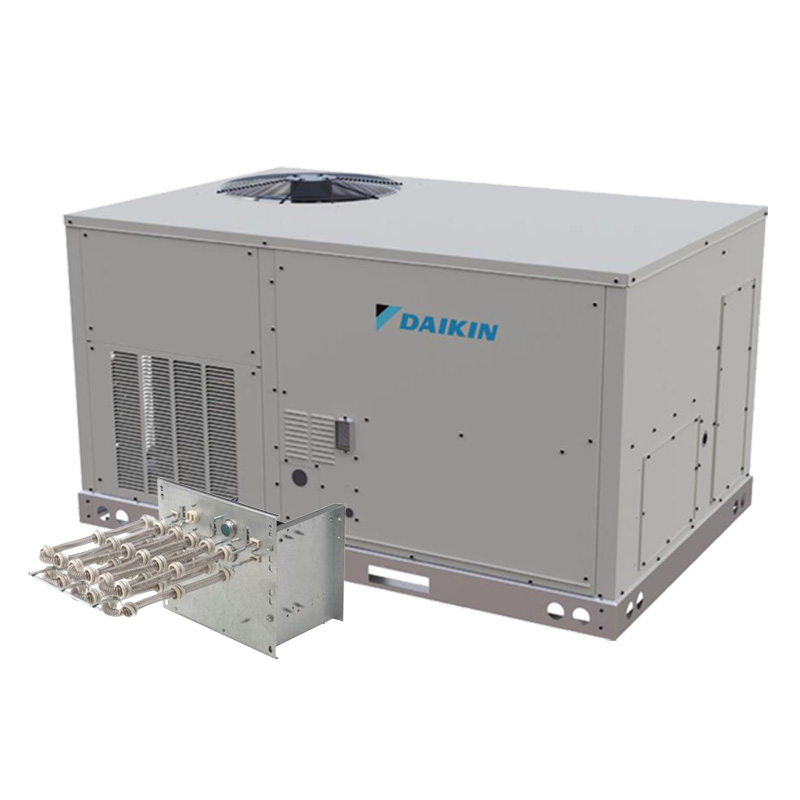
Daikin 4 Ton Commercial Package Unit AC With Electric Heat – 13.7 SEER2, 208-230/3/60, Single Stage, R32
View on AC Direct see your lowest price →Check current price on AC Direct →
Key features
- 4-ton cooling capacity, single-stage compressor, 13.7 SEER2 efficiency rating
- All-in-one package unit with integrated electric heat strips
- R-32 refrigerant with lower global-warming potential than R-410A
- Three-phase 208-230V/60Hz power for standard commercial electrical service
- 12-year parts warranty available with registration within 60 days of installation
- Daikin commercial build quality with corrosion-resistant cabinet construction
About this system
The Daikin 4-Ton Commercial Package Unit with electric heat is a self-contained rooftop or ground-level system that houses the compressor, condenser, evaporator coil, and electric heat strips all in a single cabinet. That all-in-one configuration makes it a practical fit for light commercial buildings, retail spaces, small offices, and warehouses where there is no room or budget for a split system with separate indoor and outdoor equipment. The three-phase 208-230V power requirement is standard in commercial construction, and R-32 refrigerant gives this unit a lower global-warming potential than the R-410A it replaces.
At 13.7 SEER2, this unit clears the current federal minimum for commercial package equipment but sits near the lower tier of available efficiency ratings. That means operating costs will be higher than a 15 or 16 SEER2 unit over a long service life, a real trade-off worth weighing against the lower upfront price. Single-stage operation keeps the mechanical design simple and the purchase price accessible, but the compressor runs at full capacity whenever it is on, which can cause more temperature swings and somewhat noisier cycling than a variable-capacity system would produce. For spaces that need straightforward, code-compliant cooling and backup heat without complex zoning, this system does the job.
This Daikin package unit is a solid, straightforward choice for light commercial applications where a simple single-stage system meets code and budget requirements. The 13.7 SEER2 rating is baseline-compliant rather than impressive, so buyers prioritizing long-term energy savings should look at higher-efficiency options. Daikin's reputation for durable hardware is a genuine asset here, but documented issues with electronic controls and parts support are real concerns for a commercial setting where downtime is costly.
Overall score is the average of the five ratings above.
What we like
- Single-cabinet design simplifies installation and reduces rooftop penetrations
- R-32 refrigerant reduces environmental impact compared to R-410A systems
- Three-phase operation aligns with standard commercial electrical infrastructure
- Daikin is consistently rated among longer-lasting HVAC brands by Consumer Reports and industry experts
- 12-year parts warranty provides meaningful long-term coverage when registered on time
Trade-offs
- 13.7 SEER2 is near the federal minimum, resulting in higher operating costs than mid- or high-efficiency alternatives
- Single-stage compressor cycles fully on and off, producing more temperature variation and noise than modulating units
- Electronic control board failures and error codes are the most documented complaint for Daikin commercial units
- Parts availability and warranty service draw consistent complaints, a serious risk in a commercial downtime scenario
What homeowners and pros say about Daikin
Among HVAC professionals who work with commercial equipment, Daikin earns respect for build quality and cabinet durability that holds up over years of rooftop exposure. Consumer Reports and industry reviewers consistently place Daikin among the longer-lasting brands, and that reputation is reflected in the premium pricing the company commands. However, the same pros who praise the hardware frequently flag two recurring pain points with Daikin commercial units: electronic control board failures that can leave a system throwing error codes with no obvious cause, and a parts and service network that does not always match the quality of the equipment itself. When a control board goes out on a busy weekday, waiting days for a Daikin-specific part is a real operational problem.
On consumer review platforms, the picture is more polarized. PissedConsumer rates Daikin at roughly 1.4 out of 5, but that channel skews heavily toward frustrated customers and captures only a small slice of the installed base, with most complaints centering on price disputes and service delays rather than catastrophic hardware failures. Compressor performance loss over time and increasing noise on cycling are the hardware complaints that do show up repeatedly. For a commercial buyer, the takeaway is that Daikin hardware tends to last, but building a relationship with a certified local dealer who stocks common control boards and knows Daikin’s diagnostic system is not optional. It is part of the cost of ownership.
Sources: PissedConsumer Daikin reviews, AHRI Directory of Certified Product Performance, U.S. DOE appliance and equipment efficiency standards, Daikin product specifications.
What it costs to run
At 13.7 SEER2, cooling this 4-ton system for a typical 1200-hour cooling season at the U.S. average electricity rate of $0.17/kWh works out to roughly $715 per year in cooling, about $16 less per year than a minimum-efficiency 13.4 SEER2 unit of the same size. Your real cost depends on your climate and local rate.
Method: (48,000 BTU/hr ÷ 13.7 SEER2) × 1200 hours ÷ 1000 × $0.17/kWh. Rate source: U.S. EIA average; cooling hours: moderate-climate estimate.
How it compares
| Brand | Comparable model | SEER2 | Stage | Price position |
|---|---|---|---|---|
| Daikin | 4-Ton Commercial Package Unit with Electric Heat (this unit) | 13.7 | Single-stage | Value pick |
| Carrier | WeatherMaster 50XC | 14.0-15.0 | Single-stage | Comparable to slightly higher than this unit |
| Trane | Precedent PKG Series | 14.0-15.5 | Single-stage | Typically higher than this unit |
| Lennox | LRP16 Commercial Packaged Rooftop | 16.0 | Single-stage | Premium over this unit |
Competitor rows are comparable single-stage units at similar efficiency; price is relative position, not a quote.
Questions about this system
Does this unit require a dedicated three-phase electrical service, and can it run on single-phase power with a converter?
Yes, this unit is rated for 208-230V/3-phase/60Hz and requires a true three-phase supply. Running it through a phase converter is not recommended by Daikin and can void the warranty, so confirm your building's electrical service before ordering.
What does the 12-year parts warranty actually cover, and what can void it?
The 12-year parts warranty covers the compressor and major components but requires product registration within 60 days of installation. Failure to register drops coverage to the base unregistered term. Labor is not included, and using uncertified refrigerant or non-authorized service can also void coverage.
How does R-32 refrigerant affect servicing compared to R-410A?
R-32 is mildly flammable, so technicians must be certified to handle it and need compatible recovery equipment. It is not a drop-in replacement for R-410A, meaning any future refrigerant work requires a tech with R-32 experience, which is becoming more common but is still less universal than R-410A service.
What are the most common failure points to watch for on this type of Daikin commercial unit?
The most documented issues on Daikin commercial package equipment are electronic control board errors that can leave the unit unresponsive or displaying fault codes, along with compressor performance loss over time. Units can also develop rattling or humming noise on startup and shutdown as they age.
Is 13.7 SEER2 still compliant with current federal efficiency standards for commercial package units?
Yes, 13.7 SEER2 meets current federal minimums for commercial package equipment, but it is not far above the threshold. If your local utility offers rebates for higher-efficiency equipment or if the unit will run heavily during peak hours, stepping up to a 15 or 16 SEER2 model may pay back the cost difference within a few years.
Specifications
| Cooling capacity | 4 Ton |
| Efficiency | 13.7 SEER2 |
| Refrigerant | R-32 |