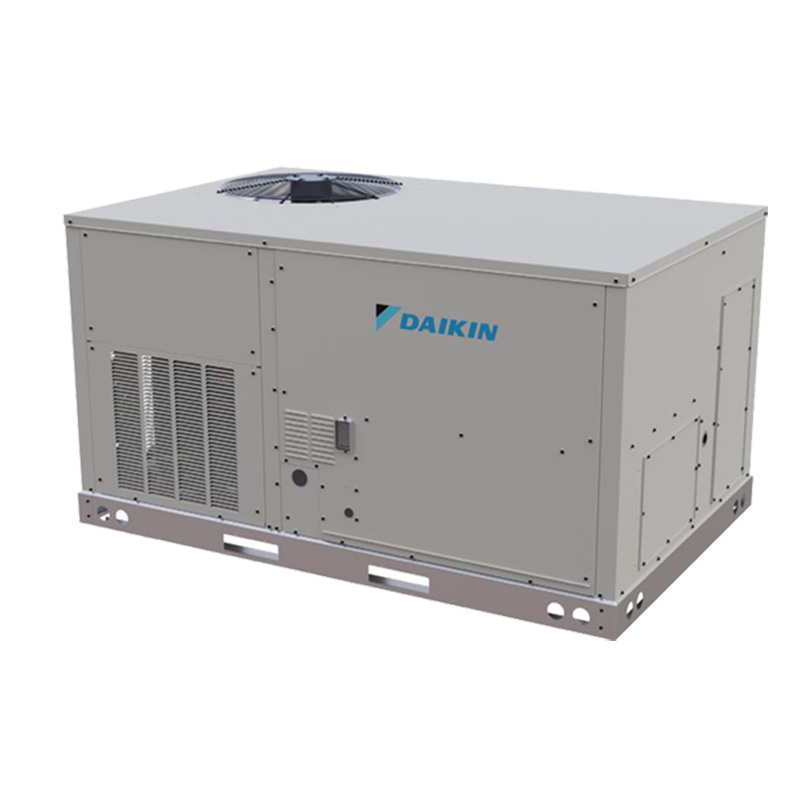
Daikin 5 Ton Commercial Package Unit AC Cooling Only – 13.7 SEER2, 208-230/3/60, Single Stage, R32
View on AC Direct see your lowest price →Check current price on AC Direct →
Key features
- 5-ton cooling-only package unit rated at 13.7 SEER2
- R-32 refrigerant with lower global warming potential than R-410A
- Three-phase 208-230V/60Hz electrical supply for commercial applications
- Single-stage scroll compressor for straightforward operation and service
- Self-contained rooftop or ground-mount configuration with factory-charged refrigerant circuit
- 12-year parts warranty available with registration within 60 days of installation
About this system
The Daikin 5-Ton Commercial Package Unit is a self-contained cooling-only rooftop or ground-mounted system built for light commercial applications: small office buildings, retail spaces, restaurants, and similar structures that need a single, consolidated unit rather than a split-system installation. At 5 tons of cooling capacity, it handles roughly 2,000 to 2,500 square feet of conditioned space depending on insulation, ceiling height, and internal heat load. The 208-230V/3-phase/60Hz electrical configuration is strictly commercial territory, requiring a three-phase power supply that most residential properties simply do not have.
The 13.7 SEER2 rating sits at the federal minimum threshold for commercial packaged equipment, meaning it meets code but does not deliver standout efficiency savings. Running costs will be moderate to high compared to higher-SEER2 alternatives. The switch to R-32 refrigerant is a genuine forward-looking spec: R-32 has a much lower global warming potential than the R-410A it replaces, and it is becoming the commercial standard. Single-stage operation means the compressor runs at full capacity whenever it cycles on, which is straightforward to maintain but less efficient during mild-load conditions than a variable-speed or two-stage alternative. Buyers who prioritize simplicity and proven technology over operating efficiency will find that trade-off acceptable; those with high annual run hours should model the long-term energy cost difference carefully.
This Daikin package unit delivers a dependable, code-compliant cooling solution backed by a manufacturer with a strong durability track record, but the baseline 13.7 SEER2 efficiency and single-stage operation mean it is built for simplicity and longevity rather than low operating costs. Buyers should budget carefully for parts support, since Daikin's service network and warranty fulfillment draw consistent complaints that can turn a minor repair into a lengthy wait.
Overall score is the average of the five ratings above.
What we like
- Daikin's build quality and component longevity are consistently rated among the best in the industry by HVAC professionals
- Factory-charged R-32 circuit simplifies installation and positions the unit for current and near-future refrigerant regulations
- Self-contained package design eliminates the need for a separate air handler, reducing installation footprint and leak points
- 12-year parts warranty is above average for commercial equipment when registration is completed on time
- Three-phase single-stage scroll compressor is a mature, well-understood design that most commercial HVAC technicians can service
Trade-offs
- 13.7 SEER2 is the regulatory floor for this class, so operating costs will be higher than two-stage or variable-speed alternatives over a long run-hour schedule
- Electronic control boards and circuit boards are the most documented failure point, sometimes leaving the unit unresponsive until a board is sourced
- Parts availability and warranty claim handling are a recurring complaint, meaning downtime during a repair can stretch longer than the repair itself warrants
- Premium Daikin pricing means the upfront cost is higher than several competitors offering comparable or better efficiency at this tonnage
What homeowners and pros say about Daikin
Among HVAC professionals, Daikin’s commercial package units are generally respected for build durability and component quality, consistent with Consumer Reports and industry expert rankings that place Daikin among the longer-lasting brands. Contractors who have installed multiple Daikin units over the years often note that the physical construction holds up well in rooftop environments where UV exposure, vibration, and weather cycling degrade lesser equipment faster. That professional confidence is real and earned over time. The documented concerns, however, center on electronic control and circuit board reliability: technicians report units that throw error codes or go unresponsive, and tracking down replacement boards through Daikin’s parts distribution network can take longer than the job should require. Compressor performance degradation and increasing mechanical noise on startup and shutdown are also noted as the units accumulate years of service.
On the owner and end-user side, Daikin’s PissedConsumer rating of roughly 1.4 out of 5 is worth acknowledging even though that platform skews heavily toward complainants. The recurring themes are price shock on parts and frustration with warranty claim processing, not unit performance itself during normal operation. For a commercial buyer, the practical takeaway is to treat parts logistics as part of the total cost of ownership: establish a relationship with a local Daikin commercial distributor before a breakdown, not after. The R-32 refrigerant specification and the 12-year parts warranty (contingent on timely registration) are legitimate strengths that distinguish this unit from some competitors at the same efficiency tier, but neither advantage fully offsets the service-support complaints that follow the brand consistently.
Sources: PissedConsumer Daikin reviews, AHRI Directory of Certified Product Performance, U.S. DOE appliance and equipment efficiency standards, Daikin product specifications.
What it costs to run
At 13.7 SEER2, cooling this 5-ton system for a typical 1200-hour cooling season at the U.S. average electricity rate of $0.17/kWh works out to roughly $893 per year in cooling, about $20 less per year than a minimum-efficiency 13.4 SEER2 unit of the same size. Your real cost depends on your climate and local rate.
Method: (60,000 BTU/hr ÷ 13.7 SEER2) × 1200 hours ÷ 1000 × $0.17/kWh. Rate source: U.S. EIA average; cooling hours: moderate-climate estimate.
How it compares
| Brand | Comparable model | SEER2 | Stage | Price position |
|---|---|---|---|---|
| Daikin | 5-Ton Cooling-Only Commercial Package Unit (13.7 SEER2, R-32) | 13.7 | Single-stage | Value pick |
| Carrier | WeatherMaster 50XC Series (5-Ton Commercial Package) | 14.0-14.5 | Single-stage | Comparable to slightly higher than Daikin |
| Trane | Precedent WSC Series (5-Ton Commercial Package) | 14.0 | Single-stage | Comparable to slightly higher than Daikin |
| Lennox | LRP16 Commercial Package Series (5-Ton) | 16.0 | Two-stage | Noticeably higher than Daikin at this efficiency tier |
Competitor rows are comparable single-stage units at similar efficiency; price is relative position, not a quote.
Questions about this system
Does this unit require three-phase power, and can I run it on single-phase 240V?
Yes, the 208-230/3/60 specification means three-phase power is required. It cannot be run on a standard single-phase residential or light commercial service without significant electrical infrastructure changes. Confirm your building's power supply with an electrician before purchasing.
What does the 60-day registration requirement mean for the 12-year parts warranty?
Daikin requires the unit to be registered with them within 60 days of the installation date to unlock the 12-year parts warranty. If registration is missed, the warranty typically falls back to a shorter baseline period. Make sure your installing contractor completes this step or confirm it yourself shortly after commissioning.
How does R-32 refrigerant affect service and future maintenance costs?
R-32 is mildly flammable (A2L classification), so technicians need specific training and equipment to handle it safely. It is widely available and increasingly stocked by commercial HVAC suppliers, and its lower global warming potential aligns with current EPA direction, reducing regulatory risk over the unit's lifespan. Most commercial contractors in larger markets are already equipped for it.
What are the most common repair issues owners should watch for on this type of Daikin unit?
Electronic control boards and circuit board errors are the most frequently reported problem, sometimes displaying fault codes or leaving the system unresponsive. Compressor cooling loss and noise development over time, including rattling or humming on startup and shutdown, are also documented. Stocking a spare control board or establishing a parts relationship with a Daikin distributor before a failure occurs can reduce downtime significantly.
Is 13.7 SEER2 good enough for a commercial cooling-only package unit, or should I consider a higher-efficiency option?
13.7 SEER2 meets current federal minimum efficiency standards for this equipment class, so it is code-compliant everywhere in the U.S. Whether it is 'good enough' depends on your annual run hours and energy costs. Facilities running the unit heavily, say 2,000 or more hours per year, should price out 14-plus SEER2 alternatives and model the energy savings against the price difference, since the payback period can be shorter than it first appears.
Specifications
| Cooling capacity | 5 Ton |
| Efficiency | 13.7 SEER2 |
| Refrigerant | R-32 |