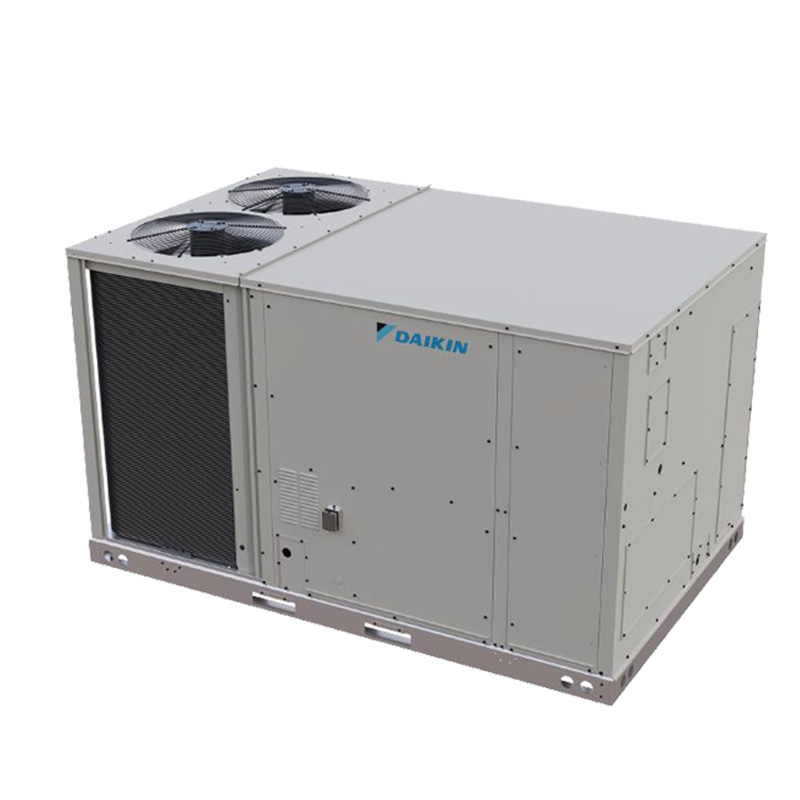
Daikin 7.5 Ton Commercial Package Unit AC Cooling Only – 16 IEER, 208-230/3/60, Two Stage, R32
View on AC Direct see your lowest price →Check current price on AC Direct →
Key features
- 7.5-ton cooling-only output in a single self-contained package unit cabinet
- Two-stage compressor for part-load efficiency and reduced temperature swing
- 16 IEER efficiency rating, a solid tier for light commercial rooftop equipment
- R-32 refrigerant with lower global warming potential than R-410A
- 208-230/3/60 three-phase electrical supply requirement
- 12-year parts warranty available with registration within 60 days of installation
About this system
The Daikin 7.5-ton commercial package unit is a self-contained, rooftop-ready cooling-only system built for light commercial applications: small office buildings, retail spaces, restaurants, and similar structures that need serious cooling capacity in a single cabinet. At 7.5 tons, you are covering roughly 2,500 to 3,500 square feet of well-insulated commercial space, though real-world sizing depends on building envelope, occupancy, and local climate. The 208-230/3/60 electrical configuration means this unit runs on three-phase power, which is standard in commercial construction but must be confirmed at the service panel before purchase.
The two-stage compressor operation is a meaningful practical feature at this capacity. Rather than cycling fully on and off, the unit can run at a reduced stage during moderate load conditions, which smooths temperature swings, reduces short-cycling wear, and can meaningfully cut operating costs during shoulder seasons. The 16 IEER (Integrated Energy Efficiency Ratio) rating is the commercial-equipment equivalent of SEER2 for packaged rooftop units and represents a solid mid-to-upper efficiency tier for this class of equipment. R-32 refrigerant has a substantially lower global warming potential than R-410A, which positions this unit ahead of tightening regulatory requirements and simplifies future serviceability as R-410A supply tightens.
Daikin manufactures this class of equipment to commercial-grade tolerances with a well-documented track record for long operational life when properly maintained. That said, this is premium-priced equipment, and buyers should budget not just for the unit but for professional three-phase electrical verification, crane or lift access for rooftop placement, and the real costs of parts sourcing if a circuit board or compressor issue arises mid-lease.
The Daikin 7.5-ton commercial package unit offers genuinely good build quality, a competitive efficiency rating for its class, and the credibility of the world's largest HVAC manufacturer behind it. The trade-offs are real: premium pricing, three-phase electrical requirements that add installation complexity, and a documented pattern of circuit board issues and difficult parts sourcing that can make repairs slower and costlier than they should be. This is a strong long-term investment for buyers who can absorb higher upfront costs and have reliable commercial service partners in their area.
Overall score is the average of the five ratings above.
What we like
- Two-stage operation reduces energy consumption during part-load conditions typical in commercial spaces
- 16 IEER is a competitive efficiency rating for this equipment class and capacity
- R-32 refrigerant reduces environmental impact and future-proofs against tightening refrigerant regulations
- Daikin's build quality is consistently recognized by industry experts for above-average lifespan
- 12-year parts warranty provides meaningful long-term cost protection when registration is completed on time
Trade-offs
- Premium price point sits above several competing commercial packaged units with comparable IEER ratings
- Electronic control boards and circuit board errors are the most commonly documented failure mode, sometimes leaving the unit unresponsive
- Parts availability and warranty claim handling draw consistent complaints, which is a real risk in a commercial downtime scenario
- Three-phase power requirement means this unit is not suitable for most residential or small commercial sites without existing three-phase service
What homeowners and pros say about Daikin
Among HVAC professionals who work regularly on commercial rooftop equipment, Daikin units in this class are generally respected for their build quality and longevity. Industry reviewers and Consumer Reports consistently place Daikin among the longer-lasting brands, and that reputation holds at the commercial package level where the two-stage platform has a track record of meaningful runtime without catastrophic failure under regular maintenance. That said, the specific failure modes that come up repeatedly in field reports are worth knowing: electronic control board and circuit board errors are the leading complaint, sometimes leaving a unit in a lockout state with no clear diagnostic path until a technician with Daikin-specific training arrives. Compressor performance degradation and outright compressor failures are also documented, particularly on units past the ten-year mark or in high-cycle applications.
On consumer review channels like PissedConsumer, Daikin scores approximately 1.4 out of 5, though that platform is heavily weighted toward frustrated owners rather than satisfied ones, and a large share of those complaints center on pricing disputes and warranty claim processing rather than equipment failure alone. The most operationally relevant complaint for a commercial buyer is parts lead time: when a circuit board fails on a Friday in August, the difference between a one-day and a two-week repair window is a real business cost. Buyers are strongly advised to confirm that their commercial HVAC contractor carries or can rapidly source Daikin commercial controls inventory, and to complete the 60-day warranty registration without delay to protect the 12-year parts coverage.
Sources: PissedConsumer Daikin reviews, AHRI Directory of Certified Product Performance, U.S. DOE appliance and equipment efficiency standards, Daikin product specifications.
How it compares
| Brand | Comparable model | SEER2 | Stage | Price position |
|---|---|---|---|---|
| Daikin | 7.5-Ton Commercial Package Unit, Two-Stage, R-32 | N/A (16 IEER) | Two-stage | Value pick |
| Carrier | WeatherMaster 50XC Series (7.5 Ton) | N/A (15-16 IEER range) | Two-stage | Comparable to slightly above Daikin depending on distributor |
| Trane | Precedent Series (7.5 Ton) | N/A (15-16 IEER range) | Single-stage or two-stage depending on configuration | Comparable to Daikin, with strong regional parts availability often cited as an advantage |
| Lennox | Landmark Series (7.5 Ton) | N/A (15-16 IEER range) | Two-stage | Generally priced at or above Daikin at this capacity tier |
Competitor rows are comparable single-stage units at similar efficiency; price is relative position, not a quote.
Questions about this system
Does this unit work on single-phase power, or do I need three-phase service at my building?
This specific model is rated 208-230/3/60, which means it requires three-phase electrical service. Single-phase power will not run it. Confirm your panel configuration with a licensed electrician before purchasing, as upgrading from single-phase to three-phase service is a significant additional cost if it is not already in place.
What does the 12-year parts warranty actually cover, and what do I need to do to activate it?
Daikin's 12-year parts warranty covers the replacement cost of covered components but requires product registration within 60 days of the installation date. Without registration, coverage typically defaults to a shorter base warranty period. The warranty covers parts, not labor, so factor in service call and labor costs when evaluating total repair expense.
How does two-stage operation translate to real energy savings in a commercial building?
Two-stage compressors run at a lower capacity during mild weather or low-occupancy periods rather than cycling fully on and off, which reduces electricity consumption and mechanical wear during part-load hours. In commercial applications where the building is not always at peak heat load, this can produce meaningful savings on cooling-season utility bills compared to a single-stage unit of the same tonnage.
What are the most common repair issues reported on Daikin commercial package units?
The most frequently documented failure modes are electronic control board errors, which can leave the unit unresponsive or throwing fault codes, and compressor issues including reduced cooling capacity or outright failure over time. Units can also become noisier with age, including rattling or humming at startup and shutdown. Parts availability and warranty service response are the most consistent service complaints, which is worth considering when choosing a local commercial HVAC service contractor.
Is R-32 refrigerant safe and easy for technicians to work with, and will it be available long-term?
R-32 is an A2L refrigerant, which means it is mildly flammable and requires technicians with specific handling training and equipment. Most commercial HVAC contractors in larger markets are already equipped for it, but confirm this with your service provider before installation. R-32 has a much lower global warming potential than R-410A and is not subject to the same phase-down pressure, so availability and pricing should remain stable or improve as the industry transitions away from R-410A.
Specifications
| Cooling capacity | 7.5 Ton |
| Refrigerant | R-32 |