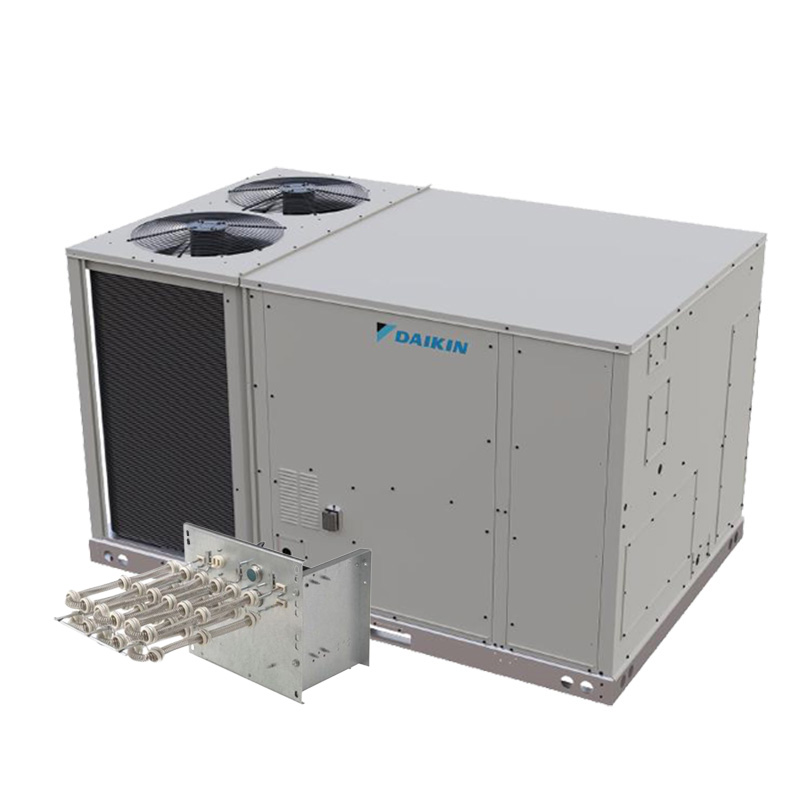
Daikin 7.5 Ton Commercial Package Unit AC With Electric Heat – 16 IEER, 460/3/60, Two Stage, R32
View on AC Direct see your lowest price →Check current price on AC Direct →
Key features
- 7.5-ton two-stage cooling with 16 IEER efficiency rating
- R-32 refrigerant: lower global warming potential than R-410A
- 460V/3-phase/60Hz commercial electrical configuration
- Built-in electric heat strips for single-cabinet, single-fuel operation
- Self-contained package design simplifies rooftop or pad installation
- 12-year parts warranty available with registration within 60 days of install
About this system
The Daikin 7.5-ton commercial package unit combines air conditioning and electric heat into a single rooftop or ground-level cabinet, making it a practical choice for mid-size commercial spaces such as retail shops, small office buildings, warehouses with office sections, and light-use facilities in the 3,000 to 5,000 square foot range. Running on 460V/3-phase/60Hz power, it is designed strictly for commercial electrical infrastructure, so residential or single-phase applications are off the table. The R-32 refrigerant charge is a forward-looking choice: R-32 has roughly one-third the global warming potential of the R-410A it replaces and generally achieves slightly better heat transfer efficiency.
The two-stage compressor is the most operationally significant spec here. Rather than cycling fully on and off, the unit runs at a reduced capacity stage during moderate loads and steps up only when conditions demand it. That translates to steadier interior temperatures, lower peak demand charges on commercial electric bills, and reduced wear versus a single-stage unit hammering the same compressor. The 16 IEER (Integrated Energy Efficiency Ratio) rating is the commercial equivalent of SEER2 and represents a solid efficiency tier for a packaged unit of this class, though it is not the ceiling of what the category offers. Buyers should confirm local utility rebate eligibility, as 16 IEER frequently qualifies.
Electric heat strips are built in, which simplifies installation by eliminating a gas line and heat exchanger, but operating costs for electric resistance heat are substantially higher than gas or heat pump alternatives in most climates. This unit suits mild-winter regions or buildings where heating loads are light and simplicity of a single-fuel system outweighs the efficiency penalty of strip heat.
The Daikin 7.5-ton commercial package unit is a well-built, forward-thinking option for mid-size commercial cooling with its R-32 refrigerant and two-stage operation, and Daikin's reputation for long equipment life is a genuine asset in this class. The trade-offs are real, though: the premium purchase price, documented difficulties with parts availability and warranty service, and the high operating cost of electric strip heat need honest consideration before signing off on a purchase.
Overall score is the average of the five ratings above.
What we like
- Two-stage operation reduces temperature swings and lowers peak demand draw compared to single-stage units
- R-32 refrigerant is lower GWP and generally more efficient than R-410A, positioning the unit well ahead of pending refrigerant regulations
- Daikin is consistently rated among the longer-lasting commercial HVAC brands by industry experts and Consumer Reports
- 16 IEER is a competitive efficiency level that frequently qualifies for utility rebates in commercial programs
- Self-contained package configuration reduces installation complexity versus split systems requiring line sets and matched components
Trade-offs
- Electric resistance heat carries significantly higher operating costs than gas or heat pump alternatives in most climates
- Daikin parts availability and warranty claim handling draw consistent complaints, which can mean extended downtime when something fails
- Electronic control boards and circuit boards are the most documented failure mode, and replacements can be slow to source
- Premium purchase price sits at the higher end of the commercial package unit market, requiring a longer payback horizon
What homeowners and pros say about Daikin
Among HVAC professionals who work on commercial rooftop equipment, Daikin occupies a respected but complicated position. The build quality and longevity story is real: industry experts and Consumer Reports consistently place Daikin among the longer-lasting commercial HVAC brands, and contractors who have serviced older Daikin equipment frequently note its durability. The move to R-32 refrigerant is also seen positively by forward-thinking installers preparing for tightening refrigerant regulations. That said, the same contractors will caution buyers about the parts ecosystem. Documented failure modes on Daikin commercial units include electronic control board and circuit board faults that can leave a system throwing error codes with no clear path to a quick fix, compressor issues that develop over time, and units that grow noisier with age. When those failures hit, the parts sourcing and warranty processing experience is where Daikin’s reputation takes a hit.
On the consumer and end-user side, the picture is polarized in a way that mirrors the ratings gap between platforms. PissedConsumer scores Daikin at roughly 1.4 out of 5, a number heavily weighted by price and service frustrations rather than equipment failure alone. Owners who have had smooth installations and no major repairs tend not to file reviews, which skews complaint-heavy platforms sharply negative. What does come through consistently across both professional and owner accounts is that Daikin’s equipment can run a long time when installed correctly and maintained properly, but the support infrastructure around warranty claims and parts supply does not always match the quality of the hardware itself. For a 7.5-ton commercial unit, building in a service agreement with a contractor who stocks common Daikin boards and components is a practical way to offset that documented weak point.
Sources: PissedConsumer Daikin reviews, AHRI Directory of Certified Product Performance, U.S. DOE appliance and equipment efficiency standards, Daikin product specifications.
How it compares
| Brand | Comparable model | SEER2 | Stage | Price position |
|---|---|---|---|---|
| Daikin | 7.5-Ton Commercial Package Unit, Two-Stage, R-32, 16 IEER | N/A (16 IEER commercial rating) | Two-stage | Premium tier |
| Carrier | 48XC Commercial Package Unit | N/A (IEER-rated commercial) | Single-stage | Comparable to slightly below Daikin at similar efficiency |
| Trane | Precedent WCD/WCH Commercial Package Unit | N/A (IEER-rated commercial) | Single-stage or two-stage depending on configuration | Comparable premium pricing to Daikin; strong service network typically included in total cost |
| Lennox | LGH/LCH Commercial Package Unit | N/A (IEER-rated commercial) | Single-stage | Generally slightly below Daikin at this tonnage; broader single-stage lineup |
Competitor rows are comparable single-stage units at similar efficiency; price is relative position, not a quote.
Questions about this system
Does this unit require three-phase power, or can it be adapted for single-phase service?
This unit is rated 460V/3-phase/60Hz and cannot be adapted for single-phase service. Your building must have a three-phase commercial electrical service already in place before installation. Confirm this with your electrician before purchasing.
What does the 12-year parts warranty actually cover, and what do I need to do to get it?
Daikin's 12-year parts warranty covers the replacement cost of covered components but does not include labor. You must register the unit within 60 days of installation to activate it; unregistered units typically fall back to a shorter base warranty period. Given documented complaints about Daikin's warranty claim handling, keep your registration confirmation and all installation documentation on file.
Why does this package unit use electric heat instead of gas, and is that a problem?
Electric heat strips are simpler and less expensive to install because they require no gas piping, flue, or heat exchanger. The trade-off is that electric resistance heating is significantly less efficient than gas or heat pump alternatives, which can substantially increase winter energy bills in colder climates. This configuration is best suited to mild-winter regions or facilities where heating is occasional rather than the primary seasonal load.
What are the most common things that go wrong with Daikin commercial package units?
Based on documented service patterns, the most frequent issues are electronic control board and circuit board faults, which can cause error codes or leave the system unresponsive. Compressor failures and gradual loss of cooling capacity have also been reported, along with increasing noise such as rattling or humming during startup and shutdown cycles. Parts availability and slow warranty processing are the most commonly cited service frustrations when repairs are needed.
Is 16 IEER a good efficiency rating for a 7.5-ton commercial package unit, and does it qualify for rebates?
16 IEER is a solid mid-to-upper efficiency level for this class of commercial package unit and exceeds the federal minimum standards for this tonnage range, which typically makes it eligible for utility rebate programs. However, it is not the highest IEER available in the category, so buyers in states with aggressive energy codes or utilities offering large rebates for higher-efficiency equipment should compare the cost premium of stepping up before committing.
Specifications
| Cooling capacity | 7.5 Ton |
| Refrigerant | R-32 |