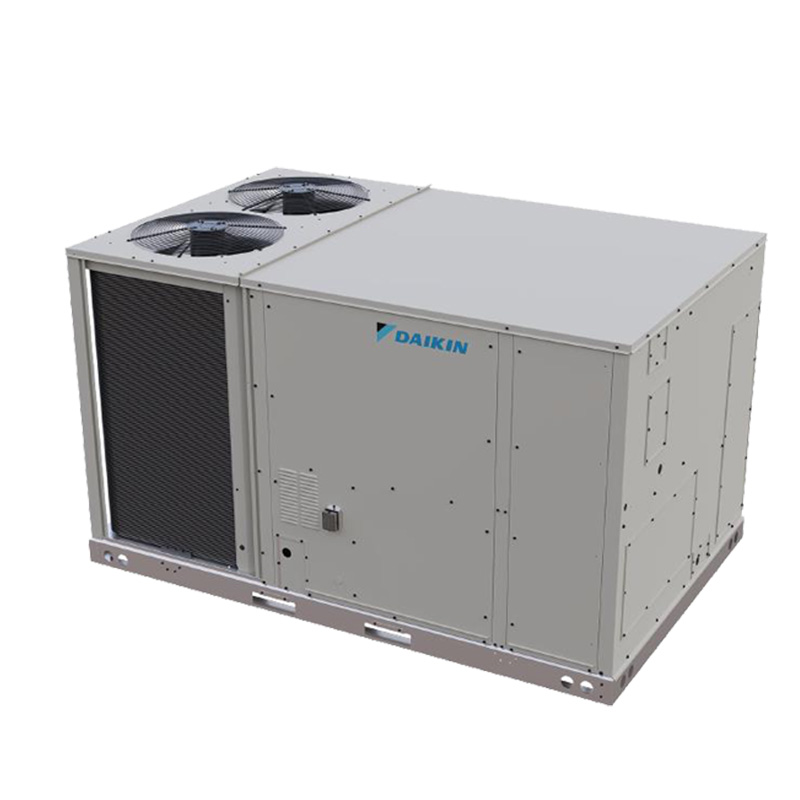
Daikin 8.5 Ton AC And 225000 BTU Gas/Electric Commercial Package Unit – 14.8 SEER2, Two Stage, 81% AFUE, R32
View on AC Direct see your lowest price →Check current price on AC Direct →
Key features
- 8.5-ton two-stage cooling at 14.8 SEER2 for reduced short-cycling and steadier comfort
- 225,000 BTU gas heat section at 81% AFUE in a single rooftop-ready cabinet
- R-32 refrigerant with lower global warming potential than R-410A
- Factory-assembled package configuration eliminates field refrigerant line sets
- Two-stage compression reduces energy use during partial-load conditions
- 12-year parts warranty available with registration within 60 days of installation
About this system
The Daikin 8.5-ton commercial rooftop package unit combines a 225,000 BTU gas heating section rated at 81% AFUE with a 14.8 SEER2 two-stage cooling system, all in a single self-contained cabinet designed to drop onto a rooftop curb or slab. At 8.5 tons, this unit is sized for larger commercial spaces such as small retail stores, restaurants, medical offices, or light industrial facilities in the 3,000 to 5,000 square foot range, depending on local climate and building envelope. R-32 refrigerant replaces older R-410A blends with a lower global warming potential, and Daikin has been among the earlier large manufacturers to adopt it across commercial lines.
The two-stage compressor is the operational centerpiece here. Rather than running at full capacity every cycle, it steps down to a lower stage during moderate load conditions, which reduces short-cycling, steadies indoor temperatures, and keeps the 14.8 SEER2 efficiency figure achievable in real-world conditions rather than just on a lab sheet. The 81% AFUE gas heat section is functional but not exceptional by current standards; it meets code in most jurisdictions but sits well below the 90%-plus condensing furnace tier. Buyers primarily heating large commercial spaces should factor that efficiency gap into annual operating cost projections. As a package unit, all refrigerant, heat exchanger, and electrical components ship as a factory-assembled assembly, which simplifies installation to ductwork connections, gas piping, and electrical hookup rather than a split-system line set charge.
This Daikin commercial packaged unit delivers solid mid-tier efficiency and the build quality Daikin is known for in a straightforward rooftop configuration, making it a credible choice for commercial buyers who want longevity over the lowest upfront price. The 81% AFUE heating section and 14.8 SEER2 cooling are competitive but not best-in-class, and Daikin's documented parts availability and customer service issues are a real operational risk for a commercial building owner who cannot afford extended downtime. Buyers should weigh those service trade-offs seriously before committing.
Overall score is the average of the five ratings above.
What we like
- Two-stage cooling improves real-world efficiency and comfort compared to single-stage commercial units
- R-32 refrigerant is lower-impact and positions the unit well ahead of future regulatory shifts
- Daikin's build quality and component durability are consistently rated among the best in the industry by HVAC professionals
- Package unit configuration reduces installation complexity and potential refrigerant leak points versus split systems
- 12-year parts warranty is competitive for the commercial segment when registered on time
Trade-offs
- 81% AFUE heating is below the 90%-plus threshold of high-efficiency commercial units, resulting in meaningfully higher gas bills in colder climates
- Daikin's parts availability and warranty claim handling draw consistent complaints, which is a significant concern for commercial operators facing downtime
- Electronic control board and circuit board failures are the most commonly documented failure mode, potentially causing full system shutdowns
- Premium brand pricing means higher upfront cost than comparable-efficiency units from some competitors, without a proportional service support advantage
What homeowners and pros say about Daikin
Among HVAC professionals who install commercial rooftop equipment, Daikin’s build quality is generally respected. Technicians familiar with the brand frequently cite durable heat exchangers and robust cabinet construction as genuine advantages over budget-tier commercial units. That said, the same installers are quick to flag Daikin’s parts supply chain as a real operational risk, a complaint that shows up repeatedly in professional forums and is consistent with the brand’s low 1.4 out of 5 score on PissedConsumer, a channel that skews toward negative experiences but reflects a clear pattern of price and service frustration rather than a random statistical noise. Consumer Reports and independent HVAC evaluators, by contrast, place Daikin among the longer-lasting brands for durability and lifespan, suggesting the equipment itself holds up but the support experience is inconsistent.
For commercial operators specifically, the failure modes most worth tracking are electronic control board errors, which are the most documented complaint and can result in the entire system going unresponsive or locking into error code cycles until a board is sourced and replaced. Compressor performance degradation over time and increasing operational noise, including rattling and humming on startup and shutdown, are also noted in real-world commercial service records. Given that parts sourcing is the most common service complaint for this brand, commercial buyers are best served by confirming in advance that their local Daikin commercial distributor stocks control boards and compressor components for this unit size, rather than discovering lead times after a summer breakdown.
Sources: PissedConsumer Daikin reviews, AHRI Directory of Certified Product Performance, U.S. DOE appliance and equipment efficiency standards, Daikin product specifications.
What it costs to run
At 14.8 SEER2, cooling this 8.5-ton system for a typical 1200-hour cooling season at the U.S. average electricity rate of $0.17/kWh works out to roughly $1406 per year in cooling, about $147 less per year than a minimum-efficiency 13.4 SEER2 unit of the same size. Your real cost depends on your climate and local rate.
Method: (102,000 BTU/hr ÷ 14.8 SEER2) × 1200 hours ÷ 1000 × $0.17/kWh. Rate source: U.S. EIA average; cooling hours: moderate-climate estimate.
How it compares
| Brand | Comparable model | SEER2 | Stage | Price position |
|---|---|---|---|---|
| Daikin | DPS Series 8.5-Ton Gas/Electric Package Unit | 14.8 | Two-stage | Value pick |
| Carrier | 48XC Series Commercial Rooftop | 15.0-16.0 | Two-stage | Comparable to slightly higher than this Daikin unit |
| Trane | YCD Series Commercial Packaged Rooftop | 14.5-15.5 | Two-stage | Comparable to slightly higher than this Daikin unit |
| Lennox | LGH/LCH Series Commercial Package Unit | 15.0-16.0 | Two-stage | Typically higher than this Daikin unit at similar tonnage |
Competitor rows are comparable single-stage units at similar efficiency; price is relative position, not a quote.
Questions about this system
What size building will an 8.5-ton commercial package unit typically cover?
A rough rule of thumb for commercial spaces is 400 to 600 square feet per ton, which puts this unit in the range of roughly 3,400 to 5,100 square feet. However, actual sizing depends heavily on ceiling height, insulation, window area, internal heat loads, and climate zone, so a Manual J or equivalent commercial load calculation is required before selecting this or any unit.
Is 81% AFUE acceptable for a commercial gas heating application?
81% AFUE meets minimum efficiency requirements in most U.S. jurisdictions for commercial package units and is typical for rooftop gas-electric systems in this class. It is not high-efficiency by modern standards, meaning roughly 19 cents of every gas dollar is lost as exhaust. For buildings with high heating loads or in colder climate zones, the long-term fuel cost difference versus a 90%-plus unit can be substantial.
What does the 12-year parts warranty actually cover, and are there conditions?
Daikin's 12-year parts warranty covers factory-supplied components but requires product registration within 60 days of the installation date. Missing that window typically drops coverage to a shorter base warranty. The warranty covers parts costs but not labor, refrigerant, or diagnostic fees, so a service contract covering those costs is worth budgeting separately.
How difficult is it to find technicians certified to work on R-32 refrigerant?
R-32 requires EPA 608 certification, which most commercial HVAC technicians already hold. However, R-32 is mildly flammable (A2L classification), so technicians need to follow specific handling protocols and some older service equipment may need updating. In most metro areas this is not a barrier, but in rural markets it is worth confirming your service contractor is comfortable with A2L refrigerants before purchase.
What are the most common failure points to watch for on Daikin commercial packaged units?
Daikin's documented failure modes in this product category include electronic control board and circuit board errors that can render the unit unresponsive or locked in error code mode, compressor issues that may show up as reduced cooling capacity or outright failure, and noise development over time including rattling or humming on start and stop cycles. Parts availability for Daikin commercial units has been a consistent service complaint, so establishing a relationship with a stocking commercial Daikin distributor before you need emergency parts is a practical precaution.
Specifications
| Cooling capacity | 8.5 Ton |
| Efficiency | 14.8 SEER2 |
| Furnace output | 225000 BTU |
| Furnace efficiency | 81% AFUE |
| Refrigerant | R-32 |