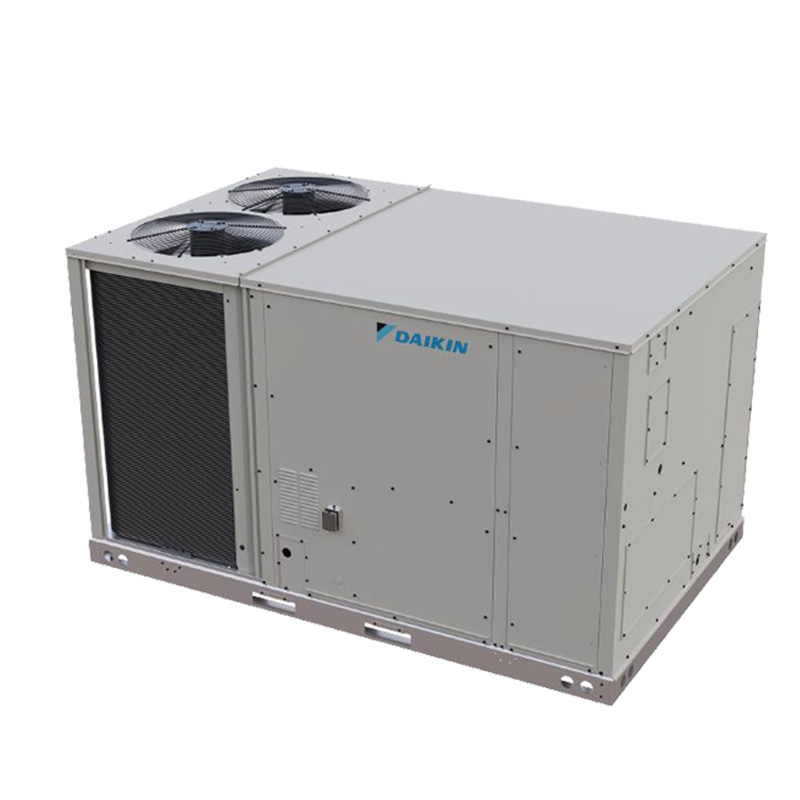
Daikin 8.5 Ton Commercial Package Unit AC Cooling Only – 15.5 IEER, 208-230/3/60, Two Stage, R32
View on AC Direct see your lowest price →Check current price on AC Direct →
Key features
- 8.5-ton cooling-only commercial package unit for three-phase 208-230V/60Hz power
- Two-stage compressor for part-load efficiency and more stable space temperatures
- 15.5 IEER integrated efficiency rating, measuring real-world part-load performance
- R-32 refrigerant with roughly one-third the global warming potential of R-410A
- Single-cabinet design houses all components for simplified rooftop or ground-mount installation
- 12-year parts warranty with required registration within 60 days of installation
About this system
The Daikin 8.5-ton commercial package unit is a cooling-only rooftop or ground-mount system built for medium-sized commercial spaces: think retail suites, small office buildings, restaurants, or light-industrial bays in the 3,000-to-5,000-square-foot range. Running on three-phase 208-230V power, it is designed specifically for commercial electrical infrastructure and will not work on standard single-phase residential service. The two-stage compressor is the core operational advantage here: the unit can run at a lower capacity stage during mild weather and ramp to full output during peak heat, which reduces energy cycling, lowers wear on the compressor, and keeps space temperatures more consistent than a single-stage unit would.
The 15.5 IEER (Integrated Energy Efficiency Ratio) rating measures part-load efficiency across a range of operating conditions, which is the more meaningful metric for commercial equipment that rarely runs at full load. For a package unit at this tonnage, 15.5 IEER sits in the solid mid-to-upper tier of currently available equipment, though it does not reach the top efficiency levels of variable-capacity commercial systems. The switch to R-32 refrigerant is a genuine forward-looking spec: R-32 has a global warming potential roughly one-third that of the still-common R-410A, and it is the direction most major manufacturers are heading, which should help with long-term parts and refrigerant availability.
As a package unit, all components including the compressor, condenser, and evaporator coil are housed in one cabinet, which simplifies installation relative to split systems and keeps all serviceable components in a single location. The trade-off is that the entire unit must be accessed for any repair. Proper crane or lift access for rooftop placement, correct three-phase wiring, and commercial refrigerant certification are all mandatory for installation and warranty compliance.
The Daikin 8.5-ton commercial package unit offers a credible combination of two-stage efficiency and low-GWP R-32 refrigerant at a price point that reflects Daikin's premium positioning. Build quality and longevity are genuine strengths backed by independent expert assessments, but parts availability, service responsiveness, and the strict warranty registration window are real operational risks that commercial buyers should factor into their total cost of ownership. It earns consideration for facilities with reliable Daikin service coverage nearby, but less so for sites far from a qualified Daikin service network.
Overall score is the average of the five ratings above.
What we like
- Two-stage operation reduces energy consumption and temperature swings compared to single-stage commercial units
- 15.5 IEER represents solid efficiency for the commercial package segment
- R-32 refrigerant future-proofs the installation against tightening environmental regulations on higher-GWP refrigerants
- Daikin is consistently recognized by HVAC experts and Consumer Reports as one of the longer-lasting commercial HVAC brands
- Single-cabinet package design consolidates all components, reducing rooftop penetrations and simplifying scheduled maintenance
Trade-offs
- Premium pricing versus comparable Carrier or Trane commercial package units at similar efficiency tiers
- Parts availability and warranty handling are the most documented service complaints from Daikin owners, which is a significant risk for a commercial operation facing downtime
- Electronic control board errors and compressor failures are the most reported failure modes, and sourcing replacement boards can be slow
- The 12-year parts warranty requires registration within 60 days of install; missing that window drops coverage substantially, and the clock starts regardless of when the paperwork is processed
What homeowners and pros say about Daikin
Among HVAC professionals who work on commercial equipment, Daikin’s build quality and component longevity are generally well-regarded, and industry experts alongside Consumer Reports place Daikin consistently among the longer-lasting commercial HVAC brands. That reputation carries real weight for a facilities manager thinking in 15-to-20-year lifecycles. On the other hand, the brand’s PissedConsumer rating sits at approximately 1.4 out of 5, a figure that reflects a platform heavily weighted toward complaint-motivated reviews but still signals recurring frustration with two specific areas: parts lead times and warranty service responsiveness. For a commercial operation, a slow parts chain is not an abstract concern but a direct cost in downtime and emergency service calls.
The documented failure modes most relevant to this specific unit are worth knowing before purchase. Electronic control board errors are the most commonly reported issue, with units sometimes throwing fault codes or going unresponsive, and replacement boards have been difficult to source quickly through standard channels. Compressor degradation resulting in reduced cooling output or outright failure has also been reported on Daikin commercial equipment. Over the service life of the unit, increased noise on startup and shutdown, described as rattling or humming, has appeared in contractor feedback. None of these are unique to Daikin among commercial brands, but the parts availability gap makes them more consequential here than they might be with a brand that has deeper regional distribution. Buyers in markets with a strong, experienced Daikin commercial service dealer are in a meaningfully better position than those who would rely on general HVAC contractors for warranty work.
Sources: PissedConsumer Daikin reviews, AHRI Directory of Certified Product Performance, U.S. DOE appliance and equipment efficiency standards, Daikin product specifications.
How it compares
| Brand | Comparable model | SEER2 | Stage | Price position |
|---|---|---|---|---|
| Daikin | 8.5-Ton Commercial Package Unit (this unit) | N/A (15.5 IEER) | Two-stage | Premium tier |
| Carrier | 48XC / WeatherMaker 8.5-ton commercial package | N/A (IEER ~15.0-15.5 range for comparable config) | Two-stage | Comparable to slightly lower than Daikin at similar efficiency tier |
| Trane | YCD / Precedent 8.5-ton commercial package | N/A (IEER in 15.0-15.5 range for comparable config) | Two-stage | Comparable to Daikin, with broader regional parts network often cited as an advantage |
| Lennox | LCA / Strategos 8.5-ton commercial package | N/A (IEER ~15.0-16.0 depending on configuration) | Two-stage or variable | Premium tier, broadly similar to Daikin with variable-capacity options available at higher cost |
Competitor rows are comparable single-stage units at similar efficiency; price is relative position, not a quote.
Questions about this system
Does this unit work on single-phase power, or do we need three-phase service at the building?
This unit is rated 208-230/3/60, meaning it requires three-phase electrical service. It will not operate on single-phase power. If your building currently has only single-phase service, you would need a utility upgrade or a phase converter before installation, both of which add significant cost and complexity.
What does 15.5 IEER actually mean in practice, and how does it compare to SEER2?
IEER (Integrated Energy Efficiency Ratio) is the commercial-equipment efficiency standard and measures performance across a weighted range of part-load conditions, which better reflects how a commercial unit actually operates most of the time. SEER2 is a residential metric and is not directly comparable. A 15.5 IEER is a solid result for a commercial package unit at this tonnage, placing it above the federal minimum for this class but below the highest-efficiency variable-capacity commercial systems.
What is the most common thing that goes wrong with Daikin commercial package units?
Based on documented failure patterns, electronic control board errors are the most frequently reported issue, sometimes causing the unit to throw error codes or become unresponsive. Compressor performance degradation and outright compressor failure have also been reported, along with the unit growing louder over time. Parts availability for control boards in particular has drawn complaints from service contractors.
How does the 12-year parts warranty actually work, and what happens if we miss the registration window?
Daikin's 12-year parts warranty requires the unit to be registered within 60 days of installation. If registration is missed, the warranty reverts to a shorter base coverage period. It is worth confirming the exact fallback terms with your Daikin dealer at the time of purchase, and building the registration deadline into your installation project checklist rather than leaving it to follow-up.
Is R-32 refrigerant readily available, and are our current technicians certified to handle it?
R-32 is increasingly available in commercial HVAC supply chains as the industry transitions away from R-410A, and its lower GWP is a regulatory advantage. However, R-32 is mildly flammable (A2L classification), which means technicians need specific training and certification for handling it safely. Confirm that your service contractor is already certified for A2L refrigerants before commissioning this unit.
Specifications
| Cooling capacity | 8.5 Ton |
| Refrigerant | R-32 |