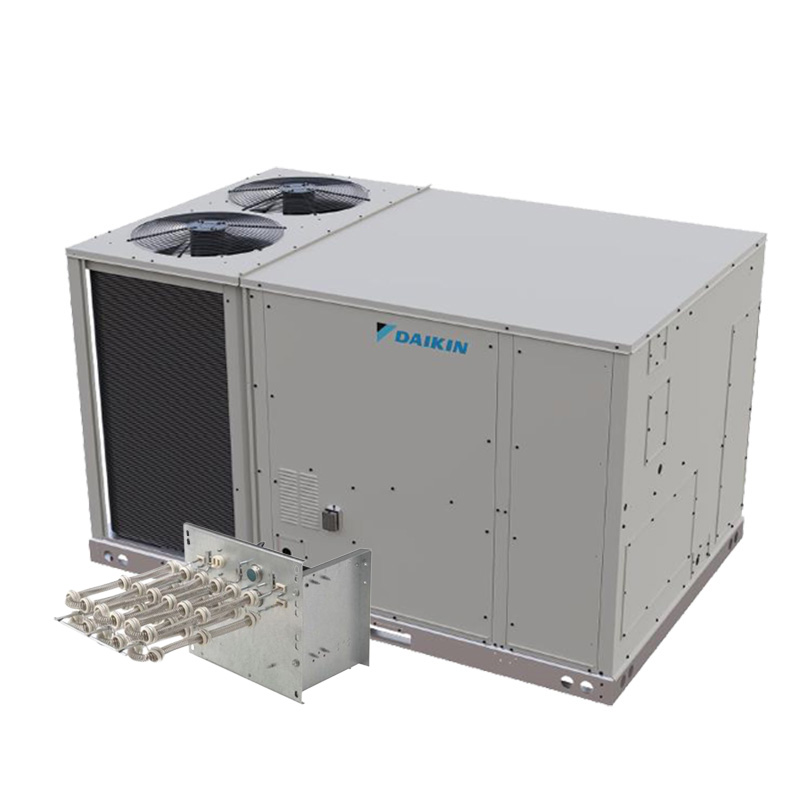
Daikin 8.5 Ton Commercial Package Unit AC With Electric Heat – 15.5 IEER, 208-230/3/60, Two Stage, R32
View on AC Direct see your lowest price →Check current price on AC Direct →
Key features
- 8.5-ton capacity for light commercial buildings, single-cabinet package unit design
- 15.5 IEER efficiency rating, upper-mid tier for commercial rooftop equipment
- Two-stage compressor reduces short-cycling and improves humidity control
- R-32 refrigerant, lower global warming potential than R-410A
- 208-230V / 3-phase / 60Hz power configuration, standard for commercial service
- Electric heat strips included, no gas supply required
About this system
The Daikin 8.5-ton commercial package unit is a self-contained rooftop or ground-level system that houses the compressor, condenser, and evaporator coil in a single cabinet, making it a strong candidate for light commercial buildings such as small offices, retail suites, restaurants, or warehouses that lack the mechanical room space for split-system equipment. At 8.5 tons, it covers roughly 3,000 to 4,500 square feet of commercial space depending on insulation, ceiling height, and internal heat loads. The three-phase 208-230V electrical configuration is standard for commercial construction, and the R-32 refrigerant charge is a forward-looking choice given R-32’s lower global warming potential and higher efficiency compared to R-410A.
The two-stage compressor is the spec that most directly affects occupant comfort and operating cost in a commercial setting. Unlike single-stage units that run at full capacity or not at all, two-stage operation lets the system run at a lower capacity during mild weather, which reduces short-cycling, maintains steadier indoor humidity, and puts less mechanical stress on the compressor over time. The 15.5 IEER (Integrated Energy Efficiency Ratio) rating applies specifically to commercial packaged equipment and represents a solid mid-to-upper tier result for rooftop units in this class, offering meaningful energy savings over baseline commercial equipment. Paired with electric heat strips rather than gas, this unit suits climates with mild winters or buildings where gas supply is impractical, though resistive electric heat carries a higher per-BTU operating cost than a heat pump or gas furnace alternative.
This system is best suited for facilities managers, commercial contractors, and property owners who want a single-source rooftop unit from a manufacturer with a strong global parts network and a reputation for long equipment life. Budget accordingly for installation: commercial package units at this size require structural roof assessment or a proper pad, three-phase electrical work, licensed refrigerant handling, and commissioning by a qualified commercial HVAC technician. First-cost is at the premium end of the market, which is consistent with Daikin’s positioning across its commercial line.
The Daikin 8.5-ton commercial package unit delivers a genuinely competitive IEER rating, a future-oriented refrigerant choice, and the durability track record that Daikin's commercial line is known for among HVAC professionals. The premium price, documented parts availability headaches, and the real risk of electronic control board failures mean buyers should budget for a strong service agreement from day one. For facilities managers who prioritize long equipment life and can accept higher upfront cost, this unit competes well; for cost-driven buyers or those in markets with limited Daikin commercial service coverage, the calculus is less clear.
Overall score is the average of the five ratings above.
What we like
- 15.5 IEER is a solid efficiency result for commercial rooftop equipment at this tonnage
- Two-stage operation reduces mechanical wear and improves comfort versus single-stage alternatives
- R-32 refrigerant is lower GWP and positions the unit well ahead of regulatory shifts
- Daikin's commercial builds are consistently recognized for long service life by HVAC professionals
- Self-contained package unit simplifies installation compared to split systems in space-constrained buildings
Trade-offs
- Premium first-cost puts this unit at the higher end of the commercial rooftop market
- Electronic control board and circuit board errors are the most documented failure mode across Daikin commercial equipment
- Parts availability and warranty claims processing draw frequent complaints, which is a real risk for a business-critical system
- Electric resistance heat has a significantly higher operating cost per BTU than gas heat in cold climates
What homeowners and pros say about Daikin
Among HVAC professionals who work in the light commercial segment, Daikin’s package units earn consistent respect for build quality and long service life, and that reputation holds for the commercial rooftop line. Consumer Reports and industry professionals place Daikin among the longer-lasting brands, which matters considerably for a commercial installation where replacement means a crane, a permit, and significant disruption to the business. The R-32 refrigerant choice is also drawing positive attention from contractors who are already planning for eventual R-410A phase-down. That said, the field consensus is not without reservation. Electronic control and circuit board errors are the most frequently documented failure mode, and when a board fault takes a commercial unit offline, the complaint is almost always the same: Daikin’s parts availability and warranty handling slow the recovery. On PissedConsumer, Daikin scores around 1.4 out of 5 across its product line, though that channel is heavily weighted toward customers who have had problems and tends to overrepresent service and price grievances rather than reflecting the full installed base.
For a facilities manager weighing this unit, the honest picture is that the equipment itself is likely to outlast cheaper alternatives and the two-stage R-32 platform is technically sound, but you are accepting real service risk unless you have a Daikin-authorized commercial contractor on a service agreement before the unit ever runs. The noise complaints that appear in long-term owner feedback, specifically rattling or humming on start and stop that develops over years of operation, are worth noting for tenant-sensitive spaces like medical offices or conference rooms. Compressor failures, while less common than control board issues, have been documented and can represent a significant repair cost on a unit this size. The premium price Daikin commands is defensible if you have the service infrastructure to back it up; it is harder to justify if your market has thin Daikin commercial parts support.
Sources: PissedConsumer Daikin reviews, AHRI Directory of Certified Product Performance, U.S. DOE appliance and equipment efficiency standards, Daikin product specifications.
How it compares
| Brand | Comparable model | SEER2 | Stage | Price position |
|---|---|---|---|---|
| Daikin | 8.5-Ton Commercial Package AC with Electric Heat, Two-Stage, R-32 | N/A (15.5 IEER) | Two-stage | Premium tier |
| Carrier | WeatherMaker 50XC Series (8-10 ton range) | N/A (IEER 15.0-16.0 depending on config) | Two-stage | Comparable premium tier, slightly lower in most markets |
| Trane | Precedent XR Series (7.5-10 ton commercial package) | N/A (IEER 14.5-15.5 depending on config) | Single-stage or two-stage depending on model | Comparable premium tier, broadly similar to Daikin |
| Lennox | LGH/LCH Series Elite Commercial Package (8.5 ton) | N/A (IEER 15.0-16.0 depending on config) | Two-stage | Premium tier, typically close to or slightly above Daikin depending on region |
Competitor rows are comparable single-stage units at similar efficiency; price is relative position, not a quote.
Questions about this system
What does the 15.5 IEER rating actually mean for my monthly energy bill compared to a standard commercial rooftop unit?
IEER (Integrated Energy Efficiency Ratio) measures efficiency across a range of part-load conditions rather than just peak load, which is more representative of real-world commercial operation. A 15.5 IEER is meaningfully better than the federal minimum for commercial equipment in this class, which sits around 11 to 12 IEER, so you can expect lower cooling-season energy costs compared to a baseline unit. The actual dollar savings depend on your local electricity rate, run hours, and how well the building envelope is sealed.
Why does this unit use electric heat instead of gas, and is that a problem in a northern climate?
Commercial package units come in gas-electric and electric-electric configurations. The electric heat version uses resistance heat strips, which are inexpensive to manufacture and install but cost more to operate per BTU than a gas furnace when natural gas prices are typical. In climates with cold winters and high heating loads, the operating cost difference can be substantial over a heating season. This configuration makes the most sense in mild-winter climates or buildings where gas supply is unavailable or expensive to run.
What is the real warranty coverage, and what do I need to do to get the 12-year parts warranty?
Daikin's 12-year parts warranty requires that the equipment be registered within 60 days of installation by the installing contractor or the owner. Missing that registration window typically drops coverage to a shorter base warranty. Given that Daikin's parts support and warranty processing are among the most frequently cited complaints in owner feedback, it is worth confirming registration was completed and keeping a copy of the registration confirmation before the contractor leaves the job.
How serious is the documented electronic control board failure issue on Daikin commercial units, and can I protect against it?
Control board and circuit board errors are the most commonly reported failure mode for Daikin commercial equipment, sometimes resulting in the unit throwing error codes or becoming unresponsive. This is not unique to Daikin, as complex commercial controls add potential failure points across all brands, but it is a well-documented pattern. A service contract with a Daikin-authorized commercial technician and a spare or refurbished control board on the shelf can significantly reduce downtime if a fault occurs.
Does this unit require a dedicated electrical service, and what should I budget for installation beyond the equipment cost?
Yes. The 208-230V, 3-phase, 60Hz power requirement means you need a verified three-phase electrical service at the installation point, which many smaller commercial buildings may need to upgrade or extend. Installation costs for a commercial package unit at this size typically include roof curb fabrication or pad preparation, electrical disconnect and wiring, ductwork connections, crane or lift rental for rooftop placement, and commissioning by a licensed commercial HVAC contractor. These costs can run a significant fraction of the equipment cost itself and should be included in the project budget from the start.
Specifications
| Cooling capacity | 8.5 Ton |
| Refrigerant | R-32 |