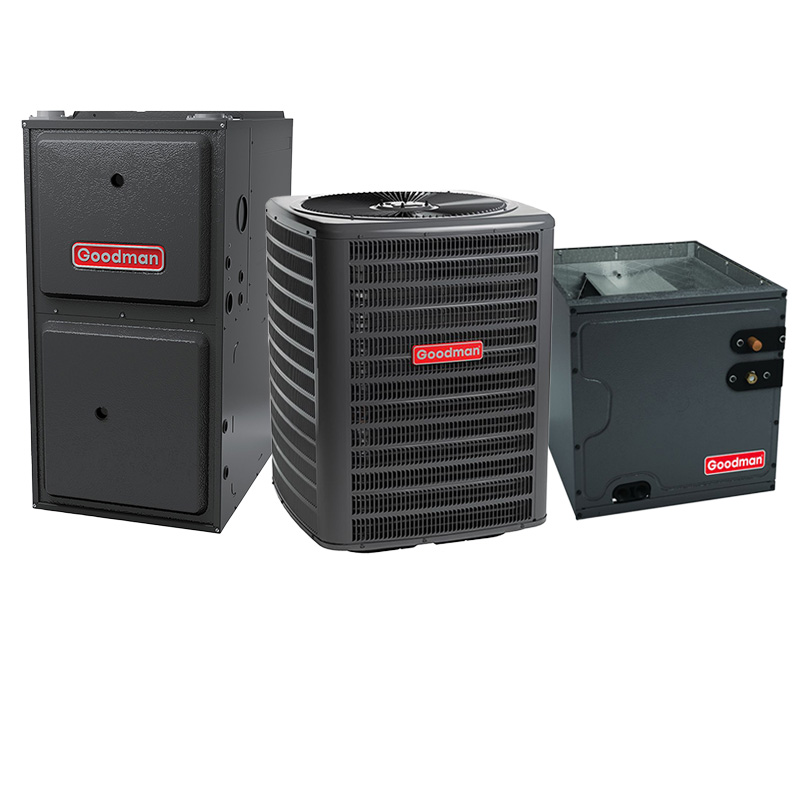
Goodman 1.5 Ton 14.5 SEER2 40000 BTU 80% AFUE Two Stage Multi-Speed ECM Gas Furnace System – Upflow | R32
View on AC Direct see your lowest price →Check current price on AC Direct →
Key features
- 1.5-ton, 14.5 SEER2 cooling rated for smaller homes and zone applications
- Two-stage 40,000 BTU gas furnace reduces temperature swings and short-cycling
- 80% AFUE meets federal minimum efficiency in most climate zones
- Multi-speed ECM blower motor for quieter, more consistent airflow
- R-32 refrigerant with lower global-warming potential than R-410A
- Upflow cabinet configuration suits installations above a basement or in a utility closet
About this system
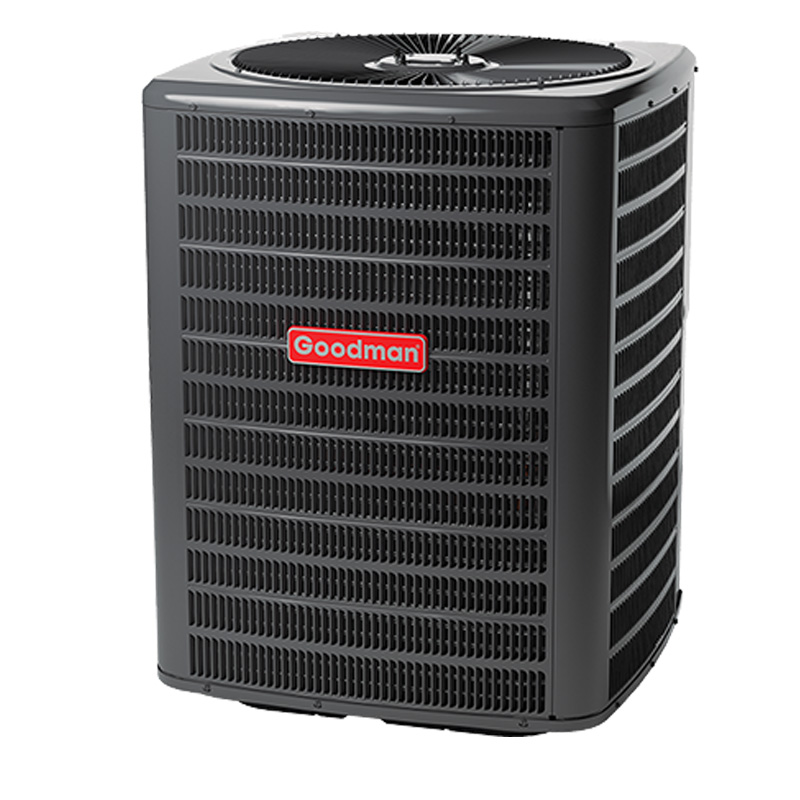
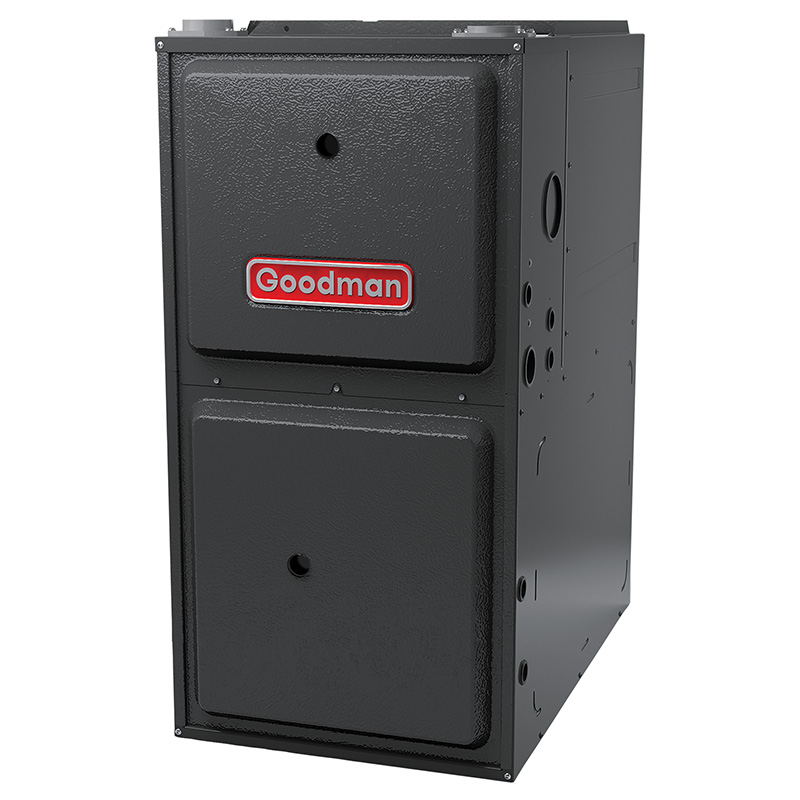
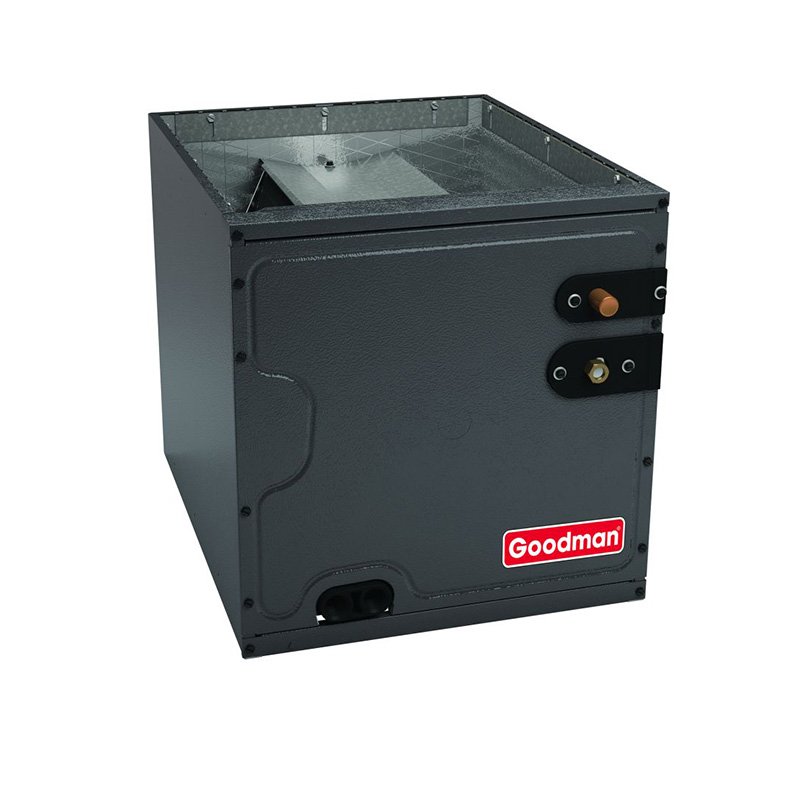
The Goodman GLXS4BA1810 pairs a 1.5-ton, 14.5 SEER2 air conditioner with a 40,000 BTU, 80% AFUE two-stage gas furnace in an upflow configuration, making it a practical choice for smaller homes or individual zones in the 600 to 900 square foot range, depending on local climate and insulation. The two-stage furnace fires at a lower capacity during mild weather and steps up only when temperatures drop sharply, which reduces temperature swings and tends to be easier on the heat exchanger over time compared to a single-stage unit cycling on and off at full blast. The multi-speed ECM blower motor adjusts airflow continuously, supporting more consistent comfort and quieter operation than a standard PSC motor.
The system uses R-32 refrigerant, a lower global-warming-potential refrigerant that is becoming more common as the industry moves away from R-410A. R-32 is serviceable by any EPA 608-certified technician, though your installer should confirm their equipment is compatible before the job starts. At 80% AFUE, this furnace meets federal minimum efficiency standards in most northern climate zones but does not qualify for the higher federal tax credits tied to 90% or above AFUE equipment. Buyers prioritizing the lowest upfront cost in a mild-to-moderate heating climate will find this tier acceptable; those in very cold regions or with high heating bills may want to evaluate a 96% AFUE option before committing.
The GLXS4BA1810 delivers a functional, code-compliant heating and cooling system at a price point meaningfully below comparable Carrier, Trane, and Lennox packages, and the two-stage furnace and ECM motor add real comfort value at this tier. The trade-off is a brand track record that shows more post-year-7 repair activity than premium competitors, and long-term performance depends heavily on how carefully the system is installed and commissioned. It is a reasonable choice for budget-conscious buyers who plan to use a licensed, experienced installer and stay on top of routine maintenance.
Overall score is the average of the five ratings above.
What we like
- Priced 15 to 25 percent below comparable Trane, Lennox, and Carrier systems
- Two-stage furnace operation improves comfort and reduces on/off cycling compared to single-stage
- ECM blower motor is more energy-efficient and quieter than standard PSC motors
- R-32 refrigerant is forward-looking and compliant with evolving environmental regulations
- Upflow configuration is widely compatible with common ductwork layouts in homes with basements or utility closets
Trade-offs
- 80% AFUE does not qualify for the higher federal tax credits reserved for 90%+ AFUE equipment
- Dual-run capacitor failures are the most commonly reported repair, typically occurring after several years of use
- Compressor lifespan averages 10 to 14 years versus 15 to 20 years for premium-brand compressors
- A minority of owners report refrigerant leaks in the first year, most often tied to install or charge issues rather than equipment defects
What homeowners and pros say about Goodman
Homeowners who have owned Goodman equipment long enough to form a real opinion tend to split into two camps. Those who had a careful installation and kept up with maintenance often describe years of trouble-free operation and point to the lower purchase price as straightforward savings. Those who ran into problems more often cite repairs that started stacking up after year seven or eight, which lines up with the recurring pattern visible in Goodman’s ConsumerAffairs score of roughly 2.5 out of 5. That channel skews toward complaints, so it overstates the failure rate, but the post-warranty repair cost theme appears consistently enough to take seriously. Google dealer reviews land at around 3.8 out of 5, where affordability and installer responsiveness are the most common positives.
HVAC technicians generally describe Goodman as a workable product whose longevity depends more on the installer than on the equipment itself. They flag dual-run capacitor failure as the most common service call, typically a straightforward and relatively low-cost repair, and note that evaporator coil leaks show up in a meaningful share of owner histories. Compressor lifespan on Goodman units tends to run 10 to 14 years in documented experience, shorter than the 15 to 20 years more commonly associated with Trane, Carrier, and Lennox compressors. A small number of owners have reported refrigerant leaks within the first year, which technicians attribute to installation or charge issues rather than a factory defect in most cases. For this specific system, the two-stage furnace and ECM motor represent genuine upgrades over the base Goodman line, and buyers who treat the installation as seriously as the purchase price tend to have better long-term outcomes.
Sources: ConsumerAffairs Goodman owner reviews, AHRI Directory of Certified Product Performance, U.S. DOE appliance and equipment efficiency standards, Goodman product specification sheets.
What it costs to run
At 14.5 SEER2, cooling this 1.5-ton system for a typical 1200-hour cooling season at the U.S. average electricity rate of $0.17/kWh works out to roughly $253 per year in cooling, about $21 less per year than a minimum-efficiency 13.4 SEER2 unit of the same size. Your real cost depends on your climate and local rate.
Method: (18,000 BTU/hr ÷ 14.5 SEER2) × 1200 hours ÷ 1000 × $0.17/kWh. Rate source: U.S. EIA average; cooling hours: moderate-climate estimate.
How it compares
| Brand | Comparable model | SEER2 | Stage | Price position |
|---|---|---|---|---|
| Goodman | GLXS4BA1810 | 14.5 | two-stage furnace / single-stage cooling | Value pick |
| Carrier | Performance 14 (24ACC4) with 58MVC furnace | 14.3 | single-stage | Typically 15 to 25 percent more than this Goodman package |
| Trane | XR14c with S8B1 furnace | 14.3 | single-stage | Typically 15 to 25 percent more than this Goodman package |
| Lennox | Merit 14ACX with ML180 furnace | 14.3 | single-stage | Typically 15 to 25 percent more than this Goodman package |
Competitor rows are comparable single-stage units at similar efficiency; price is relative position, not a quote.
Questions about this system
Does the 80% AFUE furnace qualify for the federal energy efficiency tax credit?
No. The federal Inflation Reduction Act tax credit for gas furnaces requires 97% AFUE for most of the country (with a lower threshold allowed only in specific southern climate zones). At 80% AFUE, this furnace does not qualify. If the tax credit is a priority, you will need to step up to a high-efficiency furnace.
Is R-32 refrigerant harder to find or service than R-410A?
Any EPA 608-certified HVAC technician can handle R-32, but they need recovery equipment rated for it, since R-32 is mildly flammable. Most established service companies are already equipped for it as the industry transitions away from R-410A, but it is worth confirming with your service provider before scheduling a call.
What does two-stage mean for the furnace, and does it matter on a 40,000 BTU unit?
Two-stage means the furnace can fire at a lower capacity during moderate cold and only ramp to full output when temperatures are more severe. Even on a smaller 40,000 BTU unit, this helps avoid the temperature swings and noise spikes that come with a single-stage furnace cycling on and off at full blast throughout the day.
What is the most common repair I should budget for after the warranty period?
Dual-run capacitors are the most frequently reported failure on Goodman systems and typically cost between 300 and 600 dollars to diagnose and replace. Scheduling annual tune-ups where the technician checks capacitor health is one of the better ways to catch this before it causes a full system shutdown.
Will a 1.5-ton system be enough for my home?
A 1.5-ton unit is generally appropriate for roughly 600 to 900 square feet in an average climate, though the right size depends on insulation, window area, ceiling height, local climate, and duct layout. An undersized or oversized system will short-cycle or underperform regardless of brand, so have a licensed contractor perform a Manual J load calculation before purchasing.
Specifications
| Cooling capacity | 1.5 Ton |
| Efficiency | 14.5 SEER2 |
| Furnace output | 40000 BTU |
| Furnace efficiency | 80% AFUE |
| Configuration | Upflow |
| Refrigerant | R-32 |
| Model | GLXS4BA1810 |