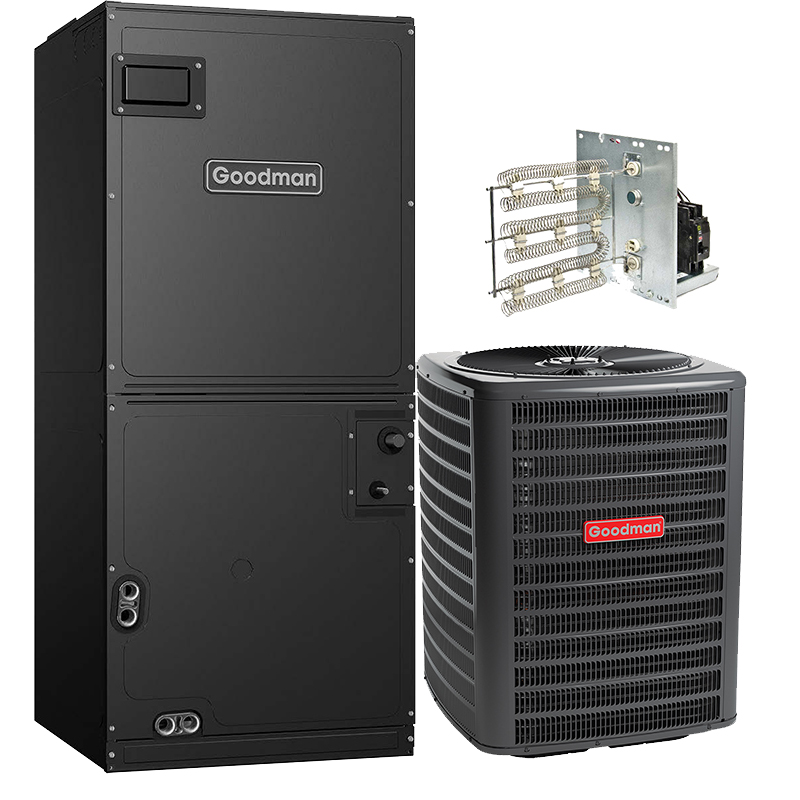
Goodman 1.5 Ton 15 SEER2 Split System with Electric Heat w/2 Ton A/H
View on AC Direct see your lowest price →Check current price on AC Direct →
Key features
- 1.5-ton cooling capacity paired with a 2-ton air handler for installation flexibility
- 15 SEER2 efficiency rating, meeting current federal minimum standards
- Electric resistance heat configuration, suited for mild climates or supplemental heating
- Single-stage compressor operation for straightforward, low-maintenance control
- Compatible with Goodman's 10-year parts warranty when registered within 60 days of installation
- Priced approximately 15 to 25 percent below comparable Carrier, Trane, and Lennox systems
About this system
The Goodman GSXN401810 pairs a 1.5-ton, 15 SEER2 condenser with a 2-ton air handler, making it a practical choice for smaller homes, conditioned apartments, or add-on zones where a compact cooling footprint matters. The oversized air handler relative to the condenser is intentional in some configurations, allowing for better static pressure management and future flexibility, but it is worth confirming with your installer that the combination is correctly matched for your duct layout and local climate before purchase.
At 15 SEER2, this system sits right at the current federal minimum efficiency threshold for many northern regions and just above it for others. It will deliver meaningful energy savings over an aging 10 to 13 SEER system, though it will not approach the operating-cost reductions of a 17 or 18 SEER2 unit. The electric heat designation means this system relies on electric resistance strip heat rather than a heat pump, which is straightforward and inexpensive to install but typically more expensive to operate in climates with prolonged cold seasons. It suits mild-winter markets, vacation properties, or situations where gas heat handles the bulk of the heating load.
The Goodman GSXN401810 is a straightforward, budget-accessible entry point into legitimate 15 SEER2 cooling with electric heat, best suited to buyers who prioritize upfront cost and have access to a skilled installer. Its long-term performance is more dependent on installation quality than most premium alternatives, and its documented failure patterns, particularly capacitors and evaporator coil leaks after year seven, are real factors to weigh against the initial savings.
Overall score is the average of the five ratings above.
What we like
- Priced 15 to 25 percent below comparable Carrier, Trane, and Lennox equipment
- 15 SEER2 rating offers genuine efficiency improvement over aging 10 to 13 SEER systems
- Simple single-stage design means fewer components that can fail in early years
- Dual-run capacitor failures, the most common reported issue, are a relatively low-cost repair at roughly 300 to 600 dollars
- 10-year parts warranty (with registration) provides meaningful long-term protection on a budget platform
Trade-offs
- Compressor lifespan averages 10 to 14 years, notably shorter than the 15 to 20 years typical of premium brands
- Evaporator coil leaks appear in a meaningful share of owner reviews, particularly after year seven
- A minority of owners report refrigerant leaks within the first year, usually tied to install or initial charge issues
- Electric resistance heat is significantly more expensive to operate than a heat pump in climates with cold winters
What homeowners and pros say about Goodman
Homeowners who purchase Goodman equipment tend to fall into two camps, and their experiences often reflect which camp they are in. Those who worked with a skilled, experienced contractor and had the system properly commissioned frequently report years of routine, uneventful operation and point to the lower purchase price as money well spent. Those who prioritized the cheapest possible installation alongside the budget equipment tend to encounter the documented failure modes sooner, including dual-run capacitor replacements and, in some cases, evaporator coil leaks that become costly after year seven. Goodman’s ConsumerAffairs rating of around 2.5 out of 5 reflects a complaint-skewed audience and consistently surfaces repair cost concerns in the later years of ownership, while Google dealer reviews average around 3.8 out of 5, where affordability is the most cited reason for satisfaction.
HVAC technicians who work on Goodman equipment regularly note that the brand’s reputation is inseparable from installation quality in a way that is more pronounced than with premium brands. The dual-run capacitor is the most commonly flagged failure point in the field and is generally considered a straightforward, low-cost fix. More significant concerns in tech circles are evaporator coil leak rates that show up in owner feedback and compressor longevity that averages 10 to 14 years, meaningfully shorter than the 15 to 20 years associated with Carrier, Trane, and Lennox compressors. For the GSXN401810 specifically, the mismatched condenser and air handler sizing adds one more variable that underscores how much this system’s outcome depends on the person installing it.
Sources: ConsumerAffairs Goodman owner reviews, AHRI Directory of Certified Product Performance, U.S. DOE appliance and equipment efficiency standards, Goodman product specification sheets.
What it costs to run
At 15 SEER2, cooling this 1.5-ton system for a typical 1200-hour cooling season at the U.S. average electricity rate of $0.17/kWh works out to roughly $245 per year in cooling, about $29 less per year than a minimum-efficiency 13.4 SEER2 unit of the same size. Your real cost depends on your climate and local rate.
Method: (18,000 BTU/hr ÷ 15 SEER2) × 1200 hours ÷ 1000 × $0.17/kWh. Rate source: U.S. EIA average; cooling hours: moderate-climate estimate.
How it compares
| Brand | Comparable model | SEER2 | Stage | Price position |
|---|---|---|---|---|
| Goodman | GSXN401810 | 15 | Single-stage | Value pick |
| Carrier | Comfort 24ACC6 Series | 15 | Single-stage | Typically 15 to 25 percent more than Goodman |
| Trane | XR15 Series | 15 | Single-stage | Typically 15 to 25 percent more than Goodman |
| Lennox | Merit ML14XC1 Series | 15 | Single-stage | Typically 15 to 25 percent more than Goodman |
Competitor rows are comparable single-stage units at similar efficiency; price is relative position, not a quote.
Questions about this system
Why does this system use a 2-ton air handler with a 1.5-ton condenser? Is that a mistake?
It is not a mistake, but it does require careful attention during installation. Using a slightly larger air handler can help with static pressure in certain duct configurations, but your installer must verify the combination is properly matched for your specific home and ensure the refrigerant charge and airflow are set correctly for the 1.5-ton condenser capacity.
How does the 15 SEER2 rating compare to what I have now, and will it noticeably lower my electric bill?
If you are replacing a system from the early 2000s rated at 10 or 12 SEER, you will see a real reduction in cooling-season energy use. Compared to a newer 17 or 18 SEER2 unit, the savings gap narrows considerably, so the efficiency argument for this system is strongest when replacing older equipment rather than comparing it to higher-tier new equipment.
What does 'electric heat' mean on this system, and is it efficient enough for winter?
Electric heat here refers to electric resistance strip heating, which converts electricity directly to heat at roughly 100 percent efficiency but produces heat at a higher operating cost per BTU than a heat pump, which moves heat rather than generating it. This configuration works well as a backup or in climates where heating demand is minimal, but it can lead to noticeably higher utility bills if used as the primary heat source through a cold winter.
What are the most common repairs I should budget for over a 10-year ownership period?
Based on documented failure patterns, dual-run capacitor replacement is the most frequently reported issue and typically runs 300 to 600 dollars per occurrence. Evaporator coil leaks show up in a meaningful portion of owner reviews and can be more expensive to address. Refrigerant leaks in the first year are reported by a minority of owners and are usually traced back to install or initial charge quality rather than a product defect.
What do I need to do to activate the 10-year parts warranty?
Goodman requires product registration within 60 days of installation to qualify for the 10-year parts warranty; without registration, the coverage period is shorter. The installation must also be performed by a licensed HVAC contractor, and it is worth keeping your installation invoice and registration confirmation on file in case a warranty claim is ever needed.
Specifications
| Cooling capacity | 1.5 Ton |
| Efficiency | 15 SEER2 |
| Model | GSXN401810 |