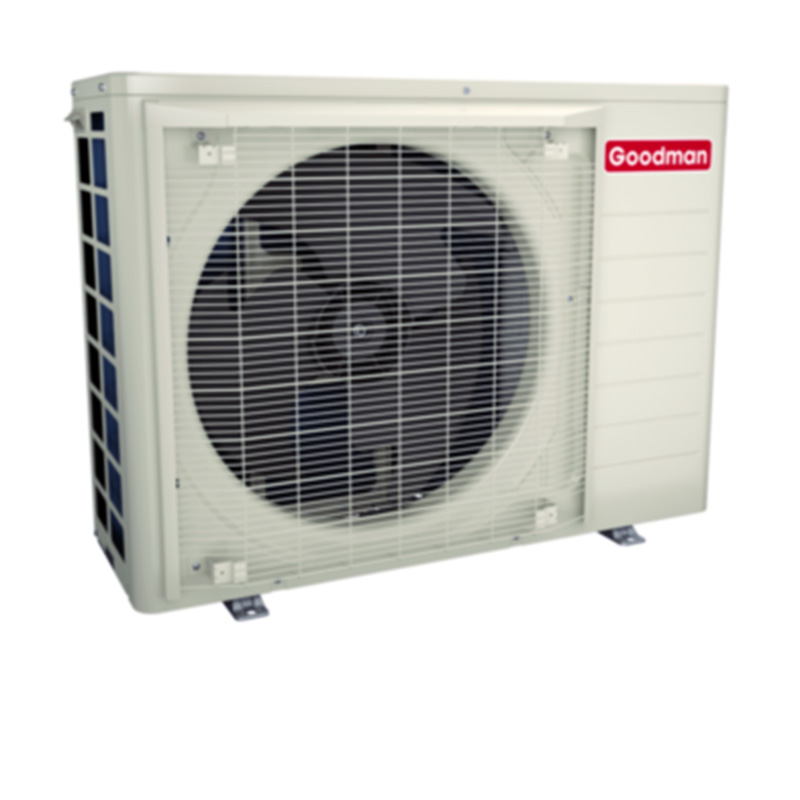
Goodman 1.5 Ton Up to 17.2 SEER2 Variable-Speed Inverter AC Side Discharge Condenser, R32 (GXV6SS1810)
View on AC Direct see your lowest price →Check current price on AC Direct →
Key features
- Variable-speed inverter compressor for continuous capacity modulation and quieter partial-load operation
- Up to 17.2 SEER2 efficiency rating when matched with a compatible variable-speed air handler and coil
- R-32 refrigerant: lower global warming potential than R-410A, smaller charge volume
- Side-discharge condenser configuration for space-limited installations
- 1.5-ton capacity suited to smaller conditioned spaces with a confirmed load in the 14,000-18,000 BTU range
- Priced approximately 15-25% below comparable variable-speed units from Trane, Lennox, and Carrier
About this system
The Goodman GXV6SS1810 is a 1.5-ton, side-discharge condensing unit rated up to 17.2 SEER2, making it one of the more efficient options in Goodman’s lineup. It uses a variable-speed inverter-driven compressor, which modulates output continuously rather than cycling on and off at full capacity. That means more precise humidity control, quieter operation at partial loads, and less wear during the long, mild cooling hours that make up the bulk of a season in most climates. The R-32 refrigerant charge is a forward-looking choice: R-32 has a lower global warming potential than R-410A and requires a smaller refrigerant volume for the same capacity, which can reduce leak impact slightly.
At 1.5 tons, this unit is sized for smaller homes, apartments, well-insulated additions, or any space where a proper Manual J load calculation lands in the 14,000 to 18,000 BTU range. Pairing it with a compatible variable-speed air handler and coil is essential to actually reach the rated 17.2 SEER2; mismatched components or an oversized duct system will pull that efficiency figure down meaningfully. Side-discharge airflow suits installations where overhead clearance is limited or where the unit sits close to a structure wall, though airflow clearance on all sides still matters for rated performance.
The GXV6SS1810 delivers genuine variable-speed efficiency at a price point that undercuts the major premium brands by a meaningful margin, making it a reasonable choice for budget-conscious buyers who prioritize upfront cost and can secure a skilled installer. The trade-off is a real one: Goodman's documented compressor lifespan of 10 to 14 years trails premium-brand benchmarks, and long-term repair costs can erode the initial savings, particularly after year seven.
Overall score is the average of the five ratings above.
What we like
- 17.2 SEER2 variable-speed performance at a value price point
- R-32 refrigerant is more environmentally friendly and future-compatible than R-410A
- Variable-speed operation provides noticeably better humidity removal and quieter part-load running
- Side-discharge design adds flexibility for tight installation sites
- Lower upfront cost leaves budget room for a quality installation or an extended service plan
Trade-offs
- Compressor lifespan averages 10-14 years versus 15-20 years for premium brands, a real long-term cost factor
- Dual-run capacitor failures are a commonly reported repair need, typically arising within the first decade
- Evaporator coil leaks appear in a meaningful share of owner reviews and can be costly to address
- Rated efficiency is only achievable with a properly matched variable-speed air handler, coil, and correct refrigerant charge; installation quality drives outcomes more than with simpler systems
What homeowners and pros say about Goodman
Homeowners who have installed Goodman equipment tend to split into two camps, and that divide shows up clearly in the brand’s ratings. On ConsumerAffairs, Goodman sits at roughly 2.5 out of 5, a score shaped by a channel where frustrated owners are far more likely to write than satisfied ones. The recurring thread in those reviews is not early catastrophic failure but rather repair costs that start stacking up after year seven or so, with dual-run capacitor replacements and, more painfully, evaporator coil leaks appearing repeatedly. On Google dealer reviews, the picture is more balanced at around 3.8 out of 5, where the most consistent praise is straightforward: the price is fair and the system cools reliably when it is installed correctly. That last qualifier matters more for a variable-speed inverter unit like the GXV6SS1810 than it does for a basic single-stage system, because inverter systems have tighter tolerances for refrigerant charge, airflow balance, and component matching.
HVAC technicians who work on Goodman equipment regularly tend to echo a pragmatic view. The hardware is functional and the parts are widely stocked, which keeps service calls manageable. The capacitor failure pattern is well known in the trade and is considered a routine repair rather than a sign of broader system failure. What technicians flag more seriously is the compressor lifespan gap: Goodman compressors averaging 10 to 14 years versus the 15 to 20 years more common in Trane, Lennox, and Carrier variable-speed lines is a real difference when you are pricing a 1.5-ton inverter system for a smaller home where the economics of early replacement hit harder. For this specific unit, the R-32 charge adds a small wrinkle in that not every local technician has completed A2L handling training yet, so verifying service availability in your area before buying is a practical step worth taking.
Sources: ConsumerAffairs Goodman owner reviews, AHRI Directory of Certified Product Performance, U.S. DOE appliance and equipment efficiency standards, Goodman product specification sheets.
What it costs to run
At 17.2 SEER2, cooling this 1.5-ton system for a typical 1200-hour cooling season at the U.S. average electricity rate of $0.17/kWh works out to roughly $213 per year in cooling, about $61 less per year than a minimum-efficiency 13.4 SEER2 unit of the same size. Your real cost depends on your climate and local rate.
Method: (18,000 BTU/hr ÷ 17.2 SEER2) × 1200 hours ÷ 1000 × $0.17/kWh. Rate source: U.S. EIA average; cooling hours: moderate-climate estimate.
How it compares
| Brand | Comparable model | SEER2 | Stage | Price position |
|---|---|---|---|---|
| Goodman | GXV6SS1810 | 17.2 | Variable-speed inverter | Value pick |
| Carrier | Infinity 24 (24VNA6) | Up to 17.0 | Variable-speed inverter | Approximately 25-35% more than this Goodman |
| Trane | XV18i | Up to 18.0 | Variable-speed inverter | Approximately 25-40% more than this Goodman |
| Lennox | XC21 | Up to 17.5 | Variable-speed | Approximately 20-35% more than this Goodman |
Competitor rows are comparable single-stage units at similar efficiency; price is relative position, not a quote.
Questions about this system
Does this unit actually need a specific air handler to hit 17.2 SEER2, or will it work with my existing equipment?
Yes, the 17.2 SEER2 rating requires a matched variable-speed air handler and approved coil combination as listed in Goodman's AHRI certificate directory. Running it with a standard single-speed air handler will still cool your home, but efficiency will drop noticeably below the rated figure and may void the efficiency warranty terms.
Is R-32 safe, and can any HVAC technician work on it?
R-32 is classified as mildly flammable (A2L), which means it requires Section 608-certified technicians who have completed A2L-specific safety training and use appropriate equipment. Most licensed HVAC contractors are now familiar with it, but it is worth confirming before scheduling service, especially for smaller independent shops.
What is the most likely repair I should budget for over the first ten years?
Based on Goodman's documented failure patterns, a dual-run capacitor replacement is the most commonly reported repair, typically falling in the $300 to $600 range and usually a straightforward fix. Evaporator coil leaks are less frequent but more expensive when they do occur, so keeping the system on a regular maintenance schedule helps catch refrigerant charge issues early.
Why does the unit have a side discharge instead of a top discharge, and does that affect performance?
Side discharge moves air out through the side panel rather than the top, which suits locations where overhead obstructions or tight vertical clearance make a top-discharge unit impractical. Performance is comparable as long as the manufacturer's minimum clearance requirements on all sides are respected; blocking the discharge path will reduce efficiency and strain the compressor.
How does the variable-speed compressor affect my electricity bill compared to a single-stage unit?
A variable-speed inverter compressor runs most of the time at reduced speeds rather than cycling fully on and off, which reduces peak power draw and improves part-load efficiency significantly. In humid climates or in homes that run the system for long hours each day, real-world savings versus a 14-15 SEER2 single-stage unit are tangible, though actual dollar savings depend on local electricity rates, duct quality, and how well the load was sized.
Specifications
| Cooling capacity | 1.5 Ton |
| Efficiency | 17.2 SEER2 |
| Refrigerant | R-32 |
| Model | GXV6SS1810 |