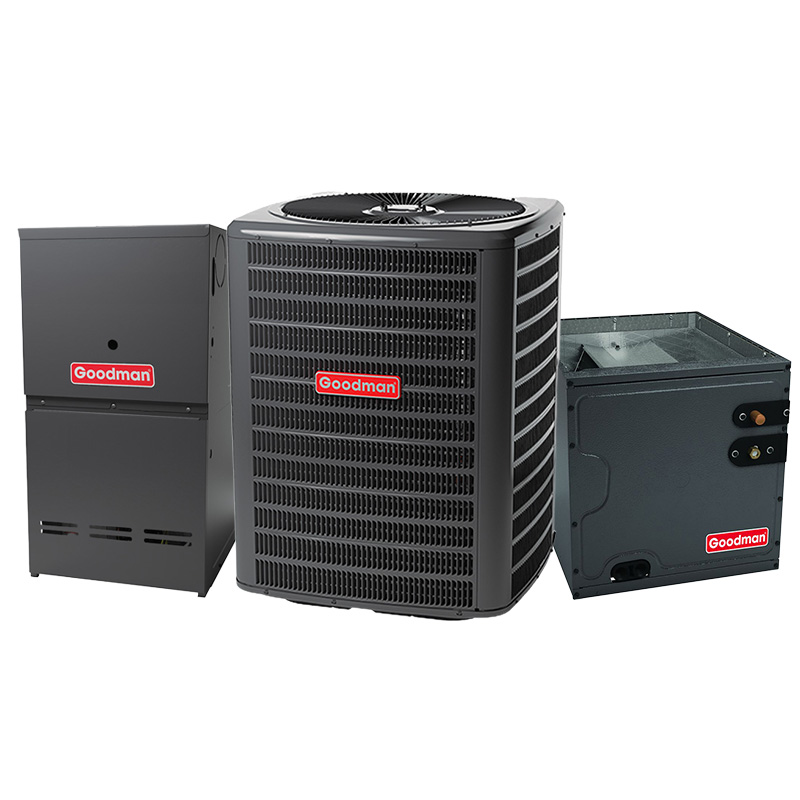
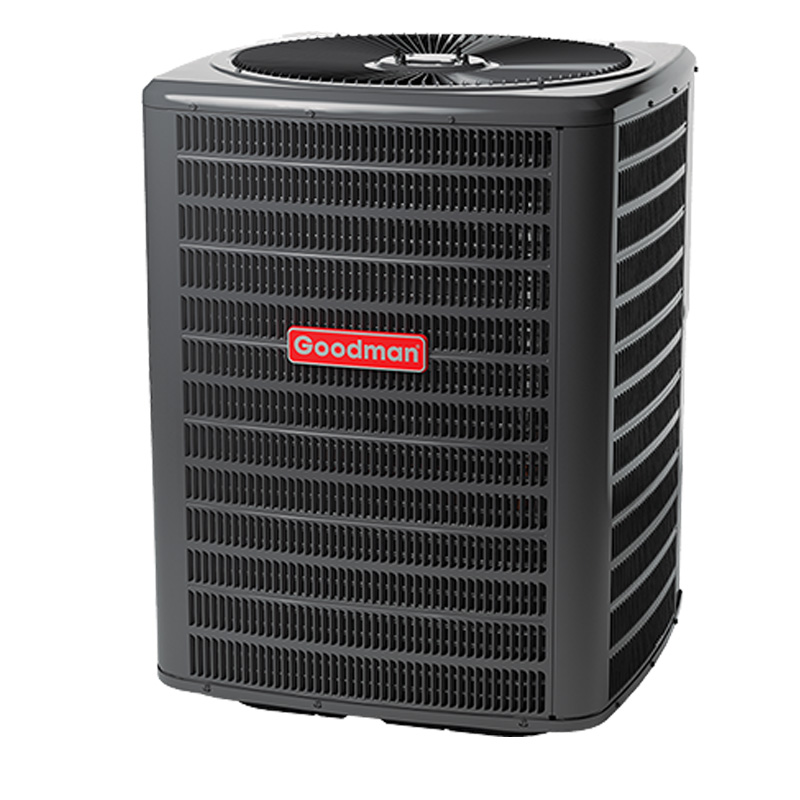
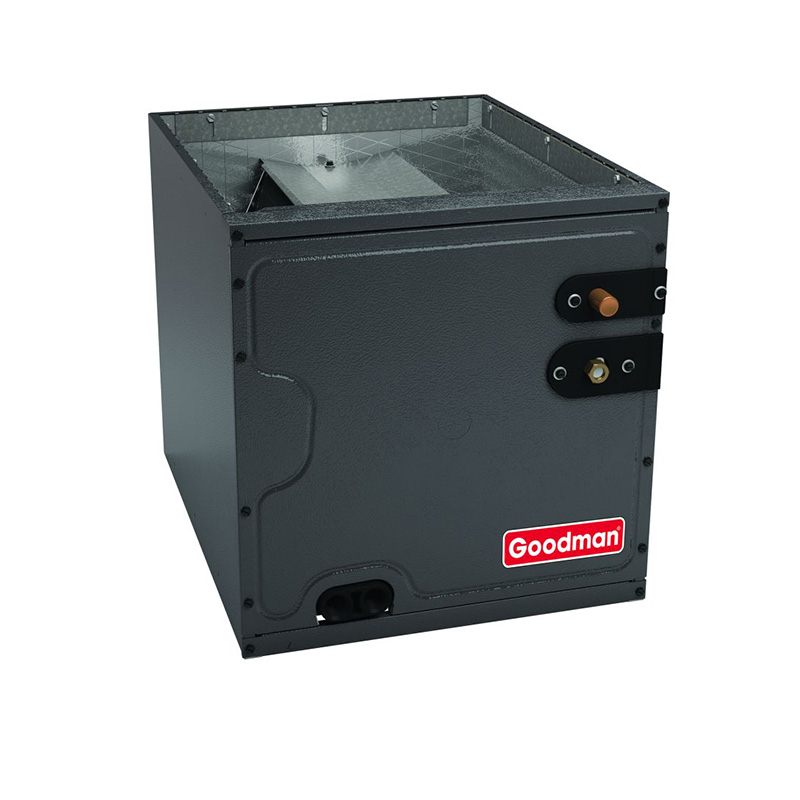
Goodman 1.5 Ton AC And 60000 BTU 80% AFUE Gas Furnace System | 14.5 SEER2 AC | Multi-Speed ECM Low NOx Furnace | Downflow | R32
View on AC Direct see your lowest price →Check current price on AC Direct →
Key features
- 14.5 SEER2 cooling efficiency meets current federal minimums for all U.S. climate regions
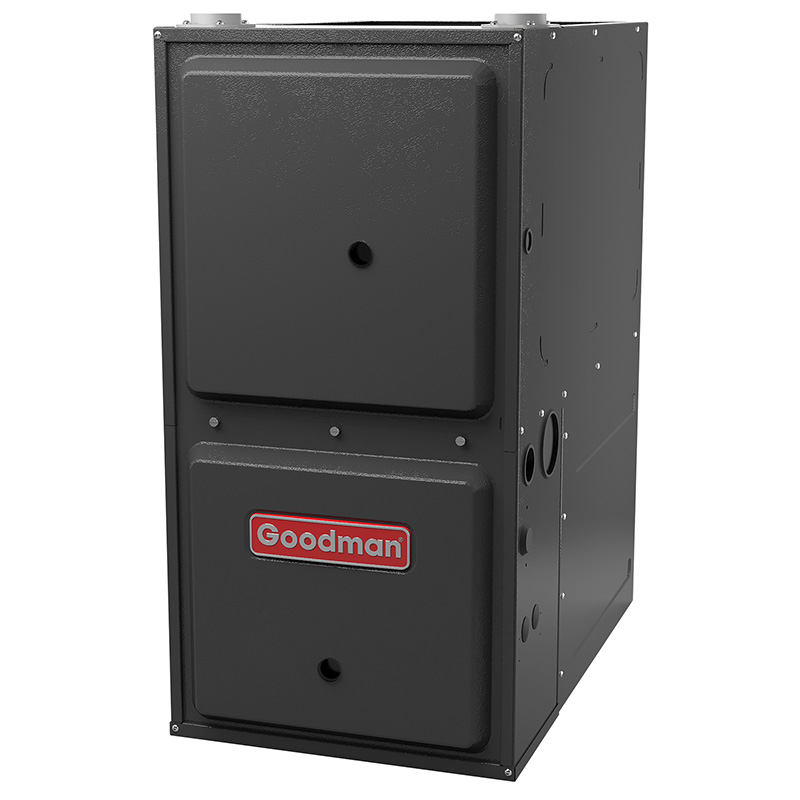
- 60,000 BTU 80% AFUE downflow gas furnace with multi-speed ECM blower motor
- R-32 refrigerant, a lower global-warming-potential alternative to R-410A
- Low NOx combustion meets California and other strict state air-quality standards
- Downflow cabinet configuration for installations feeding ductwork below the unit
- Goodman 10-year parts warranty (registration required within 60 days of installation)
About this system
The Goodman 1.5-ton, 14.5 SEER2 air conditioner paired with a 60,000 BTU 80% AFUE downflow gas furnace is a straightforward entry-level comfort system sized for smaller homes, condominiums, or individual zones typically between 600 and 900 square feet depending on climate and insulation. The 14.5 SEER2 rating meets current federal minimum efficiency standards for most U.S. regions, so it is code-legal nationwide but offers no efficiency cushion beyond that baseline. The 80% AFUE furnace means roughly 20 cents of every heating dollar exits through the flue, making this a reasonable fit for mild-to-moderate heating climates where gas heat is secondary to cooling, but a less compelling choice in cold regions where a 96% AFUE unit would pay back its cost difference in a few seasons.
The downflow configuration is a specific requirement: air enters the top of the furnace and exits through the bottom, which suits homes with a furnace closet on the main floor feeding ductwork below, or certain manufactured-home installations. Buyers should confirm their existing duct layout before ordering because this cabinet orientation cannot be field-converted to upflow or horizontal. The multi-speed ECM blower motor improves dehumidification and air distribution compared to single-speed motors, and the Low NOx combustion design meets California and other state air-quality rules. R-32 refrigerant is the newer, lower global-warming-potential replacement for R-410A, which adds a small green credential and will keep the refrigerant supply chain viable as R-410A is phased out.
This Goodman bundle is a budget-accessible way to replace an aging matched system in a smaller home, and its ECM motor and R-32 refrigerant add genuine technical merit above the bare minimum. Buyers should weigh the lower upfront cost against Goodman's documented mid-life repair frequency and shorter average compressor lifespan compared to premium brands, and budget for at least one capacitor replacement in the first decade. It rewards owners who pair it with a careful, licensed installation and a regular maintenance schedule.
Overall score is the average of the five ratings above.
What we like
- Priced roughly 15 to 25 percent below comparable Carrier, Trane, and Lennox systems, making replacement more accessible
- ECM multi-speed blower improves humidity control and air circulation versus standard PSC motors
- R-32 refrigerant is lower in global warming potential and supported by a growing supply chain as R-410A phases out
- Low NOx furnace ships California-compliant out of the box, avoiding a separate upgrade cost in regulated states
- 10-year parts warranty (with registration) covers the compressor and major components for the first decade
Trade-offs
- 80% AFUE is the lowest efficiency tier available; homeowners in cold climates will pay measurably more in annual gas bills versus a 96% AFUE unit
- Compressor lifespan averages 10 to 14 years versus 15 to 20 years on premium brands, meaning replacement may arrive sooner than expected
- Dual-run capacitors are the most frequently reported failure on Goodman AC units, typically adding a repair bill of $300 to $600 within the first decade
- Evaporator coil leaks and first-year refrigerant charge issues appear in a meaningful share of owner reports, making installer selection critical
What homeowners and pros say about Goodman
Homeowners who purchased Goodman systems tend to split along predictable lines. Those who report positive experiences almost always credit an attentive installer and consistent annual maintenance, echoing what HVAC technicians say repeatedly: Goodman equipment is sensitive to installation quality in a way that premium brands are somewhat less so. On Google dealer reviews, Goodman systems earn around 3.8 out of 5 stars across hundreds of location-level reviews, and affordability is the praise that appears most consistently. Technicians in online trade forums note that the dual-run capacitor is the single most common service call on Goodman AC units, usually a quick fix in the $300 to $600 range, but one that catches owners off guard if they have not budgeted for routine wear parts.
The ConsumerAffairs profile for Goodman sits at roughly 2.5 out of 5, a score that reflects the complaint-heavy nature of that platform but also surfaces a real pattern: repair costs tend to climb after year seven, and evaporator coil leaks show up in enough owner accounts to be a documented failure mode rather than an outlier. Compressors on Goodman units average 10 to 14 years in the field, a shorter window than the 15 to 20 years owners of Trane or Carrier equipment more commonly report. For this specific 1.5-ton downflow system, the R-32 refrigerant and ECM blower draw mild positive attention from technicians as genuine improvements over older Goodman configurations, but the underlying message from the service community remains consistent: buy Goodman if the price difference matters, invest in a quality installer, and keep up with annual maintenance or expect to meet its documented weak points sooner rather than later.
Sources: ConsumerAffairs Goodman owner reviews, AHRI Directory of Certified Product Performance, U.S. DOE appliance and equipment efficiency standards, Goodman product specification sheets.
What it costs to run
At 14.5 SEER2, cooling this 1.5-ton system for a typical 1200-hour cooling season at the U.S. average electricity rate of $0.17/kWh works out to roughly $253 per year in cooling, about $21 less per year than a minimum-efficiency 13.4 SEER2 unit of the same size. Your real cost depends on your climate and local rate.
Method: (18,000 BTU/hr ÷ 14.5 SEER2) × 1200 hours ÷ 1000 × $0.17/kWh. Rate source: U.S. EIA average; cooling hours: moderate-climate estimate.
How it compares
| Brand | Comparable model | SEER2 | Stage | Price position |
|---|---|---|---|---|
| Goodman | GLXS3BA18 / GCVC8 Series Bundle | 14.5 | Single-stage | Value pick |
| Carrier | Comfort 24ACC4 / 58SB Series | 14.5 | Single-stage | Typically 15 to 25 percent more than this Goodman bundle |
| Trane | XR14 / S8X1 Series | 14.5 | Single-stage | Typically 15 to 25 percent more than this Goodman bundle |
| Lennox | Merit ML14XC1 / ML180 Series | 14.5 | Single-stage | Typically 15 to 25 percent more than this Goodman bundle |
Competitor rows are comparable single-stage units at similar efficiency; price is relative position, not a quote.
Questions about this system
Does the downflow configuration work with my existing ductwork?
Only if your furnace closet sits above the duct plenum and air needs to discharge downward into the floor. Downflow cabinets cannot be converted to upflow or horizontal in the field, so confirm your current furnace orientation with a technician before ordering. Installing the wrong configuration requires a full cabinet swap.
Will R-32 refrigerant cost more to recharge or repair than R-410A?
R-32 is currently comparable to or slightly less expensive than R-410A in most U.S. markets, and availability is growing as manufacturers transition away from R-410A under federal phasedown rules. Most certified HVAC technicians who handle R-410A can handle R-32 with the appropriate equipment, though some older recovery machines require an upgrade.
Is 80% AFUE going to be a problem for my heating bills?
In climates where winters are mild and you run the furnace infrequently, the efficiency gap between 80% and 96% AFUE may not justify the higher upfront cost of a condensing unit. In colder regions where the furnace runs heavily from November through March, the 16-percentage-point efficiency difference can add up to meaningful annual savings that payback a higher-efficiency furnace in a few years.
What is the most likely repair I should plan for over the first 10 years?
Dual-run capacitors are the most commonly reported failure point on Goodman air conditioners and are typically a straightforward repair costing $300 to $600. Scheduling annual tune-ups gives a technician the chance to catch a weakening capacitor before it fails and takes the compressor down with it.
What do I need to do to activate the 10-year parts warranty?
Goodman requires the equipment to be installed by a licensed HVAC contractor and registered on the Goodman website within 60 days of installation. Without registration, the warranty defaults to a shorter limited period. Keep your installation invoice and model and serial numbers handy because you will need them during registration.
Specifications
| Cooling capacity | 1.5 Ton |
| Efficiency | 14.5 SEER2 |
| Furnace output | 60000 BTU |
| Furnace efficiency | 80% AFUE |
| Configuration | Downflow |
| Refrigerant | R-32 |