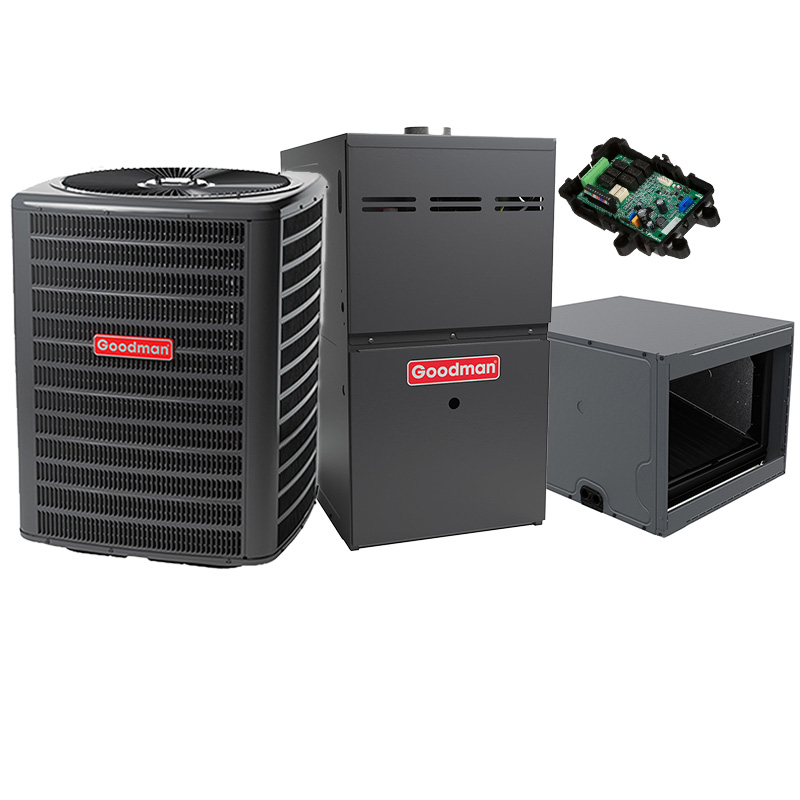
Goodman 2.5 Ton 13.8 SEER2 60000 BTU 96% AFUE Two-Stage Gas Furnace With R32 Air Condenser and Coil System – Horizontal
View on AC Direct see your lowest price →Check current price on AC Direct →
Key features
- 2.5-ton cooling capacity with 13.8 SEER2 efficiency rating
- 60,000 BTU two-stage gas furnace rated at 96% AFUE
- Horizontal configuration for attic, crawlspace, or side-mount installs
- R-32 refrigerant with lower global-warming potential than R-410A
- Two-stage heating reduces temperature swings and cycling noise
- Priced 15 to 25 percent below comparable Trane, Lennox, and Carrier systems
About this system
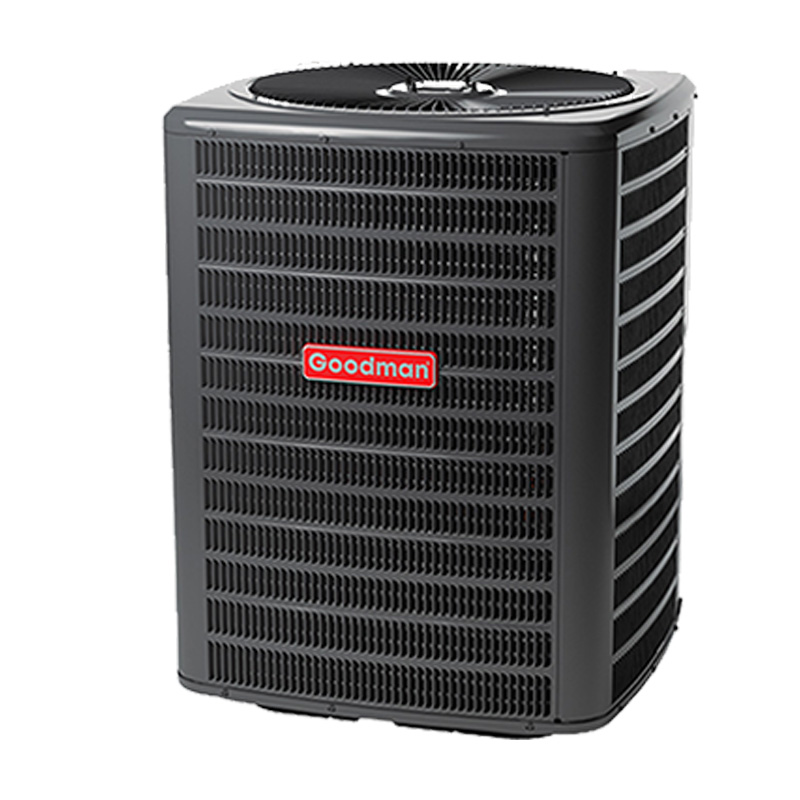
This Goodman bundle pairs a 2.5-ton R-32 air condenser and matching coil with a 60,000 BTU, 96% AFUE two-stage gas furnace in a horizontal configuration. The horizontal orientation is specifically suited to attic installations, crawlspace applications, and homes where vertical clearance is tight. R-32 refrigerant carries a lower global-warming potential than the R-410A it replaces, and its higher energy density means the system can operate with a smaller refrigerant charge. At 13.8 SEER2, this unit clears the current federal minimum for most U.S. regions but sits in the entry-to-mid efficiency tier rather than at the top of the market.
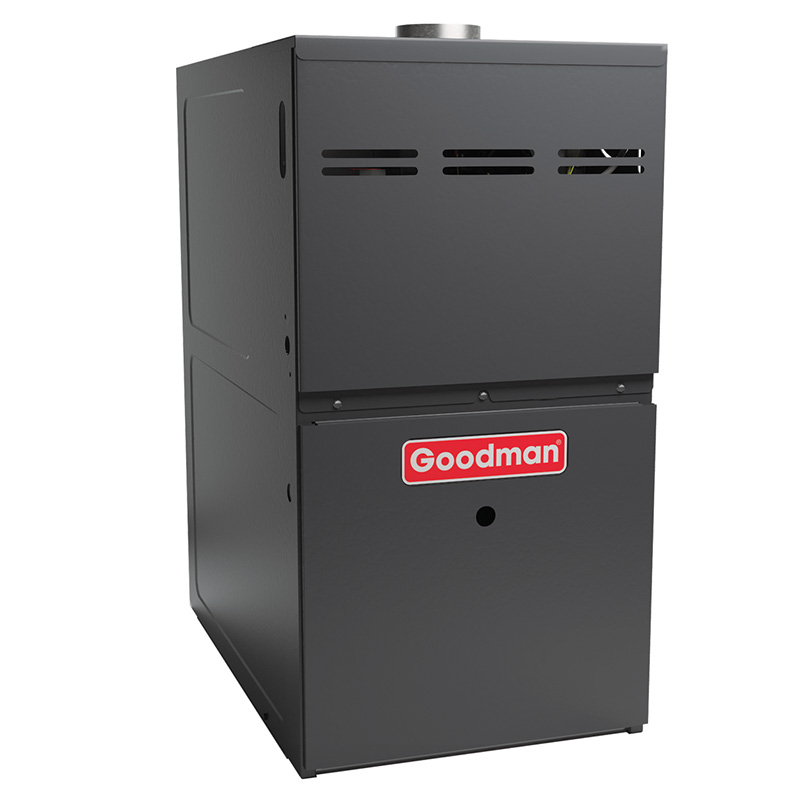
The two-stage furnace is the most practical upgrade in this bundle over single-stage alternatives. On mild days the furnace fires at its lower stage, which produces fewer temperature swings, quieter operation, and somewhat lower fuel consumption than a single-stage unit running full blast every cycle. Paired with a 96% AFUE rating, very little combustion energy is wasted as exhaust. That combination makes this system a reasonable fit for mid-size homes in cold-to-mixed climates where the furnace gets real seasonal use. Buyers in mild, cooling-dominated climates may want to weigh whether the furnace investment matches their actual heating load.
This Goodman bundle delivers honest efficiency numbers and a genuinely useful two-stage furnace at a price point that undercuts major premium brands by a meaningful margin. The trade-off is a documented history of component failures around the 7-to-10 year mark and compressor longevity that typically trails premium alternatives. It is a sound choice when budget is the primary constraint and installation quality is high.
Overall score is the average of the five ratings above.
What we like
- 96% AFUE furnace keeps fuel costs lower than 80% or 92% AFUE alternatives
- Two-stage operation improves comfort and reduces short-cycling versus single-stage
- R-32 refrigerant is more environmentally favorable and easier to source going forward
- Horizontal configuration opens up installation locations unavailable to upflow-only units
- Purchase price is substantially lower than equivalent Trane, Lennox, or Carrier bundles
Trade-offs
- Dual-run capacitors are the most frequently reported failure, typically appearing after year 5 to 7
- Evaporator coil leaks show up in a meaningful share of owner reports, a costly mid-life repair
- Compressor lifespan averages 10 to 14 years versus 15 to 20 years for premium-brand compressors
- A minority of owners report refrigerant leaks within the first year, usually tied to install or charge issues
What homeowners and pros say about Goodman
Homeowners who chose Goodman equipment tend to split into two camps fairly quickly. Those who had a skilled, attentive installer often report years of trouble-free operation and point to the lower upfront cost as money well spent. Those who ran into problems more frequently point to years 7 through 10 as when repair bills start arriving. On ConsumerAffairs, Goodman scores around 2.5 out of 5, though that platform skews heavily toward people who had a bad enough experience to write a review. Google dealer reviews, which capture a broader cross-section of buyers, average around 3.8 out of 5, and affordability is consistently the most common reason buyers say they are satisfied. The gap between those two numbers reflects how much install quality and ongoing service relationship shapes the ownership experience with this brand.
HVAC technicians who service Goodman equipment regularly tend to have a pragmatic view of it. The dual-run capacitor is the component they replace most often on these systems, a relatively inexpensive fix but one that starts showing up with some regularity after the five-to-seven year mark. Evaporator coil leaks are a more serious concern cited in owner reports, and they are costly to address regardless of brand. Compressor lifespan on Goodman equipment tends to land in the 10 to 14 year range in real-world service data, which is shorter than the 15 to 20 years technicians associate with Trane, Lennox, or Carrier compressors. On this specific horizontal two-stage bundle, the refrigerant charge and coil connections deserve close attention at installation, since a minority of owners report early refrigerant loss that typically traces back to install-day issues rather than a product defect.
Sources: ConsumerAffairs Goodman owner reviews, AHRI Directory of Certified Product Performance, U.S. DOE appliance and equipment efficiency standards, Goodman product specification sheets.
What it costs to run
At 13.8 SEER2, cooling this 2.5-ton system for a typical 1200-hour cooling season at the U.S. average electricity rate of $0.17/kWh works out to roughly $443 per year in cooling, about $14 less per year than a minimum-efficiency 13.4 SEER2 unit of the same size. Your real cost depends on your climate and local rate.
Method: (30,000 BTU/hr ÷ 13.8 SEER2) × 1200 hours ÷ 1000 × $0.17/kWh. Rate source: U.S. EIA average; cooling hours: moderate-climate estimate.
How it compares
| Brand | Comparable model | SEER2 | Stage | Price position |
|---|---|---|---|---|
| Goodman | 2.5T 13.8 SEER2 / 96% AFUE Two-Stage Horizontal Bundle | 13.8 | Two-stage | Value pick |
| Carrier | Comfort 24ACC636 / 58TP Series | ~14 | Single-stage | Typically 15 to 25 percent more than the Goodman bundle |
| Trane | XR14C / S9X2 Series | ~14 | Single-stage | Typically 15 to 25 percent more than the Goodman bundle |
| Lennox | Merit ML14XC1 / ML296V Series | ~14 | Single-stage | Typically 15 to 25 percent more than the Goodman bundle |
Competitor rows are comparable single-stage units at similar efficiency; price is relative position, not a quote.
Questions about this system
Is horizontal installation the only option with this system, or can it be installed vertically?
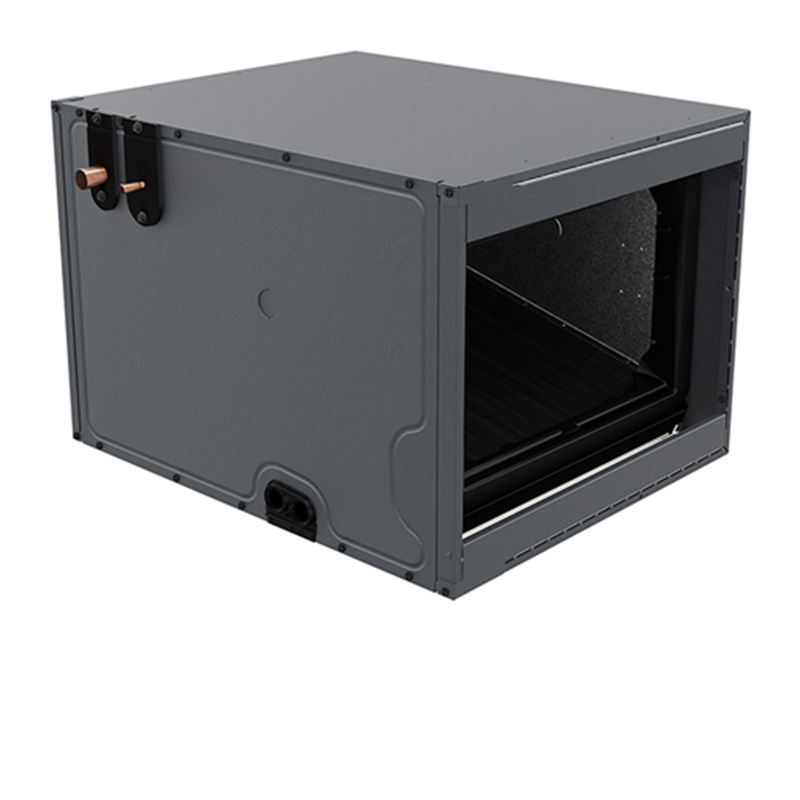
This specific bundle is configured and listed for horizontal installation. If your application requires upflow or downflow orientation, you would need to confirm with the supplier whether a different coil cabinet orientation is available, as coil drain pans and certain components are position-specific. Do not install a horizontal-rated coil in a vertical position without verifying manufacturer approval.
What does R-32 refrigerant mean for future service costs?
R-32 is becoming the industry standard replacement for R-410A, so availability is expected to be strong for the foreseeable future. It requires a smaller charge by weight than R-410A, which can reduce the cost of a recharge. Technicians will need R-32 certification and compatible equipment, which is increasingly common but worth confirming with your service provider.
How significant is the two-stage furnace upgrade over a single-stage at this price point?
In practical terms, two-stage heating means the furnace runs longer at a lower output on most days rather than blasting at full capacity and shutting off quickly. This produces more even temperatures room to room, less noise from abrupt starts and stops, and modestly lower gas consumption. For a home in a cold climate that runs the furnace heavily from November through March, the comfort difference is noticeable.
What should I budget for likely repairs over the first 10 years?
Based on documented Goodman failure patterns, dual-run capacitor replacement is the most common service call and typically runs between 300 and 600 dollars including labor. Evaporator coil leaks are more expensive, often in the 1,000 to 2,000 dollar range depending on labor market. Setting aside a modest annual service fund after year 5 is a practical approach with this brand.
Does Goodman's warranty require professional installation, and what does it actually cover?
Goodman requires registration within a specific window after installation to activate the full parts warranty, and most warranty terms require installation by a licensed HVAC contractor. The standard registered warranty covers parts for a defined term but does not cover labor costs, which is the larger portion of most repair bills. Read the warranty certificate carefully before purchase so there are no surprises at the first service call.
Specifications
| Cooling capacity | 2.5 Ton |
| Efficiency | 13.8 SEER2 |
| Furnace output | 60000 BTU |
| Furnace efficiency | 96% AFUE |
| Configuration | Horizontal |
| Refrigerant | R-32 |