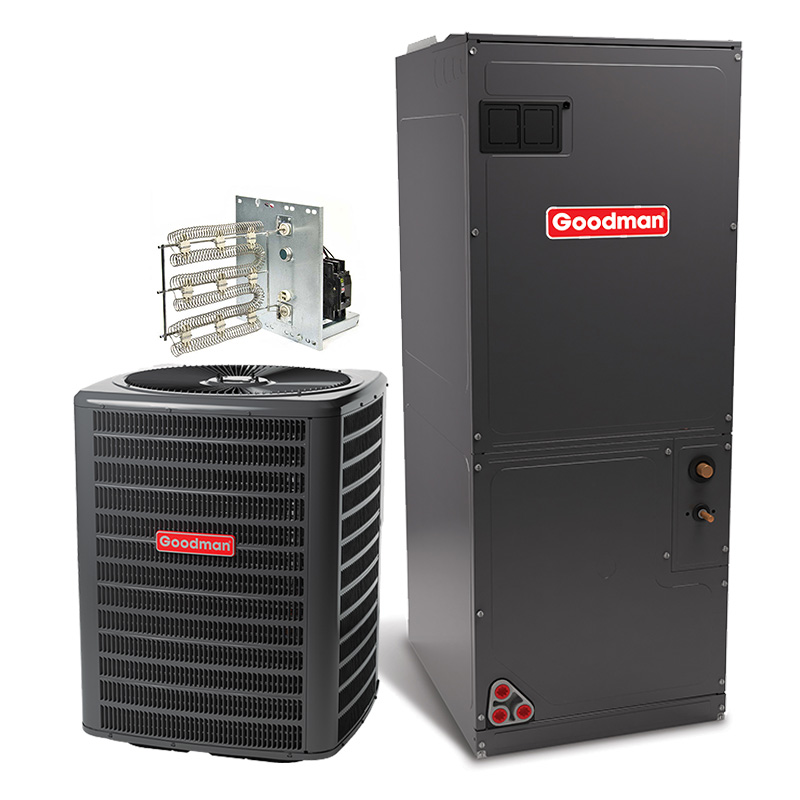
Goodman 2.5 Ton 13.8 SEER2 R32 Air Conditioner System With Electric Heat
View on AC Direct see your lowest price →Check current price on AC Direct →
Key features
- 2.5-ton capacity suitable for approximately 1,200 to 1,600 sq ft (load calculation required)
- 13.8 SEER2 efficiency rating meets current federal minimum standards
- R-32 refrigerant with lower global warming potential than R-410A
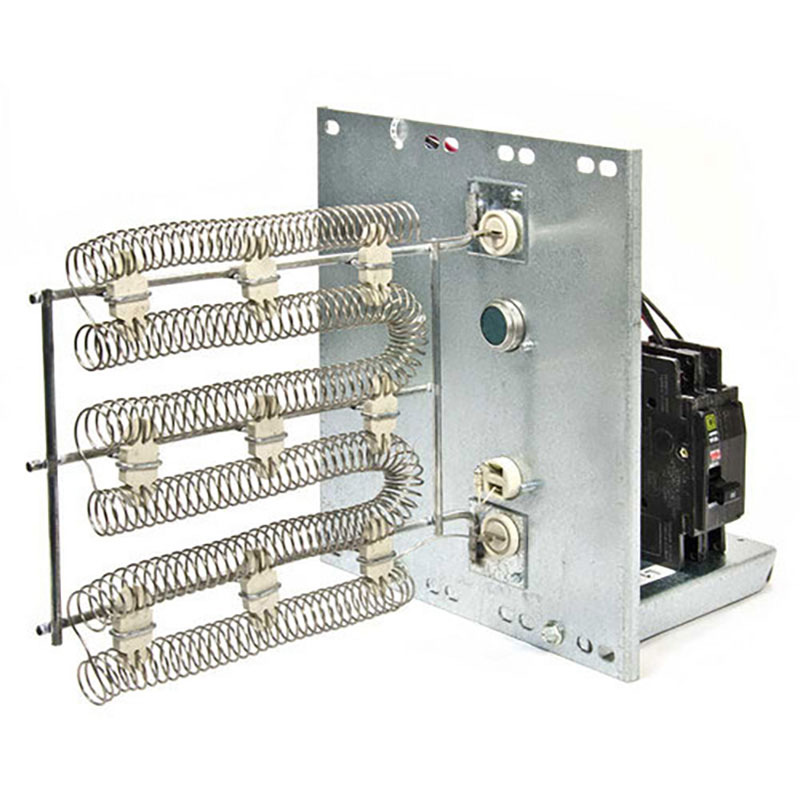
- Electric heat strips included for all-electric heating without a gas line
- Single-stage compressor operation for straightforward, proven simplicity
- Goodman value pricing typically 15 to 25 percent below Trane, Carrier, and Lennox equivalents
About this system
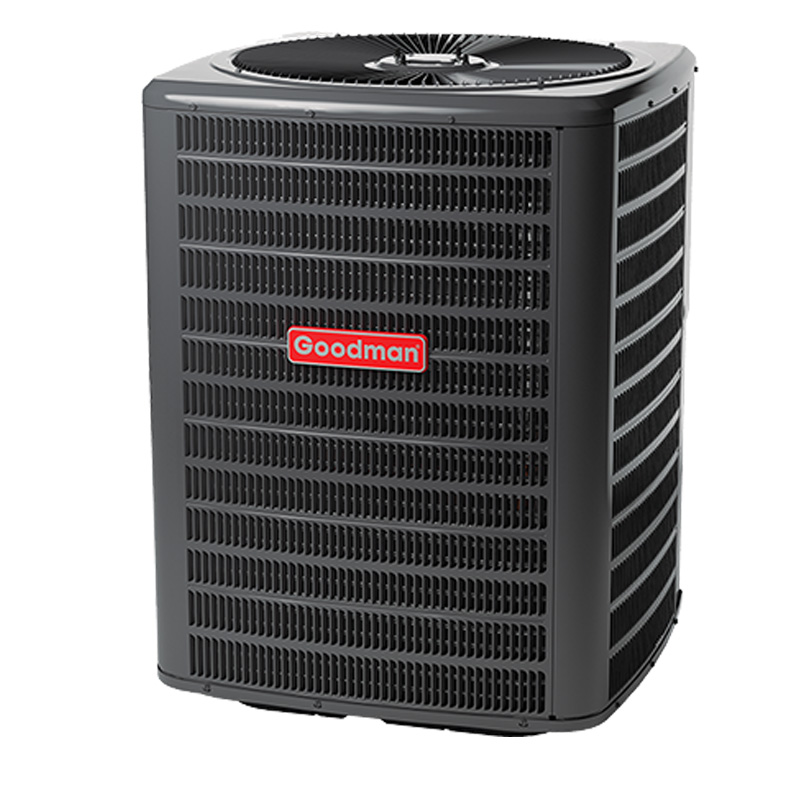
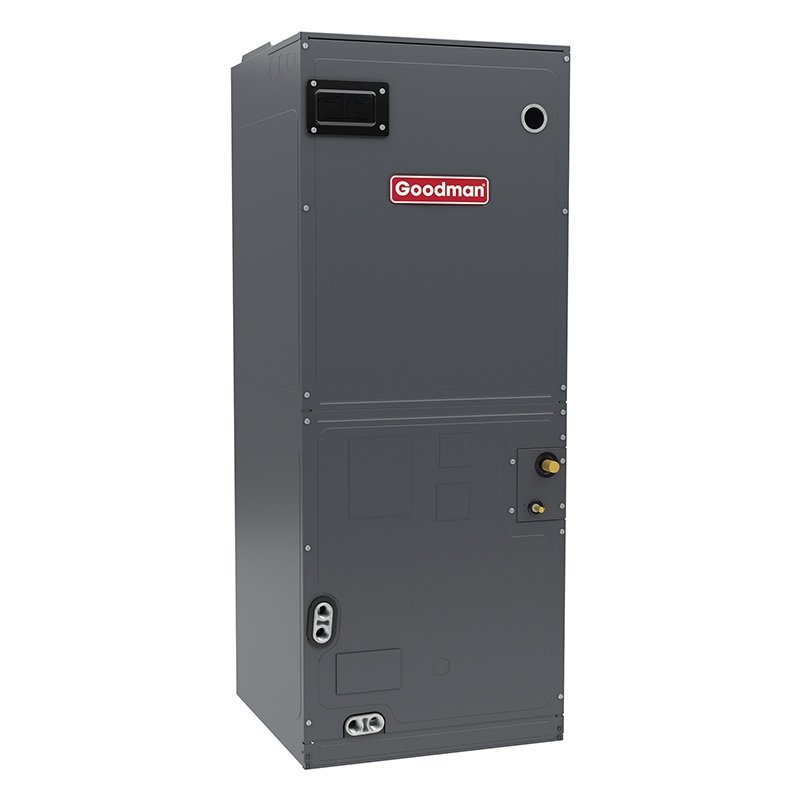
The Goodman 2.5-ton 13.8 SEER2 system with electric heat is a straightforward, entry-level cooling and heating package aimed at budget-conscious homeowners replacing aging equipment in mild to moderately warm climates. At 2.5 tons, it is sized for homes roughly in the 1,200 to 1,600 square foot range, depending on insulation, ceiling height, and local climate, though a proper Manual J load calculation by your installer should always confirm sizing. The electric heat component makes this a self-contained solution for homes that lack gas lines or prefer all-electric operation, pairing the outdoor condensing unit with an air handler and electric resistance heat strips.
The 13.8 SEER2 rating lands at the current federal minimum efficiency tier, which means it meets baseline legal requirements for new installations but will not deliver the utility savings of higher-efficiency two-stage or variable-speed systems. R-32 refrigerant is a notable step forward: it has a lower global warming potential than the R-410A it replaces, and its slightly higher energy density can support modest efficiency gains in future system designs. For a homeowner who needs reliable, affordable cooling and backup heat without a complex installation, this system hits a practical middle ground, provided it is installed carefully by a qualified technician.
This Goodman system offers one of the more accessible price points for a complete cooling and electric heat package, making it a realistic choice for homeowners prioritizing upfront cost over long-term efficiency gains. At 13.8 SEER2 it is not an efficiency standout, and Goodman's documented repair history means budgeting for potential mid-life maintenance is wise. The value proposition holds up best when installation quality is high and expectations are calibrated to a functional, no-frills system rather than a premium one.
Overall score is the average of the five ratings above.
What we like
- Upfront cost is meaningfully lower than Carrier, Trane, and Lennox equivalents at similar efficiency
- R-32 refrigerant is a forward-looking choice with lower environmental impact than R-410A
- All-electric configuration works for homes without natural gas access
- Single-stage design keeps installation and servicing straightforward for most technicians
- Replacement parts, especially capacitors, are widely available and generally low cost
Trade-offs
- 13.8 SEER2 is baseline efficiency only, offering little advantage on monthly energy bills versus higher-tier systems
- Dual-run capacitor failures are the most common documented issue, typically appearing after several years of use
- Evaporator coil leaks appear in a meaningful share of owner reviews, potentially leading to costly repairs outside warranty
- Compressor lifespan averages 10 to 14 years, shorter than the 15 to 20 years reported for premium-brand compressors
What homeowners and pros say about Goodman
Owners and dealers who leave reviews of Goodman equipment on Google give it roughly 3.8 out of 5 stars, with affordability consistently cited as the reason people choose it over name-brand alternatives. On ConsumerAffairs, the score drops to around 2.5 out of 5, though that platform skews heavily toward complaints rather than routine satisfaction, and the recurring theme there is repair costs that begin climbing noticeably after about year seven. For this 2.5-ton R-32 system, those patterns are likely to hold: buyers who get a clean installation and handle early maintenance promptly tend to get a functional decade or more from the equipment, while those who encounter the documented failure modes, particularly dual-run capacitor failures or evaporator coil leaks, sometimes find the repair costs erode the original purchase savings faster than expected.
HVAC technicians who work on Goodman equipment regularly are generally straightforward about the trade-offs. The parts are accessible and inexpensive, capacitor replacements being the prime example at roughly $300 to $600 a visit, but coil leaks and compressor longevity are real concerns to plan for. Compressors in Goodman units tend to average 10 to 14 years in field experience, versus 15 to 20 years for premium brands, which matters when sizing up the true cost of ownership. A smaller share of owners also report refrigerant leaks within the first year, which technicians attribute almost entirely to install or initial charge issues rather than the equipment itself, reinforcing why installer selection matters as much as brand selection with this system.
Sources: ConsumerAffairs Goodman owner reviews, AHRI Directory of Certified Product Performance, U.S. DOE appliance and equipment efficiency standards, Goodman product specification sheets.
What it costs to run
At 13.8 SEER2, cooling this 2.5-ton system for a typical 1200-hour cooling season at the U.S. average electricity rate of $0.17/kWh works out to roughly $443 per year in cooling, about $14 less per year than a minimum-efficiency 13.4 SEER2 unit of the same size. Your real cost depends on your climate and local rate.
Method: (30,000 BTU/hr ÷ 13.8 SEER2) × 1200 hours ÷ 1000 × $0.17/kWh. Rate source: U.S. EIA average; cooling hours: moderate-climate estimate.
How it compares
| Brand | Comparable model | SEER2 | Stage | Price position |
|---|---|---|---|---|
| Goodman | This system (2.5T 13.8 SEER2 R-32 with electric heat) | 13.8 | Single-stage | Value pick |
| Carrier | Comfort 13 / 14 Series (24ACC4) | 13.4 to 14.0 | Single-stage | Typically 15 to 25 percent more than Goodman |
| Trane | XR14 Series | 13.8 to 14.0 | Single-stage | Typically 15 to 25 percent more than Goodman |
| Lennox | Merit 14ACX Series | 13.8 to 14.3 | Single-stage | Typically 15 to 25 percent more than Goodman |
Competitor rows are comparable single-stage units at similar efficiency; price is relative position, not a quote.
Questions about this system
Is 13.8 SEER2 going to save me money on my electric bill compared to my old system?
It depends on what you are replacing. If your current unit is a 10 SEER or older system, yes, you will likely see a noticeable reduction in cooling costs. If you are replacing a relatively modern 15 or 16 SEER unit, the savings will be minimal since 13.8 SEER2 is roughly equivalent to 14 to 15 SEER under the older rating scale. This system is designed for affordability at purchase, not maximum efficiency over time.
Why does this system use R-32 refrigerant, and will it be harder to service?
R-32 is being adopted across the industry as a lower global warming potential alternative to R-410A, which is being phased down under EPA regulations. From a service standpoint, R-32 is mildly flammable (A2L classification), so technicians need proper certification and equipment to handle it safely, but it is not a barrier for any licensed HVAC professional. Parts availability is growing rapidly as more manufacturers shift to R-32.
What is the most common repair I should expect with this Goodman system over its life?
The dual-run capacitor is the single most frequently reported failure point in Goodman equipment. It is also one of the least expensive repairs, typically falling in the $300 to $600 range including labor. Evaporator coil leaks are the second most commonly reported issue and are more costly, so having a discussion with your installer about coil protection and refrigerant warranties up front is worthwhile.
Does the electric heat in this system replace a furnace completely, or do I still need one?
The electric heat strips in this package are designed to serve as your primary heat source in an all-electric setup, so a separate gas furnace is not required. However, electric resistance heat is less efficient than a heat pump, so in climates with cold winters your monthly heating costs will be higher than they would be with a heat pump or gas system. This configuration works best in mild climates or as a secondary heat source in moderate climates.
How important is installer quality for a Goodman system specifically?
It is the single biggest factor in how long this system will last and how reliably it will perform. HVAC technicians consistently cite installation quality as more consequential for Goodman equipment than for premium brands, which tend to have tighter factory tolerances and more built-in diagnostics. Choosing a licensed, experienced installer and asking specifically about refrigerant charge verification and duct sealing will have more impact on your outcome than almost any other decision you make.
Specifications
| Cooling capacity | 2.5 Ton |
| Efficiency | 13.8 SEER2 |
| Refrigerant | R-32 |