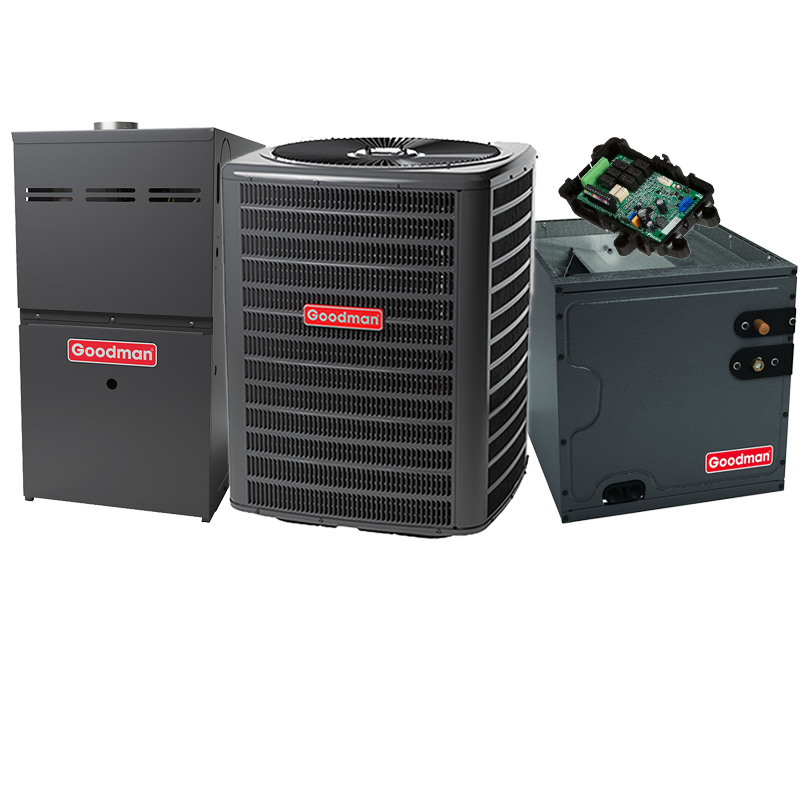
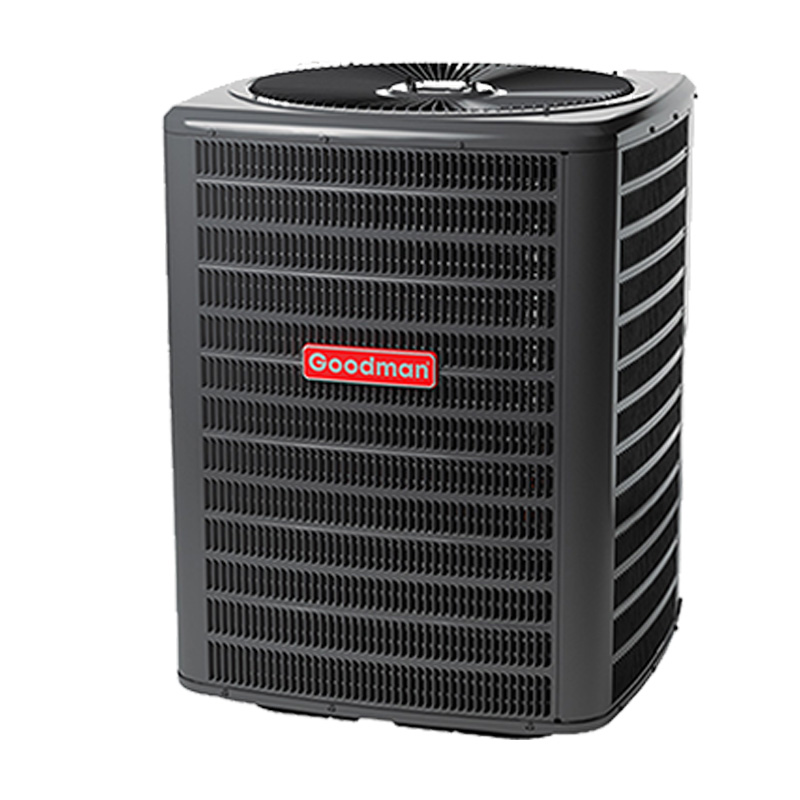
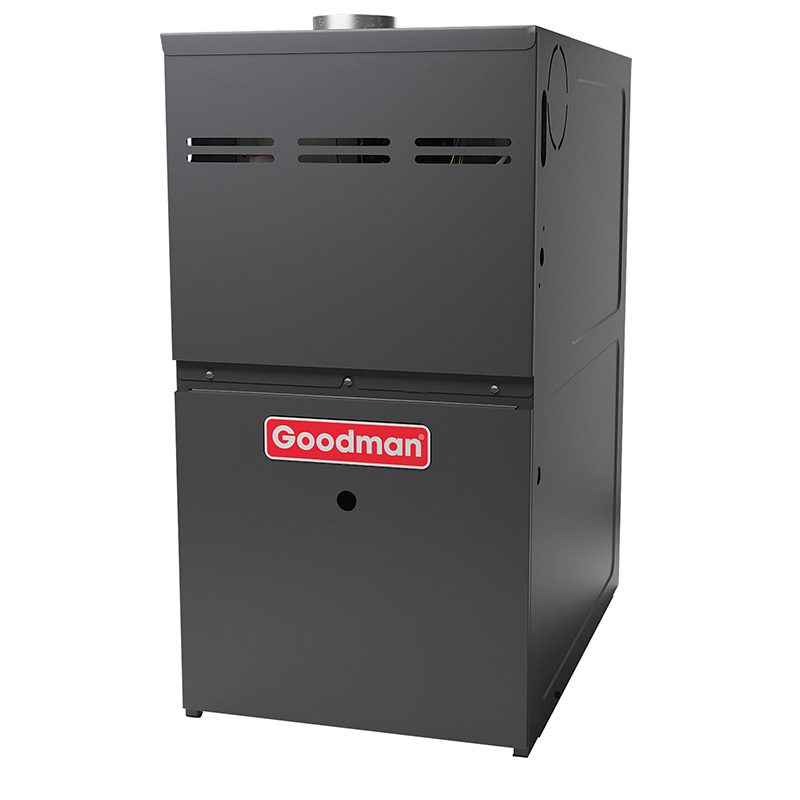
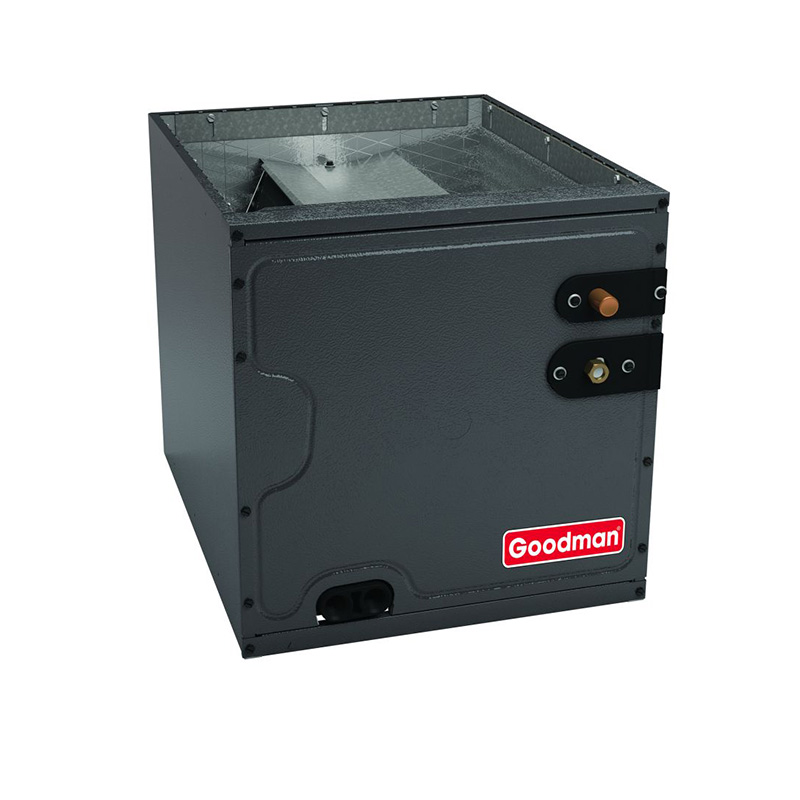
Goodman 2.5 Ton 14 SEER2 80000 BTU 80% Two-Stage Gas Furnace With R32 Air Conditioner Condenser And Coil System – Upflow
View on AC Direct see your lowest price →Check current price on AC Direct →
Key features
- 2.5-ton cooling capacity with 14 SEER2 efficiency rating
- 80,000 BTU two-stage gas furnace at 80% AFUE
- R-32 refrigerant with lower global warming potential than R-410A
- Upflow configuration for basement or utility-closet installations
- Matched condenser, evaporator coil, and furnace sold as a single bundle
- Two-stage heating reduces temperature swings and short-cycling
About this system
This Goodman upflow bundle pairs a 2.5-ton, 14 SEER2 R-32 air conditioner condenser and matching coil with an 80,000 BTU, 80% AFUE two-stage gas furnace. The 14 SEER2 rating sits at the current federal minimum efficiency floor for most U.S. climate zones, so it meets the bar but does not exceed it. What separates this package from single-stage alternatives is the two-stage furnace: it runs at a lower firing rate on mild days, which smooths out temperature swings and reduces short-cycling noise compared to a single-stage unit. R-32 refrigerant replaces the older R-410A in the cooling circuit, carrying a lower global warming potential and slightly better thermodynamic properties, though most homeowners will never notice the difference day to day.
The upflow configuration means the air handler draws return air from the bottom and discharges conditioned air upward, making it the right fit for a basement or utility closet where the duct trunk runs overhead. This is one of the more common residential configurations, and most HVAC contractors are comfortable with it. At 2.5 tons, the system is sized for roughly 1,200 to 1,600 square feet of well-insulated living space, though a proper Manual J load calculation should always confirm sizing before purchase. Bundling condenser, coil, and furnace from a single manufacturer simplifies warranty administration and ensures the components are rated to work together.
This Goodman bundle delivers a functional, code-compliant system at a price point that is noticeably below comparable Carrier, Trane, or Lennox packages, and the two-stage furnace adds real comfort value for the money. The trade-off is a brand track record that shows higher-than-average component failure rates after the seven-year mark and a compressor lifespan that typically trails premium competitors by several years. It is a reasonable choice for budget-conscious buyers who understand that installation quality and a good service relationship with their contractor will matter more than the equipment badge.
Overall score is the average of the five ratings above.
What we like
- Priced 15 to 25 percent below comparable Carrier, Trane, and Lennox systems
- Two-stage furnace improves comfort and reduces short-cycling on mild days
- R-32 refrigerant is more environmentally friendly than R-410A
- Matched component bundle simplifies warranty claims and sizing
- Upflow layout suits the most common residential duct configurations
Trade-offs
- Compressors average 10 to 14 years versus 15 to 20 years for premium brands
- Evaporator coil leaks appear in a meaningful share of owner reports
- Dual-run capacitor failures are common after year seven, adding recurring service costs
- 14 SEER2 is the efficiency floor, not a standout rating, so long-term energy savings are limited compared to higher-SEER2 options
What homeowners and pros say about Goodman
Homeowners who have lived with Goodman equipment tend to split into two camps, and the pattern shows clearly in the brand’s ratings. On ConsumerAffairs, Goodman scores around 2.5 out of 5, a channel where frustrated owners are more likely to post than satisfied ones, and the recurring complaint is repair costs that begin stacking up somewhere around year seven. Google dealer reviews tell a softer story, averaging around 3.8 out of 5 across hundreds of reviews per location, with affordability cited most often as the reason buyers chose the brand. Neither number is fabricated praise, and neither is a verdict of failure.
HVAC technicians who work on Goodman equipment regularly point to two specific failure modes worth knowing before you buy. Dual-run capacitors are the most commonly replaced part, typically a straightforward repair in the $300 to $600 range but one that tends to recur on older units. Evaporator coil leaks show up in a meaningful portion of owner reviews, and those repairs are more expensive and disruptive. On the cooling side, Goodman compressors average 10 to 14 years in real-world reports, compared to 15 to 20 years for premium-brand compressors, which is a meaningful gap if you intend to stay in the home long term. Technicians consistently note that installation quality, including proper refrigerant charge and airflow setup, is the single biggest variable in how long any Goodman system lasts, so choosing an experienced installer matters as much as the equipment itself.
Sources: ConsumerAffairs Goodman owner reviews, AHRI Directory of Certified Product Performance, U.S. DOE appliance and equipment efficiency standards, Goodman product specification sheets.
What it costs to run
At 14 SEER2, cooling this 2.5-ton system for a typical 1200-hour cooling season at the U.S. average electricity rate of $0.17/kWh works out to roughly $437 per year in cooling, about $20 less per year than a minimum-efficiency 13.4 SEER2 unit of the same size. Your real cost depends on your climate and local rate.
Method: (30,000 BTU/hr ÷ 14 SEER2) × 1200 hours ÷ 1000 × $0.17/kWh. Rate source: U.S. EIA average; cooling hours: moderate-climate estimate.
How it compares
| Brand | Comparable model | SEER2 | Stage | Price position |
|---|---|---|---|---|
| Goodman | 2.5T 14 SEER2 / 80K BTU 80% Two-Stage Bundle (this system) | 14 | two-stage furnace / single-stage cooling | Value pick |
| Carrier | Performance 14 / 58TP (Comfort 80 furnace) bundle | 14 | two-stage furnace / single-stage cooling | Roughly 20 to 25 percent higher than this Goodman bundle |
| Trane | XR14c / S8X2 (S-Series 80%) bundle | 14 | two-stage furnace / single-stage cooling | Roughly 20 to 25 percent higher than this Goodman bundle |
| Lennox | Merit ML14XC1 / ML180UH (80% furnace) bundle | 14 | two-stage furnace / single-stage cooling | Roughly 15 to 20 percent higher than this Goodman bundle |
Competitor rows are comparable single-stage units at similar efficiency; price is relative position, not a quote.
Questions about this system
Why does this system use R-32 refrigerant instead of R-410A, and does that affect service costs?
R-32 has a lower global warming potential and is being adopted across the industry as R-410A is phased down under federal regulations. Service costs should be comparable to R-410A systems, though not every technician carries R-32 yet, so confirming your local contractor stocks it before committing is worthwhile.
What does two-stage mean on the furnace, and is it worth it over single-stage?
A two-stage furnace has a low-fire setting for mild cold days and a high-fire setting for the coldest conditions, rather than running at full blast every time. In practice this means quieter operation, more even temperatures throughout the house, and slightly better fuel efficiency compared to a single-stage unit at the same AFUE rating.
What are the most common repairs I should budget for after the warranty period?
Dual-run capacitor failure is the most frequently reported issue with Goodman equipment and typically costs between $300 and $600 to fix, including labor. Evaporator coil leaks and refrigerant loss are also documented in owner reviews, and those repairs can run considerably higher depending on the extent of the problem.
Is 2.5 tons the right size for my home, or do I need a load calculation?
A Manual J load calculation performed by your installer is the only reliable way to confirm sizing. Rules of thumb like 400 square feet per ton can be off by one full ton or more depending on insulation levels, ceiling height, window area, and local climate, and an oversized or undersized system will underperform regardless of brand.
Does the upflow configuration mean I need a specific type of installation setup?
Yes. Upflow means the furnace pulls return air through its bottom and pushes conditioned air out the top, so it is designed for installations where the supply duct trunk is above the unit, typically a basement or a main-floor utility closet with attic ductwork. If your ducts run below the equipment, you would need a downflow or horizontal configuration instead.
Specifications
| Cooling capacity | 2.5 Ton |
| Efficiency | 14 SEER2 |
| Furnace output | 80000 BTU |
| Configuration | Upflow |
| Refrigerant | R-32 |