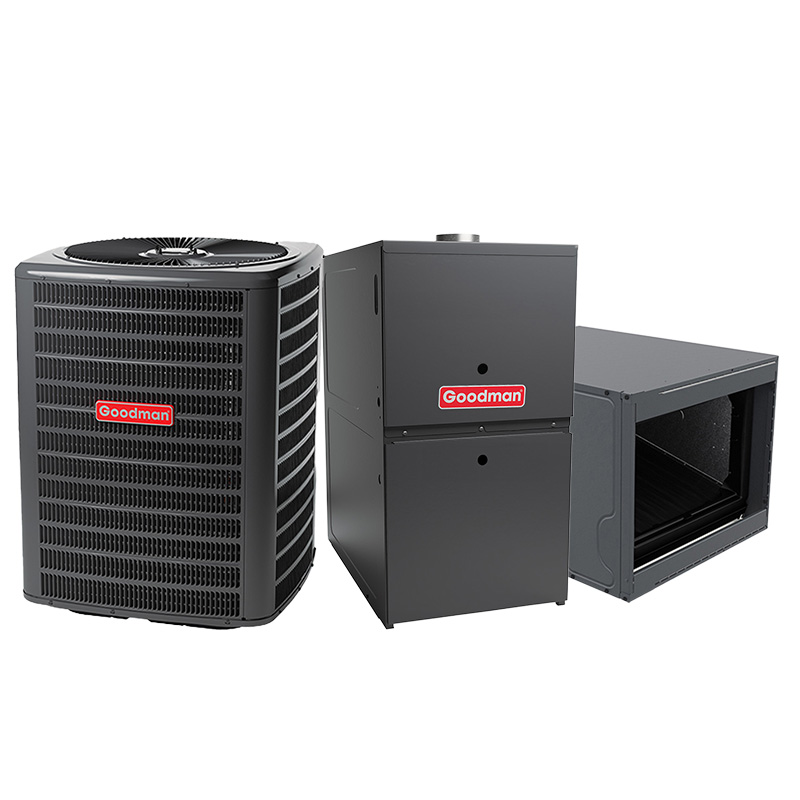
Goodman 2.5 Ton 16.2 SEER2 AC & Gas Furnace System – Two Stage Variable-Speed, 80000 BTU Low NOx Gas Furnace, 80% AFUE, Horizontal, R32
View on AC Direct see your lowest price →Check current price on AC Direct →
Key features
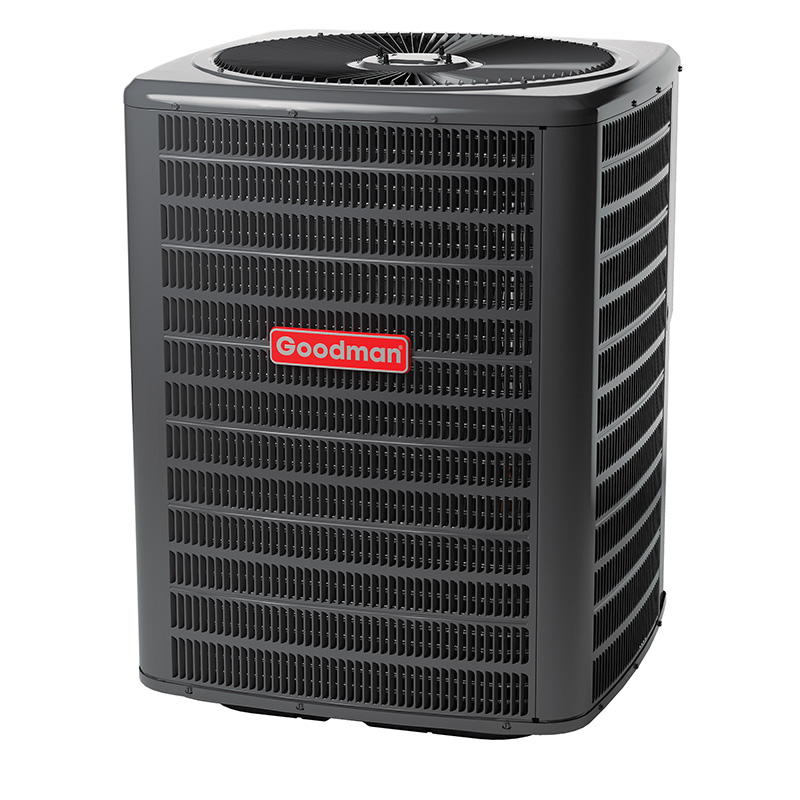
- Two-stage compressor runs at partial capacity during mild conditions to reduce short-cycling and improve dehumidification
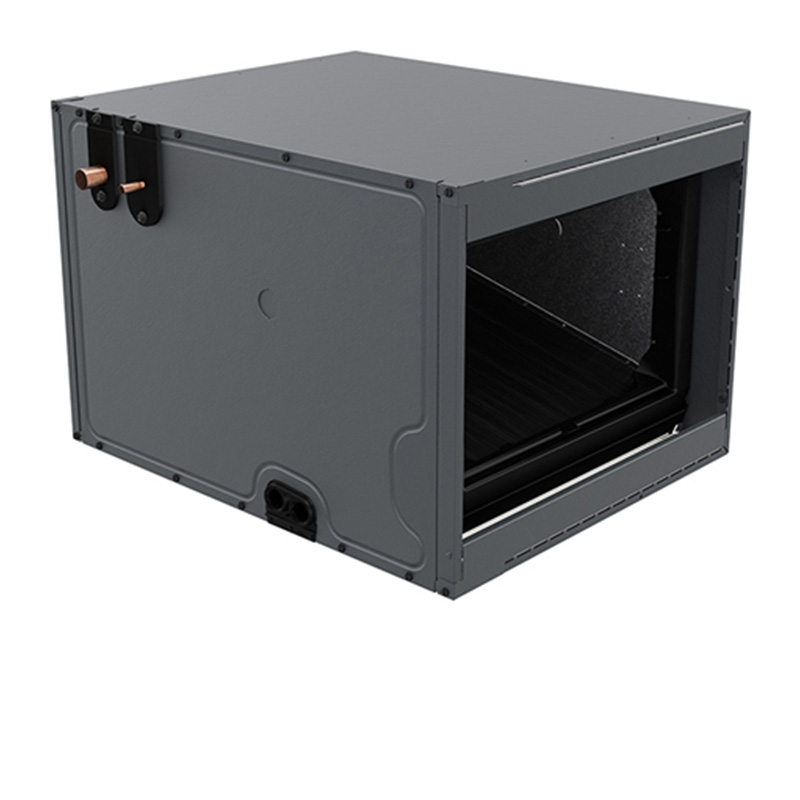
- Variable-speed ECM air handler motor adjusts airflow gradually for quieter operation and more consistent temperatures
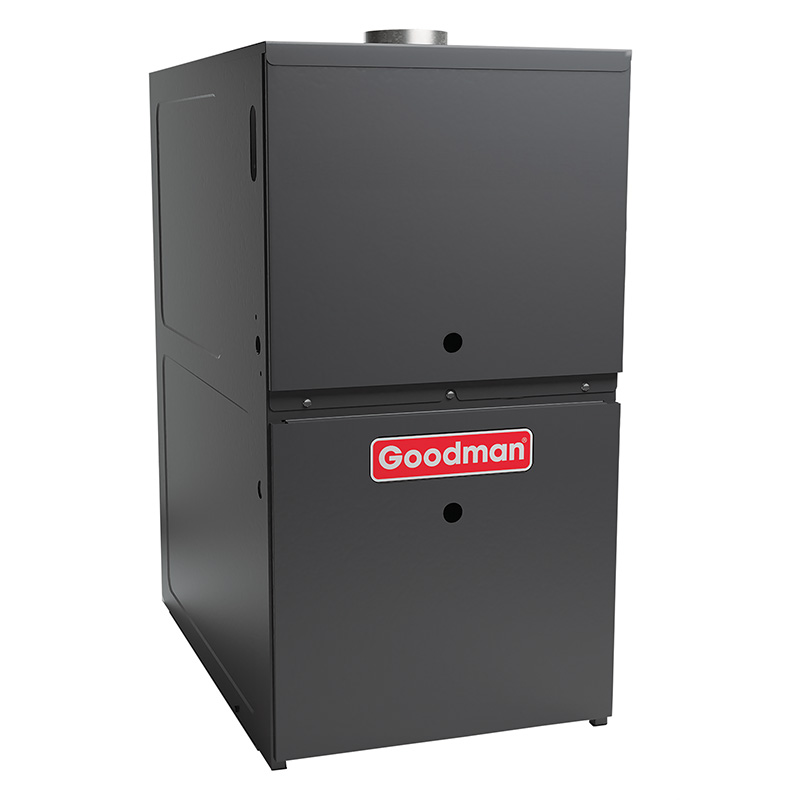
- Horizontal furnace orientation designed for attic, crawlspace, or side-discharge installations
- 80,000 BTU gas furnace at 80% AFUE with low-NOx combustion meeting stricter regional air-quality standards
- R-32 refrigerant with lower global warming potential than R-410A and growing industry-wide supply chain support
- 16.2 SEER2 efficiency rating meets 2023 federal minimums with moderate headroom above the baseline in most regions
About this system
The Goodman 2.5 Ton 16.2 SEER2 system pairs a two-stage, variable-speed air conditioner with an 80,000 BTU horizontal gas furnace rated at 80% AFUE. The two-stage compressor runs at low capacity during mild weather and steps up only when demand rises, which reduces short-cycling, lowers humidity more effectively than a single-stage unit, and eases the strain on electrical circuits compared to a full-load start every cycle. The variable-speed air handler motor further refines airflow, running quietly at reduced speeds most of the time and adjusting gradually rather than blasting on and off.
The horizontal configuration makes this system a natural fit for attic installations, crawlspace setups, or any application where vertical clearance is limited. R-32 refrigerant carries a lower global warming potential than the R-410A it replaces and is increasingly the industry standard going forward, so parts and refrigerant availability should remain solid. At 80% AFUE, roughly one dollar in five of your gas spend exits as exhaust heat, which is acceptable for mild-to-moderate heating climates but falls short of the 90%-plus efficiency available in two-stage or modulating condensing furnaces if heating costs are a primary concern.
This system is aimed at homeowners who want a meaningful step up from basic single-stage equipment without paying the premium that Trane, Lennox, or Carrier charge for comparable staging and motor technology. It suits replacement projects in homes between roughly 1,200 and 1,800 square feet in mixed climates, provided the ductwork is properly sized and the installing contractor is experienced with Goodman equipment.
This Goodman system delivers genuine two-stage and variable-speed technology at a price point that undercuts comparable Carrier, Trane, and Lennox equipment by 15 to 25 percent, making it a reasonable choice for budget-conscious buyers who prioritize upfront cost and can source a skilled installer. The 80% AFUE furnace and 16.2 SEER2 rating are competent rather than exceptional, and long-term ownership costs depend heavily on whether you land the dual-run capacitors, coil, and refrigerant charge issues that recur in owner feedback. It is not a set-and-forget system for the next 20 years, but it can perform well for 10 to 14 years with attentive maintenance.
Overall score is the average of the five ratings above.
What we like
- Two-stage compressor improves comfort and humidity control compared to single-stage systems at this price
- Variable-speed ECM motor operates quietly and reduces energy use during the majority of run hours
- Priced 15 to 25 percent below Trane, Lennox, and Carrier systems with similar staging and motor type
- R-32 refrigerant is forward-compatible with evolving regulations and has a well-established supply chain
- Horizontal configuration opens this system to attic and crawlspace installs where many furnaces will not fit
Trade-offs
- 80% AFUE means roughly 20% of gas is lost as exhaust, a real cost gap versus 95%-plus condensing alternatives in cold climates
- Dual-run capacitors are the brand's most documented failure point and can require service calls every few years after year 7
- Compressor lifespan averages 10 to 14 years versus 15 to 20 years on premium brands, meaning earlier replacement exposure
- Evaporator coil leaks and first-year refrigerant issues appear in a meaningful share of owner reports, often traced to install or initial charge quality
What homeowners and pros say about Goodman
Homeowners who track their Goodman systems online reflect a split picture. On ConsumerAffairs, Goodman sits at roughly 2.5 out of 5, a score shaped largely by owners who sought out a review platform because something went wrong. The recurring thread in those complaints is repair costs climbing after year 7, often tied to the dual-run capacitor failures the brand is well known for, as well as evaporator coil leaks that can be expensive to address once they develop. On Google dealer reviews, where a broader cross-section of buyers weighs in, the brand averages closer to 3.8 out of 5, with affordability and the accessibility of parts cited most often as reasons owners feel the purchase was worthwhile despite some maintenance friction along the way.
HVAC technicians tend to view Goodman equipment as adequate hardware whose real ceiling is set by the installation. Technicians who work on it regularly point out that the compressor lifespan running 10 to 14 years on average, compared to 15 to 20 years on premium brands, is a genuine long-term cost factor, particularly for owners who stay in a home past the 12-year mark. The first-year refrigerant leak reports that show up in a minority of owner reviews are almost universally attributed by pros to improper line set evacuation or an incorrect charge at startup rather than a manufacturing defect, which underscores why installer selection matters at least as much as brand choice when buying a Goodman system.
Sources: ConsumerAffairs Goodman owner reviews, AHRI Directory of Certified Product Performance, U.S. DOE appliance and equipment efficiency standards, Goodman product specification sheets.
What it costs to run
At 16.2 SEER2, cooling this 2.5-ton system for a typical 1200-hour cooling season at the U.S. average electricity rate of $0.17/kWh works out to roughly $378 per year in cooling, about $79 less per year than a minimum-efficiency 13.4 SEER2 unit of the same size. Your real cost depends on your climate and local rate.
Method: (30,000 BTU/hr ÷ 16.2 SEER2) × 1200 hours ÷ 1000 × $0.17/kWh. Rate source: U.S. EIA average; cooling hours: moderate-climate estimate.
How it compares
| Brand | Comparable model | SEER2 | Stage | Price position |
|---|---|---|---|---|
| Goodman | GSX16/GMVC8 Series (this system) | 16.2 | Two-stage / Variable-speed | Value pick |
| Carrier | Comfort 16 (24ACC6 Series) | 16 | Single-stage | Typically 15 to 25 percent more than this Goodman system |
| Trane | XR16 Series | 16 | Single-stage | Typically 15 to 25 percent more than this Goodman system |
| Lennox | Merit ML16XC1 Series | 16 | Single-stage | Typically 15 to 25 percent more than this Goodman system |
Competitor rows are comparable single-stage units at similar efficiency; price is relative position, not a quote.
Questions about this system
Why does the horizontal furnace configuration matter, and can this system be installed vertically instead?
Horizontal furnaces are engineered to lie on their side, with the heat exchanger, burners, and drain positioned for that orientation. Using a dedicated horizontal unit in an attic or crawlspace avoids the condensate and clearance problems that arise from forcing a convertible unit into an awkward position. This specific model is rated for horizontal installation only, so if you need a vertical or downflow setup, you will need a different furnace configuration from Goodman's lineup.
What does two-stage mean in practice, and how does it differ from a variable-speed system?
Two-stage refers to the compressor having two operating levels, typically around 65 to 70 percent capacity on the first stage and 100 percent on the second. Most run hours fall on the lower stage, which reduces humidity more effectively and avoids the abrupt on-off cycling of single-stage equipment. Variable-speed in this system describes the air handler blower motor, which modulates airflow continuously rather than switching between fixed speeds, adding further comfort and efficiency gains.
How serious is the dual-run capacitor failure issue, and what does it cost to fix?
Capacitor failures are the most commonly reported repair on Goodman equipment and tend to show up after roughly year 7. The part itself is inexpensive, and a qualified technician can typically complete the repair for 300 to 600 dollars including labor. Carrying a service agreement or simply scheduling annual tune-ups where the capacitor is tested and replaced proactively before it fails is the standard way owners manage this.
Is R-32 refrigerant easy to find, and are there safety considerations compared to R-410A?
R-32 is now used by multiple major manufacturers and is widely stocked by HVAC distributors, so availability is not a concern. It is classified as mildly flammable, which means certified technicians follow specific handling protocols, but for the homeowner the practical day-to-day experience is no different from R-410A. Code-compliant installation already accounts for the handling requirements.
Does the 80% AFUE furnace qualify for federal energy efficiency tax credits?
As of current IRS guidance, the federal 25C energy efficiency tax credit for gas furnaces requires a minimum of 97% AFUE for most of the country, meaning an 80% AFUE unit does not qualify. Some state or utility rebate programs have lower thresholds, so it is worth checking your local utility's program, but you should not count on a federal credit with this furnace.
Specifications
| Cooling capacity | 2.5 Ton |
| Efficiency | 16.2 SEER2 |
| Furnace output | 80000 BTU |
| Furnace efficiency | 80% AFUE |
| Configuration | Horizontal |
| Refrigerant | R-32 |