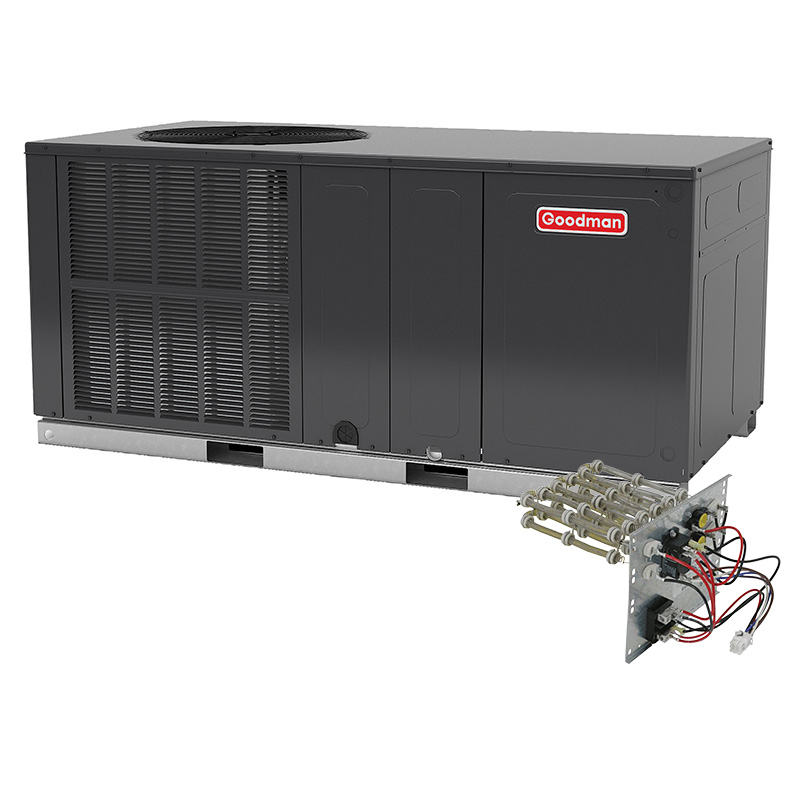
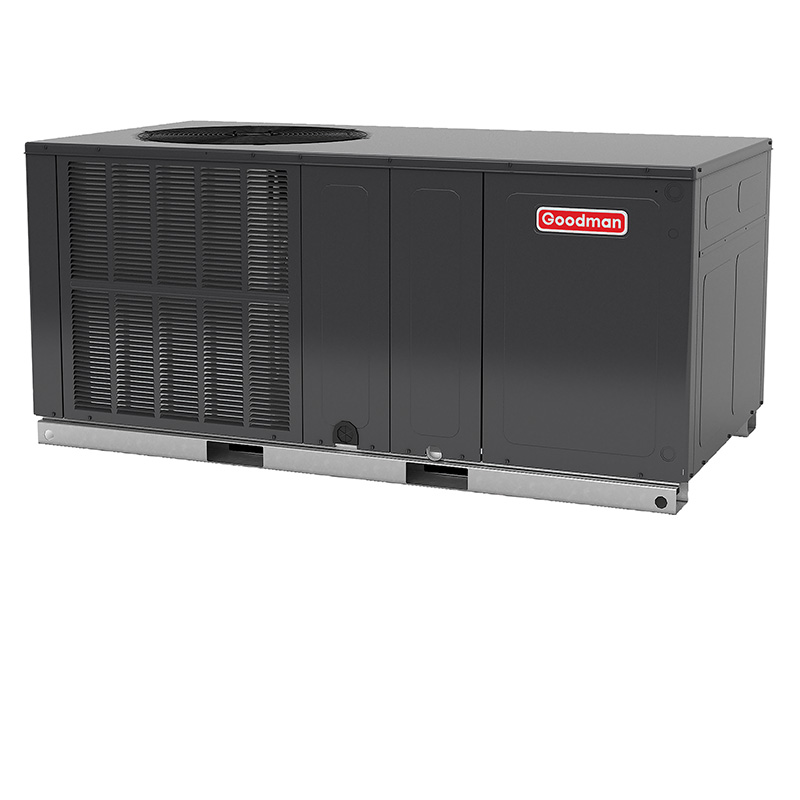
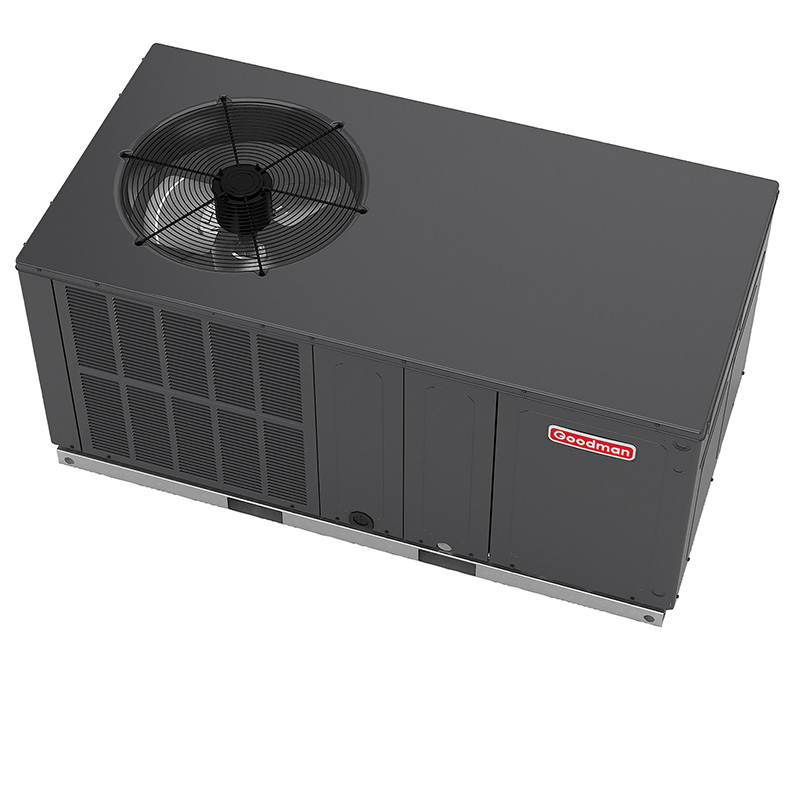
Goodman 2.5 Ton Heat Pump Package Unit – 15.2 SEER2, Horizontal Discharge, R32
View on AC Direct see your lowest price →Check current price on AC Direct →
Key features
- 15.2 SEER2 efficiency rating meets current federal minimum standards for most U.S. climate zones
- Horizontal-discharge configuration designed for rooftop, curb-mount, or under-floor installations
- 2.5-ton (approximately 30,000 BTU) capacity suited to roughly 1,200 to 1,600 square feet
- R-32 refrigerant with lower global-warming potential than outgoing R-410A
- Self-contained package unit combines compressor, coil, and air handler in one cabinet
- Single-stage scroll compressor operation with factory-installed refrigerant charge
About this system
The Goodman 2.5-ton heat pump package unit delivers 15.2 SEER2 efficiency in a horizontal-discharge configuration, making it a practical choice for manufactured homes, crawl-space installs, and applications where the unit sits on a rooftop curb or beneath a structure with limited vertical clearance. At 2.5 tons it is sized for roughly 1,200 to 1,600 square feet of conditioned space, depending on local climate, insulation quality, and window exposure. The all-in-one package design means the compressor, air handler, and coil share a single cabinet, which simplifies installation and eliminates the refrigerant line set runs required by split systems.
This unit uses R-32 refrigerant, a lower global-warming-potential option that is becoming the industry standard as older R-410A equipment phases out. R-32 operates at slightly higher pressures than R-410A, so technicians servicing this unit will need to be familiar with the refrigerant and have compatible recovery equipment. The 15.2 SEER2 rating sits right at the federal minimum efficiency threshold for most northern U.S. climate zones, and lands in the mid-tier range for heat pumps broadly. It will outperform older 13 or 14 SEER equipment by a meaningful margin on energy bills, but it does not approach the comfort consistency of higher-stage or variable-speed units at this efficiency tier.
Goodman positions this unit as a budget-conscious alternative to comparable Carrier, Trane, and Lennox package heat pumps, typically priced 15 to 25 percent below those brands. That price gap makes it an appealing fit for rental properties, budget replacements, and situations where installation cost is the primary constraint. Buyers should go in knowing that Goodman’s long-term performance record is heavily tied to installation quality, and that some documented failure modes, particularly dual-run capacitors and evaporator coil leaks, are worth factoring into ownership cost projections.
The Goodman 2.5-ton horizontal package heat pump is a functional, budget-forward option that makes the most sense when upfront cost is the primary concern and a skilled installer is handling the job. Its 15.2 SEER2 rating meets current efficiency requirements without exceeding them, and the single-stage compressor delivers straightforward but not exceptional comfort. Owners who go in with realistic expectations about Goodman's track record, and who budget for possible capacitor or coil service after year seven, will find it a defensible value.
Overall score is the average of the five ratings above.
What we like
- Priced 15 to 25 percent below comparable Trane, Carrier, and Lennox package units
- Horizontal-discharge layout opens installation options unavailable to vertical-only equipment
- R-32 refrigerant is forward-compatible as R-410A supply tightens and costs rise
- Single-cabinet package design reduces installation labor compared to split systems
- 15.2 SEER2 provides a real efficiency improvement over aging 13 SEER equipment
Trade-offs
- Single-stage operation means the compressor runs at full capacity or not at all, which can cause temperature swings and humidity issues in mild weather
- Compressor lifespan averages 10 to 14 years, notably shorter than the 15 to 20 years documented for premium-brand compressors
- Dual-run capacitor failures are the most commonly reported issue and, while relatively inexpensive to fix at $300 to $600, add to total ownership cost over time
- A minority of owners report refrigerant leaks in the first year, most traceable to installation or factory charge issues rather than equipment defects, but still a real risk with R-32 at higher pressures
What homeowners and pros say about Goodman
Homeowners who have lived with Goodman package equipment tend to split into two camps. Those who had a careful, experienced installer handle the job often report years of unremarkable, functional service and point to the lower purchase price as a clear win. Those who ran into problems tend to cite repair bills that started accumulating around year seven or eight, which aligns with Goodman’s ConsumerAffairs score of roughly 2.5 out of 5, a channel that skews heavily toward complaint-driven reviews. The most commonly documented hardware issue across owner accounts is the dual-run capacitor, a component that typically fails with clear warning signs and costs $300 to $600 to replace, making it an annoying but manageable ownership reality rather than a catastrophic one. More serious are the evaporator coil leak reports that appear in a meaningful share of owner reviews, since coil replacement is a substantially larger expense.
HVAC technicians who work on Goodman equipment regularly tend to offer a more measured view, reflected in Google dealer ratings that average around 3.8 out of 5 across locations. Pros frequently note that affordability is the honest reason to choose Goodman, and that the brand’s reputation for shorter compressor life, averaging 10 to 14 years versus 15 to 20 years for premium brands, is real but manageable if the unit is installed correctly and maintained annually. For this specific horizontal package heat pump, technicians also flag that a minority of early refrigerant leak reports involve R-32 charge issues, which makes first-year system verification by the installing contractor an important step. The consensus view from the trade is that Goodman rewards buyers who invest in a quality installation and treat annual maintenance as non-optional, and that it underperforms for those who treat the lower price as an invitation to cut corners on either front.
Sources: ConsumerAffairs Goodman owner reviews, AHRI Directory of Certified Product Performance, U.S. DOE appliance and equipment efficiency standards, Goodman product specification sheets.
What it costs to run
At 15.2 SEER2, cooling this 2.5-ton system for a typical 1200-hour cooling season at the U.S. average electricity rate of $0.17/kWh works out to roughly $403 per year in cooling, about $54 less per year than a minimum-efficiency 13.4 SEER2 unit of the same size. Your real cost depends on your climate and local rate.
Method: (30,000 BTU/hr ÷ 15.2 SEER2) × 1200 hours ÷ 1000 × $0.17/kWh. Rate source: U.S. EIA average; cooling hours: moderate-climate estimate.
How it compares
| Brand | Comparable model | SEER2 | Stage | Price position |
|---|---|---|---|---|
| Goodman | 2.5-Ton Horizontal Package Heat Pump (this unit) | 15.2 | Single-stage | Value pick |
| Carrier | WeatherMaster 50XC series | 15.2 | Single-stage | Typically 15 to 25 percent more than this Goodman |
| Trane | Precedent THC series | 15.0 to 15.5 | Single-stage | Typically 15 to 25 percent more than this Goodman |
| Lennox | TCH/THP series | 15.0 to 15.5 | Single-stage | Typically 15 to 25 percent more than this Goodman |
Competitor rows are comparable single-stage units at similar efficiency; price is relative position, not a quote.
Questions about this system
Is a horizontal-discharge package unit harder to find service for than a standard vertical unit?
Not meaningfully. The horizontal configuration changes how the unit is mounted and where discharge air exits, but the internal components, refrigerant circuit, and service procedures are essentially the same as a vertical package unit. Any technician familiar with Goodman package equipment can service it. The bigger serviceability factor is whether local dealers stock the specific parts, particularly the dual-run capacitor, which is the most commonly replaced component on this platform.
Does R-32 refrigerant cost more to service than R-410A if there is a leak?
R-32 is currently priced similarly to R-410A in most markets, and its higher energy density means a system requires less of it by weight, which can modestly reduce material cost per service call. The practical concern is that not every technician has updated their recovery equipment for R-32, so confirming your service contractor is certified and equipped for it before a problem arises is worthwhile.
What does the Goodman warranty actually cover on this unit, and are there conditions I need to meet?
Goodman typically offers a 10-year parts limited warranty on registered units, which covers the compressor and other factory components but not labor. Registration must usually be completed within a specified window after installation, and the warranty is generally voided by unauthorized modifications or failure to perform documented annual maintenance. Reading the actual warranty certificate for this specific model number before purchase is the only way to confirm current terms, as Goodman has revised coverage structures in recent years.
Will 2.5 tons be enough for my 1,400-square-foot home, or should I go up to 3 tons?
Tonnage selection should be based on a Manual J load calculation, not square footage alone. Oversizing a package heat pump causes short-cycling, which increases humidity, wears the compressor faster, and reduces efficiency. In a reasonably insulated 1,400-square-foot home in a moderate climate, 2.5 tons is often appropriate, but homes in very hot or humid climates, with high ceilings, or with significant window area may legitimately need 3 tons. Ask your installer to show you the load calculation before committing to a size.
How realistic is the 10 to 14 year compressor lifespan for Goodman, and what drives it shorter or longer?
The 10 to 14 year range reflects documented owner and technician reports across Goodman's residential heat pump line. Installation quality is the single most cited factor in how long a compressor lasts: an improperly charged system, undersized line set, or inadequate airflow across the coil all accelerate wear. Units that are serviced annually, kept clean, and had the refrigerant charge verified at installation routinely reach the higher end of that range, while neglected units trend toward the lower end.
Specifications
| Cooling capacity | 2.5 Ton |
| Efficiency | 15.2 SEER2 |
| Configuration | Horizontal |
| Refrigerant | R-32 |