Goodman 2.5 Ton Package Unit Gas / Electric AC – 81% Efficiency 60000 BTU | 13.4 SEER2 Multi-Positional | R32
View on AC Direct see your lowest price →Check current price on AC Direct →
Key features
- 2.5-ton capacity with 60,000 BTU gas heating in one cabinet
- 13.4 SEER2 cooling efficiency meets current federal minimums
- Multi-position airflow suits rooftop or slab horizontal installations
- R-32 refrigerant with lower global warming potential than R-410A
- Single-stage scroll compressor for straightforward servicing
- Factory-matched components reduce field assembly variables
About this system
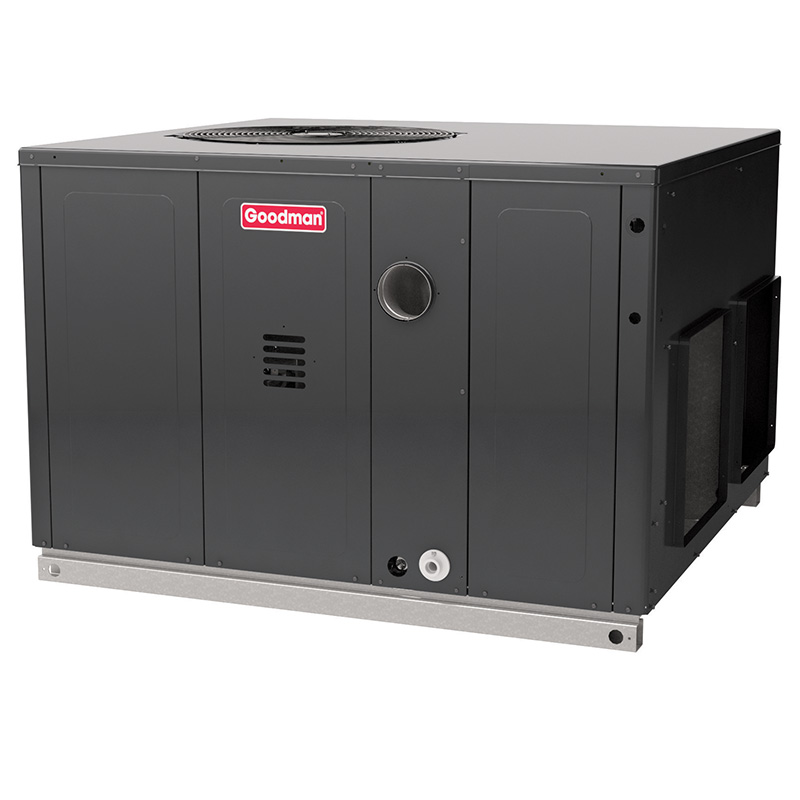
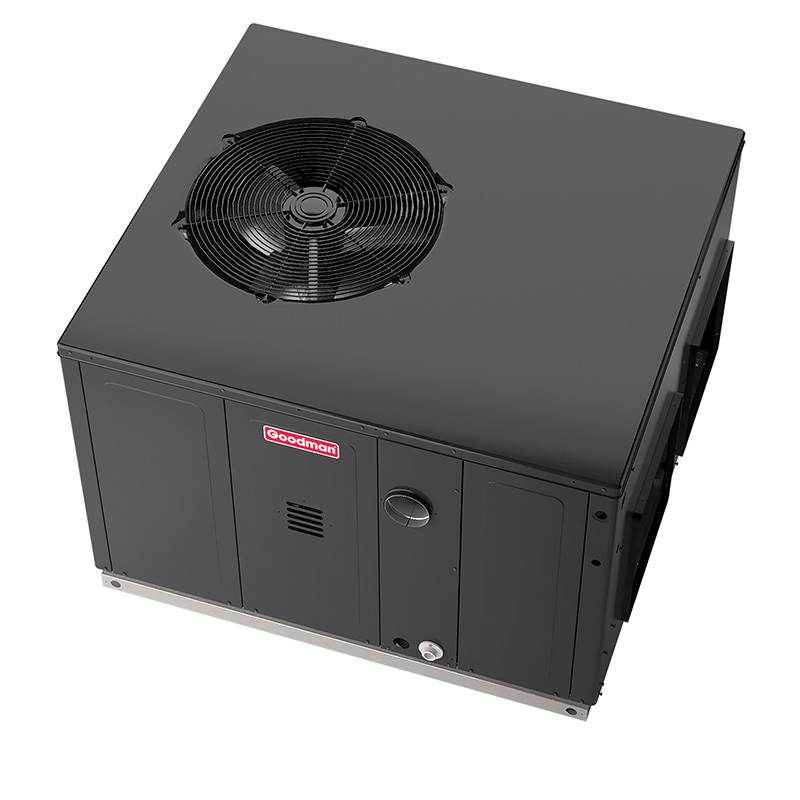
The Goodman GPGM33006041 is a 2.5-ton packaged gas/electric unit combining a 60,000 BTU furnace section and a 13.4 SEER2 cooling system in one self-contained cabinet. Because everything ships in a single box and mounts to a rooftop curb or a side-discharge slab, it is a straightforward swap for mobile homes, manufactured housing, and light commercial spaces that cannot accommodate a split system. The multi-position configuration means the unit can discharge air horizontally or vertically, giving installers some flexibility on placement without ordering a separate model.
Running on R-32 refrigerant, this unit meets the current low-GWP requirements that are becoming standard across the industry. The 13.4 SEER2 rating sits right at the federal minimum threshold for package units in most U.S. climate zones, which means operating costs will be higher than mid- or high-efficiency alternatives but the upfront equipment cost is lower. The gas heating section does not carry a published AFUE rating in standard spec documentation for this configuration, so buyers planning to heat with it heavily should ask their dealer to confirm the heating efficiency before purchase. At 2.5 tons, it is sized for roughly 1,200 to 1,600 square feet of well-insulated space, though a proper Manual J load calculation remains the only reliable way to confirm fit.
The GPGM33006041 delivers a dependable entry-level package solution for manufactured homes and light commercial applications where a split system is not practical, and the lower purchase price compared to Carrier or Trane equivalents is a genuine advantage. At 13.4 SEER2 it is not an efficiency leader, and long-term costs depend heavily on installation quality and the luck of the draw on components like the dual-run capacitor and evaporator coil. Buyers who plan to stay in the property more than eight years and can stretch the budget should at least price a mid-efficiency alternative before committing.
Overall score is the average of the five ratings above.
What we like
- Priced 15 to 25 percent below comparable Carrier, Trane, and Lennox package units
- All-in-one cabinet simplifies installation in manufactured housing and rooftop applications
- R-32 refrigerant is forward-compatible with tightening EPA refrigerant rules
- Multi-position discharge adds placement flexibility without a model change
- Widely available through Goodman distributors, keeping parts and service accessible
Trade-offs
- 13.4 SEER2 is the minimum efficiency tier, so monthly energy bills will run higher than mid-efficiency alternatives
- Dual-run capacitors are a documented weak point and should be budgeted as a likely service call within the first decade
- Evaporator coil leaks appear in a meaningful share of owner reviews and can become a costly mid-life repair
- Compressor lifespan averages 10 to 14 years versus 15 to 20 years reported for premium-brand compressors
What homeowners and pros say about Goodman
Homeowners who have owned Goodman package units tend to split along a familiar line. On Google dealer reviews, where the overall Goodman brand scores around 3.8 out of 5, the most consistent praise is straightforward: the equipment cost less than the competition, it cooled the space, and parts were easy to find when something needed fixing. On ConsumerAffairs, where the brand averages closer to 2.5 out of 5, the recurring complaint is not early catastrophic failure but rather the accumulation of repair bills after roughly year seven — dual-run capacitors going out, refrigerant charges needing attention, and in some cases evaporator coil leaks that turn into four-figure repairs. Those two pictures are not necessarily contradictory; a unit that runs fine for six years and then becomes a repair project is still a unit that delivered value upfront.
HVAC technicians who work on Goodman equipment frequently point to installation quality as the variable that separates the smooth stories from the frustrating ones. A correctly commissioned unit with proper refrigerant charge and clean electrical connections tends to perform close to spec. Units that leave the installation with marginal charge or loose connections are more likely to show the documented failure modes early — refrigerant leaks in the first year that trace back to install or charge issues, and capacitor failures that accelerate under stress. The compressor lifespan data is also worth keeping in mind for a long-term property: Goodman compressors average 10 to 14 years, a real gap compared to the 15 to 20 years reported for Trane, Carrier, and Lennox compressors in the same duty cycle.
Sources: ConsumerAffairs Goodman owner reviews, AHRI Directory of Certified Product Performance, U.S. DOE appliance and equipment efficiency standards, Goodman product specification sheets.
What it costs to run
At 13.4 SEER2, cooling this 2.5-ton system for a typical 1200-hour cooling season at the U.S. average electricity rate of $0.17/kWh works out to roughly $457 per year in cooling, about $0 less per year than a minimum-efficiency 13.4 SEER2 unit of the same size. Your real cost depends on your climate and local rate.
Method: (30,000 BTU/hr ÷ 13.4 SEER2) × 1200 hours ÷ 1000 × $0.17/kWh. Rate source: U.S. EIA average; cooling hours: moderate-climate estimate.
How it compares
| Brand | Comparable model | SEER2 | Stage | Price position |
|---|---|---|---|---|
| Goodman | GPGM33006041 | 13.4 | Single-stage | Value pick |
| Carrier | WeatherMaster 50XC / 50A Series | 13.4 | Single-stage | Typically 15 to 25 percent more than Goodman |
| Trane | YCC / YHC Precedent Series | 13.4 | Single-stage | Typically 15 to 25 percent more than Goodman |
| Lennox | LRP14 Packaged Rooftop Series | 13.4 | Single-stage | Typically 15 to 25 percent more than Goodman |
Competitor rows are comparable single-stage units at similar efficiency; price is relative position, not a quote.
Questions about this system
Is this unit compatible with a standard manufactured home roof curb?
Most manufactured homes use a standard 14-inch by 58-inch roof curb opening, and the GPGM33006041 is designed for that configuration in downflow/rooftop mode. Confirm the curb dimensions with your installer before ordering because variations exist across manufacturers and model years.
What does 'multi-position' actually mean for this package unit, and does it affect what I need to order?
Multi-position means the same unit can discharge conditioned air downward through a roof curb or horizontally through a wall or slab connection without requiring a different model. You do not need to order a separate horizontal or vertical variant, but you will need the correct accessory duct adapter for your specific mounting orientation.
The capacitor failure issue I keep reading about — how worried should I be, and what does it cost to fix?
Dual-run capacitor failure is the most commonly reported repair on Goodman equipment and typically runs between $300 and $600 for parts and labor. It is a quick repair most HVAC technicians can complete in under an hour, so while it is an inconvenience, it is not a catastrophic failure.
Why does this listing not show an AFUE rating for the gas heat section?
Package units in this class typically carry an 80 to 81 percent AFUE on the gas heating section, but that figure is not always prominently listed in distributor spec sheets. Ask your dealer to pull the full product data sheet or check the ARI/AHRI certificate for the confirmed heating efficiency before purchase if heating costs are a priority.
Will my existing R-410A line set and equipment work if I am replacing an older package unit with this R-32 model?
Package units are self-contained and do not use external refrigerant line sets, so that concern does not apply here. The refrigerant is factory-charged inside the cabinet. The connections you are matching are electrical and duct, not refrigerant lines.
Specifications
| Cooling capacity | 2.5 Ton |
| Efficiency | 13.4 SEER2 |
| Furnace output | 60000 BTU |
| Configuration | Multi-Position |
| Refrigerant | R-32 |
| Model | GPGM33006031 |