Goodman 2.5 Ton 13.4 SEER2 Heat Pump Package Unit Multiposition
View on AC Direct see your lowest price →Check current price on AC Direct →
Key features
- 2.5-ton capacity suited for roughly 1,200 to 1,500 square feet depending on climate and insulation
- 13.4 SEER2 efficiency rating meets current federal minimum standards for most U.S. regions
- All-in-one package unit design with heating and cooling in a single outdoor cabinet
- Multiposition installation supports both rooftop horizontal and ground-level vertical mounting
- Heat pump operation provides both heating and cooling from a single refrigerant-based system
- Priced approximately 15 to 25 percent below comparable Trane, Carrier, and Lennox package units
About this system
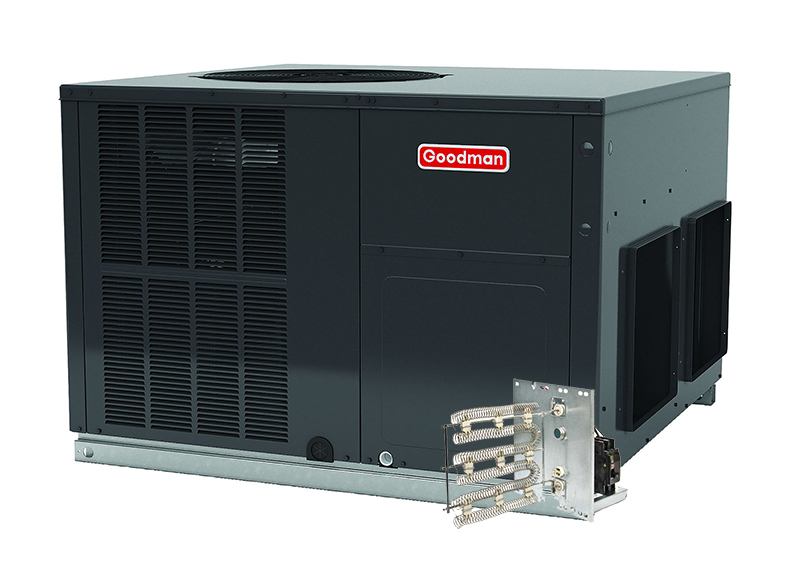
The Goodman 2.5 Ton 13.4 SEER2 Heat Pump Package Unit is an all-in-one outdoor cabinet that houses the compressor, air handler components, and heating and cooling functions in a single self-contained unit. That multiposition design means it can be installed horizontally on a rooftop curb or vertically at ground level, which makes it a practical choice for mobile homes, light commercial spaces, and homes without a traditional indoor air handler or furnace. At 2.5 tons, it is sized for spaces roughly in the 1,200 to 1,500 square foot range, depending on local climate, insulation, and ceiling height.
A 13.4 SEER2 rating sits right at the federal minimum efficiency threshold for most U.S. regions under current Department of Energy rules. That means this unit meets the legal baseline for new installations but will not deliver the operating cost savings of higher-efficiency 16 or 18 SEER2 equipment. For homeowners in mild climates where the heat pump runs fewer hours annually, or for budget-focused buyers replacing aging equipment, that efficiency compromise is often an acceptable trade-off against the lower purchase price. Goodman’s positioning as a value brand typically puts this unit 15 to 25 percent below comparable equipment from Trane, Carrier, or Lennox.
The Goodman 2.5 Ton 13.4 SEER2 package unit is a workable entry-level choice for cost-conscious buyers who need a straightforward all-in-one heat pump and are comfortable with baseline efficiency. It will serve adequately when properly installed and maintained, but owners should budget for component repairs in years seven and beyond and should not expect the compressor longevity of premium brands. This is a unit that rewards a good installer and a proactive maintenance schedule more than most.
Overall score is the average of the five ratings above.
What we like
- Purchase price is typically 15 to 25 percent lower than comparable Carrier, Trane, and Lennox package units
- All-in-one cabinet simplifies replacement in mobile home and rooftop applications where space is limited
- Multiposition design gives installers flexibility for ground-level or rooftop curb mounting
- Dual-run capacitor failures, the most common documented issue, are generally a low-cost repair in the 300 to 600 dollar range
- Heat pump design covers both heating and cooling duties, eliminating the need for a separate furnace in moderate climates
Trade-offs
- 13.4 SEER2 is the federal minimum threshold, so monthly operating costs will be higher than mid- or high-efficiency alternatives
- Compressor lifespan averages 10 to 14 years versus 15 to 20 years seen in premium brands, meaning earlier major repair or replacement costs
- Evaporator coil leaks are a documented recurring complaint among owners, and coil replacement is a significant repair expense
- A minority of owners report refrigerant leaks within the first year, typically tied to installation or initial charge quality, underscoring how heavily performance depends on installer skill
What homeowners and pros say about Goodman
Homeowners who share feedback on Goodman equipment tend to fall into two camps. Those who had a skilled installer and keep up with annual maintenance often describe years of trouble-free operation and cite the lower purchase price as the clearest advantage. Those who ran into problems more often mention repair costs climbing after the seven-year mark, a pattern reflected in Goodman’s ConsumerAffairs score of roughly 2.5 out of 5, a channel where complaint-driven reviews dominate and where rising repair expenses are the recurring theme. Google dealer reviews tell a more moderate story, with scores averaging around 3.8 out of 5 across multiple locations, where affordability is the praise most often cited.
HVAC technicians tend to view Goodman as adequate equipment that performs in proportion to the quality of the installation. They consistently flag dual-run capacitor failure as the most common service call on this brand, a repair that typically runs 300 to 600 dollars and is not unique to Goodman but shows up with enough frequency to be worth anticipating. Evaporator coil leaks are a more serious documented complaint that appears in a meaningful share of owner feedback. Compressor longevity is the longer-term concern, with Goodman compressors averaging 10 to 14 years compared to 15 to 20 years in premium brands. A small but notable share of first-year refrigerant leak reports also appear in the record, and technicians generally attribute those to installation or initial charge errors rather than a factory defect, reinforcing why contractor selection matters as much as brand selection with this equipment.
Sources: ConsumerAffairs Goodman owner reviews, AHRI Directory of Certified Product Performance, U.S. DOE appliance and equipment efficiency standards, Goodman product specification sheets.
What it costs to run
At 13.4 SEER2, cooling this 2.5-ton system for a typical 1200-hour cooling season at the U.S. average electricity rate of $0.17/kWh works out to roughly $457 per year in cooling, about $0 less per year than a minimum-efficiency 13.4 SEER2 unit of the same size. Your real cost depends on your climate and local rate.
Method: (30,000 BTU/hr ÷ 13.4 SEER2) × 1200 hours ÷ 1000 × $0.17/kWh. Rate source: U.S. EIA average; cooling hours: moderate-climate estimate.
How it compares
| Brand | Comparable model | SEER2 | Stage | Price position |
|---|---|---|---|---|
| Goodman | 2.5 Ton Heat Pump Package Unit (this unit) | 13.4 | Single-stage | Value pick |
| Carrier | WeatherMaster 50XC series | 13.4-14.0 | Single-stage | Typically 15 to 25 percent more than this Goodman |
| Trane | Precedent series package heat pump | 13.4-14.0 | Single-stage | Typically 15 to 25 percent more than this Goodman |
| Lennox | LRP14HP series package heat pump | 13.4-14.0 | Single-stage | Typically 15 to 25 percent more than this Goodman |
Competitor rows are comparable single-stage units at similar efficiency; price is relative position, not a quote.
Questions about this system
Is a 13.4 SEER2 heat pump package unit legal to install in my state right now?
13.4 SEER2 is the current federal minimum for heat pumps in most U.S. regions under Department of Energy regulations that took effect in 2023. Some states, particularly in the Southwest, have stricter regional minimums, so confirm with your local HVAC contractor or utility before purchasing.
Will this package unit work as the primary heat source, or do I need a backup furnace?
A heat pump package unit can handle primary heating in mild to moderate climates, but heating output drops as outdoor temperatures fall below freezing. Most package units include electric resistance backup heat strips for very cold nights, but in climates with extended subfreezing winters a heat pump alone may struggle to keep up without adequately sized backup heat.
What is the most likely repair I should budget for, and how much will it cost?
The most commonly reported failure on Goodman heat pump equipment is the dual-run capacitor, which typically costs 300 to 600 dollars to diagnose and replace. Evaporator coil leaks are a secondary documented concern and carry a higher repair cost, so keeping the unit clean and scheduling annual maintenance can help catch problems early.
How long should I expect this unit to last compared to a Trane or Carrier package unit?
Goodman compressors have been documented to average roughly 10 to 14 years, compared to 15 to 20 years typical of premium brands. Overall system lifespan depends heavily on installation quality and how consistently the unit is maintained, so a well-installed and well-serviced Goodman can outlast a poorly installed premium unit.
Can any licensed HVAC technician install a package unit, or does it require a specialist?
Any licensed HVAC technician can install a package unit, but the all-in-one configuration does require correct duct connection at the cabinet, proper electrical disconnect, and accurate refrigerant charge verification. Technicians consistently cite installation quality as the single biggest factor in Goodman unit longevity, so choosing an experienced contractor who is familiar with package unit installations is especially important.
Specifications
| Cooling capacity | 2.5 Ton |
| Efficiency | 13.4 SEER2 |