Goodman 2 Ton 13.4 SEER2 R32 Cooling Only Condenser (GLXS3BN2410)
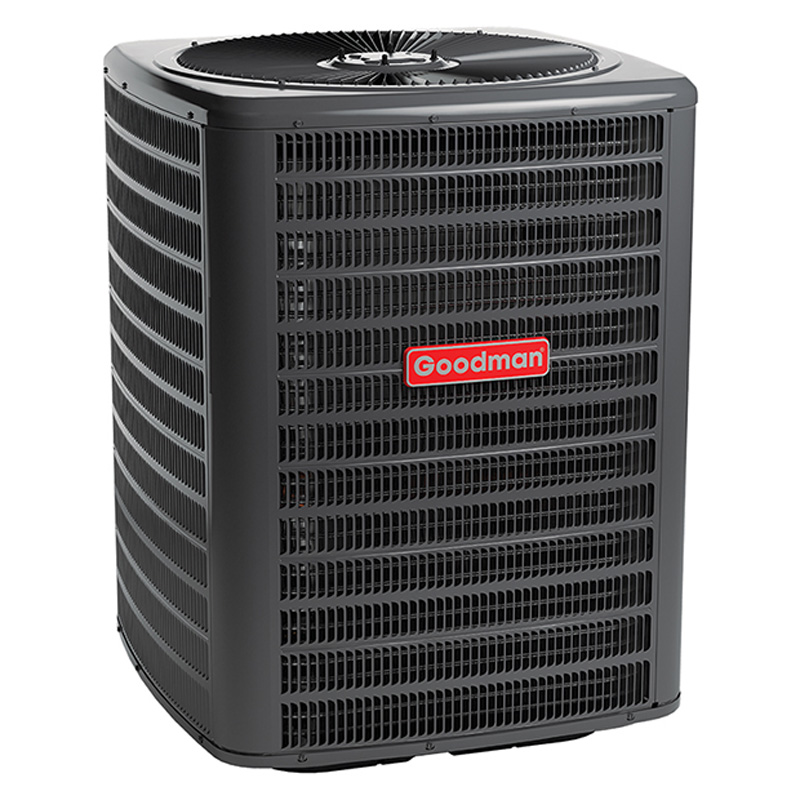
View on AC Direct see your lowest price →Check current price on AC Direct →
Key features
- 2-ton capacity, suited for smaller conditioned spaces roughly 700 to 1,100 sq ft depending on load calculations
- 13.4 SEER2 efficiency rating, meeting the current federal minimum standard for most U.S. regions
- R-32 refrigerant, which has a lower global-warming potential than R-410A and is the emerging industry standard
- Single-stage compressor operation for straightforward installation and servicing
- Cooling-only condenser design, requires a matched indoor air handler or coil and furnace
- Goodman factory warranty: 10-year parts limited warranty when registered within 60 days of installation
About this system
The Goodman GLXS3BN2410 is a 2-ton, single-stage cooling-only condenser rated at 13.4 SEER2 and built around R-32 refrigerant, a lower global-warming-potential refrigerant that is increasingly standard as the industry moves away from R-410A. At 2 tons, it is sized for smaller homes or individual zones typically in the 700 to 1,100 square foot range, depending on local climate, insulation quality, and duct design. It pairs with a separate air handler or furnace/coil combination indoors, so it belongs in a conventional split-system setup rather than a packaged or ductless application.
The 13.4 SEER2 rating sits at the federal minimum efficiency threshold that took effect in 2023, which means this unit meets the legal baseline but does not exceed it. Homeowners in moderate climates who run the system fewer months per year will feel the efficiency gap least. Those in the deep South or Southwest, where cooling loads run high for six or more months, may find that a higher-SEER2 unit pays back its premium over time. What this condenser offers in return for accepting baseline efficiency is a noticeably lower purchase price compared to 16 SEER2 or variable-capacity alternatives from premium brands, making it a practical option for budget-minded buyers, rental property owners, or anyone replacing a system on short notice.
The GLXS3BN2410 is a no-frills 2-ton condenser that does exactly what baseline efficiency equipment is supposed to do: cool a smaller space at the lowest realistic entry price. Its value case is strongest for budget-conscious homeowners and landlords who want a functioning system without premium-brand pricing, though they should budget for potential capacitor replacements down the road and understand that compressor longevity likely trails premium competitors by several years.
Overall score is the average of the five ratings above.
What we like
- Purchase price runs 15 to 25 percent below comparable Carrier, Trane, and Lennox units
- R-32 refrigerant is forward-looking and broadly serviceable as the industry transitions away from R-410A
- 10-year registered parts warranty is competitive at this price tier
- Single-stage design keeps servicing straightforward and parts widely available through Goodman's broad dealer network
- Adequate efficiency for homeowners in milder climates or those with shorter cooling seasons
Trade-offs
- 13.4 SEER2 is the federal minimum, so operating costs will be higher than mid- or high-efficiency alternatives in hot climates
- Dual-run capacitors are the most commonly reported failure point, typically adding a repair bill in the $300 to $600 range after several years
- Compressor lifespan averaging 10 to 14 years is shorter than the 15 to 20 years often seen with premium-brand compressors
- A minority of owners report refrigerant leaks in the first year, most often tied to installation or initial charge issues rather than a product defect
What homeowners and pros say about Goodman
Homeowners who chose Goodman equipment tend to split into two camps, and that divide shows up clearly in the brand’s ratings. On Google dealer reviews, where the conversation often centers on the purchasing and installation experience, Goodman scores around 3.8 out of 5, with affordability being the most consistent point of praise. On ConsumerAffairs, a channel that skews heavily toward people filing complaints, the score drops to roughly 2.5 out of 5, and the recurring theme there is repair costs accumulating after the seven-year mark. Neither number tells the whole story on its own, but together they sketch a realistic picture: Goodman equipment tends to satisfy buyers in the early years, then becomes more maintenance-dependent as it ages.
HVAC technicians are candid about what they see in the field. Dual-run capacitor failures are the most commonly cited repair on Goodman condensers, and while they are generally inexpensive to fix, they come up with enough regularity that experienced installers often advise budgeting for one during the system’s life. Evaporator coil leaks show up in a meaningful share of owner accounts, and compressor longevity on Goodman units is honestly estimated at 10 to 14 years, which is shorter than the 15 to 20 years technicians associate with premium brands. A small but notable share of owners also report refrigerant leaks in the first year, which installers attribute most often to charge or connection issues during setup rather than a factory defect. For the GLXS3BN2410 specifically, all of this means that quality installation is not optional; it is the single biggest variable in how this condenser performs over its life.
Sources: ConsumerAffairs Goodman owner reviews, AHRI Directory of Certified Product Performance, U.S. DOE appliance and equipment efficiency standards, Goodman product specification sheets.
What it costs to run
At 13.4 SEER2, cooling this 2-ton system for a typical 1200-hour cooling season at the U.S. average electricity rate of $0.17/kWh works out to roughly $365 per year in cooling, about $0 less per year than a minimum-efficiency 13.4 SEER2 unit of the same size. Your real cost depends on your climate and local rate.
Method: (24,000 BTU/hr ÷ 13.4 SEER2) × 1200 hours ÷ 1000 × $0.17/kWh. Rate source: U.S. EIA average; cooling hours: moderate-climate estimate.
How it compares
| Brand | Comparable model | SEER2 | Stage | Price position |
|---|---|---|---|---|
| Goodman | GLXS3BN2410 | 13.4 | Single-stage | Value pick |
| Carrier | Comfort 13 (24ACC3) | 13.4 | Single-stage | Typically 15 to 20 percent more than this Goodman |
| Trane | XR13c | 13.4 | Single-stage | Typically 20 to 25 percent more than this Goodman |
| Lennox | Merit 13ACX | 13.4 | Single-stage | Typically 15 to 25 percent more than this Goodman |
Competitor rows are comparable single-stage units at similar efficiency; price is relative position, not a quote.
Questions about this system
Does this condenser work with my existing R-410A air handler or coil?
No. Because this unit uses R-32 refrigerant, it must be paired with a coil and line set rated and approved for R-32. Mixing refrigerant types or using unapproved components is unsafe and will void the warranty, so confirm compatibility with your installer before purchasing.
What size home is a 2-ton condenser actually right for?
A rough rule of thumb puts 2 tons at 700 to 1,100 square feet, but the honest answer is that it depends on your climate zone, ceiling height, insulation levels, window area, and local heat gain. An ACCA Manual J load calculation from your installer is the only reliable way to confirm correct sizing for your specific home.
What is the most common repair I should plan for with this Goodman unit?
Dual-run capacitor failure is the most frequently reported issue across Goodman condensers. It is generally a straightforward, low-cost repair in the $300 to $600 range, and most HVAC technicians can complete it in under an hour. Keeping a maintenance contract or having a technician inspect capacitors annually can catch degradation before it causes a no-cool situation.
How do I make sure the 10-year parts warranty stays valid?
Goodman requires product registration within 60 days of the installation date to activate the 10-year parts limited warranty. Without registration, coverage typically defaults to a shorter 5-year period. Register at Goodman's website as soon as installation is complete and keep a copy of your receipt and the installer's documentation.
Will 13.4 SEER2 cost me significantly more to run than a higher-efficiency unit?
It depends on how long and hard you run the system. In a mild climate with a short cooling season, the efficiency gap versus a 16 SEER2 unit translates to a modest annual difference that may never pay back the higher upfront cost of a more efficient model. In hotter regions where the system runs heavily from May through September, a higher-SEER2 unit can generate meaningful annual savings, and the payback period shortens considerably over a 10-plus-year equipment life.
Specifications
| Cooling capacity | 2 Ton |
| Efficiency | 13.4 SEER2 |
| Refrigerant | R-32 |
| Model | GLXS3BN2410 |