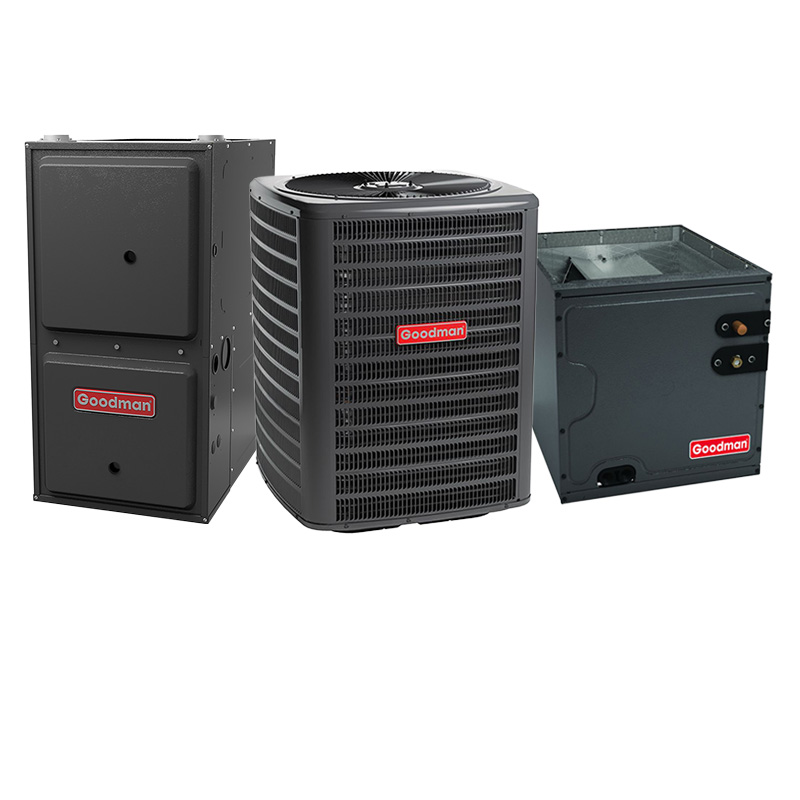
Goodman 2 Ton 14.5 SEER2 40000 BTU 80% AFUE Multi-Speed ECM Gas Furnace System – Downflow | R32
View on AC Direct see your lowest price →Check current price on AC Direct →
Key features
- 14.5 SEER2 cooling efficiency, just above current federal minimum for most U.S. regions
- 40,000 BTU, 80% AFUE gas furnace in downflow configuration for floor-register duct systems
- Multi-speed ECM blower motor reduces fan energy use and improves airflow consistency
- R-32 refrigerant, lower global warming potential than legacy R-410A
- 2-ton capacity suited to roughly 700 to 1,000 square feet depending on climate and load
- Goodman value pricing, typically 15 to 25 percent below Trane, Lennox, and Carrier equivalents
About this system
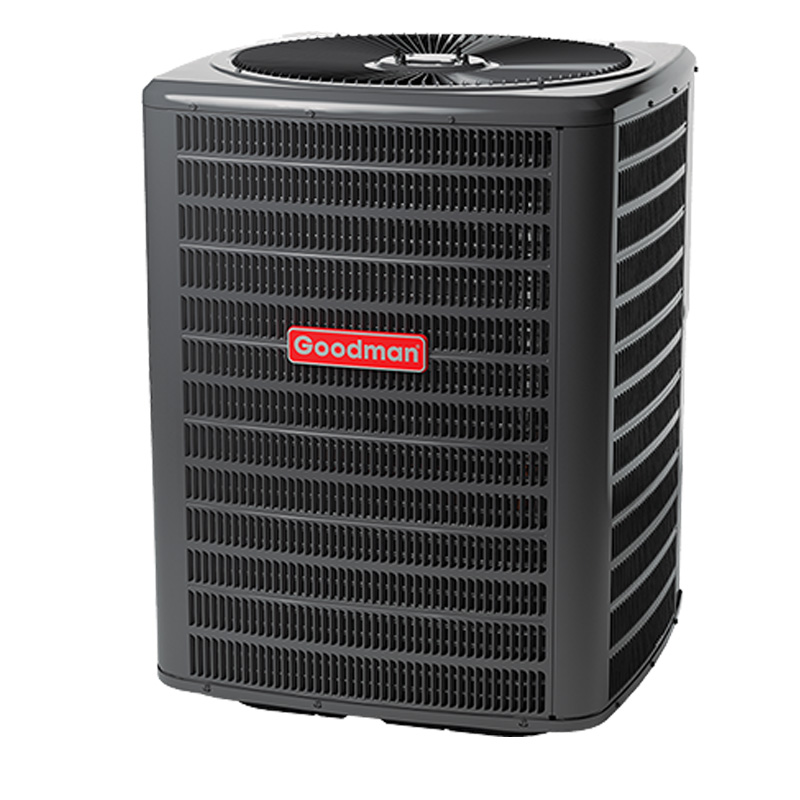
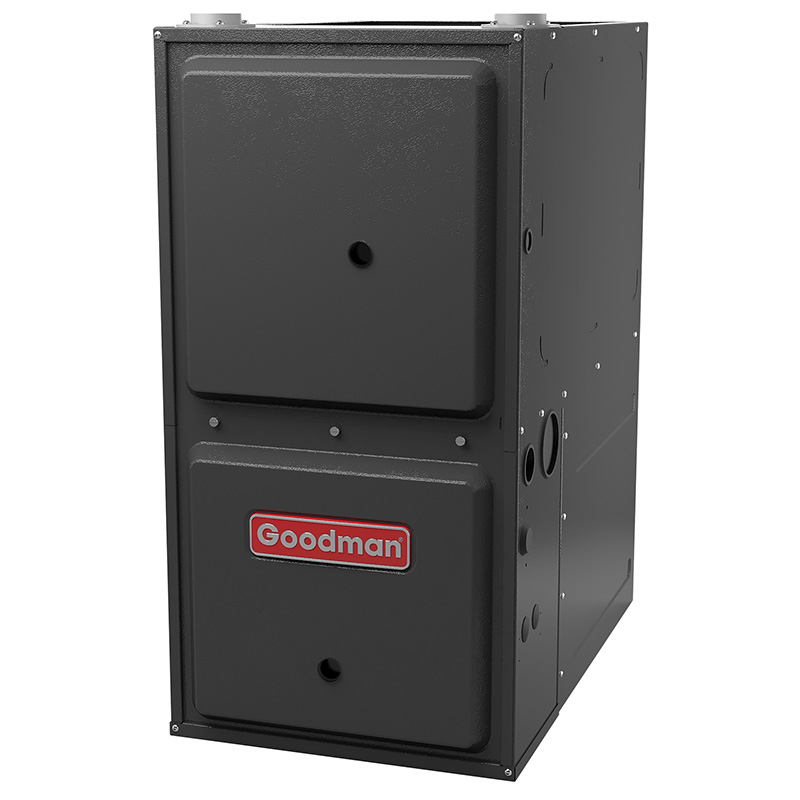
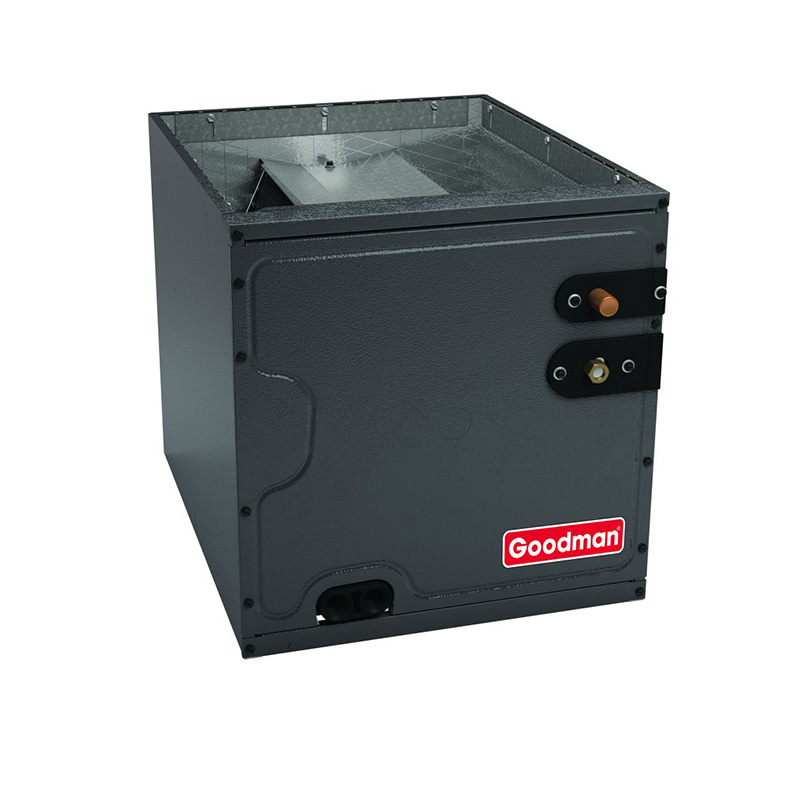
The Goodman 2-ton, 14.5 SEER2 downflow system pairs a 40,000 BTU, 80% AFUE gas furnace with a matching R-32 refrigerant split system sized for smaller homes or individual zones in the 700 to 1,000 square foot range, depending on your climate and insulation. The downflow configuration means conditioned air exits at the bottom of the air handler and flows downward through floor registers, which suits homes with the air handler mounted in a utility closet or on an upper floor above an unconditioned crawl space. If your existing duct system is designed for top-to-bottom airflow, this unit slots in cleanly; if it is not, converting ductwork adds both cost and complexity.
On the mechanical side, 14.5 SEER2 sits just above the federal minimum for most northern U.S. regions and a half-point above the 14 SEER2 floor now required in the South and Southwest. It is not a high-efficiency system, but it is a code-compliant one that will deliver meaningful savings over older 10 to 12 SEER equipment you may be replacing. The multi-speed ECM blower motor runs at different airflow levels to match demand rather than hammering on and off at full blast, which improves comfort, reduces hot and cold spots, and cuts fan electricity costs compared to a standard PSC motor. The 80% AFUE furnace is honest entry-level territory: one-fifth of every dollar of gas goes out the flue, so homeowners in cold climates should weigh whether spending more on a 96% AFUE unit pays back in annual fuel bills. R-32 refrigerant carries a lower global warming potential than the R-410A it replaces and is increasingly the industry standard going forward.
This system delivers solid entry-level performance at a price point that is hard to argue with for budget-conscious buyers replacing aging equipment in smaller spaces. The trade-off is a shorter expected compressor lifespan and a reliability track record that leans heavily on how well it is installed and how consistently it is maintained. Buyers who want long-term peace of mind or who live in a climate where the furnace runs hard all winter should look at a higher AFUE rating and a premium brand before committing.
Overall score is the average of the five ratings above.
What we like
- Priced 15 to 25 percent below comparable Carrier, Trane, and Lennox equipment
- Multi-speed ECM blower improves comfort and lowers fan operating costs vs. single-speed PSC motors
- 14.5 SEER2 meets or exceeds federal minimums in every U.S. region
- R-32 refrigerant is future-facing and widely serviceable
- Downflow design is a direct, low-disruption replacement for homes already set up for floor registers
Trade-offs
- 80% AFUE means significant heat loss up the flue; high heating-degree-day climates will see this on the gas bill
- Compressor lifespan averages 10 to 14 years, shorter than the 15 to 20 years typical of premium brands
- Dual-run capacitors are the most commonly reported failure point, and evaporator coil leaks appear in a meaningful share of owner reviews
- Downflow configuration limits installation flexibility; homes with different duct orientations face added conversion costs
What homeowners and pros say about Goodman
Homeowners who shop Goodman tend to land in one of two camps after a few years of ownership. Those who had the system properly sized, carefully commissioned, and regularly maintained report functional, unremarkable performance and appreciate paying several hundred dollars less upfront than they would have with a Trane or Carrier. That sentiment lines up with the around 3.8 out of 5 rating Goodman earns across Google dealer reviews, where affordability is the most cited reason for satisfaction. The less encouraging picture comes from channels like ConsumerAffairs, where Goodman scores around 2.5 out of 5, and the recurring theme is repair costs that start climbing after roughly year 7, particularly around dual-run capacitors, which are the most commonly documented failure point, and evaporator coil leaks, which appear in a meaningful share of owner reports.
HVAC technicians tend to frame Goodman as a system that rewards good installation and punishes shortcuts. They note that compressors on these units typically average 10 to 14 years, a shorter window than the 15 to 20 years more common on premium equipment, and that a minority of owners encounter refrigerant leaks within the first year, almost always tied to installation or charging errors rather than factory defects. For a downflow 80% AFUE system at this price point, the honest picture is: the upfront savings are real, the long-term cost depends heavily on who puts it in and whether annual maintenance happens on schedule, and buyers who want to minimize service-call risk over a 15-plus-year horizon should budget either for potential repairs or for a premium brand from the start.
Sources: ConsumerAffairs Goodman owner reviews, AHRI Directory of Certified Product Performance, U.S. DOE appliance and equipment efficiency standards, Goodman product specification sheets.
What it costs to run
At 14.5 SEER2, cooling this 2-ton system for a typical 1200-hour cooling season at the U.S. average electricity rate of $0.17/kWh works out to roughly $338 per year in cooling, about $27 less per year than a minimum-efficiency 13.4 SEER2 unit of the same size. Your real cost depends on your climate and local rate.
Method: (24,000 BTU/hr ÷ 14.5 SEER2) × 1200 hours ÷ 1000 × $0.17/kWh. Rate source: U.S. EIA average; cooling hours: moderate-climate estimate.
How it compares
| Brand | Comparable model | SEER2 | Stage | Price position |
|---|---|---|---|---|
| Goodman | 2-Ton 14.5 SEER2 Downflow System with 40K BTU 80% AFUE Furnace | 14.5 | Single-stage / Multi-speed ECM | Value pick |
| Carrier | Comfort Series (24ACC / 58CV pairing) | 14.5-15 | Single-stage | Typically 15 to 25 percent more than Goodman |
| Trane | XR14 / S8X1 Series pairing | 14.5 | Single-stage | Typically 15 to 25 percent more than Goodman |
| Lennox | Merit Series (13ACX / ML180 pairing) | 14.5 | Single-stage | Typically 15 to 25 percent more than Goodman |
Competitor rows are comparable single-stage units at similar efficiency; price is relative position, not a quote.
Questions about this system
Is a downflow furnace the right configuration for my house, and can I convert it if not?
Downflow furnaces are designed for installations where air exits the bottom of the unit and travels through floor-level or under-floor ducts, common in homes where the air handler sits in a main-floor closet above a crawl space or basement duct plenum. If your existing system uses upflow or horizontal airflow, you would need a different configuration or a duct conversion, which adds labor cost and should be quoted separately before you buy.
What does 80% AFUE actually mean for my heating bill versus a higher-efficiency furnace?
An 80% AFUE furnace sends 20 cents of every dollar of gas out the flue as exhaust. A 96% AFUE unit loses only 4 cents, so if you spend $1,200 a year heating with an 80% unit, a comparable 96% unit would cost roughly $250 less per year in fuel. In mild climates where heating loads are low, the payback period on the premium unit can stretch to 10 years or more; in cold climates it often pays back in 5 to 7 years.
What are the most common repairs on Goodman systems and how much do they typically cost?
Dual-run capacitors are the most frequently reported failure point on Goodman equipment and are generally a straightforward, low-cost repair in the $300 to $600 range when handled promptly. Evaporator coil leaks show up in a meaningful share of owner reports and are more significant, often running $1,000 or more depending on labor and refrigerant costs. A minority of owners have reported refrigerant leaks within the first year, which is usually traced to the installation or initial charge rather than a component defect.
How long should I expect this system to last compared to a premium brand?
Goodman compressors have historically averaged 10 to 14 years in documented owner experience, compared to 15 to 20 years for premium-brand compressors. The furnace heat exchanger can last longer with regular maintenance. Install quality is the single factor technicians most consistently point to as the difference between a system that reaches 14 years and one that struggles past 8.
Does R-32 refrigerant cause any service or safety concerns I should know about?
R-32 is mildly flammable (classified A2L), which means certified technicians need to follow specific handling procedures during service. It is not a practical hazard in a properly installed residential system, and it is becoming the industry standard as R-410A is phased down. Service technicians in most markets are already equipped for it, but if you are in a rural area it is worth confirming your local HVAC service companies stock R-32 before purchasing.
Specifications
| Cooling capacity | 2 Ton |
| Efficiency | 14.5 SEER2 |
| Furnace output | 40000 BTU |
| Furnace efficiency | 80% AFUE |
| Configuration | Downflow |
| Refrigerant | R-32 |