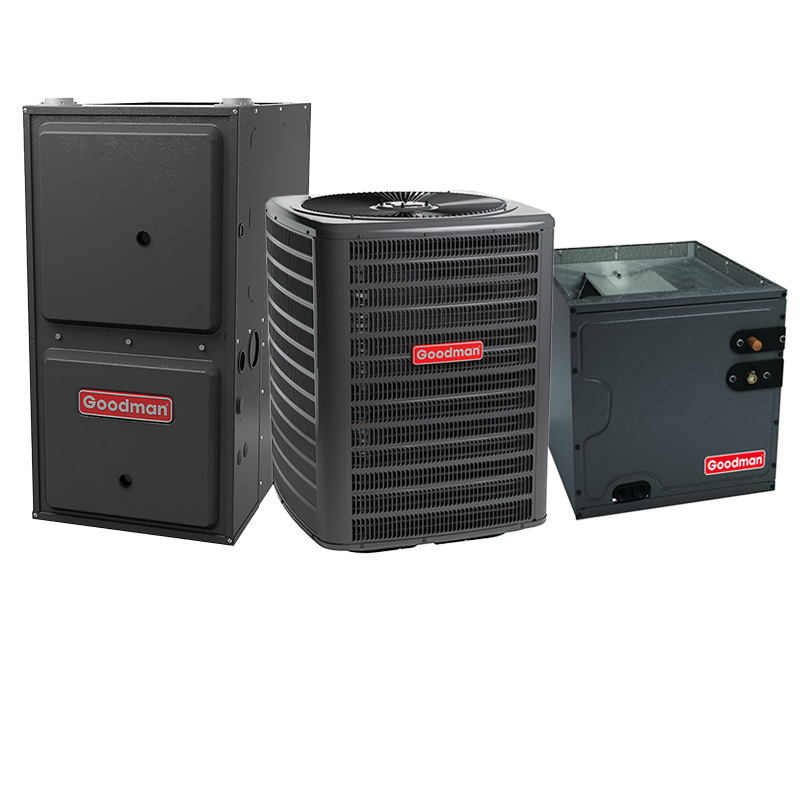
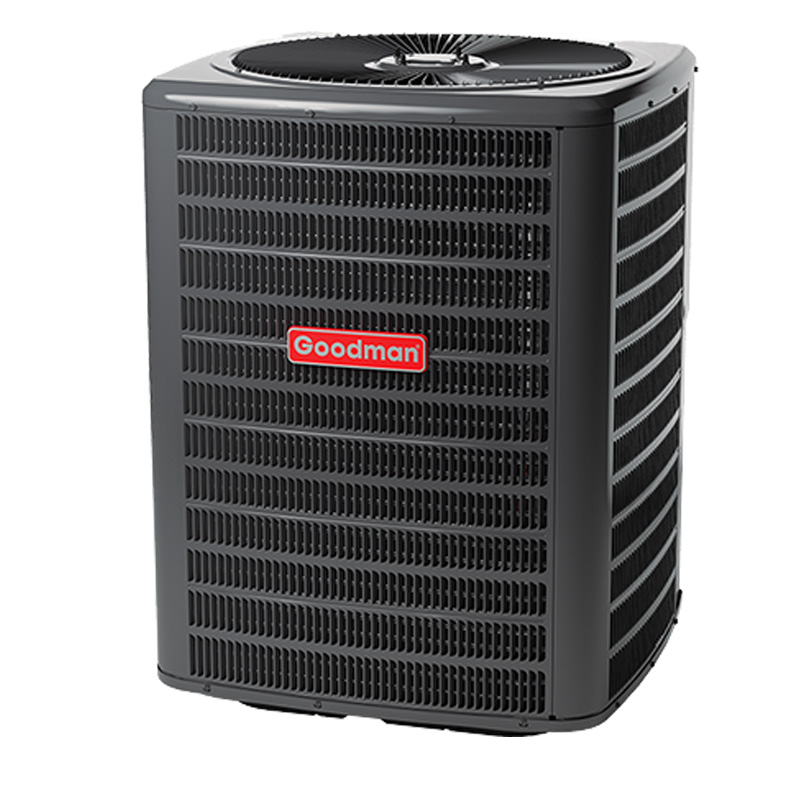
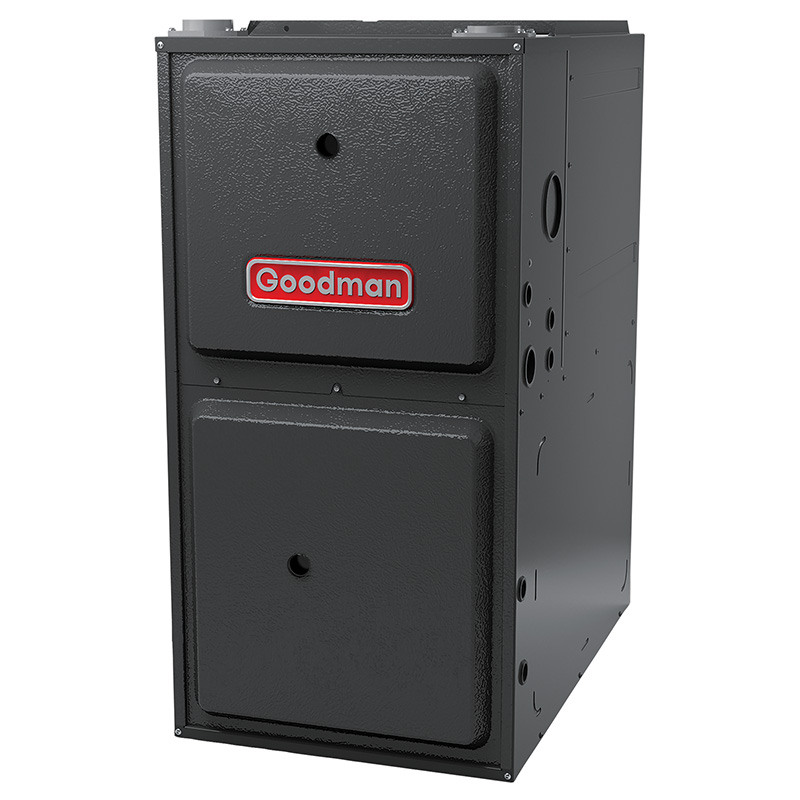
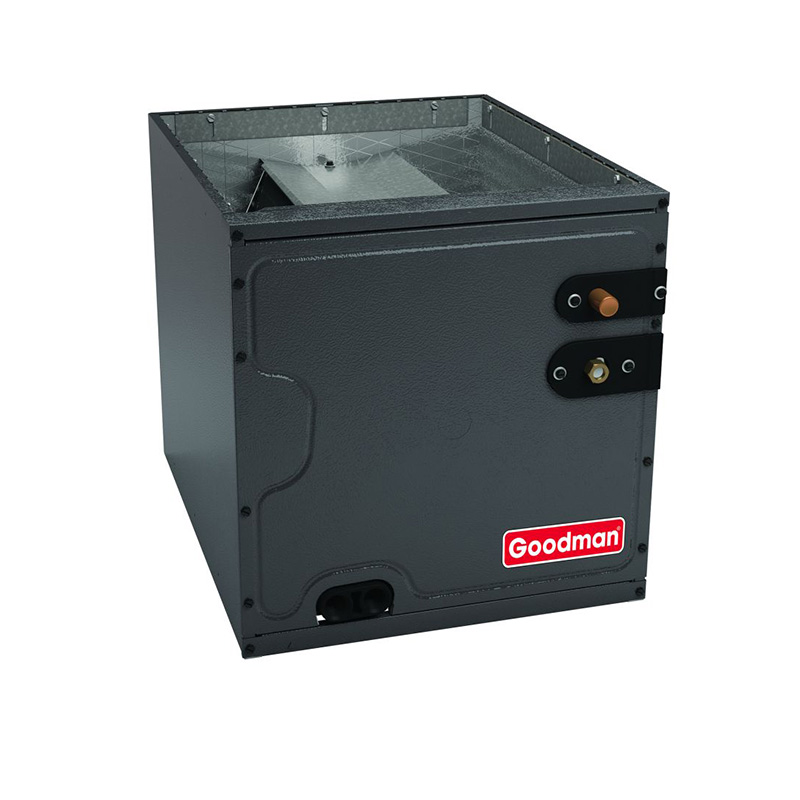
Goodman 2 Ton 14.5 SEER2 R32 AC System with 60,000 BTU 96% AFUE Gas Furnace – California & Colorado Ultra Low NOx, Upflow, Multi-Speed ECM
View on AC Direct see your lowest price →Check current price on AC Direct →
Key features
- 14.5 SEER2 single-stage cooling on 2-ton / 24,000 BTU platform
- 96% AFUE gas furnace meets California and Colorado Ultra Low NOx standards
- R-32 refrigerant with lower global-warming potential than R-410A
- Multi-speed ECM blower motor for quieter operation and improved dehumidification
- Upflow configuration for basement or ground-level installations with overhead ductwork
- 60,000 BTU heating capacity suited to mid-size conditioned spaces
About this system
The Goodman 2-ton 14.5 SEER2 system pairs a straightforward single-stage air conditioner with a 60,000 BTU, 96% AFUE gas furnace in an upflow configuration. The furnace’s AFUE rating sits at the top of the condensing tier, meaning roughly 96 cents of every dollar spent on gas goes toward heat rather than flue exhaust. That efficiency level is meaningful in colder climates and is especially relevant for California and Colorado buyers, because this unit meets those states’ strict Ultra Low NOx combustion standards without any add-on equipment. R-32 refrigerant replaces the older R-410A and carries a lower global-warming potential, which keeps the system on the right side of evolving regulations and may make replacement refrigerant easier to source over the system’s lifespan.
At 2 tons, this system is sized for conditioned spaces roughly in the 900-to-1,300 square-foot range, though a proper Manual J load calculation by your installer is the only way to confirm that for your specific home. The multi-speed ECM blower motor on the furnace adjusts airflow more precisely than a single-speed PSC motor, which helps with dehumidification on cooling mode and quieter low-demand operation on heating days. The upflow configuration suits the most common residential furnace installation: basement or ground-level air handler sending conditioned air upward through supply ducts in the floor above. If your ductwork runs differently, this configuration will not work without significant modification.
This system suits budget-conscious homeowners in California or Colorado who need a code-compliant, high-efficiency furnace paired with entry-level cooling capacity, and who have an experienced installer lined up. It is not the right pick for someone who wants the longest possible compressor life or the lowest long-term service frequency without a strong local Goodman dealer relationship.
This Goodman bundle delivers legitimate 96% AFUE efficiency and Ultra Low NOx compliance at a price point that undercuts Carrier, Trane, and Lennox by a meaningful margin, making it a practical choice for cost-focused buyers in California and Colorado. The trade-off is a brand track record that includes known weak points at the capacitor and evaporator coil level, and compressor longevity that trails premium competitors by several years on average. Whether it represents good value over a 15-year horizon depends heavily on who installs it and how quickly service calls are addressed.
Overall score is the average of the five ratings above.
What we like
- 96% AFUE furnace keeps heating costs low and satisfies strict state efficiency requirements
- Priced roughly 15 to 25 percent below comparable Carrier, Trane, and Lennox systems
- R-32 refrigerant is lower-impact and increasingly supported by technicians in regulated states
- Multi-speed ECM blower improves humidity control and comfort compared to single-speed alternatives
- Ultra Low NOx rating means no additional compliance hardware needed for CA or CO installation
Trade-offs
- Dual-run capacitors are the most frequently reported failure point, typically surfacing within the first several years
- Evaporator coil leaks appear in a meaningful share of owner accounts, which can mean costly refrigerant loss and part replacement
- Compressor lifespan averages 10 to 14 years versus 15 to 20 for premium-brand equivalents
- ConsumerAffairs scores average around 2.5 out of 5, with repair cost complaints rising noticeably after year 7
What homeowners and pros say about Goodman
Homeowners who choose Goodman systems most often point to the lower upfront price as the deciding factor, and that pattern holds for this unit. On Google, dealer locations that carry Goodman average around 3.8 out of 5 stars, with affordability cited repeatedly as the reason buyers feel the purchase was worthwhile. The picture on ConsumerAffairs is more difficult, averaging around 2.5 out of 5, and that platform’s complaint threads share a common shape: owners who are satisfied in the early years grow frustrated when repair bills begin stacking up past the seven-year mark. The two failure modes that appear most often are dual-run capacitor failures, which are generally a low-cost repair in the 300 to 600 dollar range when caught quickly, and evaporator coil leaks, which can be more disruptive and expensive depending on refrigerant pricing at the time.
HVAC technicians who work on Goodman equipment frequently make the same observation: the equipment itself is adequate for the price, but how long it lasts has a lot to do with who installed it and whether the refrigerant charge was set correctly at startup. On this R-32 system specifically, proper charge verification matters because R-32 requires technicians to use compatible recovery and charging equipment. Pros also note that Goodman compressors, while covered under the parts warranty, tend to reach end of life somewhere in the 10-to-14-year window rather than the 15-to-20-year range seen in Trane, Carrier, or Lennox equipment at similar efficiency tiers. For a homeowner who maintains service contracts and has a strong local dealer, those trade-offs are manageable. For someone buying on price alone with no service plan in place, the long-run math becomes less favorable.
Sources: ConsumerAffairs Goodman owner reviews, AHRI Directory of Certified Product Performance, U.S. DOE appliance and equipment efficiency standards, Goodman product specification sheets.
What it costs to run
At 14.5 SEER2, cooling this 2-ton system for a typical 1200-hour cooling season at the U.S. average electricity rate of $0.17/kWh works out to roughly $338 per year in cooling, about $27 less per year than a minimum-efficiency 13.4 SEER2 unit of the same size. Your real cost depends on your climate and local rate.
Method: (24,000 BTU/hr ÷ 14.5 SEER2) × 1200 hours ÷ 1000 × $0.17/kWh. Rate source: U.S. EIA average; cooling hours: moderate-climate estimate.
How it compares
| Brand | Comparable model | SEER2 | Stage | Price position |
|---|---|---|---|---|
| Goodman | GSXH502410 / GMVC960603BN (this system) | 14.5 | Single-stage | Value pick |
| Carrier | Comfort 14 series (24ACC4) | 14.3 to 14.5 | Single-stage | Typically 15 to 25 percent more than this Goodman |
| Trane | XR14c series | 14.3 to 15.0 | Single-stage | Typically 15 to 25 percent more than this Goodman |
| Lennox | Merit ML14XC1 series | 14.3 to 15.0 | Single-stage | Typically 15 to 25 percent more than this Goodman |
Competitor rows are comparable single-stage units at similar efficiency; price is relative position, not a quote.
Questions about this system
Does this system actually meet California's Ultra Low NOx rules out of the box, or do I need additional equipment?
This furnace is factory-certified as Ultra Low NOx and meets both California and Colorado requirements as configured. No secondary burner kits or after-market modifications are required, though your installer should still verify local air district permit requirements before pulling a permit.
What is covered under Goodman's warranty for this system, and are there registration requirements?
Goodman typically offers a 10-year parts warranty when the system is registered online within a set window after installation, and a more limited warranty if registration is missed. The compressor is generally covered under the same 10-year term. Labor is not covered by the manufacturer, so factor local service contract costs into your budget.
I have heard about evaporator coil leaks in Goodman systems. How worried should I be?
Coil leaks are a documented failure mode that appears in a notable portion of owner reviews, though not every unit experiences them. Ensuring your installer verifies the refrigerant charge precisely at startup and checks all line set connections is the most practical way to reduce early-onset risk. Keeping the system on a maintenance plan makes it easier to catch slow leaks before they become expensive.
Is the 2-ton size right for my home, or should I size up?
Two tons serves roughly 900 to 1,300 square feet under average insulation and climate conditions, but square footage alone is not a reliable guide. An oversized unit short-cycles and leaves indoor humidity too high; an undersized one runs constantly. Ask your installer for a Manual J load calculation specific to your home's insulation, window area, and orientation before committing.
Why does this system use R-32 instead of R-410A, and does that affect servicing costs?
R-32 is a lower-global-warming-potential refrigerant that several states are beginning to favor as R-410A faces phasedown under federal rules. It is mildly flammable, which means technicians need specific certification and handling equipment. In California and Colorado, where HVAC contractors are already adapting to changing refrigerant regulations, R-32 service availability is generally reasonable, but it is worth confirming your local technicians are already equipped before purchasing.
Specifications
| Cooling capacity | 2 Ton |
| Efficiency | 14.5 SEER2 |
| Furnace output | 60,000 BTU |
| Furnace efficiency | 96% AFUE |
| Configuration | Upflow |
| Refrigerant | R-32 |