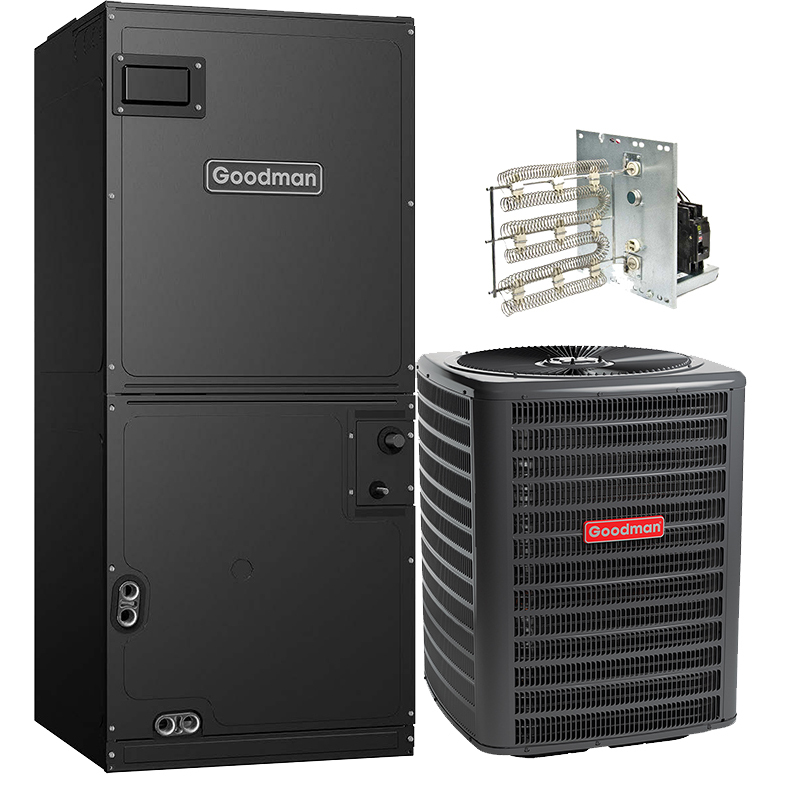
Goodman 2 Ton 14.5 SEER2 Split System with Electric Heat w/2 Ton A/H
View on AC Direct see your lowest price →Check current price on AC Direct →
Key features
- 14.5 SEER2 efficiency rating, meets current federal minimum for most U.S. regions
- 2-ton capacity, suited for roughly 800 to 1,200 sq ft depending on load calculation
- Single-stage compressor operation, full capacity or off
- Compatible with electric resistance heat strips in the matched air handler
- Designed for R-410A refrigerant (verify refrigerant spec with dealer before purchase)
- Backed by Goodman's 10-year parts limited warranty when registered within 60 days of install
About this system
The Goodman GSXN402410 pairs a 2-ton, 14.5 SEER2 condenser with a matching 2-ton air handler, making it a complete split system sized for smaller homes, condos, or additions in the 800-to-1,200-square-foot range (depending on local climate and insulation). The 14.5 SEER2 rating meets the current federal minimum efficiency standard for most U.S. regions, so it is not a high-efficiency upgrade, but it is fully code-compliant and will outperform any older R-22 or early R-410A unit it replaces. The electric heat configuration means the air handler can work with electric resistance heat strips, making it a viable all-electric option where a gas furnace is not present or desired.
Goodman targets buyers who need a reliable, code-compliant system without paying the premium associated with Trane, Carrier, or Lennox. The trade-off is real: the brand’s documented failure history, particularly around dual-run capacitors and evaporator coil integrity, means budget should be reserved for maintenance and occasional repairs, especially after year seven. This system is single-stage, meaning the compressor runs at full capacity or not at all, which is typical at this price point but less comfortable and less efficient during mild weather than two-stage or variable-speed alternatives.
The GSXN402410 is a straightforward entry-level split system that delivers adequate efficiency at a price point 15 to 25 percent below comparable equipment from premium brands. It suits budget-conscious buyers who plan to invest in quality installation and keep up with maintenance, but the brand's real-world reliability record warrants realistic expectations about mid-life repair costs. This is not the system to choose if low long-term operating cost or maximum longevity is the top priority.
Overall score is the average of the five ratings above.
What we like
- Purchase price is typically 15 to 25 percent below Carrier, Trane, and Lennox equivalents
- 14.5 SEER2 meets current federal efficiency minimums, legal for new installs across most regions
- 10-year parts warranty (registered) is competitive for this price tier
- Widely available through HVAC distributors, meaning parts and service technicians are easy to find
- Complete matched system reduces compatibility guesswork between condenser and air handler
Trade-offs
- Single-stage operation means less humidity control and comfort during mild weather compared to two-stage or variable-speed systems
- Compressor lifespan averages 10 to 14 years versus 15 to 20 years for premium-brand equivalents
- Dual-run capacitor failures and evaporator coil leaks are the most commonly documented repair issues, with repair costs rising noticeably after year seven
- A minority of owners report refrigerant leaks within the first year, typically tied to install or charge quality rather than manufacturing
What homeowners and pros say about Goodman
Homeowners who have lived with Goodman equipment reflect the split picture that its ratings tell. On ConsumerAffairs, where the brand scores around 2.5 out of 5, the recurring pattern is not early failure but rather repair bills that start adding up after roughly year seven, with capacitor replacements being the most frequently mentioned first repair and evaporator coil issues coming up often enough to be a genuine concern. On Google dealer reviews, where scores cluster around 3.8 out of 5, the tone shifts: affordability is the most common praise, and many owners who had their systems installed by experienced contractors report years of uneventful operation. The contrast between those two data points is the most honest summary of the brand.
HVAC technicians tend to view Goodman as workable equipment that punishes shortcuts. The documented failure modes, dual-run capacitors going early, evaporator coil leaks appearing in a meaningful share of units, compressors averaging 10 to 14 years rather than the 15 to 20 common with premium brands, are real but not unusual for this price tier. Techs who specialize in Goodman installs note that a precise refrigerant charge at startup, a clean coil from day one, and annual capacitor checks can push the system’s useful life toward the longer end of that range. The small percentage of owners who report refrigerant leaks within the first year are almost always dealing with an install or charge problem rather than a factory defect, which underscores why contractor selection matters as much as brand selection at this price point.
Sources: ConsumerAffairs Goodman owner reviews, AHRI Directory of Certified Product Performance, U.S. DOE appliance and equipment efficiency standards, Goodman product specification sheets.
What it costs to run
At 14.5 SEER2, cooling this 2-ton system for a typical 1200-hour cooling season at the U.S. average electricity rate of $0.17/kWh works out to roughly $338 per year in cooling, about $27 less per year than a minimum-efficiency 13.4 SEER2 unit of the same size. Your real cost depends on your climate and local rate.
Method: (24,000 BTU/hr ÷ 14.5 SEER2) × 1200 hours ÷ 1000 × $0.17/kWh. Rate source: U.S. EIA average; cooling hours: moderate-climate estimate.
How it compares
| Brand | Comparable model | SEER2 | Stage | Price position |
|---|---|---|---|---|
| Goodman | GSXN402410 | 14.5 | Single-stage | Value pick |
| Carrier | Comfort 14 (24ACC4) | 14.3-14.5 | Single-stage | Typically 15 to 25 percent more than Goodman |
| Trane | XR14c | 14.3-15.0 | Single-stage | Typically 15 to 25 percent more than Goodman |
| Lennox | Merit 14ACX | 14.3-15.0 | Single-stage | Typically 15 to 25 percent more than Goodman |
Competitor rows are comparable single-stage units at similar efficiency; price is relative position, not a quote.
Questions about this system
Is 14.5 SEER2 enough, or should I pay more for a higher-efficiency unit?
14.5 SEER2 is the current federal minimum for most U.S. climate zones and will be noticeably more efficient than any system built before roughly 2015. If your electricity rates are high or you run the system heavily, stepping up to a 16 or 18 SEER2 unit can shorten the payback period, but at 2 tons the savings difference in dollars per year is modest. The bigger efficiency gains come from two-stage or variable-speed compressors, not just a higher SEER2 number on a single-stage unit.
What heat strips do I need to add, and are they included?
Heat strips are not included in this system and must be purchased and installed separately into the air handler. Strip sizes typically range from 5 kW to 20 kW; the correct size depends on your home's heat load and local code requirements. Your installer should perform a Manual J heat load calculation to specify the right strip size before purchase.
How worried should I be about the capacitor and coil failure reports I keep reading about?
Dual-run capacitor failure is the most commonly reported issue with Goodman equipment and is genuinely worth expecting at some point, but it is also one of the cheapest HVAC repairs, typically in the 300 to 600 dollar range with a service call. Evaporator coil leaks are more serious and more expensive; keeping the coil clean and having refrigerant levels checked annually can help catch early signs. Setting aside a small annual maintenance budget is a sound approach with this brand.
Does registering the warranty really matter, and what does it actually cover?
Yes, registration within 60 days of installation is required to receive the full 10-year parts limited warranty; without registration it typically drops to five years. The warranty covers replacement parts only, not labor, refrigerant, or diagnostic fees, so out-of-pocket repair costs can still be substantial even within the warranty period. Confirm the exact terms on Goodman's current warranty documentation before purchase.
Will any qualified HVAC contractor be able to install and service this system?
Generally yes. Goodman equipment is widely distributed and its components are familiar to most residential HVAC technicians. That said, Goodman's brand facts make clear that installation quality is the single biggest factor in how long one of these systems lasts, so choosing an experienced, licensed contractor who performs a proper load calculation and refrigerant charge matters more here than it might with a more forgiving premium brand.
Specifications
| Cooling capacity | 2 Ton |
| Efficiency | 14.5 SEER2 |
| Model | GSXN402410 |