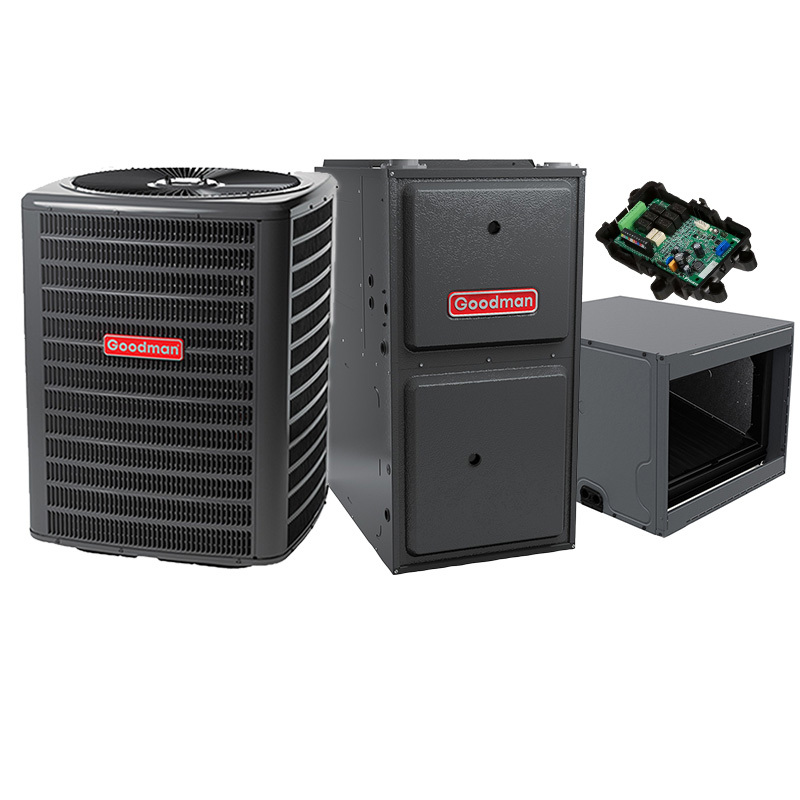
Goodman 2 Ton 14 SEER2 60000 BTU 96% AFUE Gas Furnace With R32 Air Condenser and Coil System – Horizontal
View on AC Direct see your lowest price →Check current price on AC Direct →
Key features
- 96% AFUE gas furnace converts nearly all fuel to heat, qualifying for federal efficiency tax credits
- 14 SEER2 cooling efficiency meets current federal minimums for most U.S. regions
- R-32 refrigerant with a global warming potential roughly 68% lower than R-410A
- Horizontal configuration suits attic, crawlspace, and tight-clearance installations
- 2-ton / 60,000 BTU capacity sized for approximately 900 to 1,200 sq ft under typical loads
- Matched coil and condenser system designed to work together for consistent airflow and efficiency
About this system
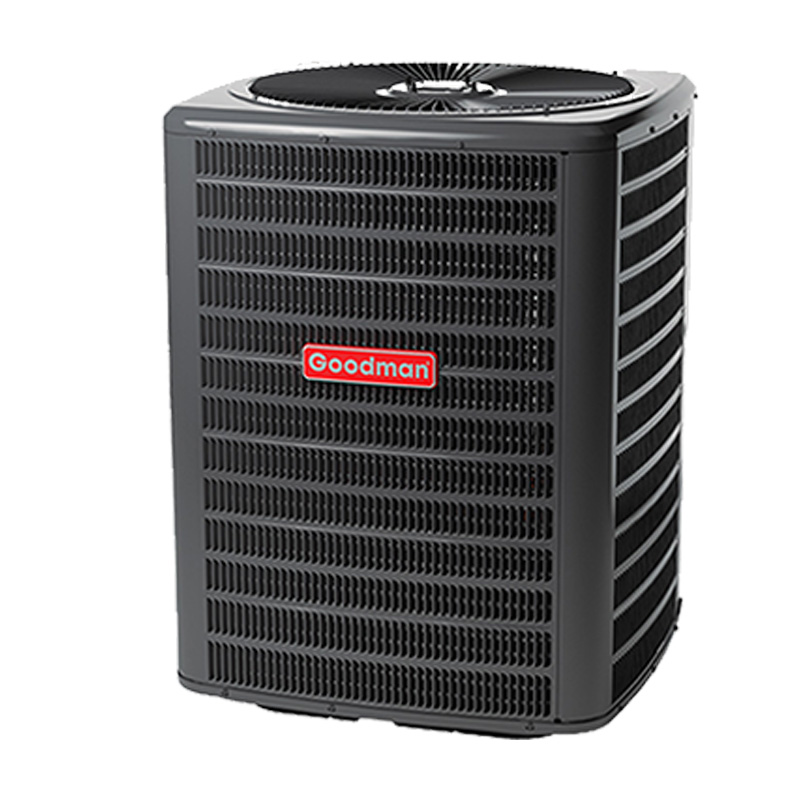
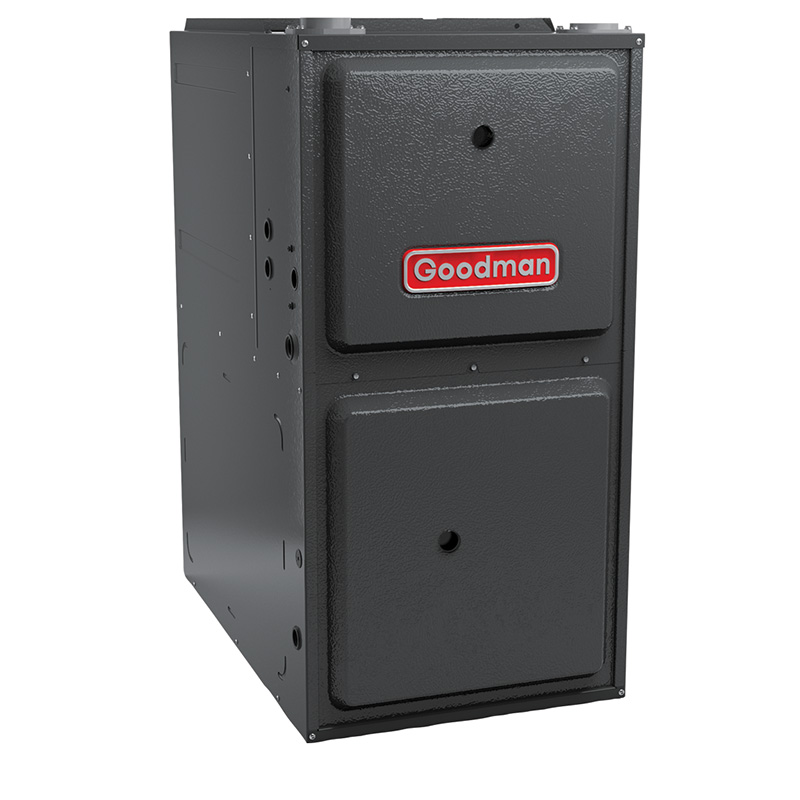
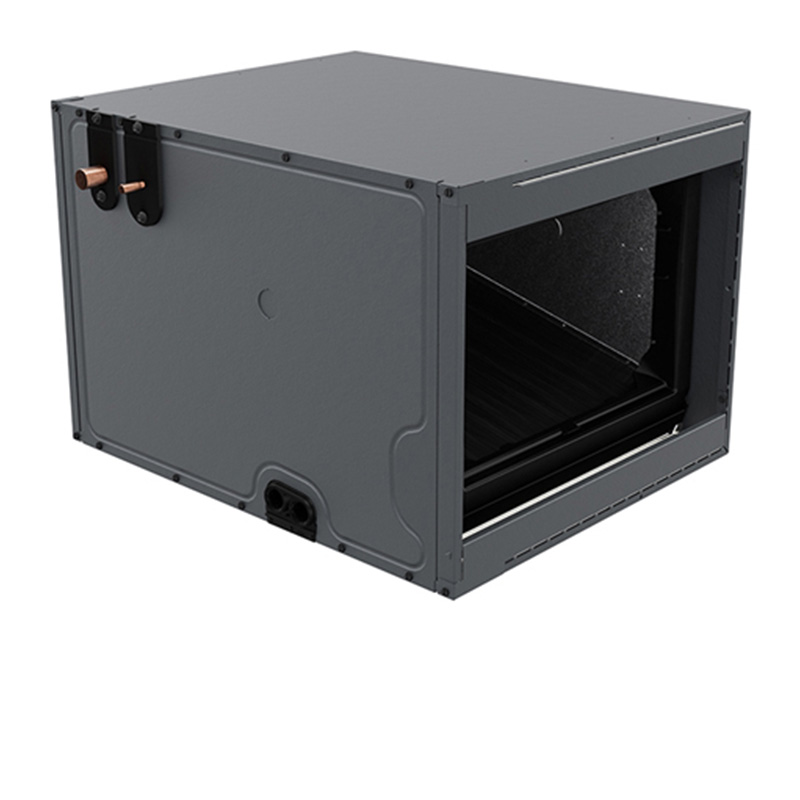
This Goodman system pairs a 2-ton, 14 SEER2 R-32 air condenser and matching evaporator coil with a 60,000 BTU, 96% AFUE gas furnace in a horizontal configuration. The horizontal layout is designed for attic or crawlspace installations where vertical clearance is limited, making it a practical choice for single-story homes, manufactured housing, or any structure where the air handler must lie on its side. At 2 tons, the cooling capacity targets spaces in roughly the 900 to 1,200 square foot range under typical load conditions, though a proper Manual J calculation by your installer is the only reliable way to confirm sizing for your home.
The 96% AFUE rating means this furnace converts 96 cents of every dollar of gas into usable heat, placing it in the high-efficiency tier and making it eligible for federal tax credits under current energy efficiency incentive programs. The shift to R-32 refrigerant is a meaningful environmental upgrade over older R-410A systems: R-32 has a global warming potential roughly 68 percent lower than R-410A, and its single-component makeup makes it easier to recover and recycle at end of life. At 14 SEER2, the cooling side meets but does not exceed current federal minimums for most U.S. regions, so buyers in hot climates who run their AC heavily should weigh whether a higher SEER2 system would pay back the price difference over time.
This Goodman combination system delivers genuine high-efficiency heating and code-compliant cooling at a price point that is hard to match from premium brands, making it a sensible budget for straightforward replacements in smaller homes. The horizontal configuration limits its audience to specific installation scenarios, and the brand's real-world reliability record means the long-term value equation depends heavily on install quality and a strong parts-and-labor warranty. Buyers who keep realistic expectations and invest in professional installation will likely get solid service life; those expecting premium-brand longevity without premium-brand cost may be disappointed after year seven.
Overall score is the average of the five ratings above.
What we like
- High-efficiency 96% AFUE furnace keeps heating bills low and qualifies for federal tax credits
- Priced roughly 15 to 25 percent below comparable Carrier, Trane, and Lennox systems, lowering the upfront barrier
- R-32 refrigerant is more environmentally responsible than R-410A and positions the system for near-term regulatory compliance
- Matched coil and condenser pairing simplifies system design and helps installers achieve rated efficiency
- Horizontal orientation solves real installation problems in attics and crawlspaces where vertical units simply will not fit
Trade-offs
- Dual-run capacitors are the most frequently reported failure point and typically need replacement within the first decade, adding service costs
- Evaporator coil leaks appear in a meaningful share of owner reviews, a failure mode that can be expensive to diagnose and repair
- Compressor life averages 10 to 14 years versus 15 to 20 years reported for premium brands, shortening the useful life of the outdoor unit
- A minority of owners report refrigerant leaks in the first year, most often traced to installation or initial charge issues rather than the equipment itself
What homeowners and pros say about Goodman
Homeowners who choose Goodman most often point to the upfront price as the deciding factor, and that sentiment shows up consistently in Google dealer reviews, where the brand averages around 3.8 out of 5 across many locations, with affordability as the most repeated compliment. The picture on ConsumerAffairs is less flattering, sitting near 2.5 out of 5, though that platform draws disproportionately from owners who had problems and wanted to register a complaint. The recurring pattern in negative reviews is not immediate failure but rather rising repair costs after roughly year seven, which aligns with the documented failure modes: dual-run capacitors are the most common early casualty and typically run 300 to 600 dollars to replace, while evaporator coil leaks and compressor wear become more prominent concerns in the second half of the system’s life.
HVAC technicians who work on Goodman equipment regularly tend to hold a pragmatic view: the hardware is serviceable and parts are widely available, but the brand’s reputation leans on how well the system is installed. Refrigerant leaks showing up in the first year are almost always pinned to installation or initial charge problems rather than a factory defect, which underscores why contractor selection matters at least as much as brand selection with this equipment. The compressor lifespan averaging 10 to 14 years versus 15 to 20 for premium brands is a genuine trade-off, not a talking point. For a homeowner planning to sell the house within a decade or working with a tight budget, that gap may be entirely acceptable; for someone expecting a 20-year run with minimal service calls, it is worth factoring into the total cost of ownership.
Sources: ConsumerAffairs Goodman owner reviews, AHRI Directory of Certified Product Performance, U.S. DOE appliance and equipment efficiency standards, Goodman product specification sheets.
What it costs to run
At 14 SEER2, cooling this 2-ton system for a typical 1200-hour cooling season at the U.S. average electricity rate of $0.17/kWh works out to roughly $350 per year in cooling, about $15 less per year than a minimum-efficiency 13.4 SEER2 unit of the same size. Your real cost depends on your climate and local rate.
Method: (24,000 BTU/hr ÷ 14 SEER2) × 1200 hours ÷ 1000 × $0.17/kWh. Rate source: U.S. EIA average; cooling hours: moderate-climate estimate.
How it compares
| Brand | Comparable model | SEER2 | Stage | Price position |
|---|---|---|---|---|
| Goodman | GMVC96 / GSXH5 / CAPF Series | 14 | Single-stage | Value pick |
| Carrier | Performance 96 / 24ACC6 Series | 14-15 | Single-stage | Moderately higher than Goodman |
| Trane | S9V2 / XR14 Series | 14-15 | Single-stage | Moderately to significantly higher than Goodman |
| Lennox | ML196 / 14ACX Series | 14 | Single-stage | Moderately higher than Goodman |
Competitor rows are comparable single-stage units at similar efficiency; price is relative position, not a quote.
Questions about this system
Is a horizontal furnace the same as a standard furnace just tipped on its side?
Not exactly. Horizontal-configuration furnaces are specifically built and certified to operate with the heat exchanger and burners oriented sideways, which affects drainage, airflow, and venting design. You cannot simply tip a standard upflow furnace on its side; you need a unit rated for horizontal installation, which this system is.
Does R-32 refrigerant require any special handling by my HVAC technician?
Yes. R-32 is mildly flammable (classified A2L), so technicians need to be aware of safe handling procedures and should use tools rated for A2L refrigerants. Most licensed HVAC professionals are already trained for this, but it is worth confirming with your contractor before scheduling service or installation.
What does the Goodman warranty actually cover on this system, and for how long?
Goodman's standard limited warranty on residential systems is 10 years on parts, including the compressor and heat exchanger, provided the equipment is registered within 60 days of installation. Without registration, coverage typically drops to 5 years. The warranty covers parts only; labor is not included unless you purchase a separate extended labor warranty through your dealer.
How worried should I be about the evaporator coil leak issue mentioned in owner reviews?
It is a real and documented concern worth monitoring, not an automatic outcome. The best defenses are ensuring your installer uses proper nitrogen brazing and leak-checks the coil before charging, and scheduling a refrigerant pressure check during your first annual maintenance visit. Catching a small leak early is far less expensive than waiting until the system stops cooling.
Will this system qualify for the federal energy efficiency home improvement tax credit?
The 96% AFUE furnace meets the efficiency threshold for the federal Energy Efficient Home Improvement Credit (25C), which can cover up to 30 percent of the cost of qualifying equipment. You should confirm current IRS guidance and retain your purchase and installation documentation, as credits are subject to annual caps and eligibility rules that can change.
Specifications
| Cooling capacity | 2 Ton |
| Efficiency | 14 SEER2 |
| Furnace output | 60000 BTU |
| Furnace efficiency | 96% AFUE |
| Configuration | Horizontal |
| Refrigerant | R-32 |