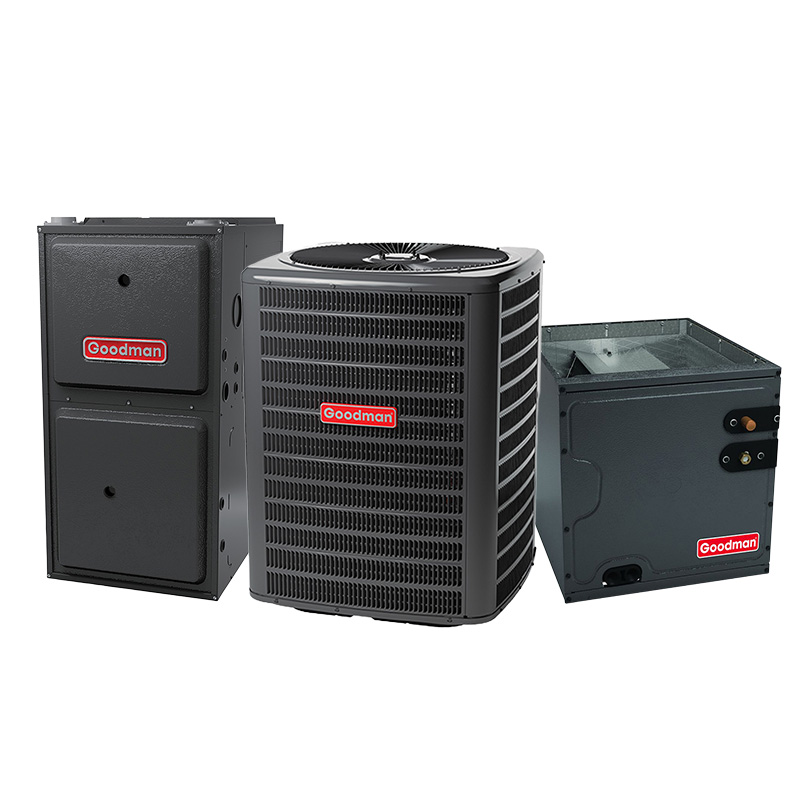
Goodman 2 Ton 15.2 SEER2 AC & Gas Furnace System – Two Stage Variable-Speed, 40000 BTU Gas Furnace, 96% AFUE, Upflow, R32
View on AC Direct see your lowest price →Check current price on AC Direct →
Key features
- Two-stage compressor runs at reduced capacity on mild days to control humidity and cut short-cycling
- Variable-speed ECM blower adjusts airflow continuously for quieter, more even comfort
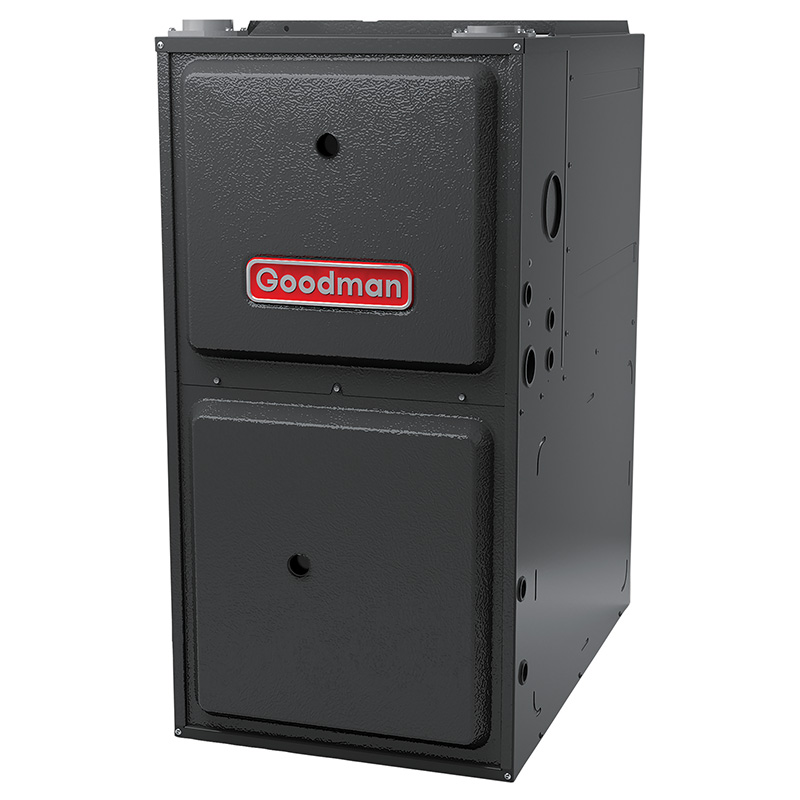
- 96% AFUE upflow gas furnace with 40,000 BTU output rated for smaller homes and add-on spaces
- R-32 refrigerant with lower global-warming potential than R-410A; requires R-32-certified technician
- 15.2 SEER2 efficiency meets current federal minimum standards for most U.S. climate regions
- Upflow cabinet orientation designed for basement or ground-floor mechanical rooms with overhead ductwork
About this system
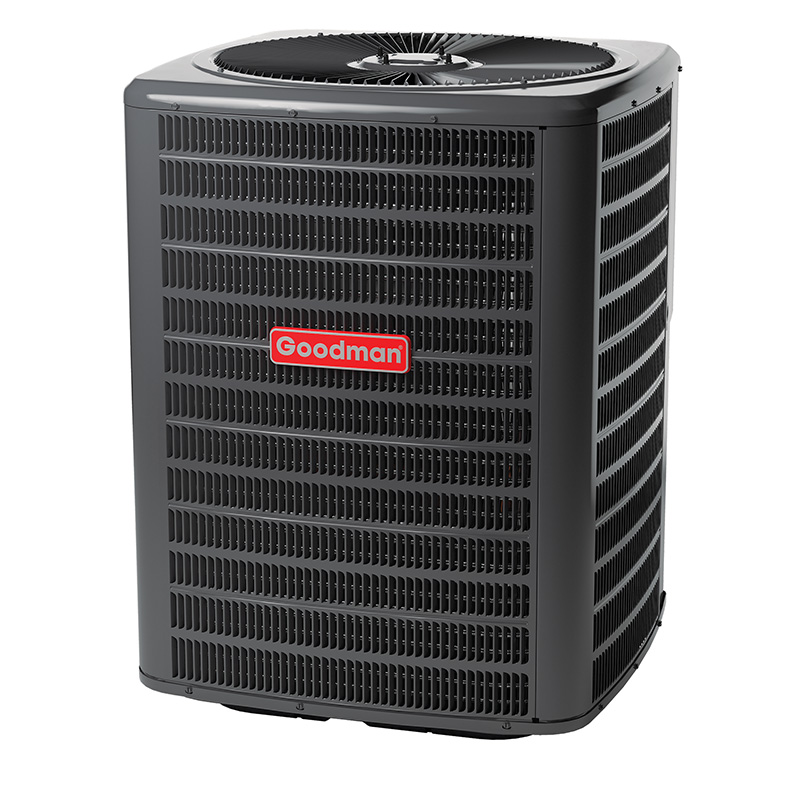
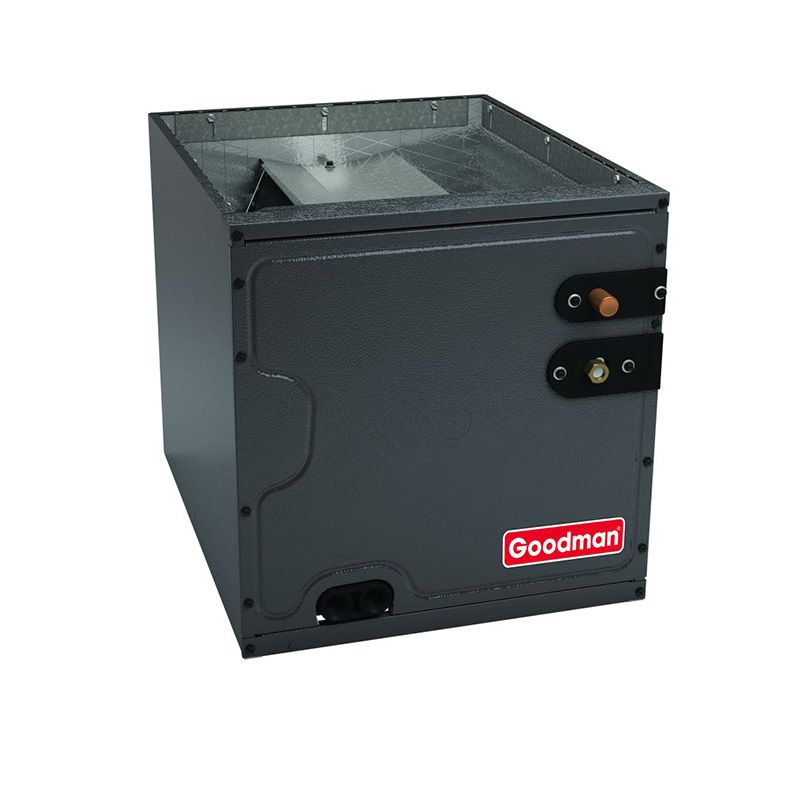
The Goodman 2-ton, 15.2 SEER2 split system pairs a two-stage, variable-speed air conditioner with a 40,000 BTU, 96% AFUE upflow gas furnace for a combination that suits smaller homes, condos, and additions in the 800-to-1,200 square-foot range. The two-stage compressor runs at a lower capacity on mild days, which keeps humidity in check and reduces short-cycling better than a single-stage unit can. The variable-speed air handler fan reinforces that by moving air slowly and steadily, improving filtration contact time and evening out hot and cold spots across the living space.
The 96% AFUE furnace rating means only 4 cents of every heating dollar escapes through the flue, making this system a reasonable fit for cold-climate homeowners who want to limit gas bills without stepping up to a condensing heat pump. R-32 refrigerant carries a lower global-warming potential than the R-410A it replaces, and its higher energy density allows slightly smaller line sets, though not every technician is yet certified to work with it, which is worth confirming before you schedule service. The upflow configuration sends conditioned air upward through floor registers or a trunk-line system, best suited to a basement or ground-level mechanical room with ductwork above.
At 15.2 SEER2 this system clears the federal minimum efficiency threshold for most U.S. climate zones but sits closer to the floor than the ceiling of what is currently available. Buyers primarily motivated by efficiency gains may want to compare variable-capacity options at 17 SEER2 and above, though the price premium is substantial. For budget-focused homeowners replacing older R-22 or R-410A equipment in a well-maintained duct system, this Goodman package offers a meaningful efficiency upgrade at a lower upfront cost than the major premium brands.
This Goodman package delivers two-stage comfort and high-efficiency heating at a price point 15 to 25 percent below comparable Trane, Carrier, and Lennox systems, making it a legitimate option for cost-conscious buyers with a solid duct system and a qualified installer. The trade-off is a compressor lifespan that tends to average 10 to 14 years versus the 15 to 20 years owners report from premium brands, and a support experience that earns notably lower consumer satisfaction scores over time. Getting the install right is not optional with this equipment; more than almost any other factor, technician quality determines how well and how long it performs.
Overall score is the average of the five ratings above.
What we like
- Two-stage operation reduces humidity and short-cycling noticeably compared to single-stage alternatives at this price level
- 96% AFUE is among the highest efficiency tiers available for gas furnaces, keeping annual heating costs low
- Priced 15 to 25 percent below Trane, Lennox, and Carrier equipment at similar specs, lowering the total project cost
- Variable-speed ECM blower improves comfort consistency and reduces fan noise at typical operating speeds
- R-32 refrigerant lowers environmental impact and is increasingly supported by HVAC distributors nationwide
Trade-offs
- Compressor lifespan averages 10 to 14 years, shorter than the 15-to-20-year range reported for premium-brand compressors
- Dual-run capacitors are the most commonly documented failure point and, while inexpensive to repair, tend to recur after year 7
- Evaporator coil leaks appear in a meaningful share of owner reviews, pointing to a quality-control concern worth noting
- R-32 certification is not universal among technicians, which can limit service options in some markets and raise emergency repair costs
What homeowners and pros say about Goodman
Homeowners who chose Goodman equipment most often point to the upfront price as the deciding factor, a sentiment that aligns with the brand’s roughly 3.8-out-of-5 average across Google dealer reviews, where affordability consistently draws the most positive comments. Early years of ownership are frequently reported as trouble-free, and when something does go wrong, the dual-run capacitor is by far the most frequently cited culprit. That repair typically runs 300 to 600 dollars and is well within a DIY-adjacent range for homeowners who know their way around electrical components, but it tends to recur, and several owners note it becomes an every-few-years expense after the system crosses the seven-year mark. Evaporator coil leaks also appear in a meaningful share of online accounts, and a smaller minority of owners have reported refrigerant issues in the first year, which service technicians generally attribute to charge or install problems rather than a factory defect.
Among HVAC professionals, the consensus on Goodman is practical rather than enthusiastic. Techs frequently note that the equipment performs acceptably when installed correctly, and that installation quality is the variable that separates the long-running units from the ones generating the complaints that pull ConsumerAffairs scores down to around 2.5 out of 5. That score carries an important caveat: complaint-driven platforms overrepresent bad outcomes, and the Google dealer average tells a more representative story. The compressor lifespan, averaging 10 to 14 years against 15 to 20 for Trane, Carrier, or Lennox, is a real and documented gap rather than anecdote, and professionals who service both brands acknowledge it. For this specific two-stage, variable-speed configuration, the components carry more complexity than a base single-stage Goodman, which raises the importance of finding an installer with documented experience on this product line rather than the lowest bidder.
Sources: ConsumerAffairs Goodman owner reviews, AHRI Directory of Certified Product Performance, U.S. DOE appliance and equipment efficiency standards, Goodman product specification sheets.
What it costs to run
At 15.2 SEER2, cooling this 2-ton system for a typical 1200-hour cooling season at the U.S. average electricity rate of $0.17/kWh works out to roughly $322 per year in cooling, about $43 less per year than a minimum-efficiency 13.4 SEER2 unit of the same size. Your real cost depends on your climate and local rate.
Method: (24,000 BTU/hr ÷ 15.2 SEER2) × 1200 hours ÷ 1000 × $0.17/kWh. Rate source: U.S. EIA average; cooling hours: moderate-climate estimate.
How it compares
| Brand | Comparable model | SEER2 | Stage | Price position |
|---|---|---|---|---|
| Goodman | 2-Ton 15.2 SEER2 Two-Stage Variable-Speed AC + 96% AFUE Gas Furnace | 15.2 | Two-stage | Value pick |
| Carrier | Comfort 15 Series (CA15 / 59SC2) | 15+ | Single-stage | Typically 15 to 25 percent more than the Goodman |
| Trane | XR15 / S8X1 Series | 15+ | Single-stage | Typically 15 to 25 percent more than the Goodman |
| Lennox | Merit ML15 / SL280V Series | 15+ | Single-stage | Typically 15 to 25 percent more than the Goodman |
Competitor rows are comparable single-stage units at similar efficiency; price is relative position, not a quote.
Questions about this system
Is a 2-ton unit actually the right size for my home, or should I size up to be safe?
Bigger is not better with HVAC equipment. A 2-ton system is generally appropriate for homes in the 800-to-1,200 square-foot range depending on insulation, ceiling height, and climate zone. Oversizing causes short-cycling, which reduces humidity control and accelerates wear. Ask your installer to perform a Manual J load calculation before confirming the tonnage.
What does the R-32 refrigerant mean for service and maintenance costs?
R-32 requires technicians to hold specific certification and use compatible recovery equipment, so not every HVAC company in your area will be equipped to service it. Before buying, confirm your preferred service contractor is R-32 certified. In most metro areas this is becoming routine, but in rural markets it can still be a limitation.
Goodman has mixed reviews online. Should I be worried about reliability?
Goodman scores roughly 2.5 out of 5 on ConsumerAffairs, a platform that attracts disproportionate complaint traffic, and around 3.8 out of 5 across Google dealer reviews. The documented weak points are dual-run capacitors failing after year 7 (a relatively low-cost repair), evaporator coil leaks in a share of units, and compressor life averaging 10 to 14 years versus 15 to 20 for premium brands. A good install, a protected location for the outdoor unit, and annual maintenance significantly reduce the likelihood of early failures.
What warranty does this system come with, and are there registration requirements?
Goodman typically offers a 10-year parts warranty when the system is registered within a set window after installation, and a limited lifetime heat exchanger warranty on the furnace. Failure to register usually drops coverage to 5 years on parts. Confirm the current warranty terms with your dealer at the time of purchase, as Goodman has adjusted its warranty structure in the past.
Will this system work with my existing ductwork, or will I need modifications?
The upflow configuration requires ductwork above the air handler, typically a basement installation with supply ducts running up through the floor. If your current duct system was sized for a similar 2-ton unit in reasonable condition, it will generally work without modification. However, leaky or undersized ducts will limit performance regardless of equipment quality, so a duct inspection before installation is worth the time.
Specifications
| Cooling capacity | 2 Ton |
| Efficiency | 15.2 SEER2 |
| Furnace output | 40000 BTU |
| Furnace efficiency | 96% AFUE |
| Configuration | Upflow |
| Refrigerant | R-32 |