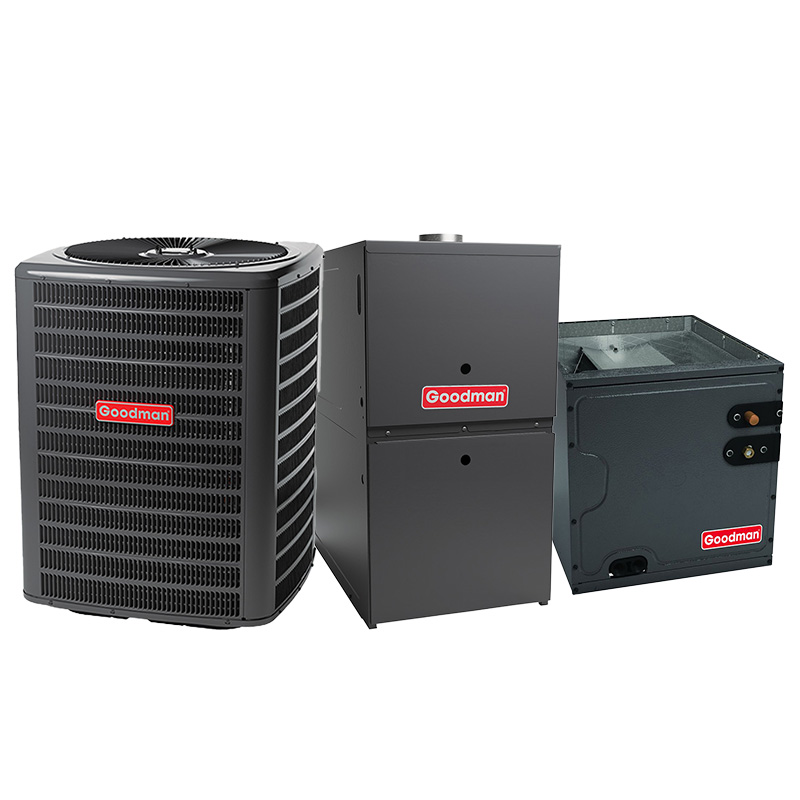
Goodman 2 Ton 15.2 SEER2 AC & Gas Furnace System – Two Stage Variable-Speed 60000 BTU Gas Furnace, 80% AFUE, Upflow, R32
View on AC Direct see your lowest price →Check current price on AC Direct →
Key features
- Two-stage compressor reduces humidity and short-cycling at 2-ton capacity
- Variable-speed ECM blower motor for quieter, more consistent airflow
- 15.2 SEER2 cooling efficiency meets or exceeds federal minimums for most U.S. regions
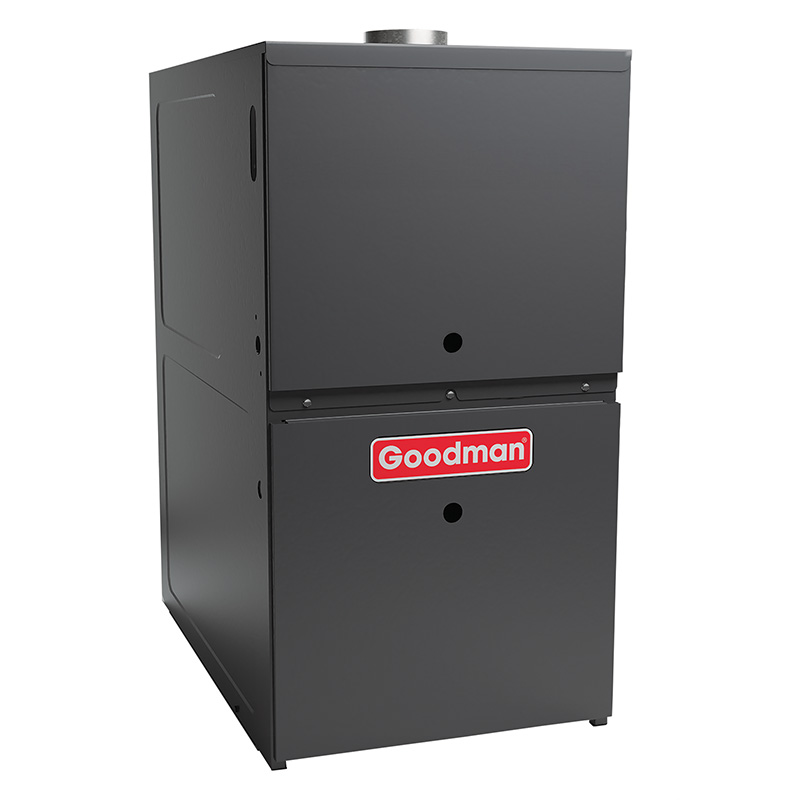
- 60,000 BTU, 80% AFUE upflow gas furnace for basement or closet installations
- R-32 refrigerant with lower global-warming potential than legacy R-410A
- Goodman 10-year parts limited warranty available with online registration within 60 days of install
About this system
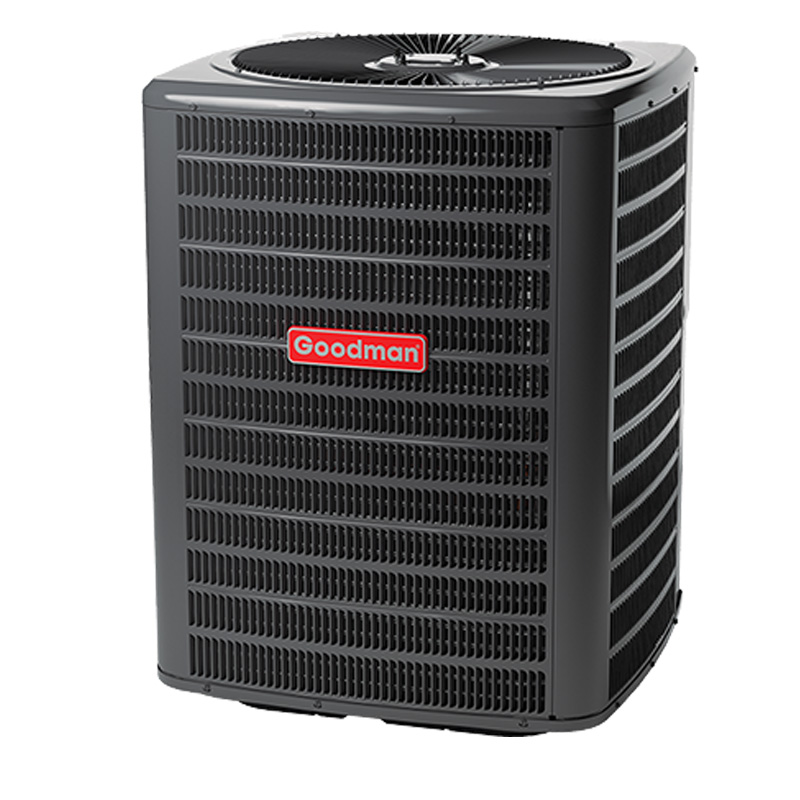
The Goodman 2-ton, 15.2 SEER2 split system pairs a two-stage air conditioner with a variable-speed, 80% AFUE upflow gas furnace rated at 60,000 BTU. The two-stage cooling compressor runs at a lower capacity during mild weather and steps up only when conditions demand it, which reduces short-cycling, helps wring more humidity out of indoor air than a single-stage unit can, and trims operating costs compared to a basic on-or-off system. The variable-speed furnace blower extends those comfort gains by moving air more gently and consistently rather than blasting at full speed every cycle.
At 15.2 SEER2 the cooling efficiency clears the federally mandated minimums for most U.S. climate zones with a reasonable margin, though it sits in the entry-to-mid tier rather than the premium efficiency range. The 80% AFUE furnace returns 80 cents of heat for every dollar of gas burned, which is code-legal in most states but below the 95-plus AFUE condensing furnaces that reduce long-run heating bills more substantially. The R-32 refrigerant charge is lower in global-warming potential than the R-410A it replaces and is becoming the industry standard, so future service availability should be solid. This system suits budget-minded buyers replacing aging equipment in homes up to roughly 900 to 1,100 square feet in moderate climates, where the upflow configuration aligns with a basement or closet air handler installation.
Because Goodman prices this system 15 to 25 percent below comparable Trane, Lennox, and Carrier equipment, the purchase-price savings are real and meaningful, especially for homeowners without the budget for a premium brand. The trade-off is a shorter expected compressor lifespan and a brand track record that generates more post-warranty repair calls than the top-tier names. Getting an experienced, licensed installer and registering the equipment promptly are both critical steps that will determine how much of the value proposition actually holds.
This system offers genuine upfront savings and real two-stage comfort upgrades over a basic single-stage setup, making it a reasonable choice for cost-focused buyers who prioritize purchase price and plan to budget for possible mid-life repairs. The 80% AFUE furnace and entry-level efficiency tier mean operating costs will be higher over a decade than a premium system, and Goodman's documented compressor and coil reliability gaps are a real risk to weigh against that initial discount. If the installation is done well and the warranty is registered, most owners get a functional system; if either slips, the savings can erode quickly.
Overall score is the average of the five ratings above.
What we like
- Priced 15 to 25 percent below comparable Carrier, Trane, and Lennox systems
- Two-stage cooling improves humidity control and comfort versus single-stage alternatives
- Variable-speed blower reduces noise and delivers steadier temperatures
- R-32 refrigerant is forward-compatible with evolving EPA regulations
- 10-year parts warranty (with registration) is competitive for the value-brand segment
Trade-offs
- 80% AFUE furnace will cost more to operate annually than a 95-plus AFUE condensing unit
- Dual-run capacitors are a documented early failure point, and evaporator coil leaks appear in a meaningful share of owner reports
- Compressor lifespan averages 10 to 14 years versus 15 to 20 years for premium brands, raising long-run replacement risk
- Performance is heavily dependent on installer quality; a poor charge or commissioning can trigger refrigerant leaks in year one
What homeowners and pros say about Goodman
Goodman earns a ConsumerAffairs rating of roughly 2.5 out of 5, though that platform disproportionately attracts frustrated owners, and the recurring theme in those complaints is repair costs that start climbing after about year 7. On Google dealer reviews the picture is more balanced, averaging around 3.8 out of 5 across hundreds of location reviews, where affordability is the most commonly cited reason buyers chose the brand. That gap between the two scores reflects a real pattern: owners who get a clean install and register their warranty tend to have satisfactory experiences for the first several years, while those who hit problems later feel the cost more sharply because Goodman equipment is more likely to be out of warranty when issues surface.
HVAC technicians who service Goodman equipment most often point to dual-run capacitors as the first thing to go, typically a quick, low-cost fix in the 300 to 600 dollar range that does not necessarily signal deeper trouble. More consequential are evaporator coil leaks, which appear in a meaningful share of owner accounts and can be a more expensive repair. Compressor longevity is another honest concern: Goodman compressors tend to average 10 to 14 years in the field, noticeably shorter than the 15 to 20 years owners of Carrier, Trane, and Lennox equipment often report. Technicians are consistent on one point: install quality matters more with Goodman than with premium brands because there is less margin for a sloppy refrigerant charge or a rushed commissioning, and refrigerant leaks within the first year are almost always traced back to the installation rather than the equipment itself.
Sources: ConsumerAffairs Goodman owner reviews, AHRI Directory of Certified Product Performance, U.S. DOE appliance and equipment efficiency standards, Goodman product specification sheets.
What it costs to run
At 15.2 SEER2, cooling this 2-ton system for a typical 1200-hour cooling season at the U.S. average electricity rate of $0.17/kWh works out to roughly $322 per year in cooling, about $43 less per year than a minimum-efficiency 13.4 SEER2 unit of the same size. Your real cost depends on your climate and local rate.
Method: (24,000 BTU/hr ÷ 15.2 SEER2) × 1200 hours ÷ 1000 × $0.17/kWh. Rate source: U.S. EIA average; cooling hours: moderate-climate estimate.
How it compares
| Brand | Comparable model | SEER2 | Stage | Price position |
|---|---|---|---|---|
| Goodman | GLXS4-2 / GMVC8-60 Series (this system) | 15.2 | two-stage | Value pick |
| Carrier | Comfort 15 Series (24ACC6) | 15.2 | single-stage | Typically 15 to 25 percent more than this Goodman system |
| Trane | XR15 Series | 15.0 to 15.5 | single-stage | Typically 15 to 25 percent more than this Goodman system |
| Lennox | Merit 15 Series (14ACX/ML14XC1) | 15.1 to 15.5 | single-stage | Typically 15 to 25 percent more than this Goodman system |
Competitor rows are comparable single-stage units at similar efficiency; price is relative position, not a quote.
Questions about this system
Do I need to do anything after installation to get the 10-year parts warranty?
Yes. Goodman requires online product registration within 60 days of the installation date to unlock the 10-year parts limited warranty. If you miss that window, coverage typically drops to 5 years, so make sure your installer gives you the model and serial numbers right away and register immediately.
Is 15.2 SEER2 going to noticeably lower my electricity bills compared to my old unit?
If your existing system is a pre-2015 unit rated at 10 to 13 SEER (old scale), you will likely see a meaningful reduction in cooling costs. Compared to a new single-stage 14 SEER2 system, the efficiency difference is modest; the bigger day-to-day comfort gain comes from the two-stage compressor reducing humidity and short-cycling rather than from a dramatic efficiency jump.
What does upflow configuration mean, and is my home set up for it?
Upflow means the furnace draws return air in at the bottom and discharges heated or cooled air out the top, which routes it upward into ductwork above the unit. This configuration suits installations in a basement, utility room, or ground-level closet where supply ducts run overhead. If your air handler sits in an attic or crawlspace blowing downward, you would need a downflow or horizontal configuration instead.
How serious is the evaporator coil leak issue people report with Goodman systems?
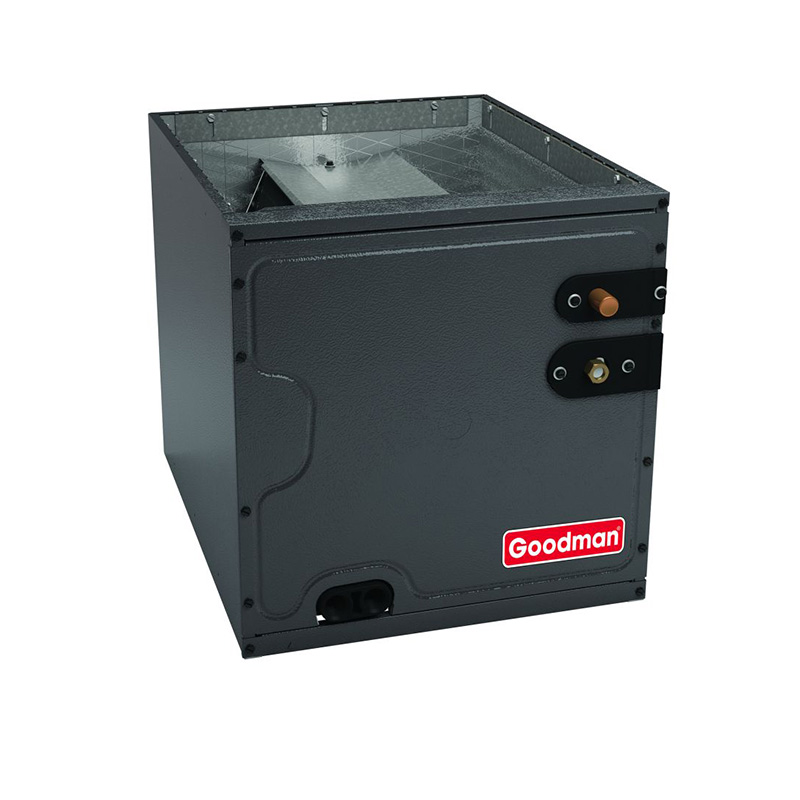
Evaporator coil leaks are a documented complaint across owner reviews, though they are not universal. A leak means refrigerant escapes, the system loses cooling capacity, and repair costs can reach several hundred dollars or more depending on whether the coil needs to be replaced. Ensuring the system is properly charged and commissioned at installation reduces early risk, and the 10-year parts warranty would cover a confirmed defective coil if it fails within the coverage period.
Can this system use R-32 refrigerant if my current system uses R-410A?
No, R-32 and R-410A are not interchangeable, and this system ships pre-charged with R-32. Your installer will need equipment and certification specific to R-32 handling. If you are replacing an R-410A system, the refrigerant lines will need to be flushed and the new system charged properly with R-32; do not assume the old refrigerant can simply be reused.
Specifications
| Cooling capacity | 2 Ton |
| Efficiency | 15.2 SEER2 |
| Furnace output | 60000 BTU |
| Furnace efficiency | 80% AFUE |
| Configuration | Upflow |
| Refrigerant | R-32 |