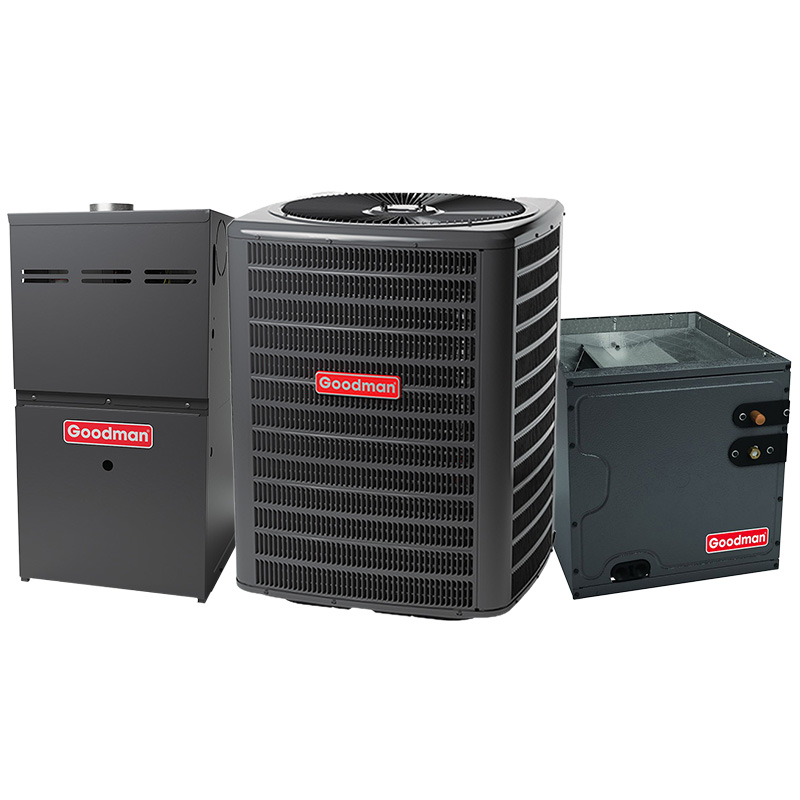
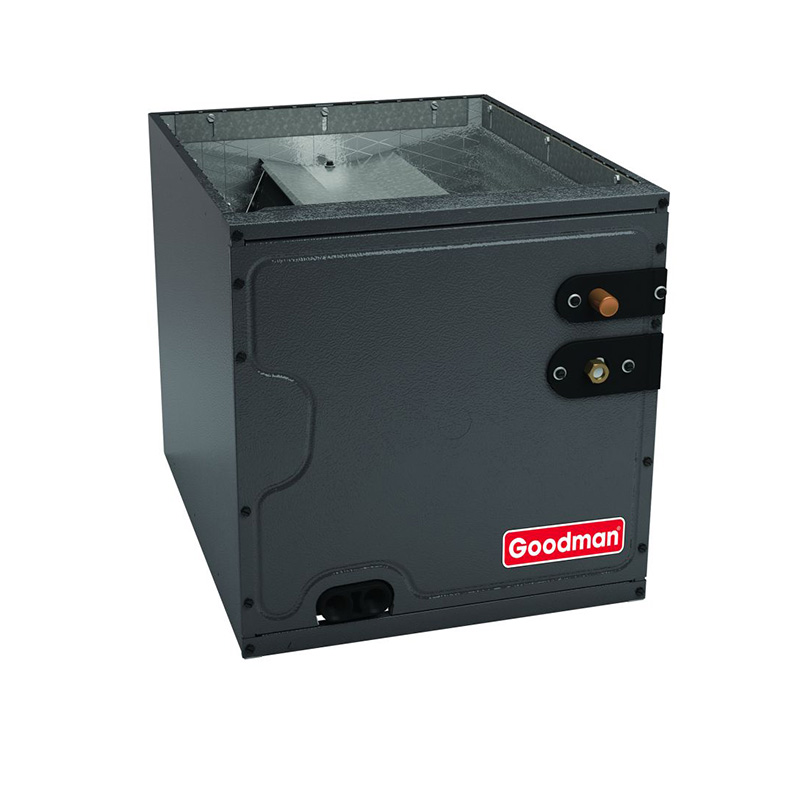
Goodman 2 Ton AC And 80000 BTU 80% AFUE Gas Furnace System | 15.2 SEER2 AC | Multi-Speed ECM Low NOx Furnace | Upflow | R32
View on AC Direct see your lowest price →Check current price on AC Direct →
Key features
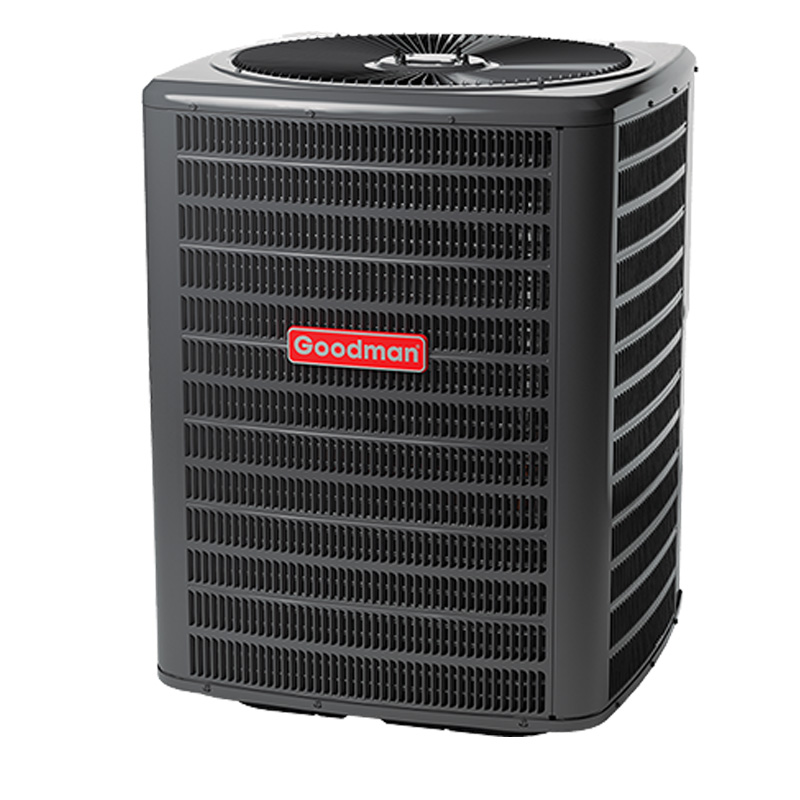
- 15.2 SEER2 single-stage central AC sized at 2 tons for spaces roughly 900 to 1,300 sq ft depending on climate and insulation
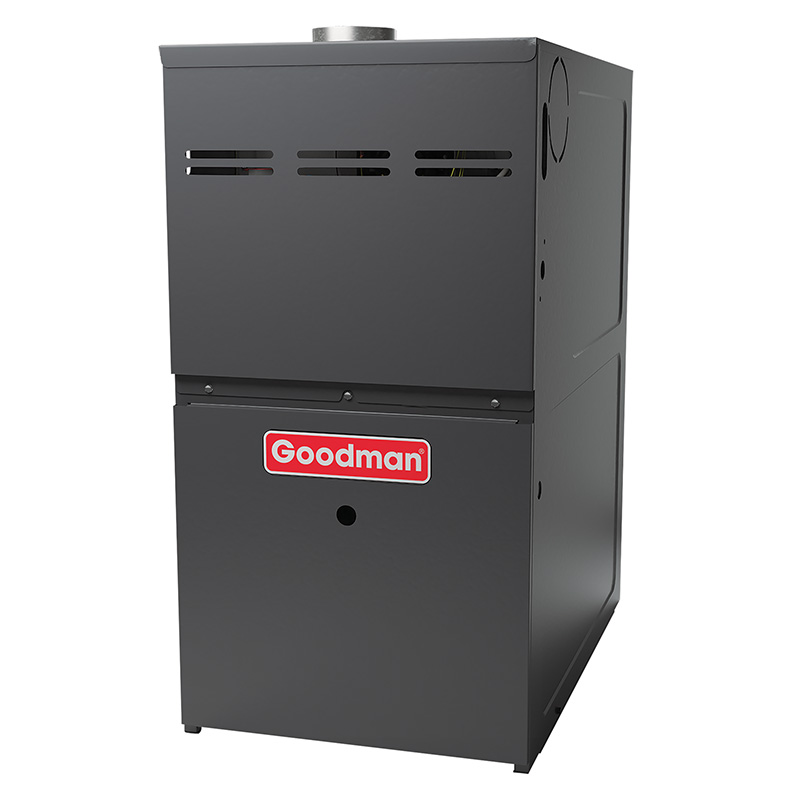
- 80,000 BTU output at 80% AFUE non-condensing gas furnace with ECM multi-speed blower
- R-32 refrigerant with a lower global-warming potential than R-410A
- Low NOx combustion meets California and other strict regional air-quality requirements
- Upflow cabinet orientation suits basement or closet installations with ductwork above the unit
- ECM blower motor reduces electrical draw compared to standard PSC motors and improves airflow consistency
About this system
This Goodman 2-ton, 15.2 SEER2 system pairs a straightforward single-stage air conditioner with an 80,000 BTU, 80% AFUE gas furnace in an upflow configuration. The AC uses R-32 refrigerant, a lower-global-warming-potential option that is becoming more common as the industry moves away from R-410A. At 15.2 SEER2 the cooling efficiency clears the federal minimum for most U.S. climate zones and will satisfy homeowners who want a code-compliant, honest performer without paying for top-tier efficiency ratings they may never fully recover through energy savings.
The furnace side runs an ECM multi-speed blower motor, which uses meaningfully less electricity than a standard PSC motor and gives the system better airflow control across different heating demands. The Low NOx designation meets stricter California and other regional air-quality standards, so this unit is permitted where conventional furnaces are not. At 80% AFUE, roughly one dollar in five of every gas dollar goes up the flue, which is standard for a non-condensing furnace. Homeowners in mild-to-moderate heating climates will find this a practical fit; those in very cold regions with high annual heating loads may want to weigh a 96% AFUE condensing option before committing.
This system suits budget-conscious buyers replacing aging equipment in smaller homes, rental properties, or situations where the priority is getting a reliable, permitted system installed without the premium price of Carrier, Trane, or Lennox. Because Goodman’s long-term outcomes correlate closely with install quality, the contractor you hire matters as much as the equipment itself.
This Goodman bundle delivers a code-compliant, adequately efficient system at a price point well below comparable Carrier, Trane, or Lennox packages, making it a sensible choice for cost-focused buyers who hire a skilled installer. The trade-off is a compressor and coil track record that lags premium brands past the seven-to-ten year mark, and ownership costs can climb if the known capacitor and coil failure modes materialize. It is a workable system, not an exceptional one.
Overall score is the average of the five ratings above.
What we like
- Price typically 15 to 25 percent below comparable Carrier, Trane, and Lennox systems
- R-32 refrigerant is more future-proof than R-410A as regulations tighten
- ECM multi-speed blower lowers electricity use and improves humidity control versus single-speed PSC motors
- Low NOx rating keeps the furnace legal in California and other strict-emissions markets
- 80% AFUE hits the non-condensing efficiency standard without the higher cost or condensate drain complexity of a 90-plus unit
Trade-offs
- Dual-run capacitors are the most commonly reported failure point, typically around years 4 to 8, though the repair usually runs $300 to $600
- Evaporator coil leaks appear in a notable share of owner reports, a more serious repair than a capacitor swap
- Compressor lifespan averages 10 to 14 years versus 15 to 20 for premium-brand compressors, meaning earlier replacement risk
- 80% AFUE loses more heat up the flue than condensing alternatives, making it a weaker long-term value in high-heating-load climates
What homeowners and pros say about Goodman
Homeowners who have lived with Goodman equipment tend to land in one of two camps, and the split often traces back to who installed the unit. On Google dealer reviews, Goodman systems average around 3.8 out of 5, with affordability and straightforward repair access earning consistent praise. On ConsumerAffairs, which skews toward frustrated owners writing in after something goes wrong, the rating drops to roughly 2.5 out of 5, with the recurring theme being that repair bills start to pile up somewhere around the seven-year mark. Neither number tells the whole story on its own, but together they suggest a system that performs acceptably when things go right and frustrates owners when they do not.
Among HVAC technicians, the most commonly cited failure point on Goodman AC equipment is the dual-run capacitor, which is generally a low-stakes, low-cost repair in the $300 to $600 range if caught early. More consequential are evaporator coil leaks, which appear in enough owner accounts to be worth noting as a real risk rather than a rare edge case. On the compressor side, real-world longevity tends to run 10 to 14 years, shorter than the 15 to 20 years that premium-brand compressors frequently achieve. A small share of owners also report refrigerant issues within the first year, which technicians typically attribute to installation errors or improper charging rather than equipment defects. The takeaway for a buyer considering this specific system is that the hardware is a known quantity with known weak points, and a careful install by an experienced contractor is the most reliable way to keep those weak points from showing up early.
Sources: ConsumerAffairs Goodman owner reviews, AHRI Directory of Certified Product Performance, U.S. DOE appliance and equipment efficiency standards, Goodman product specification sheets.
What it costs to run
At 15.2 SEER2, cooling this 2-ton system for a typical 1200-hour cooling season at the U.S. average electricity rate of $0.17/kWh works out to roughly $322 per year in cooling, about $43 less per year than a minimum-efficiency 13.4 SEER2 unit of the same size. Your real cost depends on your climate and local rate.
Method: (24,000 BTU/hr ÷ 15.2 SEER2) × 1200 hours ÷ 1000 × $0.17/kWh. Rate source: U.S. EIA average; cooling hours: moderate-climate estimate.
How it compares
| Brand | Comparable model | SEER2 | Stage | Price position |
|---|---|---|---|---|
| Goodman | 2-Ton 15.2 SEER2 AC + 80K BTU 80% AFUE Furnace Bundle | 15.2 | Single-stage | Value pick |
| Carrier | Comfort Series (24ACC / 58TP80) | 15.2 | Single-stage | Typically 15 to 25 percent more than this Goodman bundle |
| Trane | XR15 / S8X1 Series | 15.0-15.5 | Single-stage | Typically 15 to 25 percent more than this Goodman bundle |
| Lennox | Merit Series (14ACX / ML180) | 15.0-15.5 | Single-stage | Typically 15 to 25 percent more than this Goodman bundle |
Competitor rows are comparable single-stage units at similar efficiency; price is relative position, not a quote.
Questions about this system
Is 15.2 SEER2 enough efficiency, or should I step up to a higher-rated unit?
15.2 SEER2 meets current federal minimums and will satisfy most homeowners in mixed or warm climates. In very hot regions where the AC runs six or more months a year, a 17 or 18 SEER2 system can pay back its price premium over time, but the math depends on your local electricity rate and actual run hours. For a 2-ton unit in a mild-to-moderate climate, 15.2 SEER2 is reasonable.
What does R-32 refrigerant mean for me as an owner?
R-32 has a lower global-warming potential than R-410A and is already widely used in other markets. For day-to-day ownership the main practical point is that not all technicians carry R-32 yet, so confirm your local service contractors can handle it before you buy. It is mildly flammable, which requires proper handling but does not create a meaningful safety risk in normal residential use.
How long should I realistically expect this system to last?
Goodman compressors average roughly 10 to 14 years in owner experience, compared to 15 to 20 years for premium brands. The furnace heat exchanger can often outlast the AC side. After year 7, repair costs tend to rise, particularly if the dual-run capacitor or evaporator coil needs replacement. A well-executed install and annual maintenance are the biggest factors in where within that range your unit lands.
Why does the furnace say Low NOx, and does it matter if I am not in California?
Low NOx means the burner produces fewer nitrogen oxide emissions. It is required in California and some other jurisdictions with strict air-quality rules. If your local codes do not require it, it causes no harm and no performance difference either way, so you are not giving up anything by having it.
Can I install this system myself to save money?
In most states, HVAC installation requires EPA Section 608 certification to handle refrigerants and local permits for gas work. Beyond the legal requirements, Goodman's own track record shows that install quality is the primary driver of how long and how reliably these units perform. A poor installation is the most common source of first-year refrigerant leaks and early failures, so hiring a licensed contractor is strongly recommended.
Specifications
| Cooling capacity | 2 Ton |
| Efficiency | 15.2 SEER2 |
| Furnace output | 80000 BTU |
| Furnace efficiency | 80% AFUE |
| Configuration | Upflow |
| Refrigerant | R-32 |