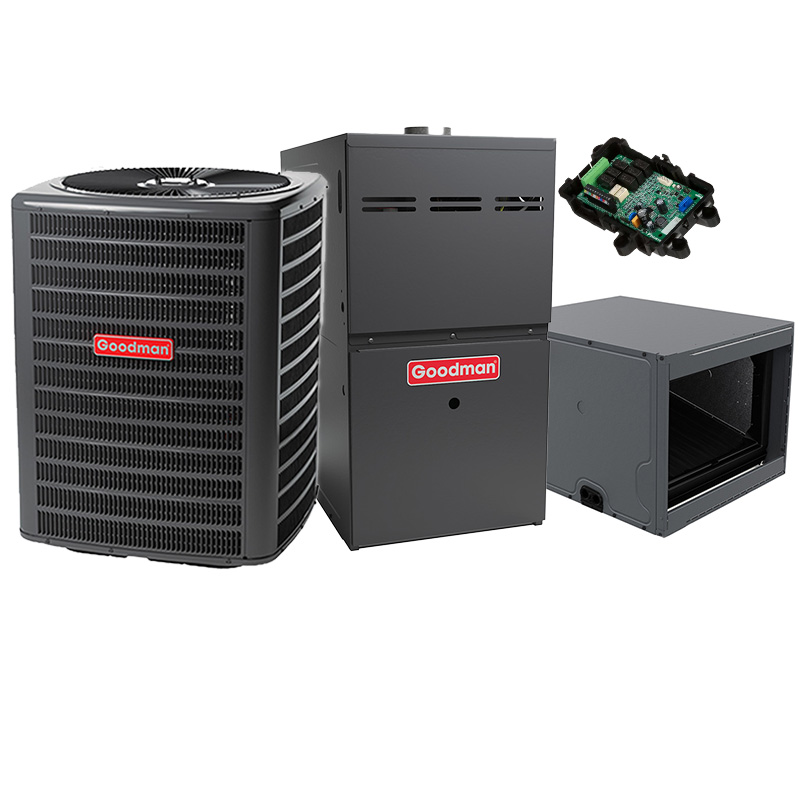
Goodman 3.5 Ton 13.4 SEER2 100000 BTU 96% AFUE Two-Stage Gas Furnace With R32 Air Condenser and Coil System – Horizontal
View on AC Direct see your lowest price →Check current price on AC Direct →
Key features
- 3.5-ton cooling capacity with 13.4 SEER2 efficiency rating
- 100,000 BTU two-stage gas furnace at 96% AFUE
- Horizontal configuration for attic, crawlspace, or side-mount installs
- R-32 refrigerant with lower global warming potential than R-410A
- Two-stage heating reduces short-cycling and improves temperature consistency
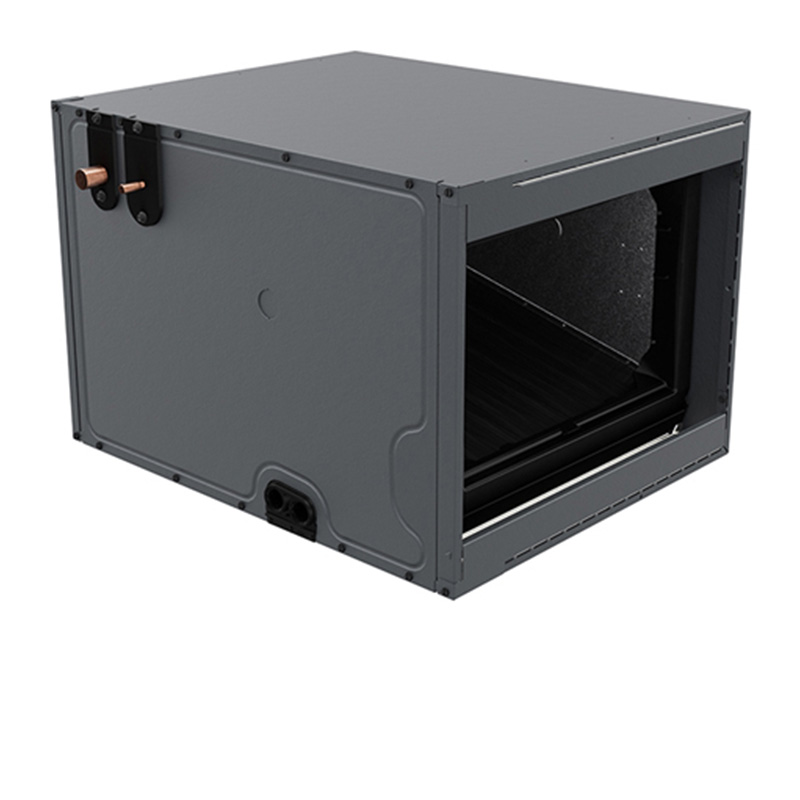
- Matched coil included for simplified system compatibility and warranty compliance
About this system
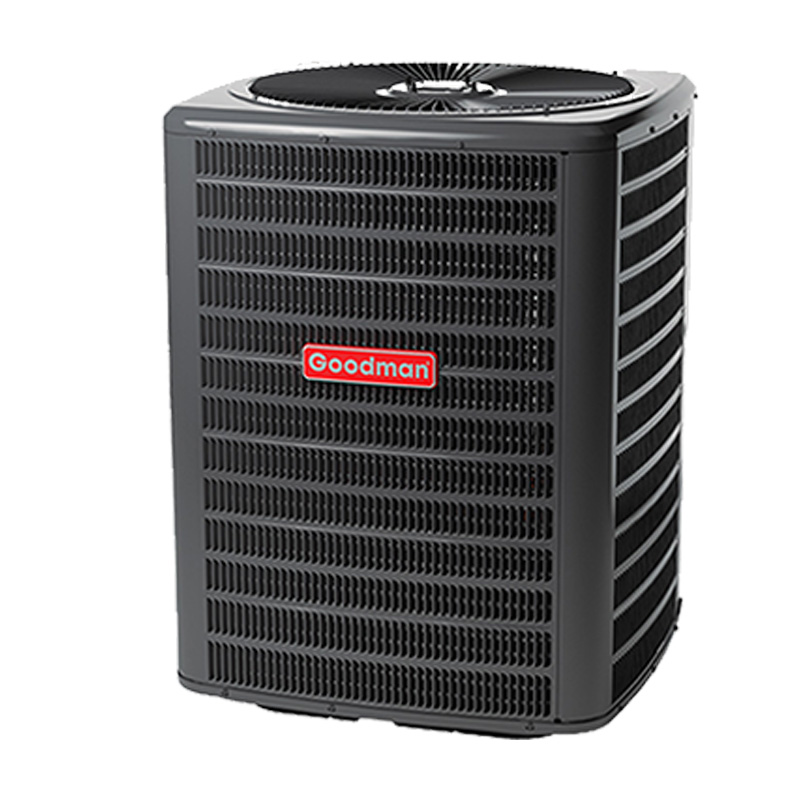
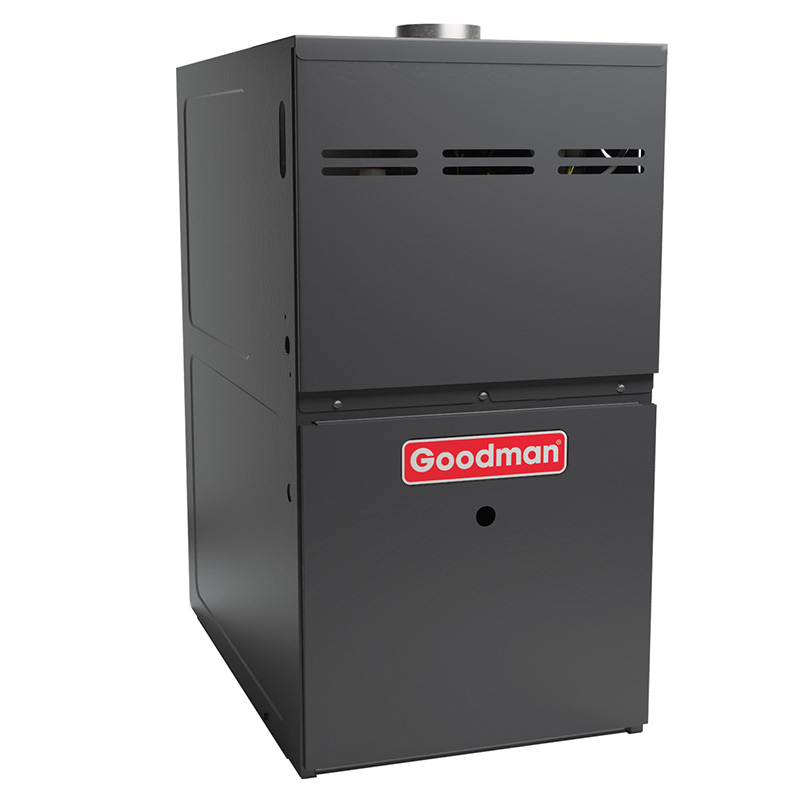
This Goodman system pairs a 3.5-ton R-32 air condenser and coil with a 100,000 BTU, 96% AFUE two-stage gas furnace in a horizontal configuration, making it a practical choice for homes where the air handler sits on its side in a crawlspace, attic, or tight mechanical closet. At 13.4 SEER2, the cooling side meets current federal minimum efficiency standards without reaching into the premium-efficiency tier, while the 96% AFUE furnace recovers nearly all of the fuel it burns, which is a genuine strength for households in colder climates with meaningful heating seasons.
The two-stage furnace is a real upgrade over single-stage models. It runs on a lower firing rate most of the time, which smooths out temperature swings, reduces short-cycling, and is easier on your duct system than a furnace that always fires at full output. R-32 refrigerant has a lower global warming potential than R-410A and is increasingly the industry standard, so sourcing refrigerant for future service calls should not be a concern. This configuration is best suited to larger homes in the 1,800 to 2,600 square foot range, depending on climate and insulation levels, that already have horizontal-friendly mechanical spaces and existing ductwork in reasonable condition.
Goodman positions this system as a value-first option, typically priced 15 to 25 percent below equivalent Trane, Lennox, and Carrier packages. That price gap is real, but so are the trade-offs: compressor longevity tends to run shorter than premium brands, and long-term ownership costs depend heavily on the quality of the initial installation. Buyers who prioritize lower upfront cost and are comfortable with the possibility of a capacitor replacement or coil service within the first decade will find this system a reasonable fit.
This Goodman system delivers a solid efficiency-to-price ratio for buyers who want a 96% AFUE two-stage furnace and functional air conditioning without the premium brand price tag. The 13.4 SEER2 cooling is entry-level by today's standards, and long-term reliability is meaningfully tied to install quality and ongoing maintenance. It is a reasonable choice for cost-conscious buyers who have a skilled installer lined up and realistic expectations about the service history of value-tier equipment.
Overall score is the average of the five ratings above.
What we like
- 96% AFUE furnace is genuinely high efficiency and cuts heating fuel costs in cold climates
- Two-stage furnace operation improves comfort and reduces duct stress versus single-stage
- Priced 15 to 25 percent below comparable Trane, Lennox, and Carrier systems
- R-32 refrigerant is a forward-looking choice with broad industry support
- Matched coil inclusion simplifies installation and satisfies warranty requirements
Trade-offs
- 13.4 SEER2 is the current federal minimum for cooling efficiency, leaving room for better seasonal energy savings
- Compressor lifespan averages 10 to 14 years, shorter than the 15 to 20 years typical of premium brands
- Dual-run capacitor failures and evaporator coil leaks are documented recurring issues in owner reviews
- Horizontal configuration adds install complexity, and any mistakes in setup have an outsized effect on reliability
What homeowners and pros say about Goodman
Homeowners who have lived with Goodman equipment long enough to form an opinion tend to land in one of two camps. On Google dealer review pages, where the average sits around 3.8 out of 5 across hundreds of reviews per location, the most common positive theme is straightforward: the price was right and the system does what it is supposed to do. On ConsumerAffairs, which skews toward frustrated owners and carries an average closer to 2.5 out of 5, the recurring concern is repair costs that start climbing somewhere after year seven. Both pictures are probably accurate reflections of the same product for different buyers in different situations.
HVAC technicians tend to be candid about Goodman in a way that matches the data. They point to dual-run capacitor failures as the most predictable service call on these units, a repair that is typically quick and falls in the 300 to 600 dollar range, but still an inconvenience. Evaporator coil leaks come up often enough in owner forums and service records to be worth knowing about before you buy. Compressor lifespan averaging 10 to 14 years, versus 15 to 20 on premium brands, is probably the most consequential trade-off for a buyer planning a long ownership horizon. The consistent message from installers is that Goodman equipment installed carefully, commissioned correctly, and maintained on schedule performs closer to the top of its range. Cut corners on any of those three things and you will find out quickly why the price is lower than the competition.
Sources: ConsumerAffairs Goodman owner reviews, AHRI Directory of Certified Product Performance, U.S. DOE appliance and equipment efficiency standards, Goodman product specification sheets.
What it costs to run
At 13.4 SEER2, cooling this 3.5-ton system for a typical 1200-hour cooling season at the U.S. average electricity rate of $0.17/kWh works out to roughly $639 per year in cooling, about $0 less per year than a minimum-efficiency 13.4 SEER2 unit of the same size. Your real cost depends on your climate and local rate.
Method: (42,000 BTU/hr ÷ 13.4 SEER2) × 1200 hours ÷ 1000 × $0.17/kWh. Rate source: U.S. EIA average; cooling hours: moderate-climate estimate.
How it compares
| Brand | Comparable model | SEER2 | Stage | Price position |
|---|---|---|---|---|
| Goodman | 3.5T 13.4 SEER2 / 96% AFUE Two-Stage Horizontal System | 13.4 | Two-stage | Value pick |
| Carrier | Performance 17 Series (24ACC636 + 59TP6) | ~15-16 | Two-stage | Roughly 20 to 30 percent above this Goodman system |
| Trane | XR15 / XC15 with S9X2 Furnace | ~15 | Two-stage | Roughly 20 to 25 percent above this Goodman system |
| Lennox | Merit Series ML14XC1 with SLP98V Furnace | ~14-15 | Two-stage | Roughly 25 to 35 percent above this Goodman system |
Competitor rows are comparable single-stage units at similar efficiency; price is relative position, not a quote.
Questions about this system
Is 13.4 SEER2 going to cost me noticeably more to run than a higher-efficiency unit?
Compared to a 16 or 18 SEER2 system, yes, you will pay more in electricity over the cooling season, with the gap most significant in hot climates that run the AC heavily. For moderate climates or buyers who prioritize heating over cooling, the high-AFUE furnace is where this system earns back efficiency dollars. Running a payback calculation against a higher-SEER2 option is worth doing before you commit.
What does the horizontal configuration actually mean for installation, and does it affect anything else?
Horizontal means the air handler is designed to lie on its side, which is required in attics, crawlspaces, and certain closet configurations where a vertical unit simply will not fit. It adds some complexity to the install, particularly around condensate drainage and ensuring the coil sits level, so the quality of your installer matters more than in a straightforward upflow application.
What are the most common repairs I should budget for over the first ten years?
Dual-run capacitor failure is the most frequently reported issue with Goodman equipment and typically costs between 300 and 600 dollars to fix, including a service call. Evaporator coil leaks show up in a meaningful share of owner reviews and are a more expensive repair. A small number of owners have reported refrigerant leaks in the first year, which is usually traced back to installation or initial charge issues rather than a component defect.
Does using the matched coil included with this system affect my warranty coverage?
Yes, using a matched coil is important for warranty compliance. Goodman, like most manufacturers, requires registered matched components to qualify for the full parts warranty, so keeping your registration documentation and install records is strongly recommended.
How does R-32 refrigerant affect service costs compared to R-410A systems I have owned before?
R-32 is now widely stocked by HVAC suppliers and distributors, so sourcing it for a service call should not be significantly harder or more expensive than R-410A was. R-410A is being phased out industrywide, so R-32 is actually the more future-proof choice for long-term parts availability.
Specifications
| Cooling capacity | 3.5 Ton |
| Efficiency | 13.4 SEER2 |
| Furnace output | 100000 BTU |
| Furnace efficiency | 96% AFUE |
| Configuration | Horizontal |
| Refrigerant | R-32 |