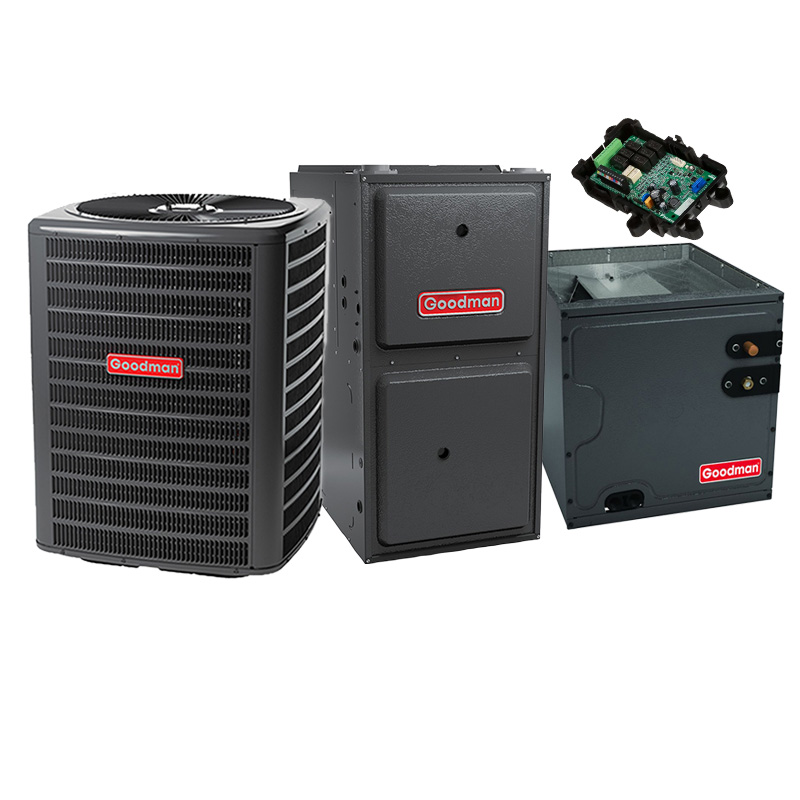
Goodman 3.5 Ton 13.4 SEER2 80000 BTU 96% AFUE Gas Furnace With R32 Air Condenser and Coil System – Upflow
View on AC Direct see your lowest price →Check current price on AC Direct →
Key features
- 3.5-ton cooling capacity with 13.4 SEER2 seasonal efficiency rating
- 80,000 BTU gas furnace at 96% AFUE for high-efficiency heating
- R-32 refrigerant with lower global warming potential than R-410A
- Upflow configuration suited to basement and utility-closet installs
- Single-stage operation on both heating and cooling sides
- Factory-matched coil included for a pre-engineered, code-compliant system
About this system
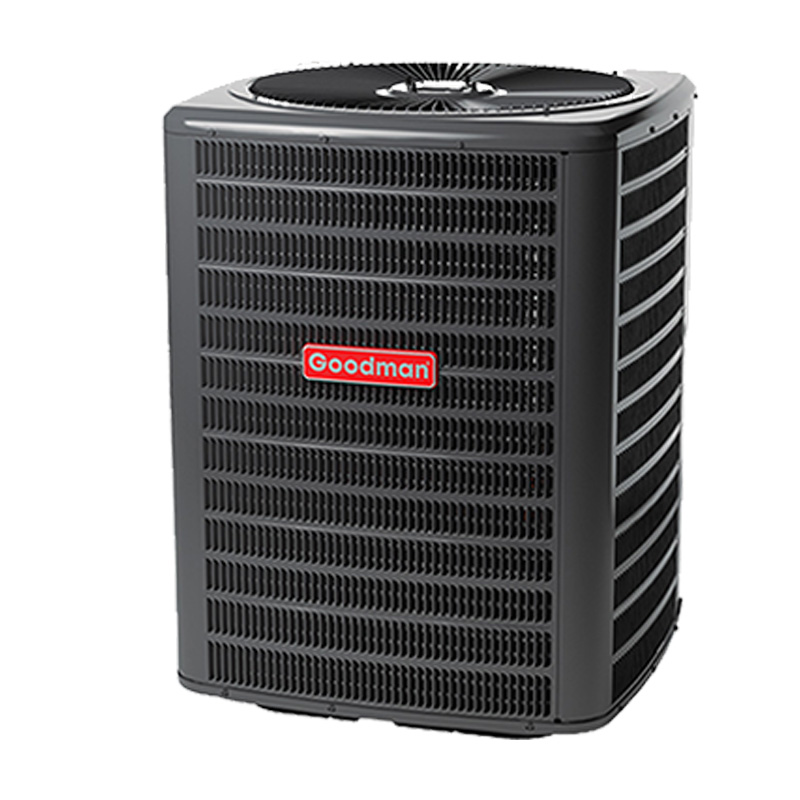
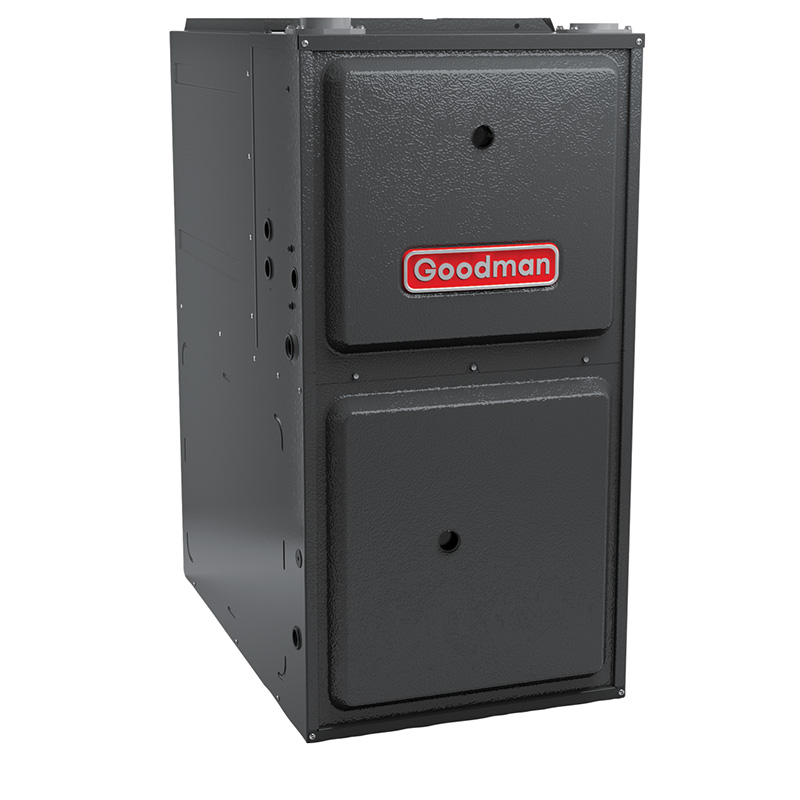
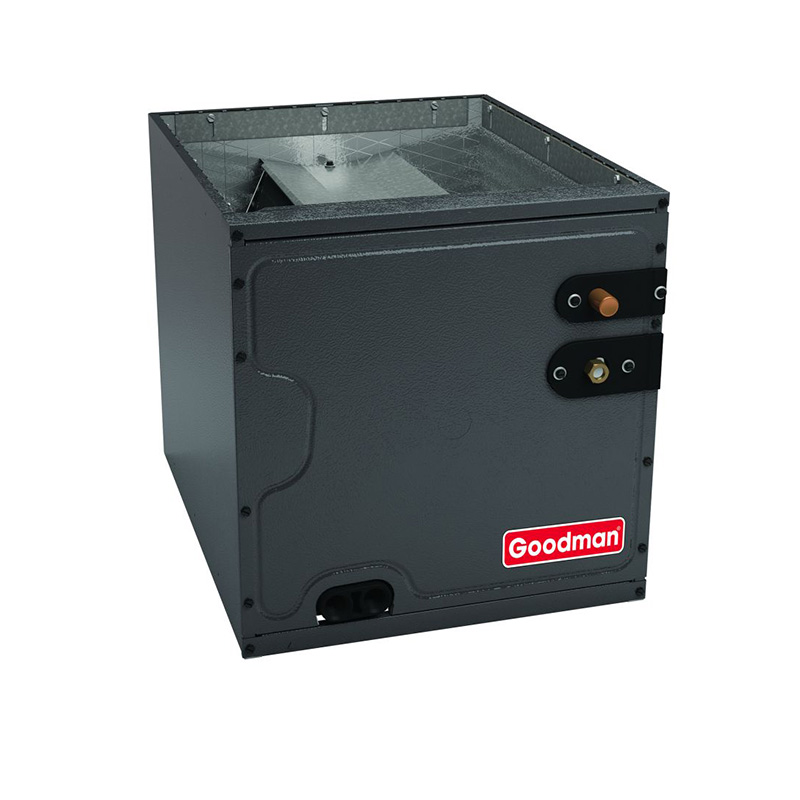
This Goodman upflow system pairs a 3.5-ton, 13.4 SEER2 R-32 air condenser and matched coil with an 80,000 BTU, 96% AFUE gas furnace. The 96% AFUE rating means 96 cents of every gas dollar goes toward heat, placing this firmly in the high-efficiency category and making it eligible for federal tax credits under current energy efficiency incentive programs. The R-32 refrigerant is a lower-global-warming-potential alternative to the R-410A it replaces, and it’s the direction the HVAC industry is moving, so parts and service familiarity will only grow over time. At 13.4 SEER2, seasonal cooling efficiency meets the current federal minimum for most northern U.S. regions and sits just above the floor for southern states, meaning it is code-compliant but not a top-efficiency unit.
The upflow configuration is designed for installations where the furnace sits in a basement or utility closet and conditioned air rises through ductwork above it, which is the most common residential setup in colder climates. This is a single-stage system on both the cooling and heating sides, so it runs at full capacity whenever it cycles on rather than modulating output to match load. That keeps purchase and install costs lower but can mean slightly less precise humidity control and more on-off cycling compared to two-stage or variable-speed alternatives. It suits homeowners in the 1,600 to 2,400 square foot range in moderate to cold climates who want a reliable, no-frills replacement without paying a premium-brand premium.
This Goodman system delivers high-efficiency heating and code-compliant cooling at a price point that is genuinely hard to match among name-brand equipment. The trade-off is a brand track record that leans on good installation to reach its potential lifespan, and documented weak points in capacitors, evaporator coils, and compressor longevity that buyers should budget for. For cost-conscious homeowners who use a skilled installer and keep up with maintenance, the value proposition is real.
Overall score is the average of the five ratings above.
What we like
- 96% AFUE furnace qualifies for current federal energy efficiency tax credits
- R-32 refrigerant is forward-compatible as the industry moves away from R-410A
- Factory-matched coil simplifies installation and supports warranty compliance
- Priced roughly 15 to 25 percent below comparable Trane, Carrier, and Lennox systems
- Upflow design is a straightforward fit for the most common U.S. residential duct layout
Trade-offs
- Single-stage operation provides less humidity control and more cycling than two-stage or variable-speed systems
- Compressor longevity averages 10 to 14 years, shorter than the 15 to 20 years seen in premium brands
- Evaporator coil leaks appear in a meaningful share of owner reviews and can be a mid-life repair cost
- Dual-run capacitor failures are the most commonly reported issue, typically surfacing after year 7
What homeowners and pros say about Goodman
Homeowners who chose Goodman most often point to price as the deciding factor, and that praise shows up consistently in Google dealer reviews, which average around 3.8 out of 5 across hundreds of reviews per location. The word you see repeatedly is affordable. Where sentiment turns negative, it tends to cluster on ConsumerAffairs, which averages around 2.5 out of 5 and draws a complaint-skewed audience. The recurring theme there is repair costs that start climbing after roughly year 7, which aligns with the documented pattern of dual-run capacitor failures as the most common service call. Those repairs typically run $300 to $600, not catastrophic, but a surprise if the homeowner was not expecting them. Evaporator coil leaks also appear in a meaningful share of owner accounts and represent a more significant mid-life expense.
HVAC technicians who work on Goodman equipment regularly tend to hold a more pragmatic view. Most will say the equipment itself is serviceable, but that install quality is the single biggest factor in how long it lasts, and that opinion is consistent across the service community. Compressor life averaging 10 to 14 years versus 15 to 20 for premium brands is a real difference, and pros will often mention it when a homeowner is deciding between Goodman and a step-up brand. A minority of owners have reported refrigerant leaks within the first year on R-32 systems, which technicians generally attribute to installation or initial charge issues rather than a defect in the equipment itself, underscoring just how much the long-term outcome depends on who puts the system in.
Sources: ConsumerAffairs Goodman owner reviews, AHRI Directory of Certified Product Performance, U.S. DOE appliance and equipment efficiency standards, Goodman product specification sheets.
What it costs to run
At 13.4 SEER2, cooling this 3.5-ton system for a typical 1200-hour cooling season at the U.S. average electricity rate of $0.17/kWh works out to roughly $639 per year in cooling, about $0 less per year than a minimum-efficiency 13.4 SEER2 unit of the same size. Your real cost depends on your climate and local rate.
Method: (42,000 BTU/hr ÷ 13.4 SEER2) × 1200 hours ÷ 1000 × $0.17/kWh. Rate source: U.S. EIA average; cooling hours: moderate-climate estimate.
How it compares
| Brand | Comparable model | SEER2 | Stage | Price position |
|---|---|---|---|---|
| Goodman | GSX/GMVC96 3.5-Ton Upflow System | 13.4 | Single-stage | Value pick |
| Carrier | Comfort 24ACC636 with 58SB 96% AFUE | 13.4 | Single-stage | Typically 15 to 25 percent more than Goodman |
| Trane | XR13c with S9X1 96% AFUE | 13.4 | Single-stage | Typically 15 to 25 percent more than Goodman |
| Lennox | Merit 13ACX with ML96 96% AFUE | 13.4 | Single-stage | Typically 15 to 25 percent more than Goodman |
Competitor rows are comparable single-stage units at similar efficiency; price is relative position, not a quote.
Questions about this system
Does this system qualify for the federal energy efficiency tax credit?
The 96% AFUE furnace meets the threshold for the federal 25C tax credit, which currently allows up to 30% of equipment and installation costs up to a $600 cap for furnaces. Confirm current IRS guidelines with your tax professional, as credit limits and qualifying criteria can change annually.
Is R-32 refrigerant safe and easy to service?
R-32 is mildly flammable (A2L classification) but is handled routinely by certified HVAC technicians using standard safety protocols. It is widely available and increasingly familiar to service technicians as the industry shifts away from R-410A, so finding qualified service should not be a problem.
What maintenance should I do to avoid the documented failure points on Goodman systems?
Annual tune-ups that include capacitor testing are the single most effective step, since dual-run capacitor failure is the most commonly reported issue and is inexpensive to catch early. Keeping the coil clean and the refrigerant charge verified at each service visit also addresses the two other documented weak points, evaporator coil condition and refrigerant levels.
Will this system handle a first-floor or slab-on-grade installation?
No. This is an upflow configuration, meaning supply air exits the top of the furnace and flows upward into overhead ductwork. A slab or first-floor installation where ductwork runs below the unit requires a downflow or horizontal model instead.
How does 13.4 SEER2 compare to current efficiency standards, and is it worth upgrading to a higher SEER2 model?
13.4 SEER2 meets the current federal minimum for most of the country and will keep the system code-compliant, but it is not a high-efficiency cooling unit. If your electricity rates are high or you run the air conditioner for six or more months per year, stepping up to a 16 SEER2 or higher model can meaningfully reduce summer utility bills and may pay back the difference in cost over the system's life.
Specifications
| Cooling capacity | 3.5 Ton |
| Efficiency | 13.4 SEER2 |
| Furnace output | 80000 BTU |
| Furnace efficiency | 96% AFUE |
| Configuration | Upflow |
| Refrigerant | R-32 |