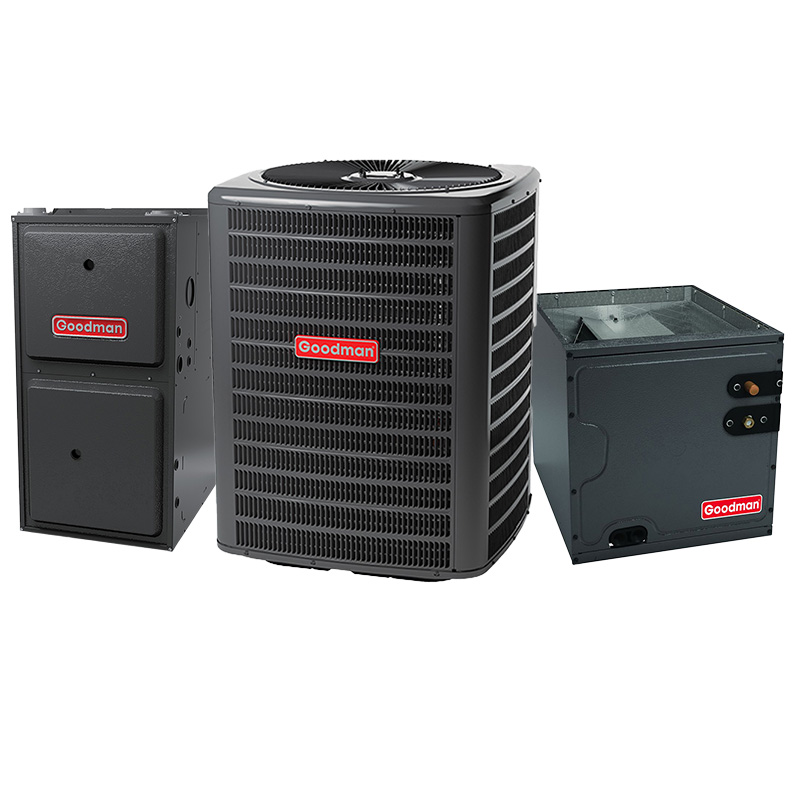
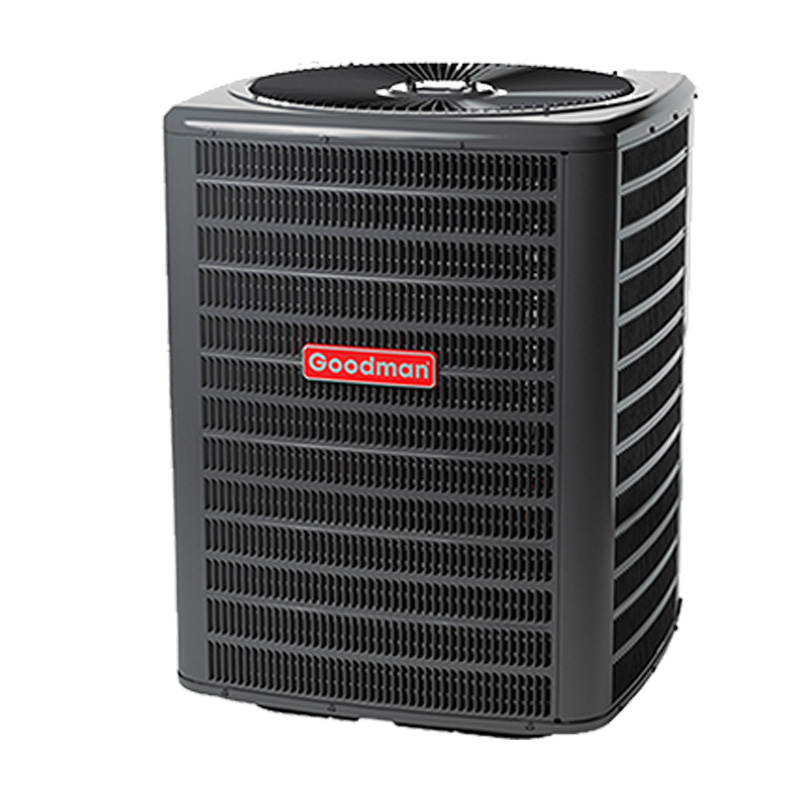
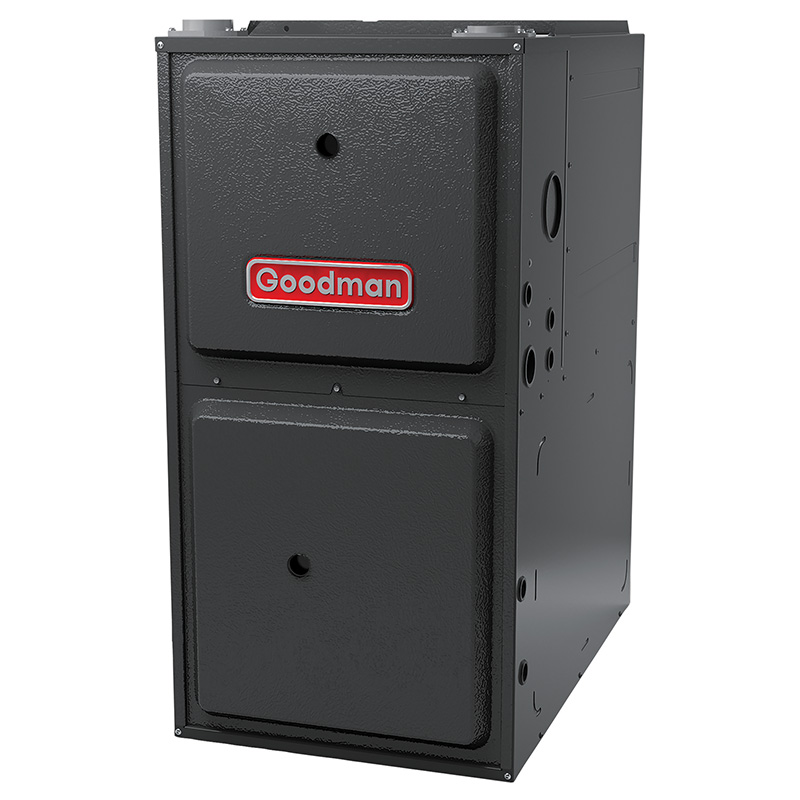
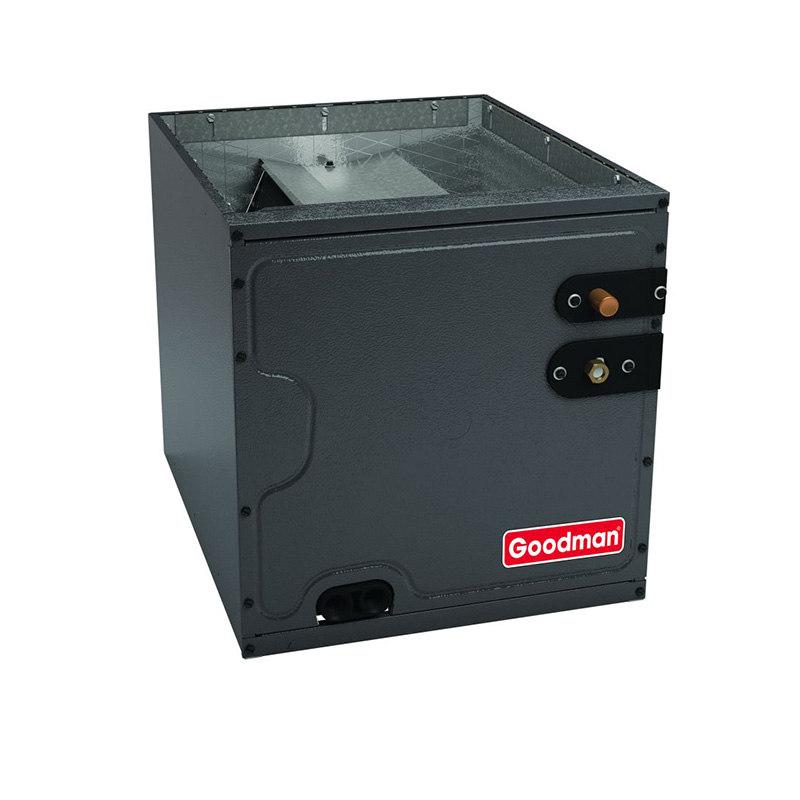
Goodman 3.5 Ton 13.4 SEER2 AC With 100000 BTU 96% AFUE 2-Stage Variable-Speed ECM Gas Furnace System – Upflow | R32
View on AC Direct see your lowest price →Check current price on AC Direct →
Key features
- 3.5-ton cooling capacity paired with 100,000 BTU two-stage gas furnace
- 96% AFUE furnace efficiency with two-stage burner for reduced temperature swings
- Variable-speed ECM blower motor for quieter operation and better humidity control
- 13.4 SEER2 cooling efficiency meets current federal minimum standards
- R-32 refrigerant with lower global warming potential than R-410A
- Upflow configuration suits most standard forced-air basement or closet installs
About this system
This Goodman bundle pairs a 3.5-ton, 13.4 SEER2 central air conditioner with a 100,000 BTU, 96% AFUE two-stage gas furnace in an upflow configuration, making it a reasonable fit for homes in the 1,800 to 2,400 square-foot range that need both year-round cooling and serious heating capacity. The furnace’s two-stage operation means it runs at a lower fire rate most of the time, cycling up to full output only on the coldest days, which reduces temperature swings and keeps gas bills lower than a single-stage unit at the same AFUE rating. The variable-speed ECM blower motor works in step with both stages, moving air more quietly and efficiently than a standard PSC motor and doing a better job of maintaining humidity levels during long cooling cycles.
The system uses R-32 refrigerant, a newer lower-global-warming-potential alternative to R-410A that is becoming the industry standard as R-410A is phased out. R-32 operates at similar pressures and is handled by most qualified technicians, but it does require R-32-rated components and certified recovery equipment, so not every installer will be set up for it yet. At 13.4 SEER2, efficiency sits right at the federal minimum for most northern regions and just above it in the Southwest and Southeast, meaning you get compliant equipment without paying for a higher-tier efficiency you may not recoup in energy savings before the first major repair. This bundle is best understood as a solid baseline system for cost-conscious buyers who want two-stage comfort and a high-AFUE furnace without the premium pricing of Carrier, Trane, or Lennox.
This Goodman system delivers a two-stage furnace and variable-speed blower at a price point that undercuts comparable Carrier, Trane, and Lennox bundles by 15 to 25 percent, which is a real advantage for buyers who want more comfort features without moving into premium-brand territory. The trade-off is a compressor and coil track record that trails the big three, and long-term costs depend heavily on who installs it and how well it is commissioned. For buyers who prioritize upfront affordability and can vet their installer carefully, it represents fair value; buyers who want a 15-plus-year worry-free system should weigh the reliability gap honestly.
Overall score is the average of the five ratings above.
What we like
- Two-stage furnace operation reduces cold spots and short cycling compared to single-stage alternatives at this price
- 96% AFUE is among the higher efficiency tiers available and will meaningfully lower gas bills versus an 80% AFUE unit
- Variable-speed ECM blower improves humidity control and lowers blower electricity costs over a PSC motor
- R-32 refrigerant is future-proof as R-410A production winds down under current regulations
- Priced 15 to 25 percent below comparable Trane, Carrier, and Lennox bundles, reducing payback period on the equipment itself
Trade-offs
- Compressor lifespan averages 10 to 14 years versus 15 to 20 for premium brands, meaning a mid-life replacement is more likely
- Evaporator coil leaks appear in a meaningful share of owner reviews and can be costly to diagnose and repair out of warranty
- Dual-run capacitor failures are the most commonly reported issue and, while inexpensive to fix at 300 to 600 dollars, add to the total cost of ownership
- A minority of owners report refrigerant leaks within the first year, typically tied to installation quality rather than a factory defect, so installer selection is critical
What homeowners and pros say about Goodman
Homeowners who have lived with this type of Goodman system for a few years tend to land in one of two camps. Those who had an experienced installer perform a careful refrigerant charge, confirm airflow, and check all electrical connections often report few complaints beyond a capacitor swap somewhere around year five to eight, which typically runs 300 to 600 dollars and takes a technician under an hour. Those who had a rushed or cut-rate installation are the primary source of the brand’s lower ConsumerAffairs score of roughly 2.5 out of 5, where the recurring theme is repair costs that start climbing after year seven. The Google dealer review average of around 3.8 out of 5 reflects a more representative sample, where the word that shows up most often is simply “affordable.”
HVAC technicians who work on Goodman equipment regularly point to dual-run capacitor failure as the most predictable maintenance item, often describing it as a known commodity rather than a surprise. Evaporator coil leaks are a more significant concern in owner communities, as a leaking coil typically means recovering refrigerant, brazing or replacing the coil, recharging the system, and verifying the repair, which adds up fast if it happens outside the parts warranty window. Compressor longevity is the longer-term consideration: documented averages of 10 to 14 years compare unfavorably to the 15 to 20 years more commonly associated with Trane or Carrier compressors, and that gap should factor into how you think about the true cost of ownership over a 15-year horizon. For buyers who weigh those trade-offs against a 15 to 25 percent lower purchase price and prioritize upfront affordability, Goodman remains a logical choice, provided the installation is done right.
Sources: ConsumerAffairs Goodman owner reviews, AHRI Directory of Certified Product Performance, U.S. DOE appliance and equipment efficiency standards, Goodman product specification sheets.
What it costs to run
At 13.4 SEER2, cooling this 3.5-ton system for a typical 1200-hour cooling season at the U.S. average electricity rate of $0.17/kWh works out to roughly $639 per year in cooling, about $0 less per year than a minimum-efficiency 13.4 SEER2 unit of the same size. Your real cost depends on your climate and local rate.
Method: (42,000 BTU/hr ÷ 13.4 SEER2) × 1200 hours ÷ 1000 × $0.17/kWh. Rate source: U.S. EIA average; cooling hours: moderate-climate estimate.
How it compares
| Brand | Comparable model | SEER2 | Stage | Price position |
|---|---|---|---|---|
| Goodman | GSXH5 / GMVC96 Bundle | 13.4 | two-stage | Value pick |
| Carrier | Comfort 14 (24ACC4) with 58TP Gas Furnace | 13.4-14 | single-stage | Typically 15 to 25 percent more than this Goodman bundle |
| Trane | XR14c with S9X2 Gas Furnace | 13.4-14 | single-stage | Typically 15 to 25 percent more than this Goodman bundle |
| Lennox | Merit 14ACX with ML196E Gas Furnace | 13.4-14 | single-stage | Typically 15 to 25 percent more than this Goodman bundle |
Competitor rows are comparable single-stage units at similar efficiency; price is relative position, not a quote.
Questions about this system
Is 3.5 tons the right size for my home, or should I go up to 4 tons?
Tonnage should be determined by a Manual J load calculation performed by your installer, not square footage alone. Factors like ceiling height, insulation levels, window area, and local climate all affect the correct size. An oversized unit will short cycle, leaving humidity high and wearing out components faster, so resist the urge to size up without a proper calculation.
What does R-32 refrigerant mean for me as a homeowner?
R-32 is a newer refrigerant with a lower environmental impact than R-410A, and it will remain available as R-410A is phased out, which protects your investment long-term. The practical difference for you is that your service technician must have R-32 recovery equipment and be familiar with its handling, so confirm your installer and any future service company are set up for it before you buy.
How does the two-stage furnace actually affect comfort day to day?
On mild days the furnace runs at its lower stage for longer periods, which distributes heat more evenly throughout the house and avoids the blast-and-coast cycle of a single-stage unit. The variable-speed ECM blower works in coordination with both stages to keep airflow consistent, which also helps the air conditioner remove more humidity during summer. Most homeowners notice fewer cold spots and a more stable temperature.
What is the warranty on this system and what does it actually cover?
Goodman typically offers a 10-year parts warranty when the unit is registered with Goodman within a set window after installation, and a limited lifetime heat exchanger warranty on the furnace. Labor is not covered by the manufacturer, so repair costs after the first year fall on the homeowner unless you purchase a separate extended labor warranty through your installer. Verify current warranty terms at registration because coverage details can change.
Goodman has mixed reviews online. Should I be worried about long-term reliability?
The concerns are real but context matters. Goodman scores around 2.5 out of 5 on ConsumerAffairs, a platform that skews toward complaints, with recurring mentions of repair costs rising after roughly year 7. Google dealer reviews average closer to 3.8 out of 5, where affordability is the most cited positive. The documented weak points are dual-run capacitor failures, evaporator coil leaks, and compressor lifespans that tend to run shorter than premium brands. None of these are reasons to avoid Goodman outright, but they do underscore that a careful installation and a relationship with a reliable service company matter more with this brand than with a Trane or Carrier.
Specifications
| Cooling capacity | 3.5 Ton |
| Efficiency | 13.4 SEER2 |
| Furnace output | 100000 BTU |
| Furnace efficiency | 96% AFUE |
| Configuration | Upflow |
| Refrigerant | R-32 |