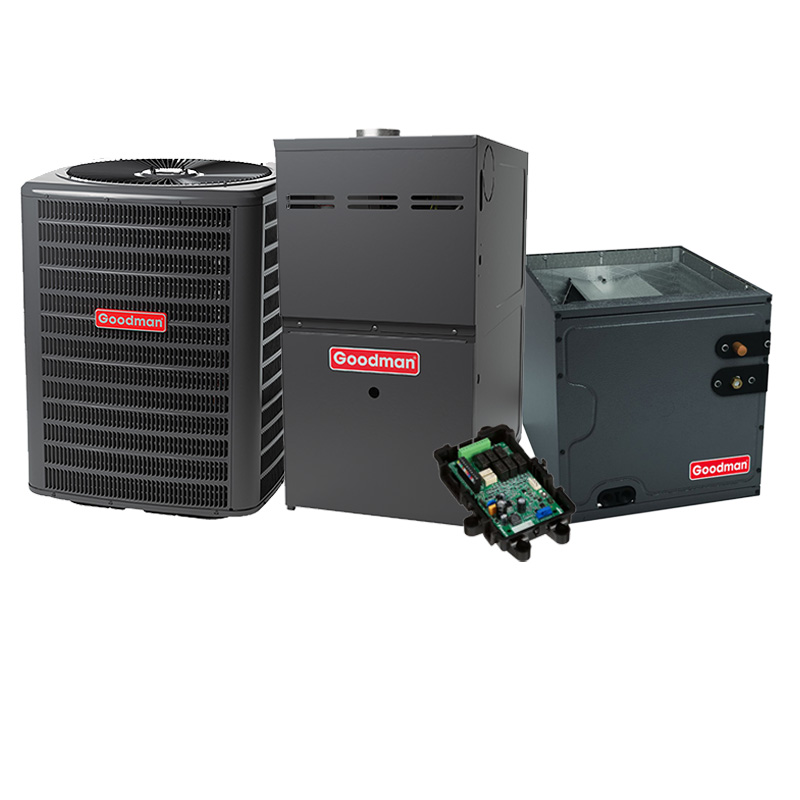
Goodman 3.5 Ton 13.6 SEER2 100000 BTU 80% Two-Stage Variable Speed Gas Furnace With R32 AC Condenser And Coil System – Horizontal
View on AC Direct see your lowest price →Check current price on AC Direct →
Key features
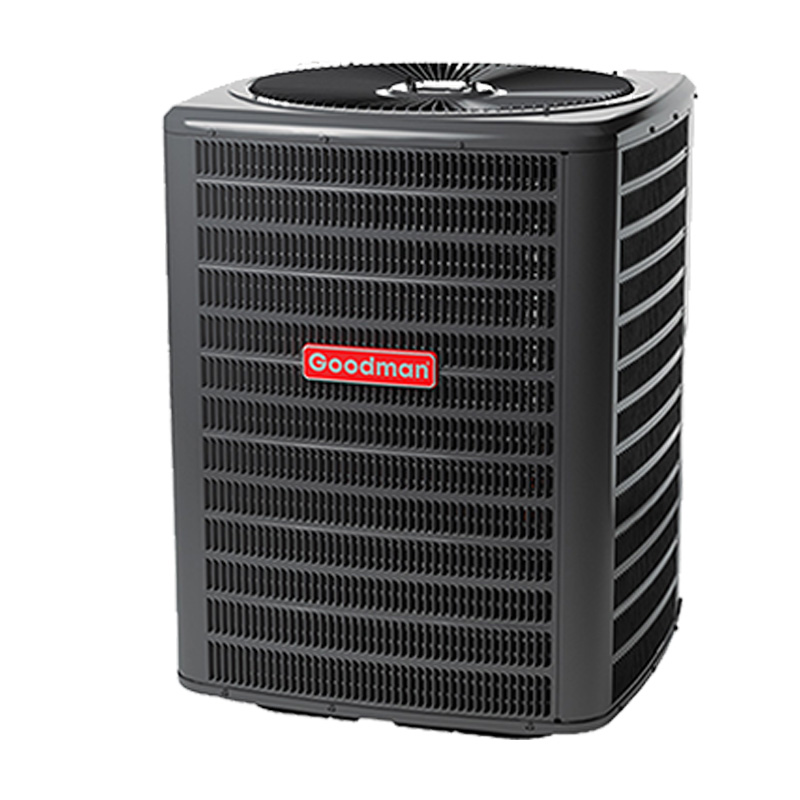
- 3.5-ton R-32 condenser, coil, and 100,000 BTU furnace sold as a matched system
- 13.6 SEER2 efficiency meets current federal minimum for northern U.S. installations
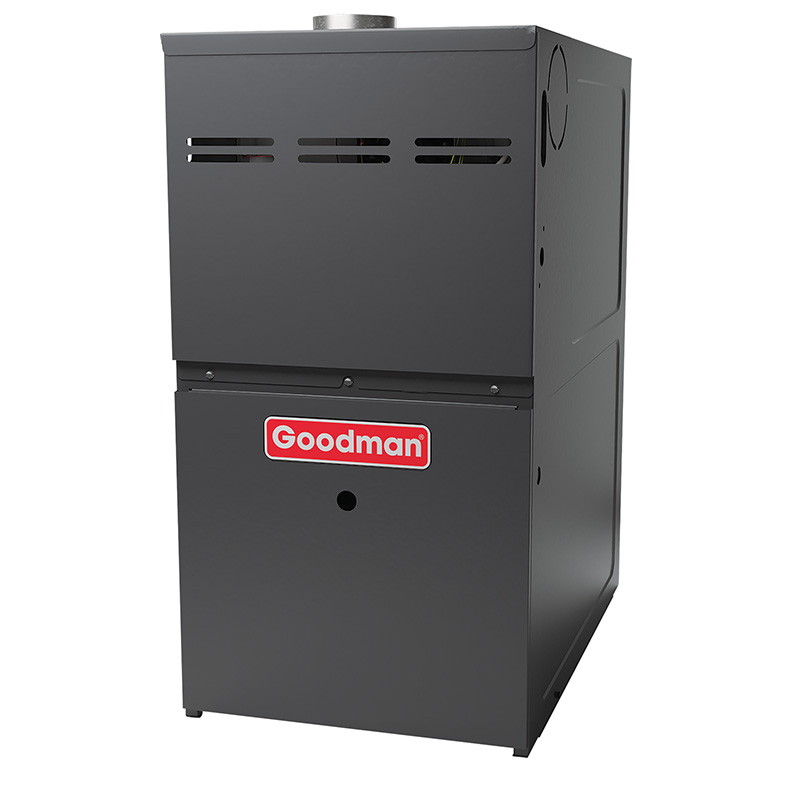
- Two-stage gas furnace operates at reduced capacity most of the time for more even heat distribution
- Variable-speed blower motor adjusts airflow to improve comfort and humidity control
- Horizontal configuration designed for attic, crawlspace, or side-discharge installations
- R-32 refrigerant offers lower global-warming potential than R-410A and broad future serviceability
About this system
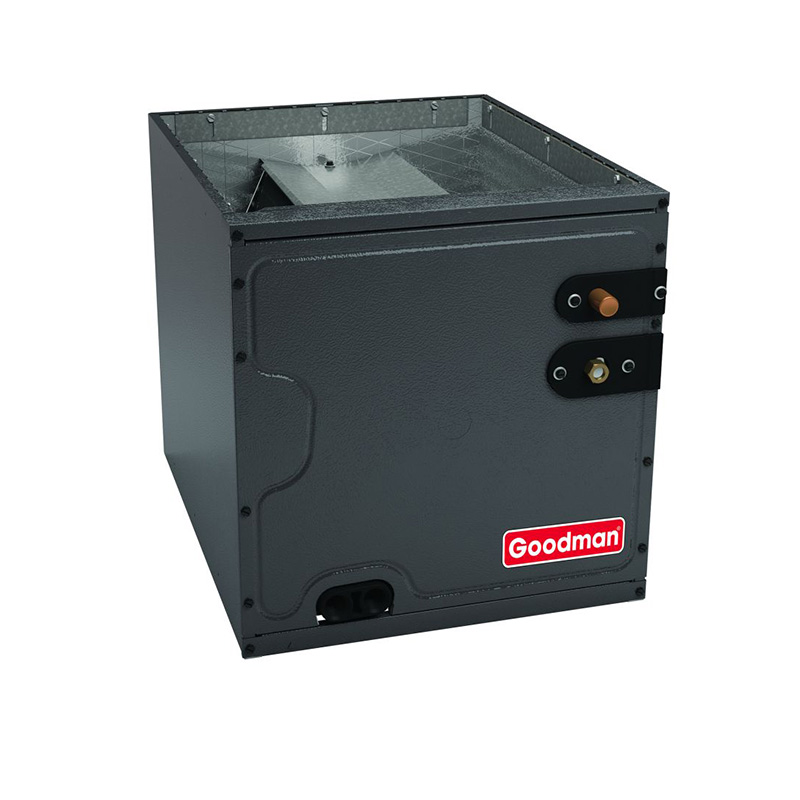
This Goodman bundle pairs a 3.5-ton R-32 condensing unit and matching evaporator coil with a 100,000 BTU, 80% AFUE two-stage gas furnace in a horizontal configuration, making it a practical choice for homes where attic, crawlspace, or side-discharge installations are required. The 13.6 SEER2 rating lands right at the current federal minimum threshold for the northern U.S. climate zones, so it meets code without reaching into premium efficiency territory. R-32 refrigerant is a lower global-warming-potential alternative to R-410A and is becoming the new industry standard, meaning parts and service availability should remain strong for the foreseeable future.
The two-stage furnace and variable-speed air handler are the most meaningful upgrades in this package over a basic single-stage setup. Two-stage heating means the furnace runs at a lower fire most of the time, cycling less aggressively and distributing heat more evenly across the home. The variable-speed blower adjusts airflow to match demand, which also helps with humidity control and air filtration. Taken together, these features suit households in climates with long heating seasons or anyone who has complained about hot and cold spots with a previous single-stage system. At 3.5 tons, this system is sized for roughly 1,600 to 2,200 square feet depending on insulation quality, local climate, and duct design.
Goodman positions itself as a value brand, typically priced 15 to 25 percent below comparable equipment from Trane, Lennox, and Carrier. That savings is real, but it comes with trade-offs around long-term reliability and compressor longevity that buyers should weigh honestly before purchasing. This horizontal system also adds installation complexity compared to a standard vertical upflow configuration, so finding an installer experienced with horizontal attic or crawlspace work is especially important here.
This Goodman horizontal bundle delivers a functional, code-compliant two-stage system at a price point well below premium brands, which makes it attractive for budget-conscious buyers who need a horizontal installation. The two-stage furnace and variable-speed blower are genuine comfort upgrades, but Goodman's documented track record of capacitor failures, evaporator coil leaks, and shorter average compressor lifespan means total cost of ownership over 15 years could close the gap with pricier competitors. Install quality matters more with Goodman than with almost any other brand, so the contractor you hire is as important as the equipment itself.
Overall score is the average of the five ratings above.
What we like
- Priced 15 to 25 percent below comparable Trane, Lennox, and Carrier systems
- Two-stage furnace reduces temperature swings and short-cycling compared to single-stage units
- Variable-speed blower improves humidity control and quiet low-demand operation
- R-32 refrigerant is future-ready with broad industry adoption underway
- Horizontal-specific design simplifies attic and crawlspace installations where vertical units would not fit
Trade-offs
- Dual-run capacitor failures are the most commonly reported issue, typically appearing within the first several years of ownership
- Evaporator coil leaks appear in a meaningful share of owner reports, and coil replacements are not inexpensive
- Compressor lifespan averages 10 to 14 years versus 15 to 20 years for premium-brand compressors
- Horizontal configuration adds installation complexity, and a poorly executed install is the single biggest driver of early failures with Goodman equipment
What homeowners and pros say about Goodman
Across consumer review channels, Goodman draws a predictable split of opinion. On Google dealer reviews, the brand averages around 3.8 out of 5 stars, where the most consistent praise is straightforward: buyers paid considerably less than neighbors who chose Carrier or Trane and got a system that works. That affordability advantage is real and documented, running 15 to 25 percent below comparable premium-brand equipment. On ConsumerAffairs, however, the score drops to roughly 2.5 out of 5, a channel that skews toward owners who had a problem worth writing about. The recurring pattern in those complaints is repair costs that start climbing after about year seven, which aligns with the documented compressor lifespan of 10 to 14 years versus the 15 to 20 years more commonly seen with Trane and Carrier compressors.
HVAC technicians who work on Goodman equipment regularly point to a few specific failure modes that buyers of this horizontal system should understand going in. Dual-run capacitors are the single most common service call, a relatively low-cost fix in the 300 to 600 dollar range but frustrating if it happens repeatedly. Evaporator coil leaks appear in a meaningful share of owner reports and are considerably more expensive to address. For a horizontal installation specifically, techs emphasize that Goodman’s quality ceiling is heavily influenced by the installer: a careful, experienced contractor can get strong results, while a rushed or inexperienced install tends to surface problems faster with Goodman than with brands that have tighter factory tolerances. Buying this system and pairing it with a technician who knows horizontal configurations is the clearest path to getting the value proposition Goodman promises.
Sources: ConsumerAffairs Goodman owner reviews, AHRI Directory of Certified Product Performance, U.S. DOE appliance and equipment efficiency standards, Goodman product specification sheets.
What it costs to run
At 13.6 SEER2, cooling this 3.5-ton system for a typical 1200-hour cooling season at the U.S. average electricity rate of $0.17/kWh works out to roughly $630 per year in cooling, about $9 less per year than a minimum-efficiency 13.4 SEER2 unit of the same size. Your real cost depends on your climate and local rate.
Method: (42,000 BTU/hr ÷ 13.6 SEER2) × 1200 hours ÷ 1000 × $0.17/kWh. Rate source: U.S. EIA average; cooling hours: moderate-climate estimate.
How it compares
| Brand | Comparable model | SEER2 | Stage | Price position |
|---|---|---|---|---|
| Goodman | This system (3.5T 13.6 SEER2 Horizontal Bundle) | 13.6 | Two-stage furnace / single-stage condenser | Value pick |
| Carrier | Performance 14 (24ACC4) with 80% two-stage furnace | 14.0 | Single-stage condenser, two-stage furnace | Moderately higher than Goodman, mid-tier positioning |
| Trane | XR14c with S8B1 80% two-stage furnace | 14.0 | Single-stage condenser, two-stage furnace | Higher than Goodman, closer to Carrier |
| Lennox | Merit ML14XC1 with SLP80V furnace | 14.0 | Single-stage condenser, variable-capacity furnace | Notably higher than Goodman, premium entry-level positioning |
Competitor rows are comparable single-stage units at similar efficiency; price is relative position, not a quote.
Questions about this system
Is 13.6 SEER2 going to cost me noticeably more to run than a higher-efficiency system?
Compared to a 16 or 17 SEER2 unit, you will pay somewhat more in cooling electricity each season, but the gap is modest in moderate climates and shrinks further if your home is well-insulated. In a hot southern climate with long cooling seasons, the efficiency difference becomes more meaningful and might justify spending more upfront on a higher-SEER2 unit.
What does the two-stage furnace actually do differently from a standard one-stage?
A two-stage furnace runs at a lower heat output, roughly 65 to 70 percent of capacity, during mild cold weather and only kicks to full fire on the coldest days. This reduces on-off cycling, distributes heat more evenly room to room, and tends to feel noticeably more comfortable than single-stage heating in homes with longer duct runs.
How serious is the horizontal installation compared to a standard upflow setup?
Horizontal installations require correct pitch of the coil cabinet for condensate drainage, proper support to prevent vibration over time, and clear access planning for future service. These are manageable challenges for an experienced installer but are a real source of callbacks and early failures when done by someone less familiar with horizontal configurations.
What are the realistic maintenance costs I should budget for with this system?
Dual-run capacitor replacement is the most statistically likely repair call, running roughly 300 to 600 dollars including labor. Evaporator coil leak detection and repair is more expensive and can run into the low four figures depending on refrigerant costs and labor rates. Setting aside 150 to 200 dollars annually for preventive maintenance will catch capacitor wear and low refrigerant charge before they become larger problems.
Does this system qualify for any federal tax credits or rebates?
At 13.6 SEER2 and 80% AFUE, this system sits at the efficiency threshold and does not meet the higher-efficiency minimums required for the federal 25C residential energy tax credit, which currently requires at least 15 SEER2 for central AC and 97% AFUE or heat pump qualification for heating. Check with your local utility for any available equipment rebates, which vary significantly by region.
Specifications
| Cooling capacity | 3.5 Ton |
| Efficiency | 13.6 SEER2 |
| Furnace output | 100000 BTU |
| Configuration | Horizontal |
| Refrigerant | R-32 |