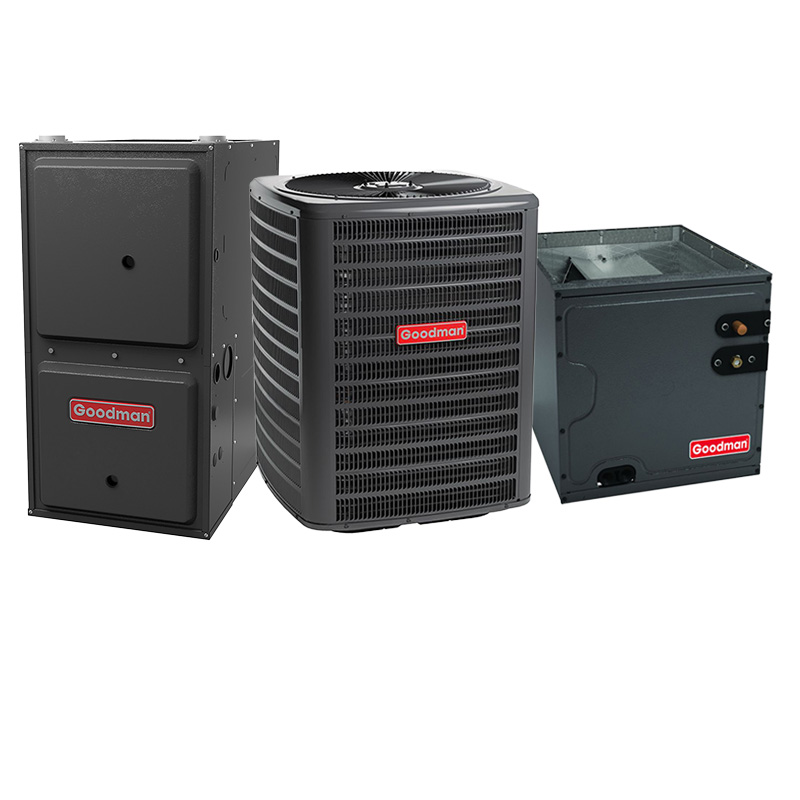
Goodman 3.5 Ton 14.5 SEER2 100000 BTU 80% AFUE Two Stage Multi-Speed ECM Gas Furnace System – Low NOX For California Downflow | R32
View on AC Direct see your lowest price →Check current price on AC Direct →
Key features
- 3.5-ton cooling capacity paired with 100,000 BTU two-stage gas heating
- 14.5 SEER2 rated cooling efficiency meets 2023 federal minimum standards
- 80% AFUE furnace with Low NOX certification for California compliance
- R-32 refrigerant with lower global warming potential than R-410A
- Multi-speed ECM blower motor reduces blower energy use versus PSC motors
- Downflow configuration designed for closet or platform installations
About this system
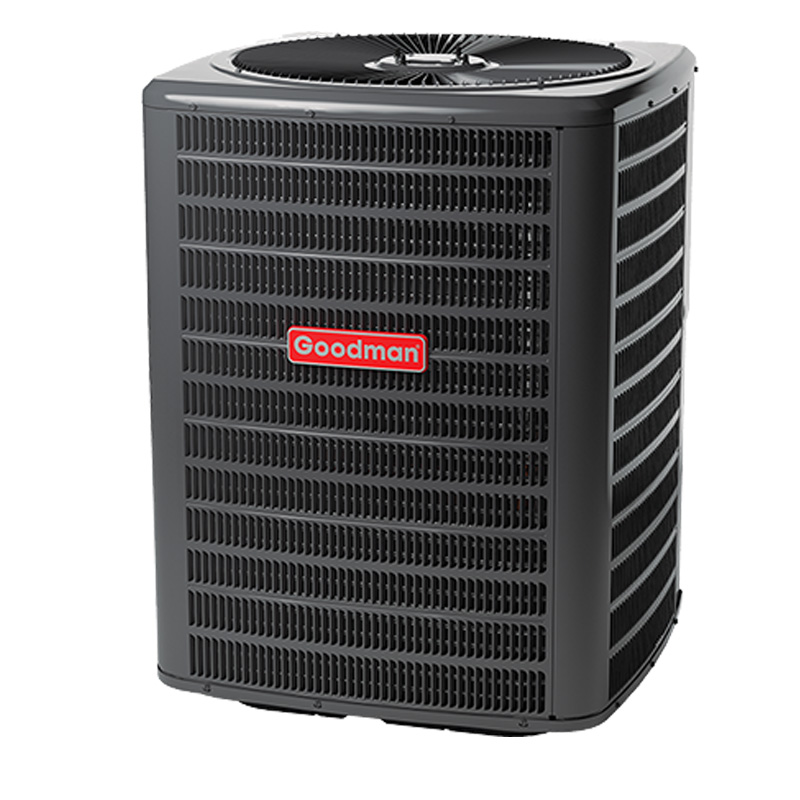
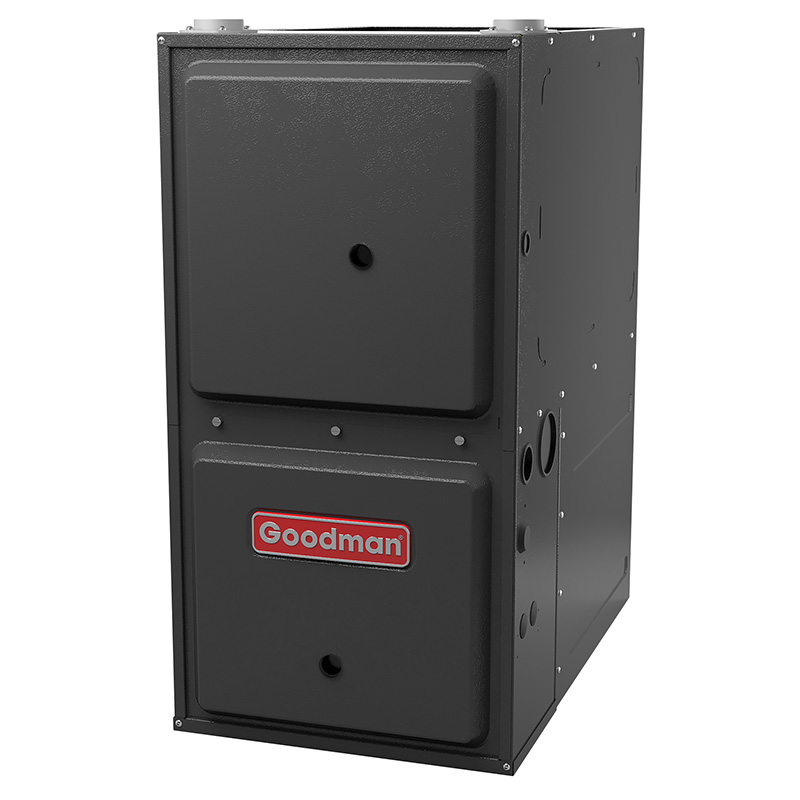
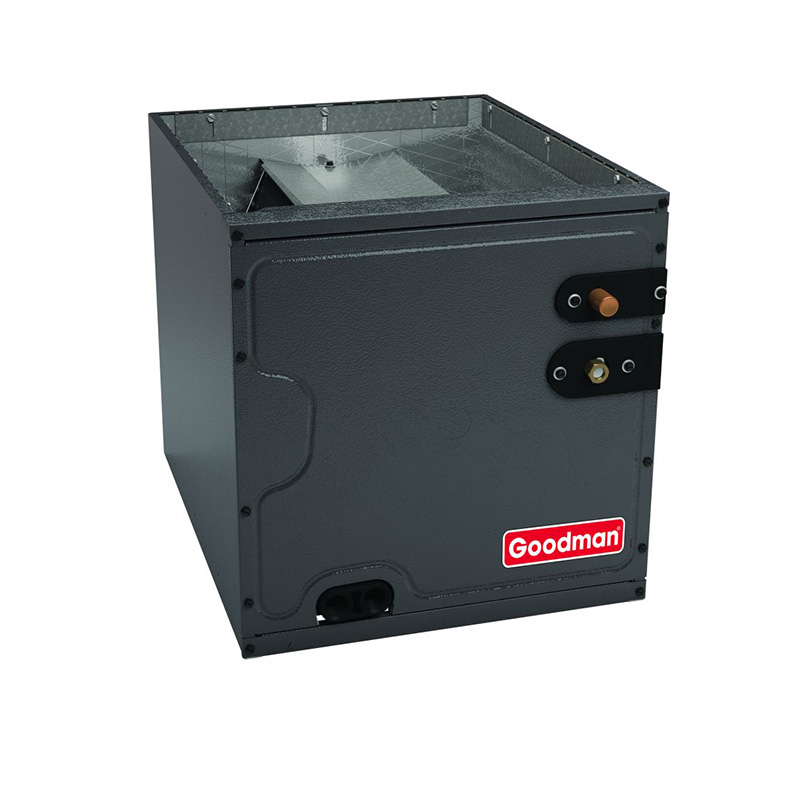
The Goodman GLXS4BA4210 bundles a 3.5-ton, 14.5 SEER2 air conditioner with a 100,000 BTU, 80% AFUE two-stage gas furnace in a downflow configuration, making it a direct fit for homes where the air handler sits above a crawl space or in a closet that blows air downward. The system uses R-32 refrigerant, a lower-global-warming-potential refrigerant that meets California’s Low NOX requirements, so it clears the air quality rules that disqualify many standard systems in that state.
The two-stage furnace and multi-speed ECM blower motor are the most practically meaningful specs here. Two-stage heating means the furnace runs at a reduced capacity most of the time, cycling on less frequently and distributing heat more evenly than a single-stage unit. The ECM motor adjusts airflow to match demand, which cuts blower electricity use compared to a standard PSC motor and tends to reduce hot and cold spots. At 80% AFUE the furnace converts four out of every five units of gas into usable heat, which sits at the lower legal threshold for efficiency in most U.S. climate zones. Buyers in cold climates who prioritize long-term gas savings should weigh whether stepping up to a 96% or higher AFUE furnace makes financial sense over a 10-to-15-year ownership window.
This system is sized for homes roughly in the 1,800 to 2,400 square foot range, though a proper Manual J load calculation by your installer should confirm that before purchase. Downflow-only configuration means this unit will not work in a standard attic or basement horizontal installation without a separate coil cabinet and furnace oriented for that application, so confirming your mechanical room layout before ordering is critical.
The Goodman GLXS4BA4210 delivers a two-stage, ECM-equipped system at a price point that premium brands typically do not match, and its California Low NOX and R-32 credentials make it one of fewer options that qualifies in that market without an upgrade charge. The trade-off is an 80% AFUE furnace that costs more to operate than higher-efficiency alternatives, a brand reliability record that trails Trane and Carrier, and a system whose long-term performance is unusually dependent on install quality.
Overall score is the average of the five ratings above.
What we like
- Priced 15 to 25 percent below comparable Carrier, Trane, and Lennox systems
- Two-stage furnace and ECM blower improve comfort and reduce cycling versus single-stage setups
- R-32 refrigerant and Low NOX rating satisfy California regulatory requirements
- 14.5 SEER2 meets current federal efficiency minimums without a significant price premium
- Widely available through Goodman's large dealer and parts network, which helps with service access
Trade-offs
- 80% AFUE is the lowest legal efficiency tier, so gas operating costs will be higher than 95% or 96% AFUE alternatives over the system's life
- Compressor lifespan averages 10 to 14 years, notably shorter than the 15 to 20 years documented for premium brands
- Evaporator coil leaks and early refrigerant loss in the first year are recurring complaints in owner reviews
- Downflow-only configuration limits installation flexibility and requires careful pre-purchase verification of your ductwork layout
What homeowners and pros say about Goodman
Owner and technician sentiment about Goodman tends to split along familiar lines. On Google dealer reviews the brand averages around 3.8 out of 5 stars across locations with several hundred reviews each, and the most repeated praise is straightforward: buyers got a functional, two-stage system installed for significantly less than a Trane or Carrier quote. Technicians in those same review threads often echo that when installation is done correctly by an experienced contractor, Goodman equipment performs acceptably and parts are easy to source. The value proposition is real, and for a downflow California-compliant system with R-32 and Low NOX credentials, the competitive field at this price is thin.
The rougher side of the picture shows up on ConsumerAffairs, where Goodman sits at roughly 2.5 out of 5 stars, a channel that skews toward people who have had problems. The recurring theme there is repair costs climbing after about year seven of ownership. The specific failure modes that show up most consistently in owner accounts are dual-run capacitor failures, which are annoying but usually affordable to fix, and evaporator coil leaks, which are more disruptive and costly. Compressor longevity is a legitimate concern as well: documented averages of 10 to 14 years compare unfavorably to the 15 to 20 years more commonly cited for premium brands. A minority of owners also report refrigerant loss in the first year, which technicians generally attribute to installation issues or improper charging rather than a manufacturing defect, underscoring how heavily this brand’s real-world durability depends on who installs it.
Sources: ConsumerAffairs Goodman owner reviews, AHRI Directory of Certified Product Performance, U.S. DOE appliance and equipment efficiency standards, Goodman product specification sheets.
What it costs to run
At 14.5 SEER2, cooling this 3.5-ton system for a typical 1200-hour cooling season at the U.S. average electricity rate of $0.17/kWh works out to roughly $591 per year in cooling, about $48 less per year than a minimum-efficiency 13.4 SEER2 unit of the same size. Your real cost depends on your climate and local rate.
Method: (42,000 BTU/hr ÷ 14.5 SEER2) × 1200 hours ÷ 1000 × $0.17/kWh. Rate source: U.S. EIA average; cooling hours: moderate-climate estimate.
How it compares
| Brand | Comparable model | SEER2 | Stage | Price position |
|---|---|---|---|---|
| Goodman | GLXS4BA4210 (this system) | 14.5 | two-stage | Value pick |
| Carrier | Comfort 14 / 59TP6 series bundle | 14.5 | two-stage | Typically 20 to 25 percent more than this system |
| Trane | XR14 / S8X2 series bundle | 14.5 | two-stage | Typically 20 to 25 percent more than this system |
| Lennox | Merit 14 / ML180 series bundle | 14.5 | two-stage | Typically 15 to 20 percent more than this system |
Competitor rows are comparable single-stage units at similar efficiency; price is relative position, not a quote.
Questions about this system
Does this system actually qualify for use in California, and what makes it different from a standard Goodman unit?
Yes. This version is specifically designated Low NOX, meaning the furnace meets the nitrogen oxide emission limits required by California air quality management districts. It also uses R-32 refrigerant rather than R-410A, which has a lower global warming potential and aligns with California's refrigerant transition rules. If you are outside California you can still install it, but the Low NOX designation is what unlocks permit approval in most California counties.
Can I install this in a horizontal or upflow application if my space changes?
No. This furnace is rated for downflow installation only, meaning it is designed to blow conditioned air downward into the duct plenum below the unit. Installing it horizontally or in an upflow position is not approved and would likely void the warranty. If your mechanical space requires a different orientation, you will need a different furnace model.
What are the most common repairs owners run into with Goodman equipment like this, and how expensive are they?
Dual-run capacitors are the most frequently reported failure point and are typically a straightforward repair in the 300 to 600 dollar range. Evaporator coil leaks show up in a meaningful share of owner accounts and are more expensive to address. Compressors average a 10 to 14 year lifespan on Goodman equipment, which is shorter than the 15 to 20 years typically seen on premium brands, so budgeting for a potential compressor replacement in the second decade of ownership is reasonable.
Goodman's warranty is listed as 10 years on parts, but is there anything I need to do to activate it?
Yes, Goodman requires online product registration within a specific window after installation, typically 60 days, to receive the full 10-year parts warranty. If you skip registration, coverage may default to a shorter base period. Your installer should provide the unit's serial number at job completion so you can register promptly through Goodman's website.
Given the 80% AFUE rating, how much more would I spend on gas annually compared to a 96% AFUE furnace?
The rough rule is that every 1% of AFUE efficiency represents about 1% less gas used for the same heat output, so a 96% AFUE furnace uses roughly 16 to 17 percent less gas than this 80% unit. On a 1,200 dollar annual heating bill the difference could be in the range of 190 to 200 dollars per year, though actual savings depend on local gas rates, climate severity, and how well the home is insulated. Over a 10-year ownership period that gap adds up, which makes the AFUE upgrade worth serious consideration before purchase.
Specifications
| Cooling capacity | 3.5 Ton |
| Efficiency | 14.5 SEER2 |
| Furnace output | 100000 BTU |
| Furnace efficiency | 80% AFUE |
| Configuration | Downflow |
| Refrigerant | R-32 |
| Model | GLXS4BA4210 |