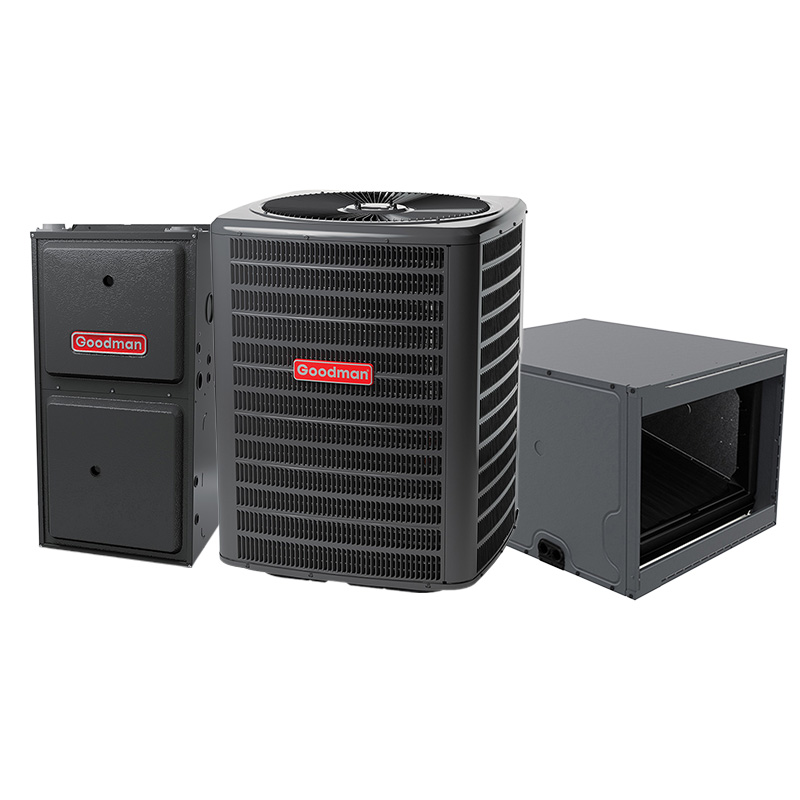
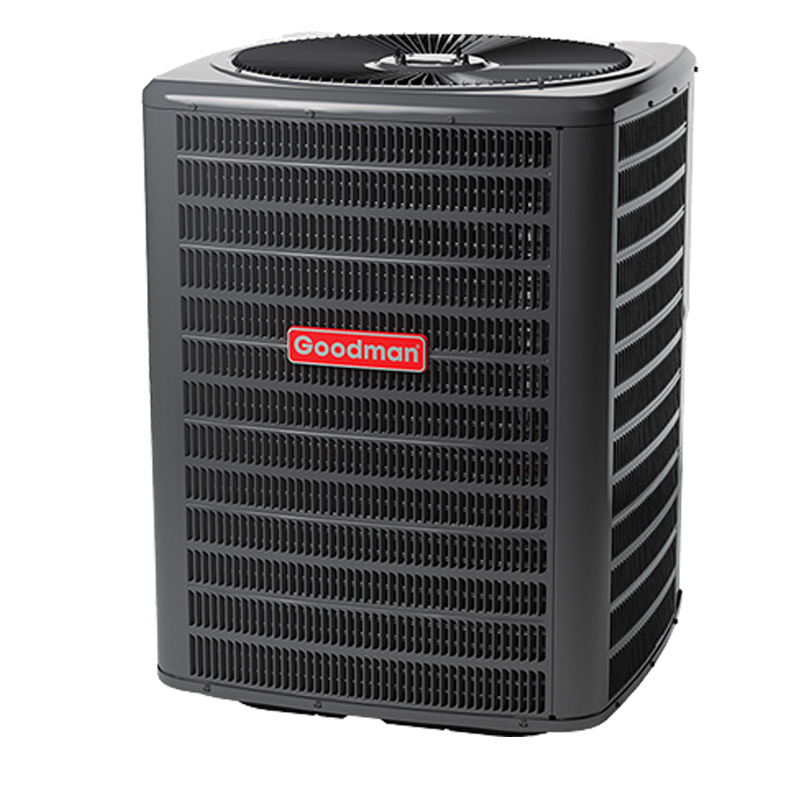
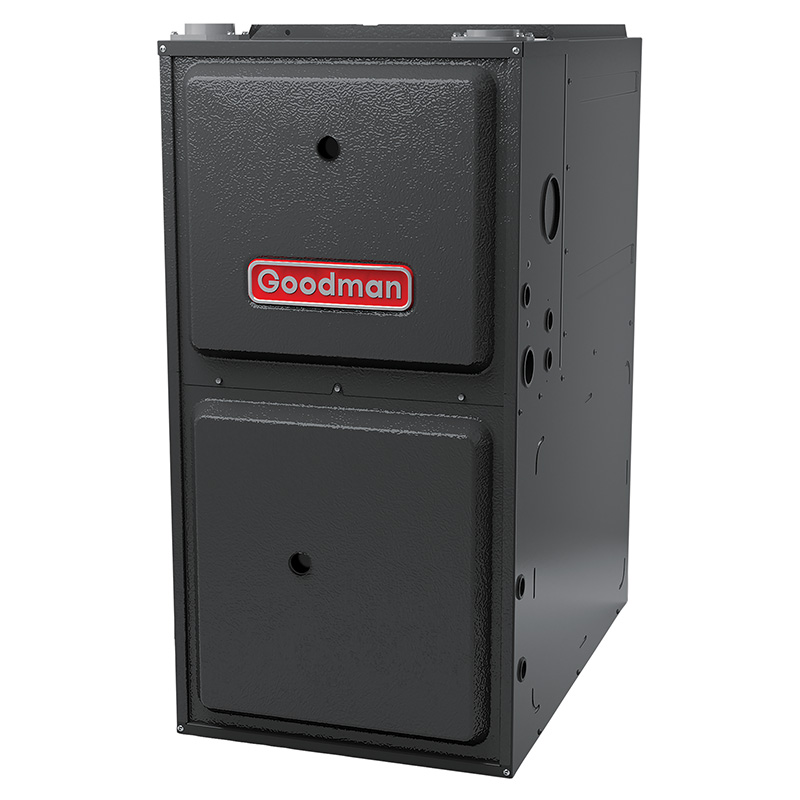
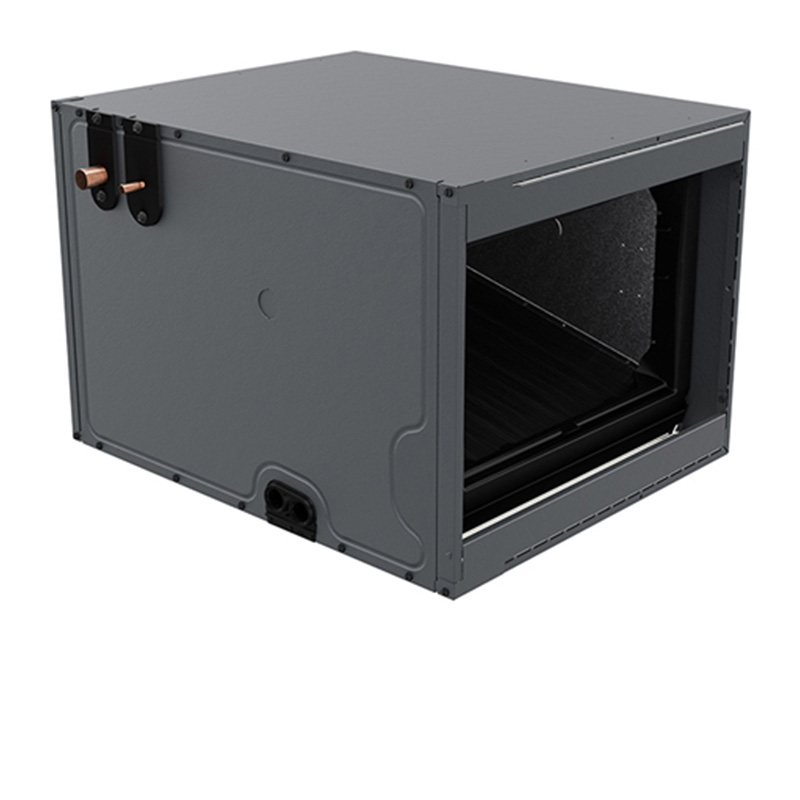
Goodman 3.5 Ton 14.5 SEER2 AC & Gas Furnace System – Multi-Speed, 80000 BTU Gas Furnace, 92% AFUE, Horizontal, R32
View on AC Direct see your lowest price →Check current price on AC Direct →
Key features
- 3.5-ton cooling capacity with 14.5 SEER2 efficiency rating
- 80,000 BTU gas furnace at 92% AFUE for above-minimum heating efficiency
- Horizontal cabinet configuration for attic, crawlspace, or side-discharge installations
- R-32 refrigerant with lower global-warming potential than R-410A
- Multi-speed blower motor for improved airflow and dehumidification control
- Factory-matched coil and condensing unit designed for simplified system matching
About this system
The Goodman GLXS4BA4210 pairs a 3.5-ton, 14.5 SEER2 air conditioner with an 80,000 BTU, 92% AFUE multi-speed gas furnace configured for horizontal installation. That horizontal orientation makes it a practical fit for attic spaces, crawlspaces, and tight utility closets where an upflow or downflow cabinet simply will not fit. R-32 refrigerant carries a lower global-warming potential than the R-410A it replaces, and it tends to operate at slightly higher efficiency under real-world conditions, which aligns well with the system’s efficiency rating.
At 14.5 SEER2, this system sits at the entry point of current federal minimum efficiency standards for most U.S. climate zones, so it will not win awards for energy savings compared to two-stage or variable-speed equipment. The 92% AFUE furnace is a meaningful step above standard 80% units, keeping more of each gas dollar as usable heat rather than flue exhaust. Multi-speed blower operation gives the furnace some flexibility in airflow delivery, which can improve comfort and dehumidification compared to a single-speed motor, though it stops short of the continuous modulation that variable-speed systems offer. This combination is best suited to homeowners replacing aging equipment on a defined budget, particularly those in mid-sized homes in mixed or heating-dominant climates where the furnace efficiency upgrade offers a real payback.
This Goodman system delivers solid entry-level efficiency at a price point that undercuts comparable Carrier, Trane, and Lennox equipment by 15 to 25 percent, making it a reasonable choice for budget-conscious buyers who prioritize upfront cost. The horizontal configuration fills a specific need that many competing systems cannot, and the 92% AFUE furnace adds genuine heating value. The trade-off is a brand track record that shows higher-than-average repair frequency after year 7 and a compressor lifespan that lags premium competitors, so the long-term cost equation depends heavily on install quality and maintenance discipline.
Overall score is the average of the five ratings above.
What we like
- Upfront cost is typically 15 to 25 percent below Carrier, Trane, and Lennox equivalents
- Horizontal configuration addresses installation scenarios that standard cabinets cannot
- 92% AFUE furnace meaningfully outperforms standard 80% units on annual heating bills
- R-32 refrigerant is more environmentally responsible and widely available going forward
- Multi-speed blower improves comfort and humidity control over single-speed alternatives
Trade-offs
- 14.5 SEER2 is baseline efficiency only, with no pathway to the savings a two-stage or variable system provides
- Dual-run capacitors and evaporator coil leaks are documented recurring failure points that add to ownership costs after year 7
- Compressor longevity averages 10 to 14 years versus 15 to 20 years typical of premium-brand compressors
- A minority of owners have reported refrigerant leaks within the first year, pointing to sensitivity to install and charge quality
What homeowners and pros say about Goodman
Homeowners who discuss Goodman equipment online tend to split along a predictable line. On Google dealer reviews, where the audience includes satisfied customers who followed through with a functioning installation, Goodman scores around 3.8 out of 5, with affordability cited most often as the reason for recommending it. On ConsumerAffairs, a channel that skews toward people motivated by a frustrating experience, the brand scores roughly 2.5 out of 5, and the complaints cluster around one theme: repair costs that start to accumulate after approximately year 7 of ownership. Neither score tells the whole story on its own, but together they suggest a brand that delivers acceptable early-life performance and stumbles more often in middle age than its premium competitors do.
HVAC technicians who service Goodman equipment frequently point to dual-run capacitors as the most predictable failure point, a repair that is quick and typically falls in the 300 to 600 dollar range, so it is annoying rather than catastrophic. More concerning to experienced installers are the evaporator coil leaks that show up in a meaningful share of owner accounts, and the refrigerant leak reports within the first year that point directly to install or charge quality. Compressor longevity is the other honest conversation: Goodman compressors tend to average 10 to 14 years in real-world use, a gap of several years behind the 15 to 20 years more commonly seen in Trane, Carrier, and Lennox equipment. For a horizontal-configuration system at this price point, those trade-offs may be fully acceptable, provided you budget for maintenance and keep a qualified technician in the loop from the first startup.
Sources: ConsumerAffairs Goodman owner reviews, AHRI Directory of Certified Product Performance, U.S. DOE appliance and equipment efficiency standards, Goodman product specification sheets.
What it costs to run
At 14.5 SEER2, cooling this 3.5-ton system for a typical 1200-hour cooling season at the U.S. average electricity rate of $0.17/kWh works out to roughly $591 per year in cooling, about $48 less per year than a minimum-efficiency 13.4 SEER2 unit of the same size. Your real cost depends on your climate and local rate.
Method: (42,000 BTU/hr ÷ 14.5 SEER2) × 1200 hours ÷ 1000 × $0.17/kWh. Rate source: U.S. EIA average; cooling hours: moderate-climate estimate.
How it compares
| Brand | Comparable model | SEER2 | Stage | Price position |
|---|---|---|---|---|
| Goodman | GLXS4BA4210 | 14.5 | Single-stage | Value pick |
| Carrier | Comfort 14 (24ACC4) | 14.3–14.5 | Single-stage | Typically 15 to 25 percent more than this Goodman |
| Trane | XR14c | 14.3–15.0 | Single-stage | Typically 15 to 25 percent more than this Goodman |
| Lennox | Merit ML14XC1 | 14.3–15.0 | Single-stage | Typically 15 to 25 percent more than this Goodman |
Competitor rows are comparable single-stage units at similar efficiency; price is relative position, not a quote.
Questions about this system
Is horizontal the only way I can install this system, or can it be converted to upflow?
The GLXS4BA4210 furnace cabinet is specifically designed for horizontal installation and is not field-convertible to upflow or downflow. If your space requires a vertical configuration, you will need a different model in the Goodman lineup. Confirm your installation orientation with your HVAC contractor before purchasing.
What does R-32 refrigerant mean for future service and recharge costs?
R-32 is widely stocked by HVAC distributors and is expected to remain available and affordable as R-410A is phased down under current regulations. It operates at pressures similar to R-410A, so most certified technicians already have compatible equipment. A recharge after a verified leak typically costs in a similar range to R-410A service today.
The 92% AFUE sounds high, but is it enough to see a real difference on my gas bill?
Compared to a standard 80% AFUE furnace, a 92% unit converts 12 more cents of every dollar of gas into usable heat. In a heating-dominant climate with an average gas bill, that difference can amount to a meaningful annual saving, though the exact payback depends on your local gas rates and how many heating degree days your area sees each winter.
What are the most likely repairs I should budget for over the first ten years?
Based on documented owner feedback for Goodman equipment, dual-run capacitor failure is the most common service call and is typically a low-cost repair in the 300 to 600 dollar range. Evaporator coil leaks appear in a meaningful share of owner reports and can be more expensive to address. Keeping up with filter changes and annual maintenance reduces the likelihood of both.
Does Goodman's warranty require professional registration, and what does it actually cover?
Goodman typically requires product registration within a set window after installation to activate the full parts warranty period; unregistered units fall back to a shorter base coverage. The warranty covers parts, not labor, so any repair will still carry a technician service charge. Verify the specific registration deadline and coverage terms on Goodman's current warranty documentation, as terms can change between model years.
Specifications
| Cooling capacity | 3.5 Ton |
| Efficiency | 14.5 SEER2 |
| Furnace output | 80000 BTU |
| Furnace efficiency | 92% AFUE |
| Configuration | Horizontal |
| Refrigerant | R-32 |
| Model | GLXS4BA4210 |