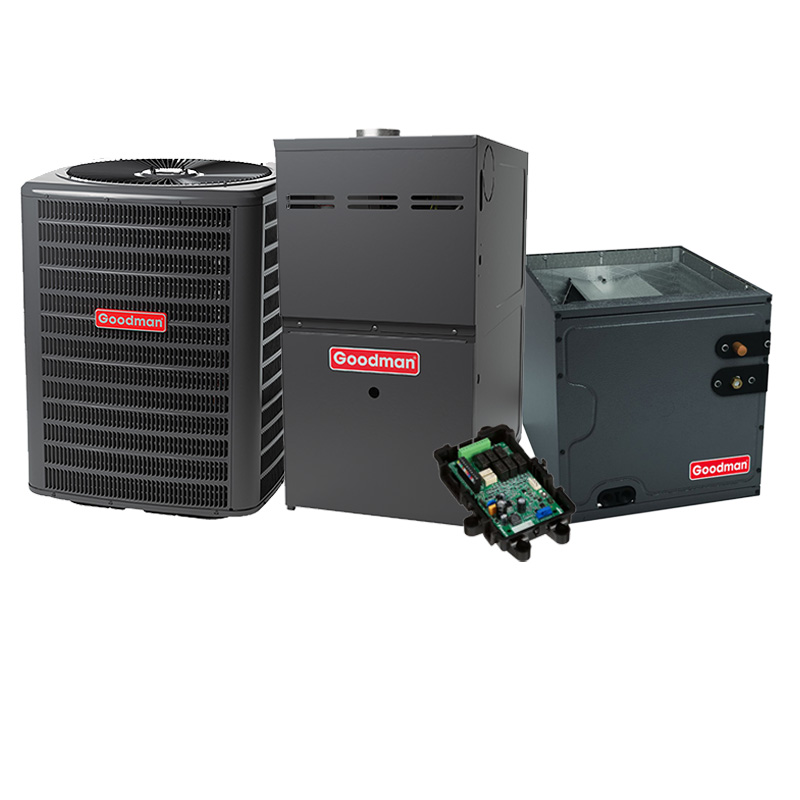
Goodman 3.5 Ton 14 SEER2 100000 BTU 80% Two-Stage Variable Speed Gas Furnace With R32 AC Condenser And Coil System – Upflow
View on AC Direct see your lowest price →Check current price on AC Direct →
Key features
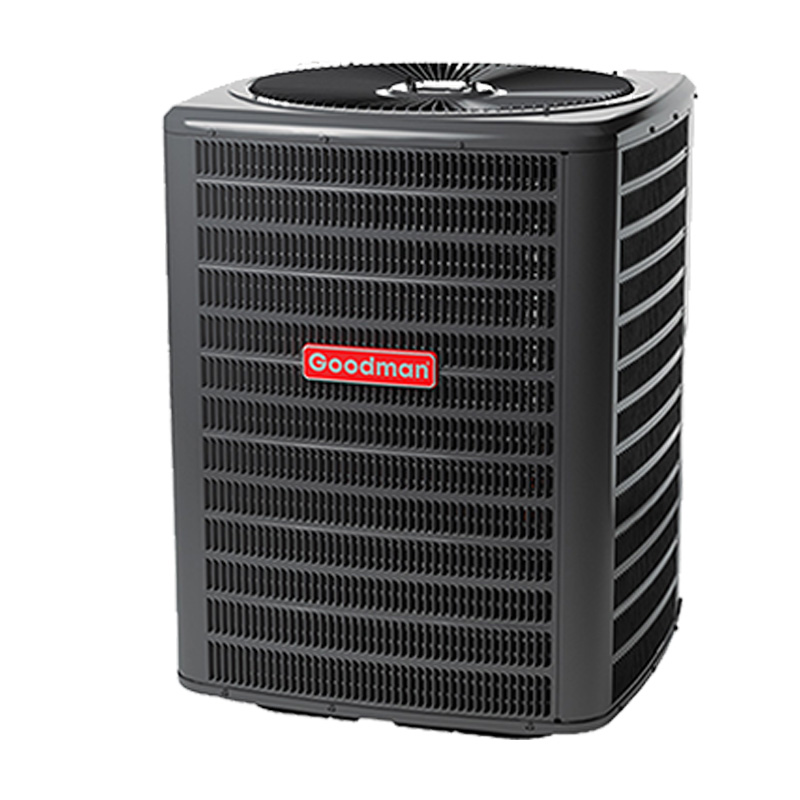
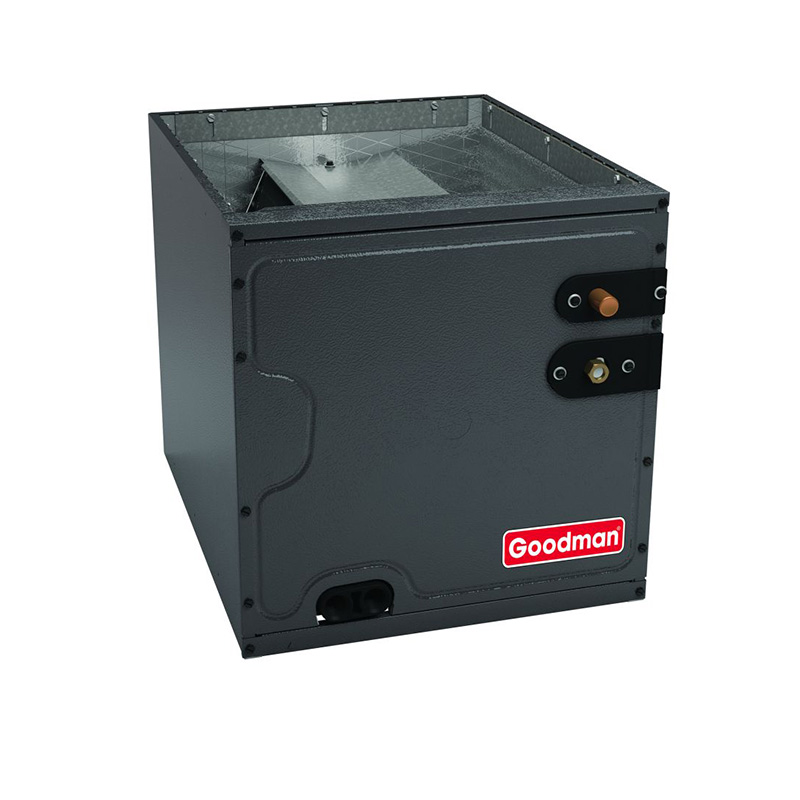
- 3.5-ton R-32 AC condenser with matched evaporator coil, upflow configuration
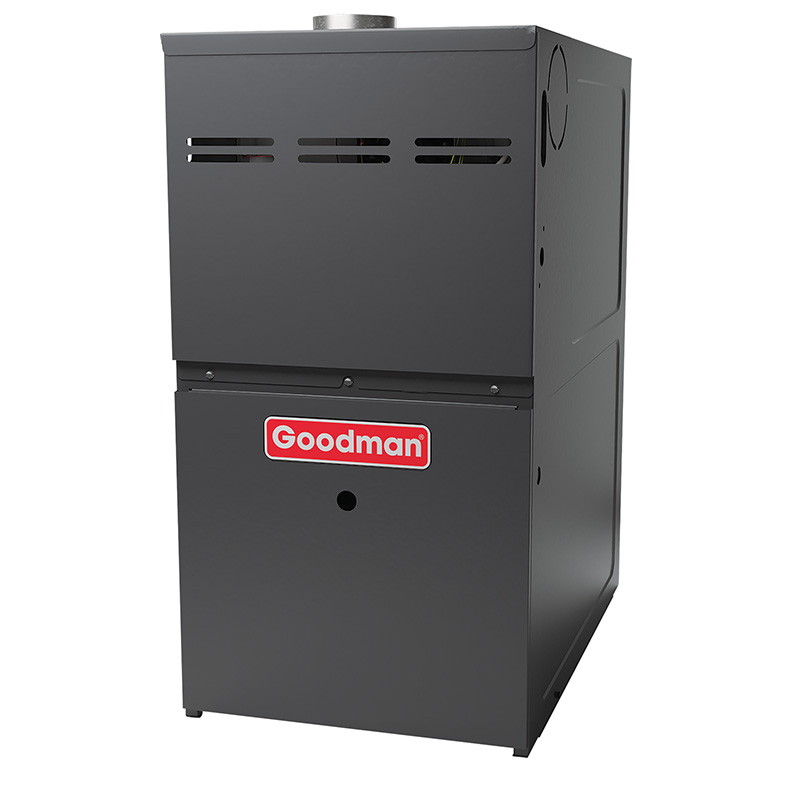
- 100,000 BTU two-stage gas furnace runs at reduced capacity most of the time for steadier comfort
- Variable-speed ECM blower motor improves humidity control and reduces energy use at the air handler
- 14 SEER2 cooling efficiency meets current federal minimums for most U.S. regions
- R-32 refrigerant with lower global warming potential than R-410A; requires certified R-32 technician for service
- 80% AFUE heating efficiency; 20% of combustion energy exits as flue gas
About this system
This Goodman upflow system pairs a 3.5-ton R-32 air conditioning condenser and matched evaporator coil with a 100,000 BTU, 80% AFUE two-stage, variable-speed gas furnace. The combination is sized for homes roughly in the 1,800 to 2,400 square foot range, depending on climate, insulation, and ceiling height. The two-stage furnace runs on a lower firing rate the majority of the time, cycling less aggressively and holding steadier indoor temperatures than a single-stage unit. The variable-speed air handler fan ramps up and down to match demand, which also helps with humidity removal during the cooling season.
The R-32 refrigerant is a meaningful spec here. R-32 has a lower global warming potential than the R-410A it replaces, and it operates at slightly different pressures, so any technician servicing this system needs to be current on R-32 handling procedures and hold the appropriate certification. At 14 SEER2, this system meets federal minimum efficiency standards for most U.S. climate zones but sits at the lower end of the efficiency range, so monthly operating costs will be higher than a 16 SEER2 or better unit over the system’s lifespan. For buyers prioritizing upfront cost over long-term energy savings, that is the deliberate trade-off this package represents.
This Goodman bundle delivers a legitimate two-stage, variable-speed system at a price point that undercuts Carrier, Trane, and Lennox by a meaningful margin, making it a reasonable choice for budget-conscious buyers who prioritize upfront cost. The 14 SEER2 rating keeps operating efficiency modest, and long-term ownership costs depend heavily on install quality and how the system's known weak points, particularly capacitors and evaporator coils, hold up past year seven. It is not the last system you will ever buy, but it can be a sensible one if expectations are set accordingly.
Overall score is the average of the five ratings above.
What we like
- Two-stage furnace and variable-speed blower deliver noticeably more even temperatures than basic single-stage equipment
- Priced 15 to 25 percent below comparable Carrier, Trane, and Lennox systems, lowering the barrier to a full matched system
- R-32 refrigerant is more environmentally responsible than the R-410A it replaces
- Matched coil and condenser from a single manufacturer reduces compatibility guesswork and simplifies warranty claims
- Wide availability of parts and service technicians familiar with Goodman equipment across most U.S. markets
Trade-offs
- Dual-run capacitors are the most frequently reported failure point and typically require a service call within the first 10 years
- Evaporator coil leaks appear in a meaningful share of owner reviews and can be costly to diagnose and repair
- Compressor longevity averages 10 to 14 years, shorter than the 15 to 20 years reported for premium-brand compressors
- 14 SEER2 is entry-level efficiency; higher-SEER2 alternatives will reduce monthly operating costs noticeably over the system's life
What homeowners and pros say about Goodman
Homeowners who have posted about Goodman systems on ConsumerAffairs give the brand roughly 2.5 out of 5 stars, a score that reflects a channel where complaints dominate. The consistent thread in that feedback is not early catastrophic failure but rather a pattern of repair costs that start accumulating after about seven years of service, with dual-run capacitors and evaporator coil leaks cited most often. On Google dealer review pages, where the audience skews toward buyers comparing quotes and completed installs, Goodman averages around 3.8 out of 5 across several hundred reviews per location, and the most repeated reason for choosing the brand is straightforward: it cost less than the Carrier or Trane alternative without giving up the core comfort features the homeowner wanted.
HVAC technicians tend to have a nuanced view. Many will install Goodman without hesitation when a customer has a firm budget, and they keep capacitors on their trucks because replacements are routine. The concern that comes up most in trade discussions is compressor longevity, where Goodman compressors averaging 10 to 14 years falls short of the 15 to 20 years that premium-brand units tend to reach. A minority of owners also report refrigerant leaks within the first year, which technicians generally attribute to installation or initial charge issues rather than a product defect, reinforcing the widely held view that install quality is the single biggest variable in how a Goodman system performs over time. For this two-stage, variable-speed bundle specifically, the upside of getting a genuinely capable comfort system at a value price point is real, but so is the need to plan for service costs in the back half of its service life.
Sources: ConsumerAffairs Goodman owner reviews, AHRI Directory of Certified Product Performance, U.S. DOE appliance and equipment efficiency standards, Goodman product specification sheets.
What it costs to run
At 14 SEER2, cooling this 3.5-ton system for a typical 1200-hour cooling season at the U.S. average electricity rate of $0.17/kWh works out to roughly $612 per year in cooling, about $27 less per year than a minimum-efficiency 13.4 SEER2 unit of the same size. Your real cost depends on your climate and local rate.
Method: (42,000 BTU/hr ÷ 14 SEER2) × 1200 hours ÷ 1000 × $0.17/kWh. Rate source: U.S. EIA average; cooling hours: moderate-climate estimate.
How it compares
| Brand | Comparable model | SEER2 | Stage | Price position |
|---|---|---|---|---|
| Goodman | This system (3.5T R-32 bundle, upflow) | 14 | two-stage | Value pick |
| Carrier | Comfort 14 (24ACC4 series with matching furnace bundle) | 14 | single-stage | Moderately higher than this Goodman bundle |
| Trane | XR14 (4TTR4 series with XR80 or XR95 furnace bundle) | 14 | single-stage | Moderately to substantially higher than this Goodman bundle |
| Lennox | Merit 14 (ML14 condenser with Merit-series furnace bundle) | 14 | single-stage | Moderately higher than this Goodman bundle |
Competitor rows are comparable single-stage units at similar efficiency; price is relative position, not a quote.
Questions about this system
Do I need a special technician to service this system because it uses R-32 refrigerant?
Yes. R-32 requires technicians to hold current certification for that specific refrigerant, as it operates at different pressures than R-410A and has its own handling requirements. Before scheduling installation or future service, confirm your contractor is R-32 certified, since not all HVAC technicians have updated their credentials yet.
What does 80% AFUE actually mean for my heating bills compared to a 96% AFUE furnace?
An 80% AFUE furnace sends roughly 20 cents of every dollar spent on gas out the flue as exhaust. A 96% AFUE unit loses only about 4 cents. The gap is meaningful in colder climates with long heating seasons; in mild climates with short winters, the payback period for the higher-efficiency unit stretches out considerably.
The Goodman ConsumerAffairs rating is around 2.5 out of 5. Should I be worried?
ConsumerAffairs is a complaint-skewed channel where unhappy owners are far more motivated to post than satisfied ones, so the score overstates failure rates relative to the installed base. The more useful signal in that data is the recurring pattern of repair costs climbing after roughly year seven, which aligns with the documented capacitor and coil failure modes. Google dealer reviews average around 3.8 out of 5, a more balanced sample where affordability is the most common praise.
Is 3.5 tons the right size for my home?
Tonnage should be determined by a Manual J load calculation, not square footage alone. Ceiling height, insulation levels, window area, local climate, and ductwork all factor in. An oversized system short-cycles, which worsens humidity control and accelerates component wear, so do not skip the load calculation even if a 3.5-ton unit seems like an obvious fit.
What are the most likely repairs I should budget for over the life of this system?
Dual-run capacitor replacements are the most commonly reported issue with Goodman equipment and typically run $300 to $600 per service call. Evaporator coil leaks appear in a meaningful share of owner reviews and carry a higher repair cost. Compressor replacement or system changeout becomes a realistic conversation after 10 to 14 years, which is a shorter horizon than premium brands tend to offer.
Specifications
| Cooling capacity | 3.5 Ton |
| Efficiency | 14 SEER2 |
| Furnace output | 100000 BTU |
| Configuration | Upflow |
| Refrigerant | R-32 |