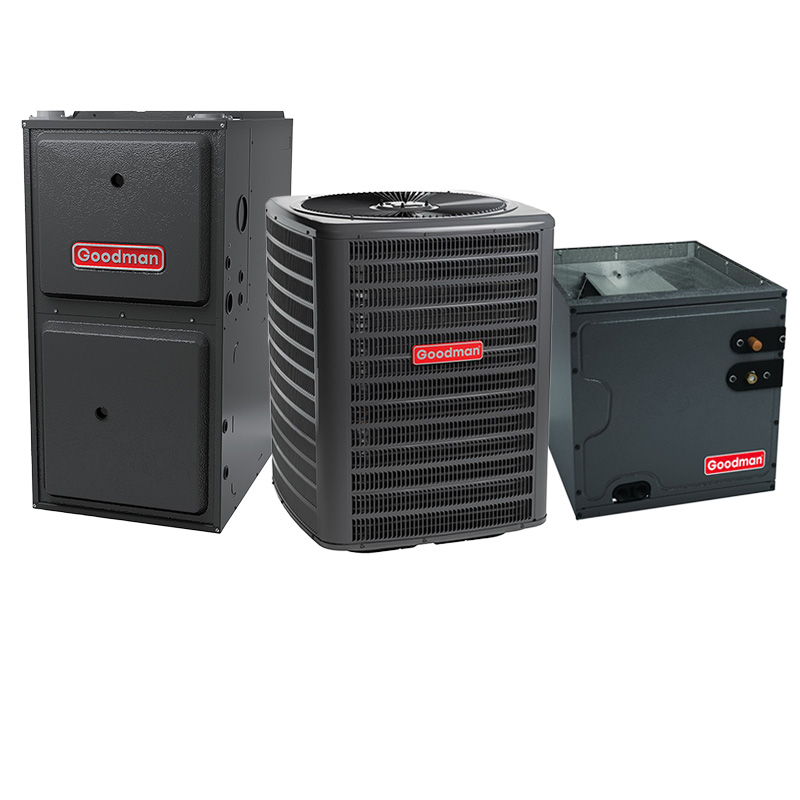
Goodman 3.5 Ton 15.2 SEER2 100000 BTU 80% AFUE Two Stage Multi-Speed ECM Gas Furnace System – Upflow | R32
View on AC Direct see your lowest price →Check current price on AC Direct →
Key features
- 3.5-ton two-stage cooling rated at 15.2 SEER2 for moderate efficiency gains over minimum-standard equipment
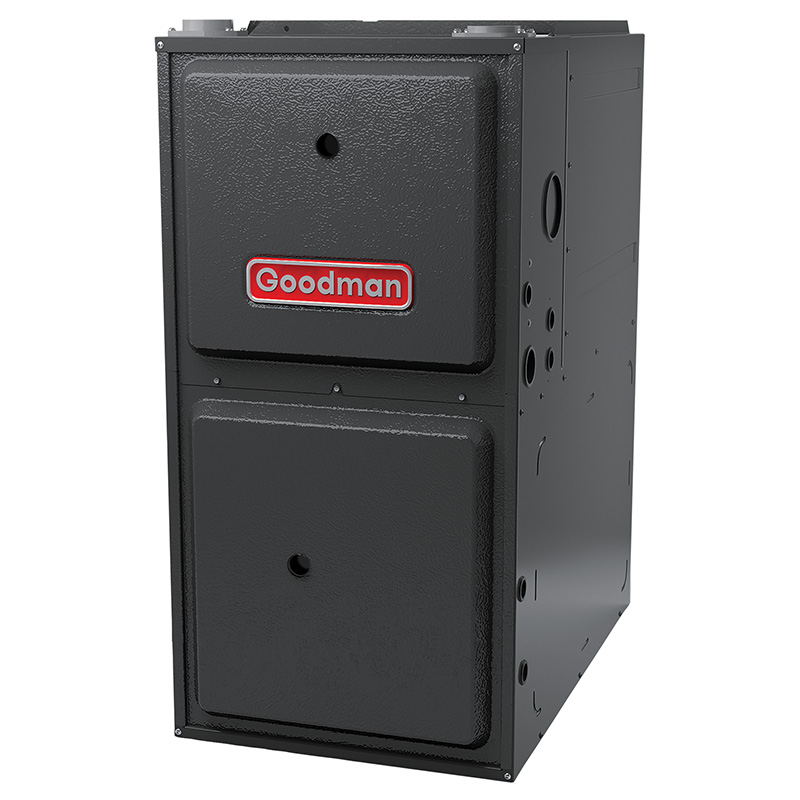
- 100,000 BTU 80% AFUE gas furnace, upflow configuration for standard forced-air duct layouts
- Multi-speed ECM blower motor reduces energy use at the air handler and improves airflow consistency
- R-32 refrigerant charge, lower global warming potential than R-410A, increasingly code-compliant nationwide
- Two-stage compressor operation reduces short cycling and improves dehumidification versus single-stage units
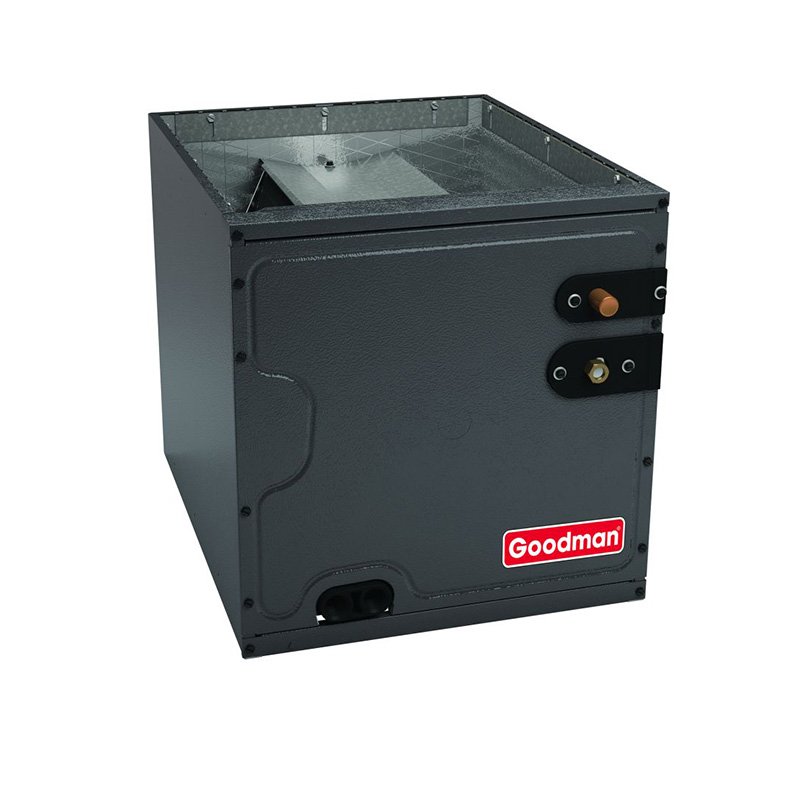
- Factory-matched coil and outdoor unit sold as a system to simplify permitting and equipment compatibility
About this system
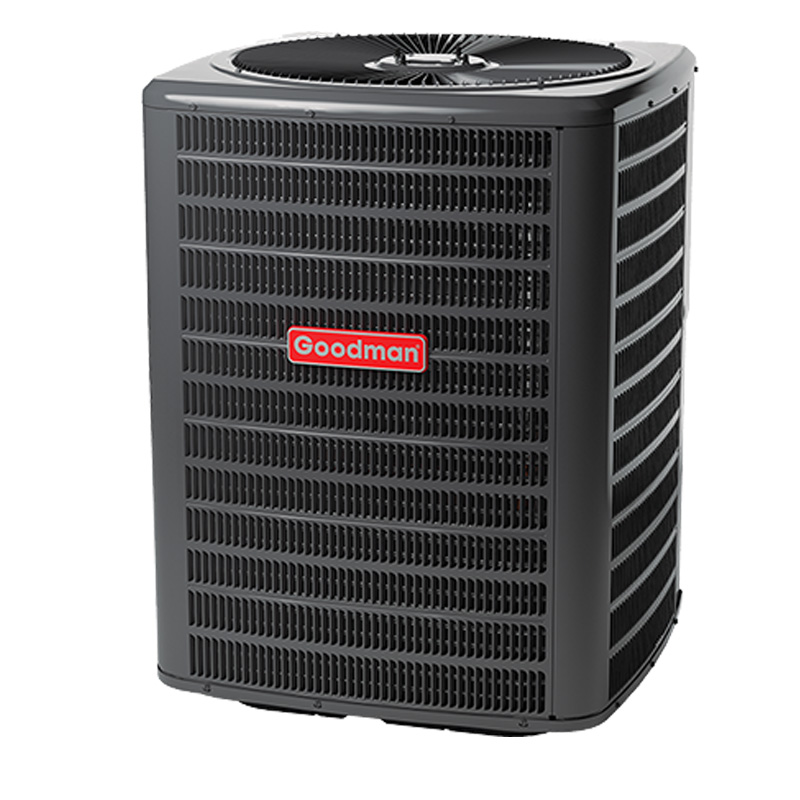
The Goodman GLXS4BA4210 bundles a 3.5-ton, 15.2 SEER2 air conditioner with a 100,000 BTU, 80% AFUE two-stage furnace into an upflow configuration that suits most standard forced-air homes in the 1,800 to 2,600 square foot range. The system runs on R-32 refrigerant, which carries a lower global warming potential than the R-410A it replaces and is increasingly the industry standard for new equipment. Two-stage cooling and a multi-speed ECM blower work together to reduce short cycling, keep humidity more stable than a single-stage setup would, and trim operating costs compared to simpler on/off systems.
The 80% AFUE furnace is a baseline efficiency rating, meaning 20 cents of every heating dollar goes up the flue. That is acceptable in mild to moderate climates or in homes where natural gas prices are low, but homeowners in the northern half of the country often find the step up to a 96% AFUE unit pays for itself within a few seasons. The upflow configuration requires the air handler to sit below the duct system and discharge warm or cool air upward, which is the most common residential setup and should work without structural modification in most existing mechanical rooms or utility closets.
Goodman positions this system as a capable, no-frills package for buyers who want two-stage comfort without the price premium of Trane, Carrier, or Lennox. The trade-off is a brand with a well-documented value reputation: competitive upfront cost, performance that depends heavily on installation quality, and a track record that shows some component wear after the seven- to ten-year mark. If your installer is experienced and the startup is done correctly, this system delivers solid everyday performance. If corners are cut at install, that reputation for repair calls tends to materialize quickly.
The GLXS4BA4210 is a competent mid-tier system that delivers real two-stage comfort at a price point 15 to 25 percent below comparable name-brand equipment. Owners who invest in quality installation and plan for a capacitor replacement around year seven or eight will likely get good value here. Those expecting the component longevity of premium brands should adjust expectations, particularly around compressor lifespan and the possibility of evaporator coil leaks over time.
Overall score is the average of the five ratings above.
What we like
- Two-stage operation improves humidity control and comfort compared to single-stage alternatives at this price
- ECM blower motor lowers continuous fan energy consumption and supports better air distribution
- R-32 refrigerant is forward-looking and already compliant with tightening environmental regulations
- Factory-matched system simplifies contractor sizing, permitting, and warranty documentation
- Significantly lower upfront cost than comparable Trane, Carrier, or Lennox two-stage systems
Trade-offs
- 80% AFUE furnace is the lowest efficiency tier available; homeowners in cold climates will see meaningfully higher heating bills than with a 96% AFUE alternative
- Dual-run capacitors are the most documented failure point, typically requiring a 300 to 600 dollar repair, often surfacing after year five
- Compressor life averages 10 to 14 years versus 15 to 20 years for premium-brand compressors, which matters when evaluating total cost of ownership
- A minority of owners report refrigerant leaks in the first year, nearly always tied to installation or initial charge issues rather than the equipment itself
What homeowners and pros say about Goodman
Goodman sits at roughly 3.8 out of 5 across Google dealer reviews, where the most consistent praise is straightforward: buyers got a working, code-compliant system installed for less than competing bids from Trane or Carrier dealers. Affordability shows up repeatedly as the deciding factor, and for homeowners who did their homework on the contractor, that calculation often holds up through the first five to seven years without significant issues. The picture shifts on ConsumerAffairs, where Goodman scores around 2.5 out of 5. That channel over-represents frustrated owners, but the recurring theme is worth noting: repair costs tend to climb after roughly year seven, and dual-run capacitor failures and evaporator coil leaks are the two failure modes that appear most often in owner accounts. Neither is catastrophic on its own, but together they account for a meaningful share of the dissatisfaction in longer-term ownership reports.
HVAC technicians who work on Goodman equipment regularly tend to land in a middle position. They acknowledge that the company manufactures to a tighter margin than premium brands, which shows up in component selection over a 15-year horizon. Compressors on Goodman systems are widely reported to average 10 to 14 years of reliable service, compared to 15 to 20 years on premium-brand units, a gap that matters when evaluating the true total cost of ownership. The same technicians are consistent on one point: installation quality is the single biggest variable in how any Goodman system performs and how long it lasts. A correctly sized, properly charged, and carefully commissioned GLXS4BA4210 from a skilled installer will outperform a carelessly installed premium-brand unit every time. The first-year refrigerant leak reports that appear in owner reviews are almost universally attributed to installation or charge errors rather than factory defects, which reinforces why vetting your contractor matters at least as much as choosing your equipment brand.
Sources: ConsumerAffairs Goodman owner reviews, AHRI Directory of Certified Product Performance, U.S. DOE appliance and equipment efficiency standards, Goodman product specification sheets.
What it costs to run
At 15.2 SEER2, cooling this 3.5-ton system for a typical 1200-hour cooling season at the U.S. average electricity rate of $0.17/kWh works out to roughly $564 per year in cooling, about $75 less per year than a minimum-efficiency 13.4 SEER2 unit of the same size. Your real cost depends on your climate and local rate.
Method: (42,000 BTU/hr ÷ 15.2 SEER2) × 1200 hours ÷ 1000 × $0.17/kWh. Rate source: U.S. EIA average; cooling hours: moderate-climate estimate.
How it compares
| Brand | Comparable model | SEER2 | Stage | Price position |
|---|---|---|---|---|
| Goodman | GLXS4BA4210 | 15.2 | two-stage | Value pick |
| Carrier | Comfort 16 (24ACC6 series) | 15.2 | single-stage | Typically 15 to 25 percent more than this Goodman system |
| Trane | XR15 series | 15.0 | single-stage | Typically 15 to 25 percent more than this Goodman system |
| Lennox | Merit ML14XC1 series | 15.0 | single-stage | Typically 15 to 25 percent more than this Goodman system |
Competitor rows are comparable single-stage units at similar efficiency; price is relative position, not a quote.
Questions about this system
Is 80% AFUE enough for my climate, or should I step up to a 96% unit?
For homes in USDA climate zones 1 through 3, 80% AFUE is generally acceptable and the payback on upgrading is slow. In zones 4 through 7, the 16 to 20 percentage point efficiency gap translates to a noticeable difference on monthly gas bills, and most HVAC contractors in those regions recommend at least a 96% furnace. If you are on the fence, ask your installer to run a simple payback calculation using your local gas rates.
What does two-stage cooling actually mean for comfort, and is it worth paying more for?
A two-stage compressor runs at a lower capacity most of the time, cycling longer at reduced output rather than blasting on and off at full power. The practical effect is more even temperatures room to room, better moisture removal on humid days, and lower peak energy draws. For a 3.5-ton system serving a home in a humid climate, the humidity control benefit alone tends to justify the modest cost difference over a single-stage unit.
Why does R-32 refrigerant matter, and will it cost more to service?
R-32 has a global warming potential roughly 68 percent lower than R-410A and is the refrigerant the industry is moving toward as R-410A faces regulatory phase-down. Servicing cost is comparable to R-410A right now since supply is growing, but you should confirm your local contractor is certified to handle R-32 before booking any future service calls, as not every technician has updated their certifications yet.
What is the most common repair I should budget for with a Goodman system like this?
Dual-run capacitors are the single most frequently reported failure across Goodman equipment, typically surfacing after year five and costing 300 to 600 dollars to diagnose and replace. It is a straightforward repair for any qualified technician. Some owners also report evaporator coil leaks over time, which are more involved to fix, so keeping the system on a maintenance plan that includes coil inspection is worthwhile.
Does this system come with a labor warranty, or is that something I need to arrange separately?
Goodman's standard equipment warranty covers parts but does not include labor, which is one of the practical downsides of value-tier brands. Labor coverage, if any, comes from the installing contractor's own workmanship guarantee, which varies widely. Some dealers offer extended service agreements that bundle labor; it is worth asking about this before signing the installation contract, since labor costs on a compressor or coil replacement can easily exceed the part cost itself.
Specifications
| Cooling capacity | 3.5 Ton |
| Efficiency | 15.2 SEER2 |
| Furnace output | 100000 BTU |
| Furnace efficiency | 80% AFUE |
| Configuration | Upflow |
| Refrigerant | R-32 |
| Model | GLXS4BA4210 |