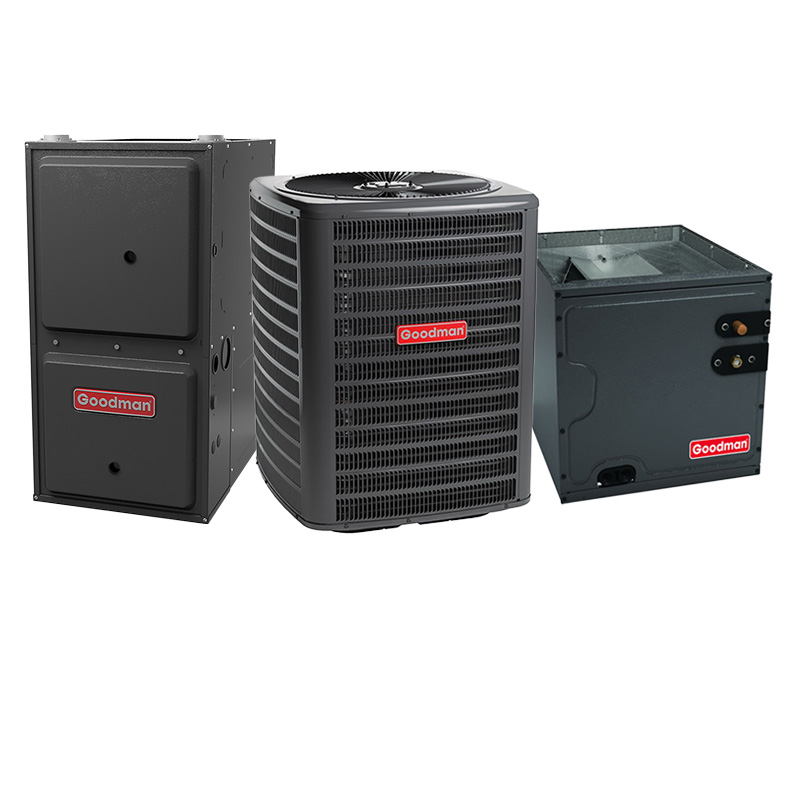
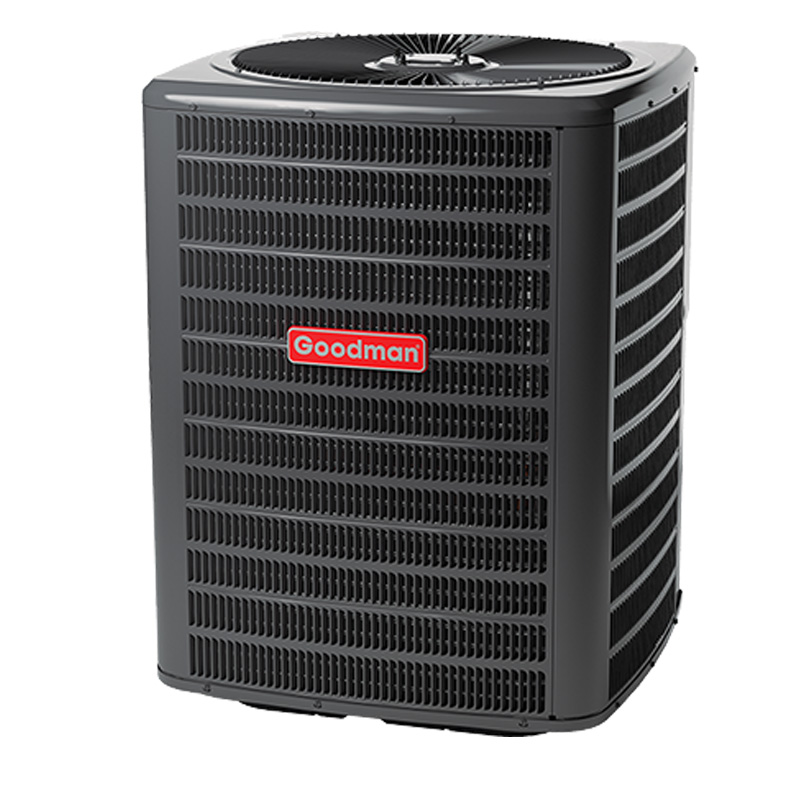
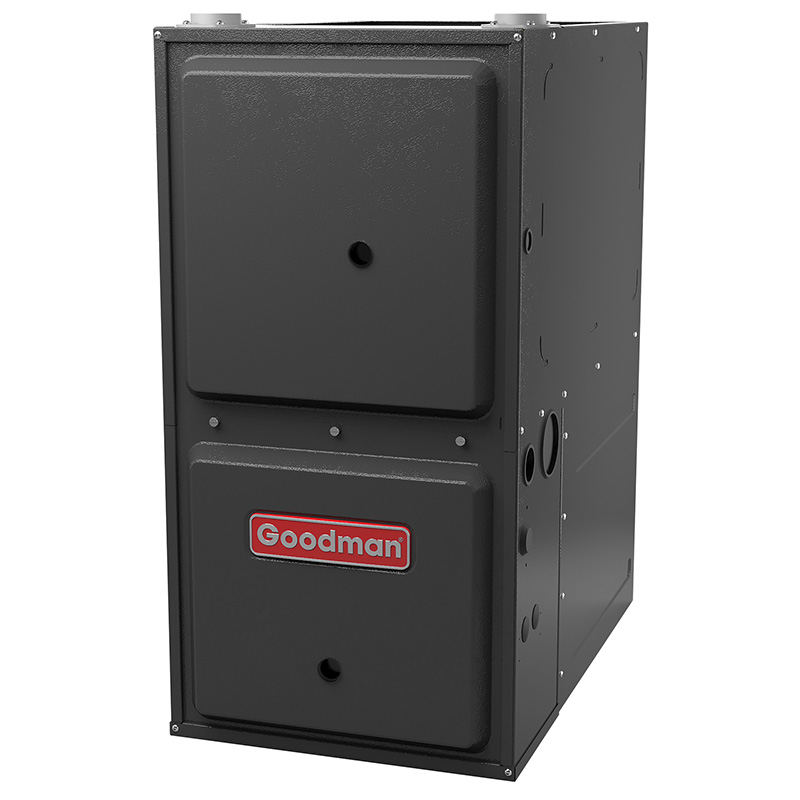
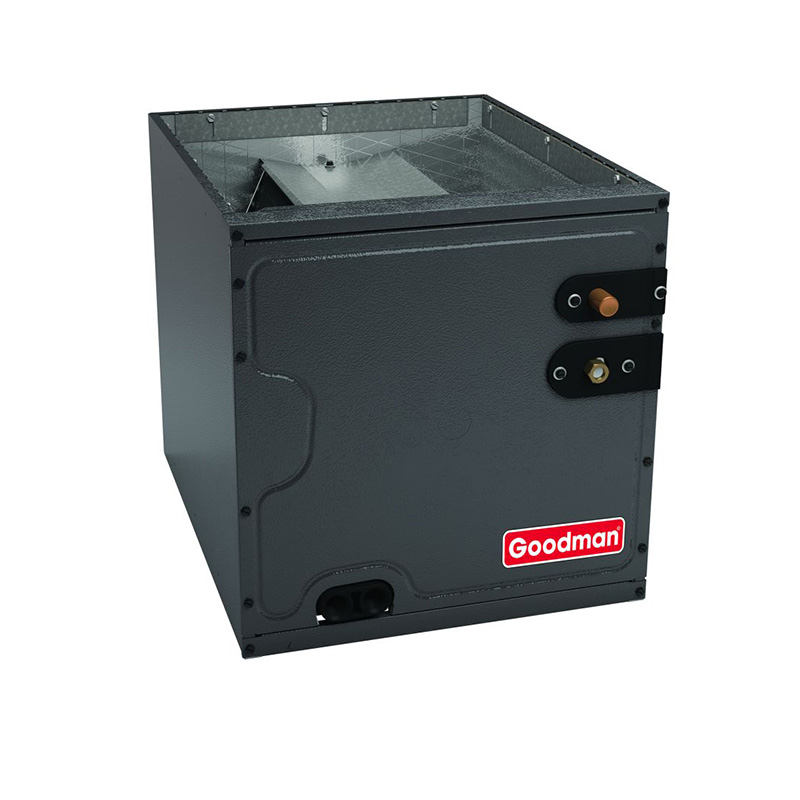
Goodman 3.5 Ton 15.2 SEER2 80000 BTU 80% AFUE Multi-Speed ECM Gas Furnace System – Downflow | R32
View on AC Direct see your lowest price →Check current price on AC Direct →
Key features
- 15.2 SEER2 cooling efficiency meets current federal minimums for most regions
- 80,000 BTU / 80% AFUE gas furnace suits mild-to-moderate heating climates
- Multi-speed ECM blower motor reduces energy use and improves comfort over single-speed motors
- Downflow configuration designed for above-living-space air handler installations
- R-32 refrigerant with lower global warming potential than R-410A
- Priced roughly 15 to 25 percent below comparable Trane, Lennox, and Carrier systems
About this system
The Goodman 3.5-ton, 15.2 SEER2, 80,000 BTU downflow system is a budget-conscious split system aimed at homeowners replacing aging equipment in homes between roughly 1,800 and 2,400 square feet, depending on local climate and insulation. The downflow configuration means the air handler sits above the living space and blows conditioned air downward, a layout common in homes with crawl spaces, slab foundations, or utility closets built for that specific orientation. R-32 refrigerant is the newer, lower-global-warming-potential alternative to R-410A, and its presence here means the system is positioned for the near-term regulatory shift away from older refrigerants.
On the efficiency side, 15.2 SEER2 clears the federal minimums for most U.S. climate regions but sits at the lower end of what the market calls mid-efficiency. The 80% AFUE furnace means one dollar in five spent on gas goes up the flue rather than heating your home, which is acceptable for mild-winter climates but starts to look less competitive in regions with long, cold heating seasons where a 96% AFUE unit can meaningfully cut annual gas bills. The multi-speed ECM blower motor is a genuine upgrade over single-speed alternatives: it ramps airflow up and down to match demand, which reduces temperature swings, lowers blower electricity consumption, and moves more quietly at lower loads than a fixed-speed motor would.
This Goodman system delivers a workable entry-level package for homeowners who need a straightforward replacement without a premium price tag. The ECM motor and R-32 refrigerant are genuine positives, but 80% AFUE and baseline SEER2 efficiency leave long-term operating cost savings on the table compared to higher-tier options. Reliability and longevity depend heavily on the quality of the installing contractor, more so than with premium brands.
Overall score is the average of the five ratings above.
What we like
- Entry price point is 15 to 25 percent below equivalent Trane, Carrier, and Lennox configurations
- Multi-speed ECM motor improves comfort and lowers blower electricity costs versus single-speed units
- R-32 refrigerant is forward-compatible with evolving environmental regulations
- Downflow layout serves a specific installation need that not all brands stock as readily
- Broad national dealer and parts network makes service and repair scheduling relatively straightforward
Trade-offs
- 80% AFUE furnace loses 20% of fuel to exhaust, making it a poor fit for cold climates with high gas prices
- 15.2 SEER2 is entry-level efficiency; utility savings over an older system will be modest in moderate climates
- Documented compressor lifespan of 10 to 14 years runs shorter than the 15 to 20 years typical of premium brands
- Dual-run capacitor and evaporator coil leak failures are the most commonly reported issues in owner reviews, adding potential out-of-pocket repair costs after year 7
What homeowners and pros say about Goodman
Homeowners who follow Goodman on consumer review platforms tend to cluster into two camps: those who had a clean install and report years of trouble-free operation praising the lower upfront cost, and those who encountered repair bills after the system aged past roughly seven years and found the experience frustrating. The ConsumerAffairs score sits at about 2.5 out of 5, but that channel draws a disproportionate share of complaint-driven reviews, so it skews negative relative to actual ownership experience. Google dealer reviews, which capture a broader cross-section of buyers, land around 3.8 out of 5, with affordability cited most often as the reason people chose the brand in the first place.
HVAC professionals who work on Goodman equipment consistently point to the dual-run capacitor as the most common service call, typically a low-cost repair in the 300 to 600 dollar range. Evaporator coil leaks surface in a meaningful share of owner accounts and represent a more significant expense. Compressors on Goodman systems tend to reach the end of their service life in the 10 to 14 year range, which is shorter than the 15 to 20 years technicians typically see from Trane, Lennox, and Carrier compressors. A minority of owners also report refrigerant leaks in the first year, which professionals generally attribute to the install or initial charge rather than a manufacturing defect. The consistent takeaway from the trades is that Goodman equipment performs best when it is installed carefully by an experienced contractor who pressure-tests the system and charges refrigerant precisely, because this brand leaves less margin for sloppy workmanship than its premium competitors do.
Sources: ConsumerAffairs Goodman owner reviews, AHRI Directory of Certified Product Performance, U.S. DOE appliance and equipment efficiency standards, Goodman product specification sheets.
What it costs to run
At 15.2 SEER2, cooling this 3.5-ton system for a typical 1200-hour cooling season at the U.S. average electricity rate of $0.17/kWh works out to roughly $564 per year in cooling, about $75 less per year than a minimum-efficiency 13.4 SEER2 unit of the same size. Your real cost depends on your climate and local rate.
Method: (42,000 BTU/hr ÷ 15.2 SEER2) × 1200 hours ÷ 1000 × $0.17/kWh. Rate source: U.S. EIA average; cooling hours: moderate-climate estimate.
How it compares
| Brand | Comparable model | SEER2 | Stage | Price position |
|---|---|---|---|---|
| Goodman | 3.5 Ton 15.2 SEER2 80K BTU 80% AFUE Multi-Speed ECM Downflow / R-32 | 15.2 | Multi-speed | Value pick |
| Carrier | Performance 15 (24ACC636 + 58TP080) Downflow | 15.2 | Single-stage | Roughly 15 to 20 percent more than this Goodman |
| Trane | XR15 (4TTR5036 + S9X2B080U4PSA) Downflow | 15.0–15.5 | Single-stage | Roughly 20 to 25 percent more than this Goodman |
| Lennox | Merit 16ACX + ML180UH090P48C Downflow | 15.5 | Single-stage | Roughly 20 to 25 percent more than this Goodman |
Competitor rows are comparable single-stage units at similar efficiency; price is relative position, not a quote.
Questions about this system
Is a downflow furnace harder to find service for than a standard upflow unit?
Not significantly. Downflow is a less common configuration, but most experienced HVAC technicians work on them regularly, and Goodman's wide dealer network means parts are generally available. The bigger consideration is making sure your installer has verified that your existing cabinet and ductwork are set up for downflow before ordering.
Will 80% AFUE cost me noticeably more to run than a 96% AFUE furnace?
In mild climates with shorter heating seasons, the annual dollar difference may be modest enough to recover only slowly through higher upfront cost for a 96% unit. In cold climates where the furnace runs heavily from October through April, the 16-percentage-point efficiency gap can add up to real money each season, and a high-AFUE furnace often pays back the price difference within several years.
What does the multi-speed ECM blower actually do for me day to day?
The ECM motor adjusts its speed based on system demand rather than running at full blast every cycle. In practice that means quieter operation at lower loads, more even temperatures from room to room, and lower electricity consumption on the blower compared to a single-speed motor running all-or-nothing.
How does R-32 refrigerant affect maintenance or future service costs?
R-32 is becoming more widely stocked as the industry moves away from R-410A, so availability should improve over time rather than tighten. One practical note is that R-32 operates at somewhat higher pressures than R-410A, so technicians need to confirm their equipment is rated for it. Any refrigerant leak within the first year is most often traced to installation rather than a product defect, which is one reason choosing a careful, licensed installer matters.
What are the most likely repair bills I should budget for over the life of this system?
Dual-run capacitor failure is the most commonly reported issue and typically runs 300 to 600 dollars including labor, so it is a manageable expense. Evaporator coil leaks show up in a meaningful share of owner reports and are a more significant repair. Compressors on Goodman equipment tend to average 10 to 14 years of life, shorter than premium brands, so budgeting for a potential compressor replacement or full-system replacement in that window is realistic planning.
Specifications
| Cooling capacity | 3.5 Ton |
| Efficiency | 15.2 SEER2 |
| Furnace output | 80000 BTU |
| Furnace efficiency | 80% AFUE |
| Configuration | Downflow |
| Refrigerant | R-32 |